Introduction
India's REIT market has moved fast since Embassy Office Parks REIT listed in 2019. Five listed REITs now trade under SEBI rules, including Mindspace, Brookfield India, Nexus Select Trust, and the newly listed Knowledge Realty Trust. Minimum investment tickets have fallen as well.
Why the pull from the US? India's commercial real estate continues to take up office space at speed, SEBI cut minimum investment thresholds in 2021, and US-based Indian wealth wants structured exposure back home.
That demand splits in three ways. NRIs and US-based entrepreneurs want to sponsor an institutional real estate vehicle. US fund managers want India exposure through a regulated structure. A much larger group of individual investors confuses "starting" a REIT with buying units in one—and underestimates how heavy the sponsor path is on capital, compliance, and SEBI process.
This guide draws that line clearly. It then walks through the regulatory and execution steps for a USA-based sponsor building a REIT in India.
Key Takeaways
- A REIT is a SEBI-registered trust that owns income property and must pay out at least 90% of distributable income
- "Starting" a REIT means becoming a Sponsor, not buying units—and it needs institutional-scale capital
- USA sponsors must layer FEMA and RBI rules on top of SEBI's REIT Regulations
- Setup covers SPVs, SEBI registration, trustee/manager appointment, then listing or private placement
- NRIs seeking exposure only can buy listed REIT units through a standard demat account
What Is a REIT in India, and Why the Market Is Growing
A REIT is a SEBI-registered trust structure that pools capital to acquire and manage income-producing commercial real estate, such as office parks, malls, and warehouses, then passes rental income to unit holders.
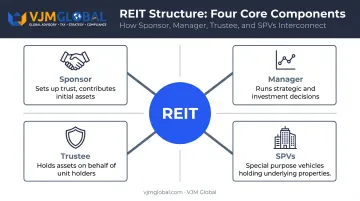
The structure has four moving parts:
- Sponsor – sets up the trust and contributes the initial assets
- Manager – runs strategic and investment decisions
- Trustee – holds the assets on behalf of unit holders
- SPVs – special purpose vehicles that legally hold the underlying properties
A REIT can either list publicly on an exchange or place units privately with institutional investors.
Why the Market Is Expanding Now
As of September 30, 2025, India had five listed REITs with a combined market capitalization of ₹1.6 trillion and control over 174 million square feet of commercial space, according to JLL's research on India's REIT market.
That scale sits on rising office demand. JLL recorded 49.56 million square feet of net office absorption across India in 2024, up 17.9% year-over-year. Grade-A stock continues to grow in Bengaluru, Mumbai, and the NCR, and REITs let institutional owners monetize those assets without an outright sale—giving US sponsors a liquid path into Indian commercial real estate.
Can a USA-Based Individual or Company Start a REIT in India? Eligibility & Foreign Investment Rules
Here's the distinction that trips up most people: "starting" a REIT means becoming a Sponsor/Promoter under SEBI's REIT Regulations. That is a completely different activity from an NRI buying REIT units on the NSE or BSE.
SEBI's sponsor eligibility rules apply regardless of nationality. A sponsor (or its group) needs:
- A minimum ₹20 crore net worth individually, with the sponsor group holding at least ₹100 crore collectively
- Five years of real estate development or fund management experience
- At least two completed projects, if the sponsor is a developer
- A minimum 5% post-offer unit holding
A USA-based sponsor clears that bar the same way an Indian sponsor does. The real difference is the FEMA framework layered on top.
The FDI Layer You Can't Skip
Two separate rules govern foreign money here, and conflating them causes real problems:
- DPIIT's FDI policy permits 100% FDI under the automatic route into completed, revenue-generating real estate projects (townships, malls, business centers) under the construction-development sector rules.
- FEMA's Non-Debt Instruments Rules (Schedule VIII) separately govern a nonresident buying units in an "investment vehicle," which includes a REIT.
When a REIT issues units to a nonresident sponsor or investor, the reporting instrument is Form InVI, filed within 30 days of issue. If an underlying SPV issues equity instruments treated as FDI, that's a separate FC-GPR filing. They're not interchangeable, and using the wrong form delays the whole structure.
NRIs, Foreign Nationals, and US Entities Aren't Treated Identically
- NRIs generally face fewer restrictions and simpler tax residency questions
- Foreign nationals and non-resident entities face closer scrutiny on sectoral caps and downstream investment conditions
- US-incorporated sponsors must structure the Indian trust and SPV network carefully—entity type drives tax treatment on both sides
Category differences matter, but none of the paths work fully remote. Every US-based sponsor still needs an Indian-registered trust, functioning SPVs, and a compliance contact on the ground. Firms like VJM Global typically structure that SPV network and manage RBI and SEBI filings so the sponsor can stay in the US.
The common misconception: treating this like starting a small business. Between sponsor net worth thresholds and asset value minimums, this is an institutional-grade undertaking from day one, not a bootstrapped venture.
SEBI Requirements You Must Meet to Register a REIT
Once eligibility is settled, the REIT must satisfy SEBI’s structural, capital, and distribution rules before it can register and launch an offer.
Trust Structure and Registration
The REIT must be constituted as a trust, with its trust deed registered under the Registration Act, 1908. Separately, the REIT itself must register with SEBI before it can launch an initial offer.
Capital and Listing Thresholds
| Requirement | Current Threshold |
|---|---|
| Minimum REIT asset value | ₹500 crore |
| Minimum initial offer size | ₹250 crore |
| Minimum public unit holders | 200 (excluding sponsors) |
| Minimum application value | ₹10,000–₹15,000 |
| Trading lot | 1 unit |
These figures have moved over time. SEBI cut the minimum application value from ₹2 lakh in the 2014 Regulations to ₹50,000 in 2019, then to the current ₹10,000–₹15,000 range in the July 30, 2021 Amendment Regulations.
Confirm current thresholds with SEBI before you lock an offer structure.
Sponsor Restrictions
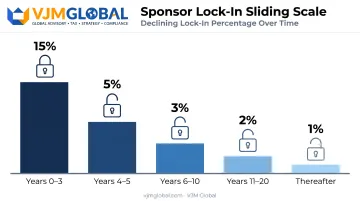
A REIT can have up to three sponsors, each required to hold a minimum stake. Sponsor lock-in currently follows a sliding scale:
- Years 0–3: 15%
- Years 4–5: 5%
- Years 6–10: 3%
- Years 11–20: 2%
- Thereafter: 1%
Asset Composition Rules
At least 80% of REIT asset value must sit in completed, income-generating properties. The remaining 20% can include under-construction assets and other permitted instruments, subject to holding-period conditions.
Manager and Trustee Requirements
- Manager: ₹10 crore minimum net worth (or net tangible assets for an LLP), five years of relevant experience, and at least two key personnel with five years’ experience each
- Trustee: SEBI-registered debenture trustee that is not an associate of the sponsor or manager
The 90% Distribution Rule
REITs must distribute at least 90% of net distributable cash flows to unit holders. Distributions are declared at least once every six months and paid within five working days of the record date.
The rule applies at every layer—from SPV to holding company to the REIT—and is what makes REIT income predictable for investors.
Step-by-Step: How to Set Up a REIT in India from the USA
Setting up a REIT spans legal structuring, regulatory filings, capital raising, and asset acquisition. Set realistic timelines from the start; this isn't a quick launch.
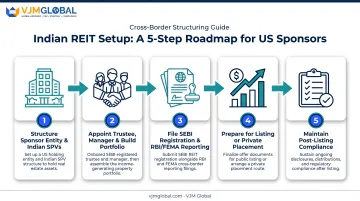
Step 1: Structure the Sponsor Entity and Indian SPVs
Decide whether you'll sponsor through an existing US entity or a newly formed Indian promoter entity, then incorporate Indian SPVs to hold the actual real estate.
Common miss: incorporating SPVs before finalising a FEMA-compliant investment route. Get the route settled first, or you'll face downstream RBI compliance delays that push the whole timeline back.
Step 2: Appoint Trustee, Manager, and Build the Asset Portfolio
Before you file with SEBI, lock in the governance parties and the seed portfolio:
- Appoint an independent, SEBI-eligible trustee
- Establish or appoint a manager that meets the net worth and experience criteria covered above
- Acquire at least two income-generating properties that satisfy the 80% completed-asset requirement
Step 3: File SEBI Registration and Complete RBI/FEMA Reporting
Submit the REIT registration application to SEBI along with the trust deed and sponsor, manager, and trustee documentation.
On the FEMA side, file Form InVI within 30 days if the REIT is issuing units to a nonresident. If an underlying SPV issues equity instruments to a foreign investor separately, that requires its own FC-GPR filing. Keep these two threads distinct in your compliance calendar.
Step 4: Prepare for Listing or Private Placement
For a public listing, meet the minimum issue size and public float norms. For a private placement, structure the REIT so units go only to institutional investors.
Either path requires engaging:
- Merchant bankers to manage the offer process
- Independent valuers to value the asset portfolio
- Legal counsel to handle due diligence and offer documentation
Step 5: Maintain Ongoing Post-Listing Compliance
Once live, recurring obligations kick in: half-yearly income distribution, regular asset valuation, and quarterly corporate governance reporting to the stock exchanges.
US-based sponsors typically engage a cross-border advisory partner for these obligations. VJM Global handles FEMA and FDI filings alongside ROC and Companies Act compliance, keeping the entity-side requirements covered while the sponsor remains abroad.
Costs, Timeline & Compliance Considerations
Starting a REIT is capital-intensive by design. Between the ₹500 crore ($60 million) minimum asset value and the ₹250 crore ($30 million) minimum offer size—1 crore equals 10 million rupees—this sits firmly in institutional territory, not a bootstrapped side project. Confirm current figures with SEBI before committing capital, since these thresholds get revised periodically.
How Long Does It Actually Take?
Public registration-to-listing gaps among existing REITs give a rough sense of range:
| REIT | SEBI Registration | Listing | Gap |
|---|---|---|---|
| Embassy Office Parks | Aug 2017 | Apr 2019 | ~20 months |
| Mindspace Business Parks | Dec 2019 | Aug 2020 | ~8 months |
| Brookfield India | Sep 2020 | Feb 2021 | ~5 months |
| Nexus Select Trust | Sep 2022 | May 2023 | ~8 months |
These are public milestones, not full structuring timelines, since SPV formation and portfolio assembly happen well before SEBI registration begins. Realistically, expect the entire process, from entity structuring through listing, to span roughly 12 to 36 months, depending on how ready the portfolio is when you start.
Recurring Costs to Budget For
- Trustee and manager fees for the life of the REIT
- Valuation and audit costs at least half-yearly
- Cross-border tax reporting, including US-side disclosure obligations
That last point matters more than people expect. US persons holding interests in an Indian trust structure often face FATCA-related disclosure under Form 8938 and FBAR reporting requirements. VJM Global advises US clients on these foreign asset disclosures alongside India-side SEBI and FEMA compliance.
Frequently Asked Questions
How much money do I need to start a REIT?
SEBI mandates a minimum REIT asset value of ₹500 crore and a minimum initial offer size of ₹250 crore. Sponsoring a REIT is a multi-crore institutional commitment, so confirm current thresholds before you proceed.
How do I start a REIT company in India?
You need to form a SEBI-registered trust with a sponsor, manager, and trustee, then acquire qualifying real estate assets. After meeting SEBI's asset composition and capital rules, you complete registration before listing or private placement.
Can NRIs buy REITs in India?
Yes. NRIs can buy units of listed REITs through their demat accounts, subject to standard KYC requirements. Buying units is separate from sponsoring or setting up a REIT.
What is the 90% rule for REITs?
REITs must distribute at least 90% of their net distributable cash flows to unit holders, typically declared every six months. It's one of SEBI's core compliance requirements and the reason REIT income tends to be predictable.
Can a foreign company or US-based entity be a REIT sponsor in India?
Yes, foreign sponsors are permitted. They must meet SEBI's sponsor eligibility criteria and comply with FEMA and FDI rules. Most sponsors need local structuring support for the entity and reporting work.
How long does SEBI take to register and list a REIT?
Timelines vary based on how ready the property portfolio and documentation are. Based on existing REITs, the gap between SEBI registration and actual listing has ranged from roughly 5 to 20 months.