Diversifying away from a US-heavy portfolio, running a side business alongside a full-time job, or testing international real estate without buying anything — these are the common motivations. Real estate investors expanding abroad, digital nomads, and small business owners chasing a second income stream are all showing up in this space.
This guide walks through the specific cross-border challenges of running a UK rent-to-rent business from the USA: legal setup, banking, remote team management, and the tax obligations that hit both sides of the Atlantic.
Key Takeaways
- Rent-to-rent means leasing a UK property and subletting it at a margin: no property purchase or UK residency required
- US citizens can own and direct a UK limited company remotely, but day-to-day operations demand a strong local team
- Launch path covers market research, UK company registration, banking, local team building, property sourcing, and dual-country compliance
- Startup capital typically requires £10,000-£20,000, depending on refurbishment scope and property type
- Cross-border tax reporting (UK company filings plus US disclosure of foreign business ownership) is the most overlooked risk area
What Is a Rent-to-Rent Business?
A rent-to-rent operator leases a property from a landlord under an agreed rent, then sublets it to tenants or guests at a higher rate. The margin between the two is the profit.
The National Residential Landlords Association describes this as a superior landlord letting to an operator, who then sublets to end tenants. That structure depends entirely on the head lease explicitly permitting the sublet arrangement.
Rent-to-rent is a management and arbitrage model, not ownership or capital appreciation. You never hold the deed; you profit from the spread between what you pay the landlord and what you collect from occupants.
Three common formats:
- Single-let subletting — a whole property re-let to one household
- HMO (room-by-room) — multiple tenants from different households sharing facilities, subject to licensing rules
- Short-let/serviced accommodation — properties re-let for short stays via platforms like Airbnb
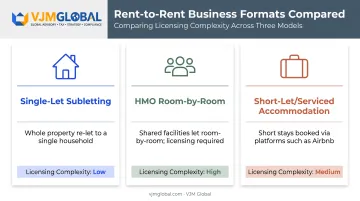
Each format carries different licensing and compliance obligations, which matters more once you're managing it from another country.
Can Americans Legally Start a Rent-to-Rent Business in the UK?
Yes. There's no restriction on foreign nationals owning or directing a UK limited company. Companies House confirms directors don't need to live in the UK at all. One shareholder can legally own 100% of the company from abroad.
That said, owning and directing a UK company remotely is a different matter from living or working in the UK. If you ever plan to relocate and manage the business in person, that requires a separate visa application entirely.
What Right-to-Rent Checks Actually Cover
Right-to-rent checks apply to the tenants you let to, not to you as the business operator. You still need to confirm your own legal standing to trade in the UK, but you won't personally undergo a right-to-rent screening as the company director.
Practical Registration Requirements
Before any landlord or letting agent takes your application seriously, you'll typically need:
- A UK registered office address (a bare PO Box no longer qualifies)
- Identity verification for all directors and persons with significant control — mandatory as of November 2025
- A UK business bank account, or a credible plan for one
This is where most US founders stumble. Getting the entity type, registered office, and identity verification right first time avoids weeks of delay. Many founders work with cross-border specialists such as VJM Global for entity formation and compliance filings, which helps foreign-owned companies avoid rejected applications and mismatched paperwork.
Even with remote ownership sorted, occasional UK travel (for viewings, lease signing, or council liaison) may still be necessary. Day-to-day ownership can run from abroad; a few in-person steps usually cannot.
What to Know Before You Start This From the USA
The time zone gap between the US and UK runs 5 to 8 hours depending on your location and the season. That gap affects landlord negotiations, tenant communication, and contractor scheduling in ways that aren't obvious until you're living them.
Trying to personally manage viewings at 9am UK time while it's 2am on the East Coast isn't sustainable. Hands-on self-management from the US is not realistic. Building a local team (agent, solicitor, property manager) from day one is essential.
Set realistic timeline expectations. Factor in extra lead time for:
- Company registration and identity verification
- Non-resident bank account approval, which UK government guidance pegs at 4 weeks to 3 months
- Finding trustworthy local partners before the business generates steady income
Rushing any of these three produces the costliest mistakes later.
How to Start a Rent-to-Rent Business in the UK from the USA – Step by Step
This breaks the process into stages adapted specifically for someone based outside the UK. The most common mistake is applying US business assumptions (self-managing, skipping local licensing checks, assuming remote banking will be quick) to a UK operation that doesn't work that way.
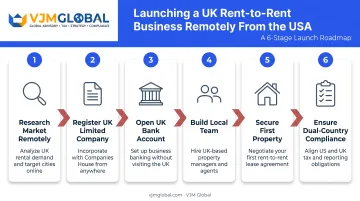
Step 1 – Research the Market and Choose a Target Area Remotely
Use Rightmove and Zoopla listings, local forums, and letting agents to gauge rental demand and licensing status in your target city before committing to anything.
- Match the area and property type to your strategy : student HMO, serviced accommodation, or family let
- Check Article 4 status, since councils can remove permitted-development rights for HMO conversions
- Compare local rules across authorities; they vary significantly and aren't interchangeable
Step 2 – Register a UK Limited Company as a Non-Resident
Companies House permits 100% foreign-owned and foreign-directed companies, provided you have a UK registered office address and pass identity verification.
This step is typically outsourced to a cross-border formation specialist. VJM Global, for example, manages registered office provision, director verification, and company secretarial requirements for US founders , so no travel to the UK is needed to get the company on the register.
Step 3 – Open a UK Business Bank Account and Set Up Cross-Border Finances
Non-resident directors routinely struggle to get UK banks to open accounts remotely. Fintech and digital banking alternatives often support non-resident applications faster than traditional high-street banks, though eligibility varies by provider and risk profile.
Two things need planning from day one:
- Currency conversion costs between GBP and USD, which erode margins if ignored
- US reporting obligations for foreign company ownership, including FBAR filings when foreign accounts exceed $10,000, plus FATCA disclosures where asset thresholds apply
Step 4 – Build a Trusted UK-Based Team Before You Need One
Don't wait until you're mid-negotiation to start assembling this team:
- UK solicitor: reviews lease and sublet agreements before you sign anything
- Local sourcing or letting agent: your eyes on the ground for viewings, negotiations, and inspections
- Property manager or virtual assistant: handles day-to-day tenant and landlord communication given the time difference
Step 5 – Find, Appraise and Secure Your First Property Remotely
Video viewings paired with a trusted local contact who physically inspects the property beforehand replace the in-person walkthrough you'd normally do yourself.
Appraise the numbers (rent, refurbishment, void risk) the same way a domestic operator would, then add a margin for remote oversight and local team costs.
Confirm the landlord's lease explicitly permits subletting, and check HMO licensing or Article 4 status with the council before signing. These aren't negotiable, and they vary property by property.
Step 6 – Get Compliant on Both Sides of the Atlantic
UK-side obligations:
- HMO licensing where applicable
- Gas Safe certificates (annual) and electrical safety inspections (at least every five years)
- Tenancy deposit protection through an approved scheme within 30 days
- Landlord insurance
US-side obligations:
- Reporting foreign company ownership and income to the IRS, potentially including Form 5471
- Understanding how the US-UK tax treaty, in force since 2003, affects double taxation and foreign tax credit eligibility
Many US founders work with a cross-border advisory firm like VJM Global to keep UK company filings and US reporting obligations aligned. Missing either side carries real financial and legal exposure. This isn't a corner worth cutting.
Costs, Common Pitfalls & Long-Term Outlook for US-Based Operators
Typical startup costs run £10,000 to £20,000, covering company registration, deposits, and refurbishment. Refurbishment alone commonly runs £10,000-£12,000 per property depending on condition. Budget an extra premium if you need a remote local team on top of that baseline.
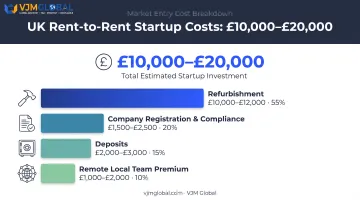
Pitfalls specific to remote ownership:
- Committing to a property without a genuine in-person inspection
- Underestimating how much time-zone lag slows decision-making during negotiations
- Falling into non-compliance on HMO licensing or Article 4 rules without local knowledge
The costliest mistakes in this business rarely come from bad deals. They come from skipping local verification because you're 5,000 miles away and it feels easier not to.
Most successful US-based operators follow a similar pattern: advisor-led setup for the first property, then a shift toward a stable, delegated local team once that property is proven. Trying to scale while still personally managing every detail from the USA tends to break down around the second or third property.
Frequently Asked Questions
How do I start a rent-to-rent business in the UK?
Research the market, register a UK company, secure funding, find a property whose head lease allows subletting, and put compliant contracts in place before taking tenants. Each step depends on the one before it, so sequence matters.
Is rent-to-rent legal in the UK?
Yes, provided the head lease explicitly permits subletting and the operator meets HMO licensing, safety, and tenancy deposit rules where applicable. Skipping any of these creates real legal exposure.
Can foreigners start a business in the UK?
Yes. Foreign nationals can own and direct a UK limited company with no residency requirement, though a registered office address and identity verification are mandatory.
How much rent should I charge tenants in a UK rent-to-rent property?
Base pricing on local market rates, occupancy demand, and the margin needed to cover head rent, refurbishment, and management overhead. Check comparable local listings before setting your figure.
Do I need a UK visa or residency to own a UK rent-to-rent business from the USA?
No. Owning or directing the company does not require a UK visa. Living or working in the UK to manage operations in person is a separate immigration issue and sits outside company ownership rules.
How much capital do I need to start a rent-to-rent business in the UK as a US-based investor?
Commonly £10,000-£20,000, covering registration, deposits, and refurbishment. Costs run higher once you factor in a remote local team's fees.