Opening a restaurant in the UK from the US carries a layer of complexity a home-market launch never touches: forming a UK legal entity, deciding whether to relocate or hire a local manager, managing tax exposure in two countries, and clearing UK-specific licensing that ignores your passport entirely.
This guide walks US-based founders through exactly what to decide before starting and how to execute each stage without necessarily setting foot in the UK.
Key Takeaways
- Budget £150,000–£500,000+ for a UK restaurant startup—US-like scale, UK-specific rules
- Own the business from the US; hands-on management needs a visa or a UK-based manager
- Register separately for UK Corporation Tax, VAT, and PAYE on top of US filings
- Use the US-UK tax treaty to avoid double tax—you still file in both countries
- Secure food, premises, and alcohol licences the same way whether you relocate or not
Why US Entrepreneurs Are Expanding Into the UK Restaurant Market
American food brands are landing in the UK at a pace that would have seemed ambitious a decade ago.
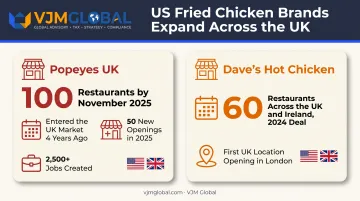
Popeyes, a US-born brand, was approaching its 100th UK restaurant in November 2025, just four years after entering the market. Its 2025 expansion plan covered almost 50 new openings and more than 2,500 jobs, according to Restaurant Online.
Los Angeles-based Dave's Hot Chicken signed a 2024 deal for 60 restaurants across the UK and Ireland combined, with its first UK site planned for London.
That momentum isn't accidental. A shared language and broadly familiar legal concepts remove several of the friction points that make expansion into non-English-speaking markets so slow. Contracts read the same way. Business norms translate reasonably well. The UK-US trade relationship provides a stable backdrop.
Demand is spreading across several types of US operators:
- Established restaurant and franchise brands using the UK as their first international market
- Chef-entrepreneurs moving a single concept or menu across the Atlantic
- Food and beverage companies testing Europe in the UK before a wider EU push
What to Know Before You Start: Visa, Residency & Legal Presence
Before touching Companies House forms, US founders need clarity on one question that trips up nearly everyone: does opening a UK restaurant mean moving there?
Do You Need to Relocate to the UK?
No, not to own it. UK company law lets a director live anywhere in the world. You can incorporate a UK Ltd company, appoint yourself as director and shareholder, and never set foot on British soil.
Running the place day-to-day is a different story. Hiring chefs, managing shifts, and handling suppliers in person is active work in the UK. That typically requires either:
- A visa that permits you to work in the business, or
- A UK-based general manager running operations while you direct strategy remotely
Passive ownership and active management sit on opposite sides of a legal line. Founders who blur that line run into trouble fast.
Visa Routes and Employment Considerations for US Founders
If you plan to relocate, two routes come up most often for restaurant founders:
- Innovator Founder visa – needs endorsement that the business is new, innovative, viable, and scalable; runs three years and lets you work in your own business
- Skilled Worker visa – needs a Home Office-approved sponsor, a certificate of sponsorship, and a role meeting salary thresholds; your restaurant can sponsor you once it holds a sponsor licence
One point catches almost every first-time founder off guard: hiring any UK-based staff, chefs, servers, or managers, requires right-to-work checks regardless of your own visa status. Their eligibility has nothing to do with yours.
Another common mistake: assuming a US passport or short business trips cover ongoing management. Standard Visitor status permits meetings, site inspections, and contract negotiations, not hands-on restaurant operations. Long-term active involvement needs a proper visa or a delegated management structure.
How to Start a UK Restaurant Business from the USA – Step by Step
This sequence is built for founders running the process from the US. Entity setup, cross-border tax, and UK hospitality requirements sit in one path—not a copy-paste of a US launch.
Step 1 – Choose Your UK Legal Structure and Register with Companies House
Most US founders form a UK Private Limited Company (Ltd), though setting up a UK branch or subsidiary of an existing US entity is also possible depending on your growth plans.
A non-UK-resident director or shareholder generally needs:
- Proof of identity (verified through GOV.UK One Login, an authorised corporate service provider, or a participating Post Office)
- A UK registered office address, which must be a physical address able to receive and confirm mail, not a PO Box
- The correct SIC code for restaurant activity, such as 56101 for licensed restaurants
Online incorporation costs £100 and usually completes within 24 hours; the paper route costs £124 and takes 8-10 days. VJM Global assists US businesses with UK entity formation and Companies House filing, so founders can complete this step without leaving the US.
Step 2 – Register for UK Tax and Coordinate with US Filing Obligations
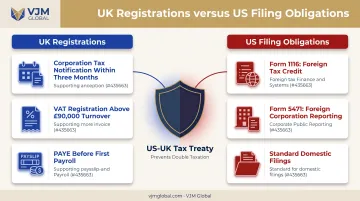
Once incorporated, three UK registrations follow:
- Corporation Tax – notify HMRC within 3 months of starting to trade
- VAT – required once taxable turnover exceeds £90,000, per HMRC's VAT threshold guidance
- PAYE – needed before your first payroll run, whether that's staff or yourself as director
The US-UK Double Taxation Treaty prevents the same profits being taxed twice, generally through foreign tax credit relief claimed via IRS Form 1116. Treaty relief doesn't erase your US reporting duties. Depending on ownership structure, you may still need filings such as Form 5471 for a foreign corporation, on top of what you file with HMRC.
VJM Global's cross-border tax specialists coordinate UK compliance alongside US filing obligations, closing the gaps that open up when founders treat the two systems as unrelated.
Step 3 – Open a UK Business Bank Account as a Non-Resident
This step catches out more founders than any other. Many UK high street banks expect an in-person meeting or a UK-resident director before opening a business account, which is a genuine problem when you're managing everything from New York or Chicago.
- UK fintech and challenger banks are generally more accommodating of non-resident directors than traditional high street banks
- A registered UK agent can speed up verification and document handling
- Build in extra time here; traditional-bank approval alone can take 4-8 weeks
Don't leave this until after signing a lease. Start the account application the moment your company is incorporated.
Step 4 – Secure Food, Premises and Alcohol Licences
UK licensing doesn't care where you're from, but it does care about timing. Required licences typically include:
- Food business registration with your local council, due at least 28 days before opening
- Premises licence, covering the sale of alcohol and other licensable activities
- Personal alcohol licence for a designated premises supervisor, if you're serving alcohol
- Music licence (TheMusicLicence, via PPL PRS) if you're playing recorded or live music
Premises licence applications go to the local council and require an operating schedule and premises plans, with a mandatory 28-day public notice period. Councils commonly advise budgeting at least two months for the full process, so start this well before your target opening date, not after.
Step 5 – Set Up Payroll and UK Employment Compliance
UK employment law applies in full from your very first hire, and it doesn't resemble at-will employment back home. Before anyone starts work, you'll need:
- Right-to-work checks using GOV.UK's online service or eligible original documents
- PAYE registration, so tax and National Insurance are deducted correctly
- National Minimum Wage compliance, with rates that change every April
- Statutory holiday entitlement of 5.6 weeks per year for almost all workers
Skipping right-to-work checks isn't a paperwork slip. It can trigger a civil penalty against the business.
Step 6 – Launch and Maintain Ongoing Cross-Border Compliance
Opening night isn't the finish line. Post-launch, you're now running two parallel compliance calendars:
- UK side: annual Confirmation Statement, annual accounts, CT600 Corporation Tax filing, ongoing PAYE Real Time Information submissions
- US side: reporting tied to owning a foreign business, plus your usual domestic filings
The most common failure point comes after opening: founders treat the UK entity as "set and forget." Statutory deadlines don't pause for a busy second year, and penalties tend to arrive quietly.
Cost of Starting a Restaurant in the UK from the US
UK restaurant startup costs vary widely by concept. Published estimates from Square's UK cost breakdown give a useful baseline:
| Concept type | Estimated startup cost |
|---|---|
| Quick-service | £200,000 – £300,000 |
| Fast casual | £200,000 – £500,000 |
| Full-service | £500,000+ |
US founders should layer a few extra line items on top of the standard build-out budget:
- Registered agent fees for the UK registered office
- Cross-border tax advisory, on top of a standard UK accountant
- Non-resident banking setup costs, including any expedited verification services
Recurring monthly costs—rent, staff wages, ingredients, and utilities—come with an extra burden for US founders: dual compliance. Budget for both a UK accountant and a cross-border advisor who track obligations on each side of the Atlantic.
Currency risk is one more line worth planning for. If you fund a UK entity with US-sourced capital, GBP-USD swings can shift your effective budget between the day you plan and the day you wire funds.
Build in an FX buffer so a weaker dollar does not eat into your build-out budget mid-project.

Conclusion
Starting a UK restaurant from the US is achievable without relocating, provided you sequence legal, tax, and licensing groundwork correctly from day one. Skip a step or handle it out of order, and the cost shows up later as a missed deadline or a stalled bank account—a slow drain on time and money.
The founders who struggle most are rarely those facing the biggest challenges. They're the ones who treated UK entity setup and compliance as an afterthought rather than the foundation it is.
Partnering with a firm experienced in both UK and US-side compliance, such as VJM Global, removes much of the cross-border guesswork. That lets you focus on the menu and the room instead of the paperwork.
Frequently Asked Questions
How much does it cost to start a food business in the UK?
Startup costs typically range from £150,000 to £500,000+, depending on concept and location. US founders should add cross-border setup costs, including entity formation and tax advisory, on top of that range.
What are the requirements to open a restaurant in the UK?
You'll need company registration, local food business registration, food hygiene training, a premises licence, an alcohol licence if serving drinks, and appropriate business insurance.
Is a restaurant business profitable in the UK?
Typical net margins sit around 3–9%, depending on concept and location, with food and labour as the largest cost lines. Getting legal and tax structure right at setup protects those margins better than reworking them later.
Do I need a visa to open or run a restaurant in the UK as a US citizen?
Ownership doesn't require a visa; you can incorporate and own a UK company remotely. Active, day-to-day management in the UK does require an appropriate visa or a delegated UK-based manager.
Can a US company own a UK restaurant without relocating?
Yes. This works through a UK subsidiary or Ltd company, with a local manager or director handling daily operations while ownership and strategic decisions stay with the US founder.
Will I be taxed in both the US and the UK on my restaurant's profits?
The US-UK tax treaty prevents double taxation on the same profits, through foreign tax credit relief. You'll still carry separate reporting obligations in both countries, even where no additional tax is owed.