The interest comes from different directions. Some Dutch SMEs want outsourced manufacturing. Freelancers are testing e-commerce or export ideas. Larger NL companies want a proper Indian subsidiary or branch office to serve the local market directly.
This guide walks a Netherlands-based founder through the practical steps: entity choice, registration, FDI compliance, and the visa reality that catches most first-timers off guard.
TL;DR
- India offers a large domestic market plus manufacturing and export upside, with growing India–Netherlands trade
- Private Limited is the usual route for Dutch founders; branch or liaison offices fit limited activities
- Budget for DIN/DSC, registration fees, and ongoing GST and ROC compliance
- Plan several weeks after incorporation for bank account opening and GST activation
- Dutch citizens need business visas and full FDI compliance; no EU-style visa exemption applies
What Does Starting a Small Business in India Involve for Dutch Entrepreneurs?
Starting a small business in India means setting up a legally recognised entity or registered presence in India while operating from, or originating in, the Netherlands. It's not the same as an EU-to-EU move.
Dutch nationals are non-resident founders under India's FDI and FEMA rules. There's no treaty shortcut. Every rupee of foreign capital, every share allotment, and every structural decision runs through India's foreign investment framework.
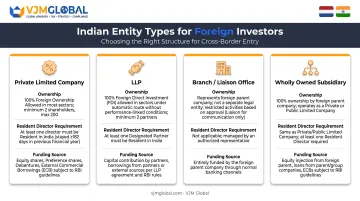
Common structures Dutch founders consider:
- Private Limited Company — most common route for 100% foreign ownership in most sectors
- LLP (Limited Liability Partnership) — lighter compliance, but at least one resident designated partner required
- Branch or Liaison Office — no separate Indian equity; funded entirely by the Dutch parent
- Wholly Owned Subsidiary — not a separate legal form; a Private Limited Company 100% owned by the Dutch parent
What to Know Before You Start a Business in India
India's registration process is digital-first but still document-intensive. Dutch founders used to KvK's relatively streamlined system often underestimate the paperwork layer that follows incorporation.
Before committing, work through these decision points:
- Remote vs. relocation: Many structures can run from the Netherlands with a resident director appointed locally, but some activities still need people on the ground.
- Realistic timeline: Incorporation can move fast digitally; GST registration, bank account opening, and sector licences add further weeks.
- FDI route: Most sectors sit on the automatic route with no prior approval; a handful (defence, certain media) need government sign-off.
- Full entity vs. lighter setup: An Employer of Record or liaison office can suit market testing better than a full subsidiary on day one.
Getting this sequencing wrong is the single biggest source of delay for Dutch founders.
Why Start a Small Business in India? (When It Makes Sense for Dutch Entrepreneurs)
India expansion pays off under specific conditions, not automatically. Run it as a fit test before you commit capital.
The trade data supports the opportunity. Dutch equity FDI inflow reached USD 4.62 billion in FY2024-25 alone, roughly 9.24% of all FDI equity India received that year. That's real capital already flowing, not speculative interest.
Sectors showing consistent demand:
- IT and software services (domestic tech revenue hit USD 54 billion in FY2024)
- Textiles and food processing (steady multi-year growth trends)
- Renewable energy (22 GW added in the first half of 2025)
- Logistics (demand tied to India's infrastructure and manufacturing push)
India's draw for Dutch SMEs comes down to two things: a massive domestic consumer base and cost-competitive manufacturing capacity. Fast digital incorporation does not erase tax, compliance, or market-entry work.
India entry usually fits when you have:
- A defined buyer segment in India (B2B niche or clear consumer use case)
- A product or service that transfers without a full redesign
- Budget and ownership for ongoing GST, ROC, and tax compliance
- A 12–24 month runway before you expect steady local revenue
Early Decisions That Matter: Business Structure and Costs
Most delays trace back to one root cause: picking the wrong entity type or underestimating what compliance actually costs. It's rarely a lack of founder effort.
Choosing Your Legal Structure
| Structure | Ownership | Capital/Resident Requirement | Best Fit |
|---|---|---|---|
| Private Limited Company | Up to 100% foreign (most sectors) | At least one resident director (120+ days in India) | Most foreign founders; liability protection, easier fundraising |
| LLP | Foreign partners allowed | Minimum two partners; one resident designated partner | Lower compliance burden, service businesses |
| Sole Proprietorship | Single owner | No separate legal identity | Rarely suitable for non-resident founders |
| Branch/Liaison Office | Funded by parent, no separate equity | Branch: USD 100,000+ parent net worth; Liaison: USD 50,000+ | Market research or coordination, not trading |
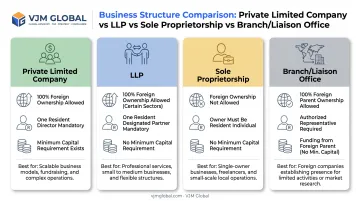
For most Dutch entrepreneurs, a Private Limited Company wins. It offers liability protection, makes fundraising easier, and gives the credibility Indian partners and banks expect.
Costs Often Overlooked
Budget beyond just the headline registration fee:
- Incorporation basics: Registrar of Companies filing fees, DSC costs (valid 1-2 years), and DIN application (a one-time, lifetime allotment)
- Professional/CA fees: For document preparation, MOA/AOA drafting, and filing support
- GST registration and filing: Ongoing monthly or quarterly return costs
- Annual compliance: ROC filings, statutory audit requirements, secretarial upkeep
None of these have a single fixed number — MCA runs an indicative fee-enquiry tool rather than publishing one flat total. Get a current quote before budgeting.
This is where VJM Global steps in for Dutch entrepreneurs, handling entity formation, DSC/DIN processing, and ongoing compliance so the setup timeline stays on track.
How to Start a Small Business in India from the Netherlands – Step by Step
Setting up a small business in India from the Netherlands follows five sequential steps, from entity choice through GST registration. The path is workable if you avoid three frequent errors: assuming Dutch KvK registration transfers over (it doesn't), underestimating FDI reporting obligations, and missing GST deadlines that don't align with the Dutch VAT calendar.
Step 1 – Choose Your Business Structure and Validate the Indian Market
Compare the main options—Private Limited Company, LLP, or Branch/Liaison Office—against your liability appetite and growth plans. Before spending on incorporation, validate demand with Indian consumers, or with NRI/expat segments if that is your niche.
Common miss: Choosing a Private Limited Company with full governance overhead when an LLP would have done the job for a small services business.
Step 2 – Obtain DIN, DSC, and Reserve Your Company Name
Apply for a Digital Signature Certificate (DSC) and Director Identification Number (DIN) first—every later MCA filing depends on them. Then reserve your company name through the RUN or SPICe+ portal.
Common miss: Delaying DSC application. Every subsequent digital filing depends on it, so this single step can stall the entire timeline.
Step 3 – Incorporate via the MCA Portal and Obtain PAN/TAN
File SPICe+, which bundles incorporation with DIN allotment, PAN, TAN, and optional GSTIN. You'll also need linked forms like e-MOA, e-AOA, and AGILE-PRO-S.
Common miss: Incomplete MOA/AOA documentation, which triggers rejection and forces a costly refiling cycle.
Step 4 – Open an Indian Business Bank Account and Bring in Capital
Open a current account with an Indian bank. Route founder capital under FEMA and FDI reporting norms. That usually means the Single Master Form on RBI's FIRMS portal.
Common miss: Not filing Form FC-GPR within 30 days of share allotment. This is a hard RBI deadline, not a suggestion, and missing it creates real compliance risk.
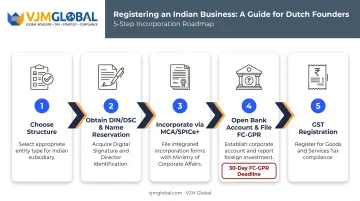
Step 5 – Register for GST and Understand Tax Obligations
Register for GST if turnover thresholds apply — note that inter-state suppliers generally can't rely on the general exemption threshold regardless of turnover. Understand corporate tax rates (ranging from 22% to 30% depending on the regime) and TDS obligations.
Common miss: Assuming Dutch VAT filing habits carry over. India's GST cadence, with GSTR-1 and GSTR-3B filed on separate schedules, doesn't map neatly to a quarterly VAT return.
Once the entity, bank account, capital reporting, and GST registration are in place, you are cleared to start trading in India under local compliance rules.
Legal and Practical Considerations for Dutch Founders
A few structural realities that don't get enough attention upfront:
- Visa requirement: Dutch citizens need an e-Business Visa to enter India for setup activities. There's no EU-to-EU-style exemption — apply through the official portal at least four days before travel.
- FDI reporting to RBI: Any foreign capital inflow must be reported to the RBI. A few sectors, such as defence or media, need prior government approval instead of the automatic route.
- Dual compliance: If your Dutch parent entity stays active, expect KvK filings in the Netherlands running alongside ROC and GST filings in India. These don't merge into one process — they run in parallel.
Conclusion
Starting a small business in India from the Netherlands is entirely achievable. It just requires the right entity choice upfront, disciplined FDI compliance, and a realistic view of timelines that stretch beyond the incorporation certificate itself.
Cross-border partners experienced in Indian entity formation, such as VJM Global, help Dutch founders handle registration, GST, FDI filings, and ongoing compliance—so India-side setup stays on track without pulling focus from operations back home.
Frequently Asked Questions
How much money is needed to start a small business in India?
There's no universal minimum capital figure for a Private Limited Company or LLP under current rules. Budget for registration fees, DSC/DIN costs, and professional fees, which vary by service provider and complexity.
Can I start a business in India with ₹50,000?
A sole proprietorship or LLP suits tight budgets better than a Private Limited Company, since compliance overhead is lower. Focus spending on registration essentials first and scale formal structure as revenue grows.
How should a beginner start a business in India?
Choose your legal structure, complete registration through the MCA portal, obtain PAN and GST numbers, then open a business bank account. Each step depends on the previous one being fully complete.
Which small business is most profitable in India?
IT services, agri-exports, and niche manufacturing often deliver strong margins for foreign entrants, especially where India–Netherlands trade flows already exist. Profitability still depends heavily on execution and market fit.
Which small businesses have the highest success rates in India?
Service-oriented and export-focused businesses generally show steadier demand and lower failure rates than purely domestic retail ventures. This holds especially true where founders bring existing international client relationships.
Do Dutch citizens need a visa to start a business in India?
Yes. A business visa (typically the e-Business Visa) is required; there is no EU-style free-movement exemption for entering India. That is a clear contrast with the free movement Dutch citizens enjoy within the EU.