Loan access matters for a reason beyond convenience, though. A new UK venture needs capital to cover incorporation costs, office setup, early hires, and marketing before revenue starts flowing. Early borrowing also builds a UK credit history that future financing rounds depend on.
This guide covers the main types of UK startup loans, the eligibility barriers that specifically trip up US-based founders, and the realistic pathways that actually work.
Key Takeaways
- UK startup finance includes government-backed loans, bank debt, alternative lenders, and equity
- Most schemes (including Start Up Loans) need UK residency and right to work—blocking most US-based founders
- UK funding usually needs a UK entity plus residency, local presence, or a UK-based co-founder
- Loan sizes range from a few hundred pounds to £500,000+, depending on the lender
- For most US founders, form the UK entity before applying—not after
What Are UK Startup Business Loans (and Why They Matter for US Entrepreneurs)
A UK startup loan is financing aimed at businesses trading for a limited period, commonly under three to five years. Founders use it to cover setup costs, buy equipment, fund marketing, hire staff, or manage working capital while revenue is still building.
These products span a wide spectrum:
- Unsecured personal-style loans backed by the UK government, issued to the individual rather than the company
- Secured or unsecured commercial bank loans that require a trading history and often a personal guarantee
- Alternative fintech lending that weighs cash flow and affordability over years in business
For US entrepreneurs, that spectrum comes with a catch. Many assume a UK loan works like an SBA loan or a US fintech product: apply online, link a bank account, get a decision in days.
UK schemes aren't built that way. They centre on UK residency, a UK-registered company, and UK credit history. That is a structural difference, not a technicality—plan for it before you apply, not halfway through the process.
Types of Startup Business Loans in the UK
"Startup loan" isn't one single product in the UK. The right option depends on your residency status, entity structure, available collateral, and how established your UK business already is.
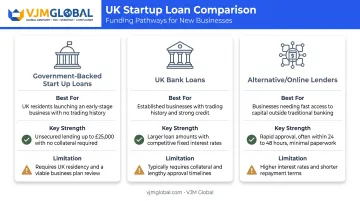
Government-Backed Start Up Loans Scheme
The Start Up Loans programme, delivered through the British Business Bank, provides unsecured personal loans to individuals starting or growing a UK business. Successful applications carry a fixed annual interest rate.
First-time applicants can be pre-launch or already trading for several years. Rates and thresholds change periodically, so confirm current figures on the official site before you apply.
- Best for: UK residents with the right to work in the UK and a UK-registered business
- Key strength: No collateral or personal guarantee required, plus free mentoring support
- Limitation: Strict residency and right-to-work criteria exclude most US-based applicants who haven't relocated or secured a qualifying visa
UK Bank and High-Street Business Loans
Traditional term loans from banks such as Barclays, HSBC, Lloyds, or NatWest require a registered UK company, a business plan, and often a personal guarantor. None of the major high-street banks publish a blanket minimum trading history for standard loan products, but that's not the same as an open door for a brand-new entity.
- Best for: Founders who've already incorporated a UK entity with a UK trading address, UK bank account, and some credit history
- Key strength: Larger loan amounts and a banking relationship that supports future financing rounds
- Limitation: Cautious with new entities lacking UK trading history; non-resident directors often need a UK-based guarantor
Alternative, Online and Peer-to-Peer Lenders
Fintech and marketplace lenders assess affordability and cash flow rather than relying purely on years in business. Funding Circle, for instance, requires at least a year of UK trading history before it will lend.
Some competitors accept newer companies but still expect a UK-incorporated entity and a UK bank account.
- Best for: UK-incorporated startups with some UK trading activity or revenue evidence, including foreign-owned UK subsidiaries
- Key strength: Faster decisions and more flexible criteria than traditional banks
- Limitation: Higher rates to offset risk; nearly all still need a UK-registered company and UK bank account
Eligibility Criteria: Can a US Entrepreneur Actually Qualify?
The honest answer: not directly, in most cases.
Barriers That Block Most US Applicants
Most government and many commercial schemes require the applicant to live in the UK and hold the right to work there. That residency rule is the single biggest blocker for US applicants, no matter how strong the business idea or US credit score.
A UK-registered company (private limited company or branch) is usually a prerequisite for any UK-based lender. Incorporating meets the entity-location test, but not the residency test that government schemes apply to the individual applicant.
UK lenders also check UK credit bureaus only. A spotless US profile and years of on-time payments do not appear in that search, so you start from zero with a UK underwriter.
Visa status matters as well. Certain UK visa categories are explicitly excluded from schemes like Start Up Loans. The official eligibility guidance lists specific excluded visa tiers, including several temporary worker and student routes. Other types, such as those with pre-settled status, can qualify.
Because that list gets updated, check your immigration route against the current official page rather than assuming.
Practical Workarounds
Many US founders solve this with one of two moves:
- Appoint a UK-resident director or co-founder who can hold the applicant-facing role on government schemes
- Build UK trading history first via a properly incorporated entity, then approach commercial or alternative lenders once you have a UK bank account and transaction record
Neither path is instant, but both beat hoping a US-based application slips through.
How US Entrepreneurs Can Realistically Access UK Startup Funding
Getting UK entity formation right is the actual starting line, not the loan application. Incorporating a UK limited company or branch creates the legal and banking foundation that every government or commercial lender expects to see before reviewing a file.
Start With the Entity, Not the Application
Once a UK company exists on paper, three things typically follow it:
- A UK business bank account, which builds the transaction history that both government and commercial lenders assess
- A UK-specific business plan and cash flow forecast, tailored to UK lender expectations rather than repurposed US pitch materials
- UK tax registrations (Corporation Tax with HMRC, VAT where applicable, PAYE if hiring) that lenders and banks expect to see in order
Cross-border support is most useful at this stage, when lender-ready records still need building. VJM Global helps US founders form a private limited company or branch through Companies House, register for Corporation Tax, and obtain the company's UTR. The same engagement typically sets up bookkeeping and payroll on platforms such as Xero or QuickBooks.
With that legal and financial groundwork done before any loan application, the business can produce the records a lender asks for without scrambling on day one.

Consider Equity and Grants Before Debt
For a foreign-owned entity with no UK trading history, equity and grant routes are often more accessible than loans:
- Angel investors who back early-stage UK companies regardless of founder nationality
- UK-focused crowdfunding platforms that raise smaller amounts from a broad base of backers
- Sector-specific grants, particularly in tech, life sciences, and green energy, that don't require repayment
These routes still leave the residency and credit-history gap in place, but they do not hinge on UK credit the way a government or bank loan does.
What to Check Before Finalizing Your Funding Approach
Before committing to any UK loan route, run through these checks.
UK vs US loan rules: SBA loans and UK Start Up Loans look similar on the surface, but residency, visa, and entity requirements differ. Confirm eligibility before you apply—not after a decline.
Compliance before capital: Companies House filings, HMRC registration, and statutory accounts need to be in place before most UK lenders will take an application seriously. Missing one is often why an otherwise solid file gets rejected.
Real cost of debt vs alternatives:
Fixed versus variable UK interest rates
Arrangement fees and any early repayment charges
Whether equity or a grant might suit a foreign-owned, early-stage entity better than a loan would
A loan that looks cheap upfront can cost more than diluting equity once fees and personal-guarantee risk are factored in. With no UK trading history yet, getting compliance right and comparing total cost of capital usually beats rushing into the first available facility.
Frequently Asked Questions
How do you get funding for a startup in the UK?
Funding routes include the government Start Up Loans scheme, bank loans, alternative lenders, grants, and equity investment. Eligibility, especially UK residency, determines which of these are realistically open to you.
How much can you borrow to start a business in the UK?
Amounts typically run from £500 up to £500,000 or more, depending on lender type. Government-backed loans are capped per founder, while commercial and alternative lenders may offer more against stronger trading history or security.
What is the monthly payment on a £50,000 business loan?
Monthly repayment depends entirely on the interest rate and loan term you're quoted. Use a loan repayment calculator with your specific rate and term rather than relying on a generic estimate.
Can a US citizen get a business loan in the UK without living there?
Not through most local schemes directly. Most UK lenders require UK residency and right to work, so a US citizen typically needs a UK entity, a UK-resident director, or qualifying visa status to access financing locally.
Do I need a UK company to apply for a UK startup loan?
Yes, in almost every case. A UK-registered business is generally required by both government and commercial UK lenders, which makes entity formation the practical first step for foreign founders.
What is the interest rate on the UK government Start Up Loan?
The scheme charges a fixed annual interest rate that gets reviewed periodically. Check the current rate on the official Start Up Loans or British Business Bank website before you apply.