Many American entrepreneurs assume UK company formation, survival rates, and compliance work roughly the same way they do at home. That assumption gets expensive fast. The two markets differ sharply in structure, speed, and regulatory expectations.
This article breaks down the latest UK start-up statistics, benchmarks them against US data, and outlines what American founders need to know before setting up shop in Britain.
Key Takeaways
- The UK recorded 846,000 new company incorporations in 2024, pushing the active business count to a record 5.63 million
- UK startups show a 38–40% five-year survival rate, broadly in line with US patterns
- Property, takeaway/food, and management consultancy were the UK's fastest-growing new business categories in 2024
- Same-day to 48-hour company registration is far faster than most US state-by-state processes
- Specialists fluent in Companies House and HMRC rules can cut setup time and rework for US founders
UK Business Population: Size, Growth and Fastest-Growing Sectors
The UK's active company count grew 3% year-on-year to hit 5.63 million by the end of 2024. That's a record high. But new formations actually slowed slightly: 846,000 companies were incorporated during the year, down 3% from 2023.
Pace varied across the year:
- Q1 2024: 248,000 incorporations, the highest quarterly total in five years
- Q4 2024: 184,000 incorporations, historically the quietest quarter
The government's broader business population estimate (a wider measure than Companies House registrations) shows a slight 1% dip between 2023 and 2024.
That follows a sharp pandemic-era contraction from 5.98 million in 2020 to 5.51 million by 2022. So 2024's incorporation record sits on a business population that is still recovering unevenly.
Regional Distribution of New UK Businesses
London dominates, with 286,000 new incorporations in 2024—slightly down year-on-year, but still far ahead of every other region. Separate ONS data on business "births" (a related but distinct measure) shows the gap clearly:
- South East: roughly 43,000
- North West: around 34,000
- Scotland: approximately 18,000
Fastest-Growing UK Business Sectors
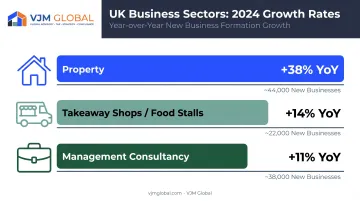
Three sectors stood out in 2024:
- Property: grew 38% year-on-year to roughly 44,000 new businesses
- Takeaway shops and food stalls: grew 14% to around 22,000
- Management consultancy: grew nearly 11% to almost 38,000
Property growth tracks demand for lettings, management, and small-scale development as institutional landlords pull back in parts of the market. Consultancy's rise follows a familiar pattern: redundancies and restructuring push experienced professionals into solo advisory work.
For US founders, that mix matters—London still concentrates formation volume, while property and consultancy are where new local competition and partner options are appearing fastest.
UK Startup Survival and Failure Rates
Five-Year Survival Rates
The most recent verified figure from the Office for National Statistics puts five-year survival at 38.4% for businesses born in 2019 that made it to 2024. That's down slightly from 39.4% for the previous year's cohort. Survival declines steadily each year after formation, with the sharpest attrition happening early and tapering off as businesses mature past the four-year mark.
Not every sector fares equally. Transport and storage consistently shows the weakest survival of any UK industry, with some regions (Wales, specifically) recording five-year survival as low as 14.8% in that sector.
Hospitality and food service also carry higher risk, given thin margins and heavy fixed costs. The UK still doesn't publish sector failure breakdowns as granular as those available in the US.
Common Reasons UK Startups Fail
The same failure modes show up again and again in practitioner reports and government guidance:
- Cash flow mismanagement: underestimating costs and overestimating sales is still the top reason startups miss year five
- First hire strain: going from solo founder to employer spikes costs and management load at a fragile moment
- Founder burnout: years of running alone without support eventually shows up in the numbers
- The "E-Myth" gap: skill at a trade (baking, coding, consulting) does not automatically mean skill at running the business
None of these are unique to Britain. But UK founders often underestimate how quickly the Companies House and HMRC compliance calendar compounds these pressures, particularly once payroll and VAT obligations kick in.
US vs UK Startup Landscape: How Do They Compare?
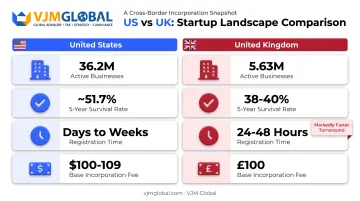
Scale is the first obvious difference. At 5.63 million active companies, the UK looks small next to the US's 36.2 million small businesses, per the SBA Office of Advocacy. That gap tracks population size roughly proportionally, so it's not a meaningful sign that one market is more entrepreneurial than the other.
| Metric | UK | US |
|---|---|---|
| Active businesses | 5.63M | 36.2M |
| Five-year survival | 38-40% | ~51.7% (2009 establishment cohort, BLS) |
| Typical registration time | 24-48 hours online | Varies by state; days to weeks |
| Base incorporation fee | £100 (digital, Companies House) | $100-$109+ depending on state |
A word of caution on that survival comparison: the US figure comes from BLS establishment data (a cohort-based measure that isn't identical in methodology to the UK's ONS company survival tracking). Treat it as directionally useful, not a precise apples-to-apples benchmark.
Entrepreneurial ambition looks strong on both sides of the Atlantic. Gallup's 2024 polling found 62% of Americans would rather be their own boss than an employee. The UK doesn't have an equally robust, directly comparable figure, but its own record incorporation numbers suggest ambition isn't the constraint.
Formation speed is where the gap really shows. Companies House registration typically completes within 24 hours online. US incorporation depends entirely on the state: some finish in a day or two, others take weeks. Delaware, for example, charges $109 base (plus $50 for 24-hour service); California's Articles run $100 with no single national timeline.
Early-stage funding looks similar in substance, if not in exact figures. US founders commonly launch on personal savings and credit, with a large share starting on under $25,000. The UK's government-backed Start Up Loans program, administered through the British Business Bank, offers £500 to £25,000 in early-stage financing, pointing to a comparable bootstrap reality in the UK too.
Who's Starting Businesses in the UK? Demographics and Regional Trends
Entrepreneurship in the UK isn't evenly distributed across gender, age, or geography.
- Gender: More men than women run UK businesses, though the ambition gap is narrower. Capital access and risk tolerance often block intent from becoming action.
- Age: Ambition peaks at 25–34, yet ownership skews to 55+. Older founders typically bring savings, redundancy payouts, or industry contacts younger aspirants lack.
- Region: London leads in desire to start a business, not always in ownership. Lower-cost regions often show stronger ownership because the financial risk of failure is lower.
Wanting to start a business and actually starting one are two different statistics. The gap says more about access to capital than appetite for risk—worth weighing when you plan funding and where in the UK you set up.
What US Entrepreneurs Should Know Before Setting Up a UK Business
US founders generally choose between two paths into the UK market.
- UK Private Limited Company (Ltd) — a standalone UK entity registered directly with Companies House. This is the most common route for founders building a genuinely UK-facing operation.
- UK branch or subsidiary of an existing US entity — useful when the US parent wants to retain direct control or consolidate reporting.
Incorporation itself moves fast: online Companies House registration is typically completed within 24 to 48 hours, a stark contrast to the variable, state-by-state US process.
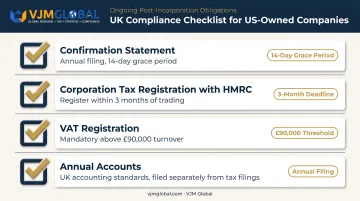
Speed isn't the whole story, though. Several compliance obligations don't map onto anything in the US system:
- Confirmation statement — a mandatory filing at least once every 12 months (with a 14-day grace window) confirming company details are current
- Corporation Tax registration with HMRC — required within three months of starting to trade, including obtaining a Unique Taxpayer Reference
- VAT registration — mandatory once taxable turnover exceeds £90,000 in a rolling 12-month period
- Annual accounts — filed separately from tax returns, using UK accounting standards rather than US GAAP
One helpful detail: UK directors don't need to live in the UK. The company just needs a UK registered office address. That makes remote UK ownership workable for US founders who don't plan to relocate.
Handling all of this without local expertise is where most American founders lose time.
VJM Global has worked with 250+ UK businesses, delivering entity formation through the UK's own regulators and statutory instruments rather than a bolted-on US-style process. That support runs from Companies House and HMRC setup through ongoing filings, so founders can run the business instead of decoding British company law.
Frequently Asked Questions
What is the success rate of startups in the USA?
Research on venture-backed founders puts first-time success at roughly 18%, rising to about 30% for founders with a prior successful exit. Exact rates vary by how “success” is defined.
What percentage of the UK business population are small businesses?
Small and micro businesses make up over 99% of the UK’s active company population—similar to the US, where small firms also dominate the business count.
How long does it take to register a company in the UK compared to the US?
UK online registration through Companies House typically completes within 24 to 48 hours. US incorporation timelines vary by state and can take anywhere from same-day to several weeks.
What is the five-year survival rate for UK startups?
UK five-year survival sits at roughly 38-40%, based on ONS business demography data. Most closures happen within the first four years of trading.
Do US citizens need a visa or UK residency to start a business in the UK?
You can own a UK company and serve as a director from abroad without UK residency. Day-to-day work in the UK may still need a visa—confirm immigration rules before you operate on the ground.
Which UK business sectors are growing fastest for new entrepreneurs?
Property, takeaway/food stalls, and management consultancy led new business formation growth in 2024, with property incorporations up 38% year-on-year.