Introduction
UK businesses expanding into Singapore face a fundamental challenge: the city-state's tax system operates on principles that directly contradict British norms. Total UK-Singapore bilateral trade reached £26.7 billion in the four quarters to Q3 2025, a 19.6% year-on-year increase — with UK outward FDI stock in Singapore at £11.6 billion at the end of 2024.
Meeting your obligations to the Inland Revenue Authority of Singapore (IRAS) — covering filing, payment, and record-keeping — requires understanding a framework built around territorial taxation, zero capital gains tax, and a single-tier dividend system.
The most common pitfall for UK companies is treating Singapore as an overseas extension of HMRC. It isn't. Getting compliance right from day one determines whether Singapore's 17% corporate tax rate works as a competitive advantage — or becomes an administrative liability.
Key Takeaways
- Singapore taxes at a flat 17% on a territorial basis—only Singapore-sourced income is taxable by default
- File Estimated Chargeable Income (ECI) within three months of your financial year-end; annual Form C/C-S is due 30 November
- GST registration is compulsory once taxable turnover exceeds SGD 1 million; the current rate is 9%
- The UK-Singapore Double Taxation Agreement prevents double taxation — but you must actively claim relief using a Certificate of Residence
- Withholding tax applies to certain cross-border payments (dividends, royalties, service fees) and must be filed within 15 days of payment
What Is Singapore Tax Compliance and Why It Matters for UK Businesses
Tax compliance in Singapore means accurately and punctually fulfilling statutory obligations under the Income Tax Act, GST Act, and related regulations administered by IRAS. It goes beyond timely payment: proper income classification, timely documentation, and understanding how Singapore's territorial tax basis differs from the UK's worldwide residence approach all form part of the obligation.
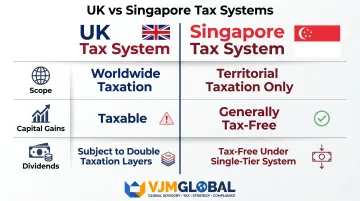
Three structural differences define the divide:
- Only Singapore-sourced income is taxed by default — UK resident companies face worldwide taxation, so the scope is fundamentally narrower
- Asset disposal gains are generally tax-free (limited Section 10L exceptions apply from 2024), unlike the UK's capital gains regime
- Dividends reach shareholders tax-free under the single-tier system, removing the layer of double taxation common in many jurisdictions
UK-incorporated companies operating through Singapore subsidiaries, branches, or representative offices face distinct compliance obligations depending on structure. A subsidiary incorporated in Singapore is treated as a separate legal entity; a branch is an extension of the UK parent. This structural choice determines tax residency, treaty access, and filing requirements.
Non-compliance carries real financial consequences. IRAS enforces escalating penalties across key obligations:
- Late or missed corporate tax filings (2+ years): Twice the tax assessed, plus fines up to SGD 10,000
- Late GST registration: 10% of GST due, plus fines up to SGD 10,000
- Serious cases: Prosecution, which moves the matter from an administrative issue to a legal one
For UK businesses unfamiliar with Singapore's regulatory environment, getting the structure and filings right from the outset is far less costly than correcting errors under scrutiny.
Core Singapore Tax Compliance Requirements
Corporate Income Tax (CIT)
Singapore assesses corporate income tax at 17% on a preceding-year basis. The Year of Assessment (YA) corresponds to income earned in the prior financial year. Annual returns are due by 30 November each year, using one of three forms:
| Form Type | Revenue Threshold | Document Submission | Field Count |
|---|---|---|---|
| Form C-S (Lite) | ≤ SGD 200,000 | Not required | 6 essential fields |
| Form C-S | ≤ SGD 5 million | Not required | 18 fields |
| Form C | Any amount | Financial statements and tax computations required | Full form |
Most UK subsidiaries with annual revenue under SGD 5 million qualify for Form C-S, provided income is taxable at 17% only and they're not claiming carry-back losses, group relief, investment allowances, or foreign tax credits.
ECI filing is a separate obligation from the annual return. Companies must submit this income estimate within three months of their financial year-end — even if income is zero. A waiver applies only when two conditions are both met: annual revenue ≤ SGD 5 million and ECI is nil before exemptions.
UK finance teams managing Singapore entities remotely frequently miss this deadline because it doesn't align with the UK tax calendar.
Two tax exemption schemes can significantly reduce effective rates:
Start-Up Tax Exemption (SUTE) — First 3 Years:
- 75% exemption on first SGD 100,000 of chargeable income (SGD 75,000 saved)
- 50% exemption on next SGD 100,000 (SGD 50,000 saved)
- Total maximum exemption: SGD 125,000 per year
Partial Tax Exemption (PTE) — All Companies:
- 75% exemption on first SGD 10,000 (SGD 7,500 saved)
- 50% exemption on next SGD 190,000 (SGD 95,000 saved)
- Total maximum exemption: SGD 102,500 per year
Goods and Services Tax (GST)
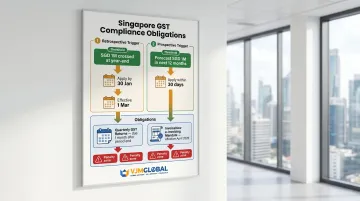
The GST rate increased to 9% effective 1 January 2024. Registration becomes compulsory when taxable turnover exceeds SGD 1 million at calendar year-end or is reasonably expected to exceed that threshold in the next 12 months. Unlike UK VAT, GST registration isn't automatic — businesses must monitor turnover and apply within statutory deadlines.
Key GST compliance points to track:
- Retrospective trigger: Apply by 30 January following the year threshold is crossed; registration effective 1 March
- Prospective trigger: Apply within 30 days of forecasting SGD 1 million turnover in next 12 months
- Quarterly GST returns due one month after accounting period end
- From 1 April 2026, all new voluntary GST registrants must adopt InvoiceNow e-invoicing
The InvoiceNow mandate phases in through 2031 for existing registrants, but any UK business voluntarily registering from April 2026 faces immediate compliance requirements.
Withholding Tax (WHT)
UK businesses with Singapore entities making payments to non-resident companies — including the UK parent — must deduct WHT and remit it to IRAS. This obligation frequently catches UK groups by surprise, particularly for intra-group transactions.
Domestic WHT rates before DTA relief:
- Interest, commissions, loan fees: 15%
- Royalties and IP payments: 10%
- Technical assistance fees: 17% (prevailing CIT rate)
- Management fees: 17%
Payment to IRAS is due by the 15th of the second month following payment to the non-resident. The Singapore entity acts as withholding agent. This responsibility sits with the local entity and cannot be passed back to the UK parent.
Transfer Pricing
Singapore requires related-party transactions to be priced at arm's length. Contemporaneous transfer pricing documentation is mandatory when gross revenue exceeds SGD 10 million (measured at the Singapore entity level, not per transaction). This threshold applies to overall entity revenue, not individual cross-border payments.
Transfer pricing enforcement carries real financial risk:
- 5% surcharge applies to all upward TP adjustments made by IRAS (from YA 2019 onwards)
- Surcharge applies regardless of whether additional tax is owed
- Fines up to SGD 10,000 for documentation failures
- Documentation must be prepared at or before the time transactions are undertaken, and no later than the CIT return filing deadline
UK parent-subsidiary transactions fall under particular scrutiny. Management fees, royalties, and intercompany loans each require documentation covering functional analysis, economic substance, comparable benchmarking, and the rationale for pricing methodology.
The UK-Singapore Double Taxation Agreement
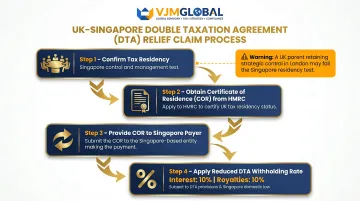
The UK-Singapore DTA allocates taxing rights between jurisdictions to prevent the same income being taxed twice. It covers dividends, interest, royalties, business profits, and employment income. The treaty does not apply automatically—businesses must claim relief proactively.
DTA-reduced WHT rates for UK tax residents:
- Dividends: 0% (Singapore doesn't impose WHT on dividends domestically)
- Interest: 10% (reduced from 15%)
- Royalties: 10%
To access these rates, the UK recipient must provide a Certificate of Residence (COR) issued by HMRC. The Singapore payer then applies the reduced rate instead of the domestic rate.
Claiming that COR, however, depends on meeting Singapore's tax residency test. A Singapore-incorporated subsidiary qualifies as tax resident only if its control and management are exercised in Singapore. IRAS interprets this as where strategic decisions are actually made: board meetings held in Singapore carry weight, but IRAS examines where genuine decision-making authority resides. UK parent companies maintaining strategic control from London may fail the residency test despite Singapore incorporation.
For larger UK groups, there is a separate layer of compliance to consider. From financial years starting 1 January 2025, Singapore implemented the Domestic Top-up Tax (DTT) and Income Inclusion Rule (IIR) for MNE groups with consolidated revenue ≥ €750 million. These groups face a minimum 15% effective tax rate. UK group finance teams must monitor whether Singapore tax incentives reduce the effective rate below 15%, triggering top-up tax obligations.
Common Compliance Mistakes UK Businesses Make in Singapore
Applying UK tax assumptions is the most pervasive error. UK businesses frequently assume Singapore follows worldwide taxation (it doesn't), treat capital gains as taxable (they're generally not), or expect automatic GST registration triggers (registration is threshold-based, requiring active monitoring).
These assumption gaps feed directly into operational failures that are harder to reverse:
- Missing ECI deadlines because UK finance teams track only the 30 November Form C deadline
- Failing to register for GST as turnover crosses SGD 1 million, triggering backdated registration and penalties
- Not maintaining transfer pricing documentation before the filing deadline, despite IRAS having authority to request it at any time
- Treating the Singapore entity as transparent for UK tax purposes while claiming separate legal entity status for liability protection
Record-keeping failures derail IRAS audits. Singapore requires business records retained for at least 5 years from the relevant Year of Assessment—invoices, receipts, contracts, bank statements, and contemporaneous TP documentation.
UK businesses that centralise all records in London without maintaining Singapore-accessible copies often fail audit requirements. IRAS expects records to be available for inspection in Singapore promptly upon request.
Practical Steps to Stay Tax Compliant in Singapore
Map the Compliance Calendar to Internal Ownership
| Deadline | Obligation | Internal Owner |
|---|---|---|
| 3 months post FYE | ECI filing | Singapore finance lead or outsourced provider |
| 30 November annually | Form C/C-S filing | Tax compliance team |
| Monthly + 15 days | WHT remittance (2nd month after payment) | Accounts payable / treasury |
| Quarterly + 1 month | GST return filing | GST compliance specialist |
| Before filing deadline | TP documentation preparation | International tax team |
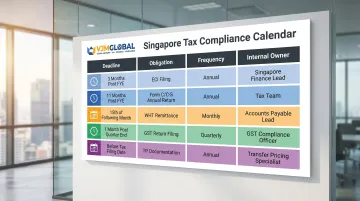
Assign each deadline to a named person or function. UK businesses managing Singapore entities remotely cannot rely on centralised UK finance teams unfamiliar with IRAS cycles. Local ownership — whether in-house or outsourced — is non-negotiable.
Engage Local Compliance Expertise
IRAS implements OECD BEPS updates including Pillar 2, issues revised transfer pricing guidelines (8th edition released November 2025), and adjusts GST compliance requirements. A local tax compliance partner tracks these changes, manages ECI and annual filings, and represents the business in IRAS queries or audits.
UK businesses without dedicated Singapore tax functions often work with cross-border compliance advisers who coordinate local in-market specialists. VJM Global, for example, supports UK businesses navigating international compliance obligations — helping finance teams identify the right local resources, structure outsourced models, and maintain oversight of multi-jurisdiction filing calendars. With 250+ UK businesses served and 30+ years of cross-border accounting experience, the firm understands the coordination challenges UK groups face when managing overseas entities remotely.
Use the Voluntary Disclosure Programme Proactively
IRAS operates a Voluntary Disclosure Programme offering 0% penalties for errors disclosed within the one-year grace period. After the grace period, a flat 5% surcharge applies per year. UK businesses discovering past filing errors should treat voluntary disclosure as priority action before an IRAS audit uncovers the issue—the penalty gap between 0% and potential prosecution makes voluntary disclosure the obvious choice.
Frequently Asked Questions
What is tax compliance in Singapore?
Singapore tax compliance refers to fulfilling statutory obligations under IRAS administration, including timely filing of corporate income tax returns, GST returns, and payment of assessed tax. Businesses must maintain accurate records for at least five years from the relevant Year of Assessment.
What are the tax compliance requirements in Singapore?
Primary obligations include:
- ECI filing within three months of financial year-end
- Annual corporate tax return by 30 November
- Quarterly GST filing if registered
- WHT deduction and remittance on qualifying payments to non-residents within prescribed deadlines
- Transfer pricing documentation for related-party transactions when revenue exceeds SGD 10 million
Does Singapore have a Double Taxation Agreement with the UK?
Yes, the UK-Singapore DTA is in force. It covers dividends, interest, royalties, and business profits to prevent double taxation. Relief must be actively claimed by submitting a Certificate of Residence issued by HMRC.
What is the corporate tax rate in Singapore?
The rate is 17% flat, assessed on a preceding-year basis. Singapore has no capital gains tax as a general rule. Effective rates can be lower through the Start-Up Tax Exemption (first three years) or Partial Tax Exemption schemes, which exempt portions of chargeable income.
When does a UK business need to register for GST in Singapore?
GST registration is compulsory when taxable turnover exceeds SGD 1 million at calendar year-end or is reasonably expected to exceed that threshold in the next 12 months. Voluntary registration may be worth considering to recover input tax.
What are the penalties for non-compliance with Singapore tax laws?
IRAS penalties include:
- Late or missing CIT returns (two or more years): twice the tax assessed plus fines up to SGD 5,000
- Transfer pricing adjustments: 5% surcharge on underpaid tax
- Failure to register for GST: financial penalties on taxable turnover
The Voluntary Disclosure Programme can reduce penalties to 0% for self-reported errors before an audit begins.