There's a catch, though. UK LLPs get marketed online as "tax-free for non-residents," and that pitch is only half true. Whether HMRC leaves your profit alone depends on where your income is sourced and whether your setup accidentally creates a UK permanent establishment. Get that wrong, and a structure built to save tax can generate an unexpected UK tax bill instead.
This guide covers how UK LLPs are actually taxed, what counts as UK-source income, your filing obligations as a non-resident member, and how the UAE's own corporate tax regime and the UK-UAE tax treaty fit into the picture.
Key Takeaways
- UK LLPs are tax-transparent — HMRC taxes members individually, not the entity itself
- Non-residents owe UK tax only on UK-source profit, not worldwide income
- UK-based decision-making, staff, or servers can convert "offshore" profit into taxable UK profit
- UK Self Assessment filing is still required for non-resident members, even when no tax is due
- UAE corporate tax and free zone rules apply independently of how the UK treats the LLP
What Is a UK LLP and How Does UK Tax Law Treat It?
A UK LLP is a body corporate in the eyes of company law. It's registered at Companies House and gives its members limited liability, much like a private company. For tax purposes, though, it's treated completely differently.
Tax Transparency: Who Actually Pays
HMRC doesn't tax the LLP itself. Instead, each member is charged Income Tax or Corporation Tax on their own share of the profit, as if they'd earned it directly. This has a direct consequence for residence status:
- UK-resident members pay tax on their worldwide share of partnership profit
- Non-UK-resident members pay tax only on their share of UK-source income
There's a wrinkle UAE-based structuring often misses. HMRC will independently decide whether a foreign entity linked to the LLP should be classed as a partnership or a company for UK tax purposes, regardless of how that entity is treated back home. A UAE holding vehicle that's transparent under UAE rules doesn't automatically get the same treatment in a UK filing.
The Salaried-Member Test
Most LLP members are treated as self-employed. But HMRC runs an annual three-part test to check whether a member genuinely carries business risk, rather than acting as a disguised employee:
- Disguised salary — at least 80% of expected pay is fixed or profit-independent
- No significant influence — the member has little real say over LLP decisions
- Low capital contribution — capital put in is less than 25% of expected fixed pay
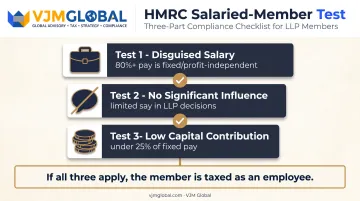
If all three apply, that member is taxed as an employee, not a partner.
UAE owners need both pieces of this picture. Transparency can keep corporation tax off the LLP itself, but only if members stay outside the salaried-member rules—get that wrong and HMRC taxes the member as an employee.
Structured correctly, a UK LLP still offers a globally recognised legal framework, remote banking and contracting, and a way to trade internationally without UK corporation tax at entity level.
UK Tax Rules for Non-Resident LLP Members
HMRC's HS380 helpsheet sets the baseline rule: what a partnership reports depends on where it's managed and whether its members are UK resident, non-resident, or a mix of both. Every other filing obligation flows from this.
Source-Based Taxation: What Counts as "UK Profit"
If every member of the LLP is non-resident, only UK-derived trading profit and UK-source investment income is taxable in the UK, according to HMRC's HS380 guidance. Everything else stays outside the UK tax net.
The problem is that "UK-derived" is broader than most people assume. Several things can pull otherwise offshore profit back into UK-source territory:
- UK-based decision-makers directing the trade
- Contracts habitually concluded in the UK, even if performed elsewhere
- UK staff or office space carrying out core business functions
- UK servers or fulfilment infrastructure for e-commerce or SaaS models
Having customers who pay in GBP or a UK bank account doesn't, by itself, create UK-source profit. Where the actual work and decisions happen is what counts.
Profit Allocation for Mixed-Residency Partnerships
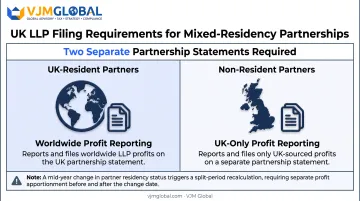
When an LLP has both UK and non-resident partners, extra filing rules apply. If the partnership is managed in the UK, it must file two separate Partnership Statements: one showing worldwide profit for UK-resident partners, and one showing UK-only profit for non-resident partners.
There's also a mid-year twist. If a partner becomes or stops being UK resident partway through the tax year, the partnership must treat them as if they'd left and rejoined, recalculating their profit allocation across the two residence periods separately.
Mixed-Member and Anti-Avoidance Rules
LLPs combining individual and corporate members face an added layer of scrutiny. UK anti-avoidance rules can reallocate profit shares from a corporate member back to an individual, which creates unexpected UK tax exposure for structures where a UAE company sits alongside individual partners.
A June 2025 First-tier Tribunal decision shows how far HMRC will push this. In Mark Wallace v HMRC, a Swiss-resident, non-UK-resident partner in three UK film LLPs argued his profit share shouldn't be fully taxable in the UK. The tribunal disagreed.
Because the underlying LLP trades were carried on wholly in the UK, his entire profit share — totalling over £447,000 across several tax years — was taxed accordingly. Being non-resident didn't protect him once the trade itself was found to be UK-based.
Do Non-Resident LLP Members Need to File a UK Tax Return?
Yes, in almost every case. Non-resident individual LLP members must register for UK Self Assessment and file a return, even if it turns out no UK tax is actually due. HMRC needs the UK-source income reported and residence status self-declared; it won't take your word for it later.
This filing obligation sits at two separate levels:
- The LLP itself must file an annual Partnership Tax Return (SA800), alongside Companies House annual accounts and a confirmation statement, regardless of where its members live
- Each member reports their own share of UK profit on their personal or corporate return
Corporate non-resident members are only liable on UK-source profit as a starting point. But if that corporate member operates through a UK permanent establishment, overseas profits attributable to that PE become reportable too, not just the UK-sourced share. That distinction catches out UAE corporate members who assume "non-resident" automatically means "limited exposure."
Common Risks: Permanent Establishment, Branch and Agency Exposure
Permanent establishment (PE) risk arises when UK activity creates a fixed place of business, or a dependent agent that habitually concludes contracts on the non-resident's behalf. Treaty PE tests sit alongside UK domestic rules; either can pull trading profits into the UK tax net.
The branch or agency rule under ITTOIA 2005 s.849 is a calculation mechanism, not a binary test. It applies when a non-resident partner's UK-based activity amounts to carrying on trade through a UK branch or agent. Once it does, profit is calculated as though the partner were UK-based.
Avoid the "brass-plate" trap. A UK registered address with no genuine offshore substance behind it does not hold up under scrutiny. HMRC (and often the tax authority in the member's home jurisdiction) looks at facts over form when deciding where a trade is actually carried on. A clean Companies House filing means nothing if real decisions are made offshore and the UK presence exists on paper only.
To evidence genuine offshore substance, UAE business owners should keep:
- Contracts signed and negotiated outside the UK
- Employment records showing where staff are actually based
- Lease agreements for offshore premises
- Calendars or travel records showing where key decisions are made
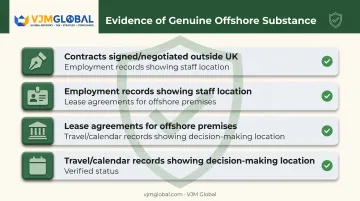
Documentation like this is your defence if HMRC ever questions where the trade genuinely sits.
Key Tax Considerations for UAE Businesses Specifically
The UAE has no personal income tax and a 9% corporate tax above a AED 375,000 threshold, introduced in 2023. That domestic simplicity can create a false sense of security.
UK transparency treatment is not automatically mirrored back home. UAE-resident members need to assess separately how their own jurisdiction treats an LLP profit share, rather than assuming it flows through untouched.
The UK-UAE Double Taxation Convention primarily addresses corporate and withholding tax relief. Article 7 of the treaty generally keeps business profits taxable only in the residence state unless they are attributable to a UK permanent establishment.
Given the UAE's low domestic tax burden, there is usually limited relief needed on UK-source income. Confirm that case by case rather than assuming it.
For UAE-based members, three issues come up often:
- Free zone entities must check UAE corporate tax "qualifying income" rules—UK LLP profits paid to a free zone designated member can affect qualifying-income status and the applicable rate
- UK LLPs with Middle East members face growing scrutiny when they look like brass-plate vehicles without real activity
- Operational substance, wherever it sits, must support the tax position the structure claims
This cuts across two tax systems at once, so use advisers who know both UK partnership tax and UAE corporate tax. VJM Global's cross-border teams support entity formation and multi-jurisdiction tax compliance for UAE businesses expanding into the UK, and for UK businesses moving the other way.
Setting Up and Staying Compliant: Practical Steps
Getting the structure right on paper is only half the job. Staying compliant year after year is where most of the real risk sits.
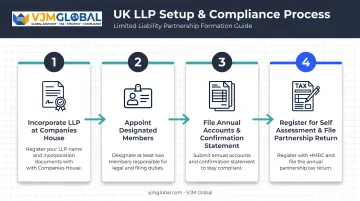
The core compliance calendar looks like this:
- Incorporate the LLP at Companies House with at least two members
- Appoint designated members responsible for filings and correspondence
- File annual accounts and a confirmation statement every year
- Register for Self Assessment (each individual member) and file the Partnership Tax Return
Depending on your activity, additional layers can apply:
- VAT registration once turnover crosses UK thresholds
- Transfer pricing documentation for transactions between the LLP and related UAE entities
- Economic substance rules, especially where UAE free zone entities sit in the structure
UK filings and UAE group rules rarely sit with one in-house team. A single adviser that handles UK LLP formation plus ongoing UK and UAE tax and accounting compliance reduces gaps between the two calendars. VJM Global provides that combined support for businesses expanding between the UK and UAE.
Frequently Asked Questions
How are LLPs taxed in the UK?
UK LLPs are tax-transparent: profits aren't taxed at the entity level. Instead, they're allocated to individual members and taxed according to each member's residence status and profit share.
Do non-residents need to file a UK tax return?
Generally, yes. Non-resident LLP members must register for and file UK Self Assessment to report their UK-source profit share, even when no UK tax ends up being payable.
Is there a double tax treaty between the UK and UAE that covers LLP profits?
A UK-UAE tax treaty exists, but it primarily addresses corporate and withholding tax matters rather than LLP profit shares specifically. UAE members should get jurisdiction-specific advice on how their profit share is treated.
Can a UAE resident or company be a designated member of a UK LLP?
Yes. UK LLPs allow non-resident individuals and companies as members with no restriction, though many structures also use a UK-based member or agent for administrative correspondence.
What triggers UK permanent establishment risk for a non-resident LLP?
PE risk arises when UK-based staff, offices, or agents habitually conclude contracts or manage the business day-to-day, which shifts profit into UK-source taxation.
Does a UK LLP need a registered UK office address?
Yes, every UK LLP must maintain a registered office address in the UK for Companies House correspondence. This alone, however, doesn't establish UK tax residence of the underlying trade.