This guide is written for UAE business owners and entrepreneurs who have already set up a UK LLP, or are weighing one up, for international trade. Cross-border structuring like this is exactly where firms with combined UK and UAE tax expertise, such as VJM Global, typically get involved.
Here's the problem: UK LLPs get marketed heavily as a "no UK tax" solution. That pitch is only half true, and the operational detail is poorly understood by many UAE business owners. The gap between what people expect and what HMRC actually enforces has landed more than one UAE-linked LLP in a costly dispute.
This article explains how UK LLP taxation actually works, what decides whether a UAE-based partner owes any UK tax, and when the LLP structure fits and when it doesn't.
TL;DR
- LLPs are tax-transparent: the entity files a return but pays no tax; profit passes straight to partners
- UAE-resident partners owe UK tax only on UK-source income or where a UK permanent establishment exists
- The UK-UAE Double Tax Treaty (2016) helps prevent double taxation, but the LLP can't claim treaty relief
- SA800 and Companies House filings are mandatory every year, whether or not tax is due
- Misjudging where the trade is "carried on" is the biggest tax risk for UAE partners
What Is a UK LLP and How Is It Taxed?
A UK LLP is a body corporate, registered at Companies House, with its own legal personality separate from its members. For company law purposes it looks like a company. For tax purposes, HMRC treats it as a partnership.
That distinction drives everything else in this guide.
The Tax Transparency Mechanism
The LLP doesn't pay corporation tax on its profits. Instead, each member's share is taxed as though that member earned it directly, based on their own tax status. A UAE-resident individual member and a UK-resident individual member in the same LLP could end up with completely different UK tax bills on identical profit shares.
The design goal is straightforward: one layer of tax, applied at partner level, rather than two.
LLP vs. UK Ltd Company
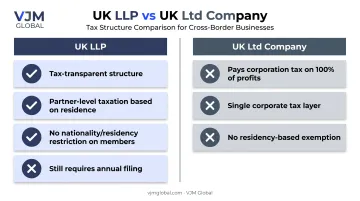
A UK Ltd company pays corporation tax on 100% of its profits, regardless of where its shareholders live. An LLP's tax exposure depends entirely on each partner's residence status and where the underlying income is sourced.
There's no restriction on who can be a member. UAE individuals and UAE-registered companies can both sit as designated or ordinary members with no nationality or residency condition attached.
Registration and annual filing with Companies House and HMRC still apply either way, whether or not any UK tax ends up being owed.
Why UAE Businesses Set Up UK LLPs
Consulting, e-commerce, trading and holding structures operating from the UAE often favour a UK LLP for three practical reasons:
- UK brand credibility when pitching to UK or EU clients
- Easier banking access: a UK-registered entity often opens doors that a purely offshore one doesn't
- Limited liability combined with partnership-style tax flexibility
Compare that to a full UK Ltd subsidiary, which pays UK corporation tax on 100% of profits no matter where the business actually trades from. For a UAE business genuinely operating and managing decisions from Dubai or Abu Dhabi, that is usually a heavier burden than an LLP faces when substance stays outside the UK.
Here's where it goes wrong. Many UAE owners assume the LLP structure automatically shields all profit from UK tax, full stop. It doesn't work that way.
If there's genuine UK-based management, UK contracts, or UK staff, the entire profit share can fall into the UK tax net—not just the slice that "feels" UK-related. The structure only delivers the outcome people expect when the operational reality backs it up.
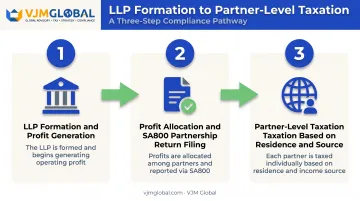
How UK LLP Profits Are Taxed (Step-by-Step)
Profit generated by the LLP flows straight through to each partner's own tax return. It's never taxed at the LLP level first.
What ultimately decides a UAE partner's UK tax bill comes down to two questions: is the income UK-source, and does a UK permanent establishment, branch, or agency exist under domestic rules?
Step 1: LLP Formation and Profit Generation
The LLP is registered at Companies House with a minimum of two members. A partnership agreement sets out how profit gets shared between them. Trading profit accrues from the underlying business activity over the accounting period.
Step 2: Profit Allocation and the Annual Partnership Return
Once the accounting period closes, the designated member(s) must file an SA800 partnership return with HMRC, showing exactly how profit was allocated among members. This filing itself creates no tax liability for the LLP. It's an information return, not a tax bill.
Step 3: Partner-Level Taxation Based on Residence and Source
Each partner then reports their own profit share on their individual return. A UAE-resident partner owes UK income tax only if:
- The profit is UK-source, or
- A UK permanent establishment, branch, or agency exists
Otherwise, the profit may be taxed only under UAE or home-country rules. This residence-and-source test is where most confusion and disputes arise for non-resident partners.
Key Factors That Determine Your UK Tax Exposure
Five variables decide where a UAE partner actually stands.
- Residence and domicile status — non-UK residents are taxed in the UK only on UK-source income, not worldwide income
- Source of trading income — where contracts are concluded, where management decisions are made, and where staff, customers, and servers sit all affect UK-source treatment
- Permanent establishment or "branch or agency" risk — genuine UK presence or decision-making authority can pull the full profit share into UK tax, even for non-resident partners
- VAT registration threshold — mandatory above £90,000 from 1 April 2024. Only UK-source taxable turnover counts, so non-UK LLP income generally does not trigger registration
- Mixed-member and anti-avoidance rules — where an LLP mixes corporate and individual members with certain profit-allocation features, HMRC can reallocate profits and create UK tax exposure that wasn't originally intended
The Treaty's Practical Limits
The UK-UAE Double Tax Treaty (2016) is designed to prevent the same income being taxed twice. But there's a catch specific to LLPs: because the LLP is tax-transparent, it generally can't claim treaty benefits itself.
Individual partners must assert their own treaty position instead. That creates real mismatches, particularly where UK and UAE domestic law apply different thresholds for what counts as a permanent establishment or an "associated enterprise." A UAE partner assuming the treaty automatically covers them can be in for a surprise.
Common Mistakes UAE Businesses Make with UK LLPs
The single biggest misconception: a UK LLP with UAE partners doesn't mean tax-free income anywhere. Partners remain liable for tax in their own home jurisdiction under that jurisdiction's own rules, separate from anything owed in the UK.
The "Brass-Plate" Trap
Relying purely on a UK registered address, with no genuine non-UK operations behind it, is a common and costly mistake. In Mark Wallace v HMRC (2025), the First-tier Tribunal found that a non-resident partner's UK film LLPs carried on their trade wholly in the UK.
The result: he was taxed on his full share of the profits, not a UK-apportioned slice. The case was not about UAE partners specifically, but the lesson applies directly: HMRC looks at where the business genuinely operates, not where the paperwork says it is registered.
The Compliance Trap
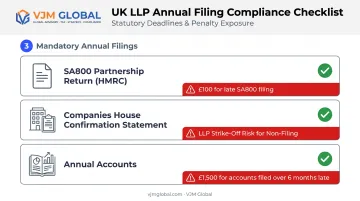
Even when zero UK tax is owed by any partner, designated members must still file:
- The SA800 partnership return with HMRC every year
- A Companies House confirmation statement
- Annual accounts
Miss these and penalties apply automatically, starting from £100 for a return one day late and rising with each missed threshold. Companies House accounts filed more than six months late attract a £1,500 penalty for a private LLP.
Have the structure, treaty position, and filing obligations reviewed by a firm with combined UK and UAE tax expertise before and after you form a UK LLP. VJM Global works across both markets and can flag exposure before HMRC does.
Frequently Asked Questions
How is an LLP taxed in the UK?
The LLP itself pays no income tax or corporation tax. Each partner is taxed individually on their profit share, based on their own residence status and where the income is sourced.
Should I pay tax in the UK for salary earned in the UAE?
Generally, no — UAE-based salary is not taxed in the UK unless you're UK tax resident or perform duties in the UK. Note that "salaried members" of a UK LLP doing UK-based work can be taxed differently under employment-style rules.
Is there a tax treaty between the UK and the UAE?
Yes, the UK-UAE Double Tax Treaty has been in force since 2016 to prevent double taxation. Because LLPs are tax-transparent, individual partners rely on the treaty, not the LLP itself.
Do UK LLPs need to file a tax return even if no UK tax is due?
Yes. The designated member must file an annual SA800 partnership return with HMRC and submit accounts to Companies House regardless of whether any partner owes UK tax.
Can a UAE company or individual be a member of a UK LLP?
Yes. There's no restriction on nationality or residence, so UAE individuals and UAE-registered companies can become designated or ordinary members.
Does a UK LLP need to register for VAT?
Only once UK-source taxable turnover exceeds £90,000 within a 12-month period. Non-UK source LLP earnings generally don't count toward that threshold.