For US fund sponsors and family offices, that growth raises a practical question: how does a Singapore corporate-fund hybrid fit into US tax and reporting obligations? Many struggle to reconcile a foreign entity that's technically a company but behaves like a fund.
This guide breaks down VCC fundamentals, the benefits that matter most to US sponsors, setup costs, and how a VCC stacks up against structures you already know.
Key Takeaways
- VCCs are fund-only entities jointly regulated by ACRA and MAS—not vehicles for operating businesses.
- Standalone or umbrella structures are available; umbrella sub-funds have statutorily segregated assets and liabilities.
- US sponsors use VCCs for master-feeder funds, family office consolidation, and APAC market entry.
- Setup requires a Singapore-resident director, company secretary, auditor, and a licensed or exempt fund manager.
What Is a Variable Capital Company (VCC)?
A VCC is a corporate structure created under the Variable Capital Companies Act 2018. The Accounting and Corporate Regulatory Authority (ACRA) handles registration and corporate administration, while the Monetary Authority of Singapore (MAS) regulates the appointed fund manager and oversees anti-money laundering compliance. ACRA is explicit that the vehicle exists mainly for investment funds, not operating businesses.
Here's what makes it unusual: legally, a VCC is a company. Operationally, it behaves like a pooled investment fund. Shares are issued and redeemed based on net asset value, similar to units in a mutual fund, rather than under the fixed-share-capital rules of a typical Singapore Companies Act entity.
Standalone vs Umbrella VCC Structures
Sponsors choose one of two formats:
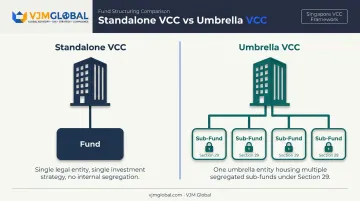
- Standalone VCC: a single fund housed in one legal entity, suited to sponsors running one strategy
- Umbrella VCC: one legal entity with multiple registered sub-funds under a shared corporate shell
Sub-funds are not separate legal persons. Section 29 of the Act statutorily segregates their assets and liabilities, so a claim against one sub-fund cannot reach another's assets. Each sub-fund still files its own annual accounts and returns.
Who Typically Uses a VCC?
The structure attracts a specific set of users:
- Licensed and MAS-exempt fund managers launching new strategies
- Single and multi-family offices consolidating wealth
- Private equity and venture capital sponsors
- Hedge fund managers seeking an Asia-based vehicle
- Wealth management platforms building multi-strategy product suites
Key Features and Benefits of a Singapore VCC
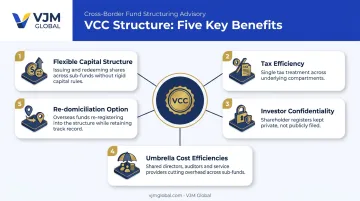
The VCC's appeal comes down to five practical advantages over a standard Singapore company.
Flexible capital structure. Shares can be issued and redeemed at NAV without shareholder approval for each transaction. Unlike ordinary companies, which may only distribute profits, a VCC can pay dividends out of capital. That flexibility matters for funds managing redemptions during drawdown periods.
Tax efficiency. Qualifying funds can access exemption schemes under Sections 13O and 13U of the Income Tax Act, subject to MAS approval and prescribed conditions:
| Scheme | Minimum fund size | Investment professionals | Annual local spend |
|---|---|---|---|
| Section 13O | S$5 million | At least 2 | From S$200,000 |
| Section 13U | S$50 million | At least 3 | From S$200,000 |
Singapore also maintains double tax agreements and exchange-of-information arrangements with roughly 100 jurisdictions, according to IRAS. That network widens the treaty relief available to a well-structured fund.
Investor confidentiality. A VCC's shareholder register and financial statements aren't published on ACRA's portal, unlike a standard private limited company's filings.
Umbrella cost efficiencies. Sub-funds can share directors, auditors, and fund managers, spreading compliance overhead across multiple strategies instead of duplicating it.
Re-domiciliation option. Foreign vehicles with a similar cellular structure, such as a Cayman segregated portfolio company or a BVI protected cell company, can transfer registration to ACRA and continue as a Singapore VCC if they meet the qualifying conditions.
Separate from those structural benefits, setup support has shifted. The VCC Grant Scheme co-funded 30% of qualifying setup expenses (capped at S$30,000 per application) for first-time fund managers, but closed after its extended window from January 2023 through January 2025. Check current MAS guidance before budgeting for a similar subsidy.
Why US Businesses Are Turning to Singapore VCCs
Singapore's regulatory stability and its position as a gateway to APAC capital markets are the headline draws. But the mechanics matter more once you're actually structuring a deal.
Master-feeder access. A common pattern has US tax-resident investors accessing a VCC master fund through a US-domiciled feeder. Both entities typically make a US "check-the-box" election on Form 8832 to be treated as tax-transparent for federal income tax purposes. That election generally takes effect no more than 75 days before filing and no later than 12 months after.
Family office consolidation. US-linked family offices increasingly use umbrella VCCs to house multiple asset classes under segregated sub-funds, gaining confidentiality and structural cleanliness that a patchwork of LLCs often can't match.
VCC vs a self-managed US vehicle. A VCC demands real local substance: a Singapore-resident director, a licensed or exempt fund manager, a resident company secretary. A Delaware LLC or LP doesn't require any of that. In exchange, the VCC delivers umbrella cost-sharing and direct Asia investor access that a purely US structure typically can't replicate.
Compliance flags to raise early:
- FATCA reporting obligations for Singapore financial institutions with US reportable accounts
- CRS due diligence and annual filing requirements
- PFIC analysis under IRS rules if the VCC is classified as a foreign corporation for US tax purposes, potentially triggering Form 8621 obligations
These flags aren't deal-breakers. Raise them early and bring in advisors on both sides before you commit.
Cross-border firms with a genuine presence in both markets, like VJM Global, work through these dual-jurisdiction questions with US clients before a structure gets locked in. They coordinate Singapore-side entity mechanics with the US tax analysis that determines how the vehicle gets treated back home.
Setting Up a VCC in Singapore: Requirements, Process and Costs
Core Requirements
Before filing anything, you need these pieces in place:
- At least one director ordinarily resident in Singapore
- A resident company secretary, appointed within six months of incorporation
- An auditor, appointed within three months (VCCs don't qualify for the small-company audit exemption)
- A registered office accessible during normal business hours
- A MAS-licensed, registered, or statutorily exempt fund manager
The Incorporation Process
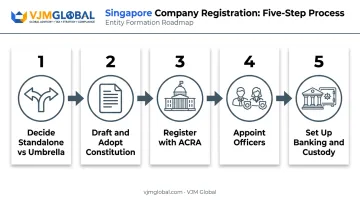
- Decide standalone vs umbrella based on how many strategies you're launching.
- Draft and adopt a constitution covering share classes, sub-fund segregation, and redemption mechanics.
- Register with ACRA, submitting officer details, fund manager consent, and financial year end.
- Appoint officers (director, secretary, auditor) within statutory deadlines.
- Set up banking and custody arrangements once the entity is live.
Cost and Timeline
VCC setup costs scale with structure complexity, so there is no single published price. Typical line items include:
- Legal and tax advisory fees
- Fund administration
- Company secretarial and auditor fees
- Regulatory compliance and AML/CFT setup
- Sub-fund-specific accounting (for umbrella structures)
A VCC still costs more upfront than a simple LLC or LP. Most of that gap comes from licensing and fund manager requirements a plain company structure does not carry.
On timing, TMF Group reports a range of 14 days for the simplest structure to 60 days for full ACRA approval, depending on how quickly officers and fund manager documentation come together.
VJM Global's cross-border team helps US clients coordinate with Singapore-licensed fund managers, track ACRA filing requirements, and align US tax and reporting workstreams. That keeps Singapore formation and US compliance on one timeline.
VCC vs Other Fund Structures
| Feature | VCC | Singapore Pte Ltd | SPV | US LLC/LP |
|---|---|---|---|---|
| Purpose | Collective investment schemes | General business | Single transaction/asset isolation | Fund or general business |
| Dividends | From capital or profits | Profits only | N/A | Flexible, per operating agreement |
| Public disclosure | Not published | Financials and shareholders public | Varies | State-dependent |
| Local substance | Resident director, licensed manager | Resident director | Varies | State-specific, generally lighter |
For US sponsors, three tradeoffs matter most: distribution flexibility, disclosure, and local substance.
Versus a Singapore Pte Ltd, the edge is flexibility and privacy. A VCC can pay dividends from capital and keeps its shareholder register off ACRA's public portal; a private limited company can only distribute profits and typically discloses more.
An SPV is a general-purpose, risk-isolation vehicle, often built for a single transaction or asset. A VCC is purpose-built for pooled investment, with a governance framework SPVs don't carry.
Against a US LLC or LP, the tradeoff is substance versus reach. The VCC brings fixed Singapore requirements (resident director, local fund manager, and registered office) that a Delaware entity skips entirely. What you get in return is credibility with Asian institutional investors and umbrella-level cost sharing that most US fund vehicles simply weren't built to offer.
Frequently Asked Questions
What is a Variable Capital Company (VCC) in Singapore?
A VCC is a fund-specific corporate structure jointly regulated by ACRA and MAS. It can operate as a standalone fund or as an umbrella entity with multiple legally segregated sub-funds.
How much does it cost to set up a Variable Capital Company (VCC) in Singapore?
Costs cover incorporation, licensing, and ongoing compliance, including legal, audit, and fund administration fees. Pricing varies significantly by structure complexity—request a quote based on your planned setup.
Is a Variable Capital Company (VCC) in Singapore considered a hedge fund?
No. A VCC is a flexible legal wrapper usable by many fund types, including hedge funds, private equity, venture capital, and real estate funds. The fund strategy inside the wrapper, not the wrapper itself, determines the classification.
Can US citizens or companies own or invest in a Singapore VCC?
Yes, typically through a feeder fund or direct investment structure. US persons should confirm the applicable tax elections and reporting obligations, such as check-the-box filings, before investing.
How is a Singapore VCC taxed for US persons and investors?
The VCC itself may qualify for Singapore tax exemptions under Sections 13O or 13U. Separately, US investors face federal tax obligations, including possible check-the-box elections and PFIC rules. Get professional advice before you invest.
Can a VCC be used by a single-family office or single investor?
Yes. A standalone VCC works well as a single-investor vehicle, making it a practical option for single-family office structures that don't need multiple sub-funds.