Introduction
Dubai's reputation as a low-tax jurisdiction attracts Singapore businesses seeking trade expansion and Middle East market access. However, since 1 January 2018, the UAE has enforced a 5% Value Added Tax (VAT) administered by the Federal Tax Authority (FTA), and misunderstanding its scope can trigger costly compliance failures for foreign businesses.
Singapore companies selling into the UAE face distinct obligations. Non-resident businesses making B2C sales must register for UAE VAT from their very first transaction—regardless of revenue thresholds. Misreading this requirement has resulted in penalties reaching AED 10,000 for late registration, plus monthly surcharges on unpaid tax.
This guide covers UAE VAT fundamentals for Singapore businesses: the 5% standard rate, registration thresholds, taxable versus exempt supplies, the reverse charge mechanism for B2B transactions, filing deadlines, and penalties. With bilateral trade between Singapore and the UAE reaching SGD 27.94 billion in 2025, getting these rules right directly protects your margins and limits regulatory exposure.
TLDR: Key Takeaways for Singapore Businesses
- UAE VAT is 5%, introduced 1 January 2018 and administered by the Federal Tax Authority
- Non-resident Singapore businesses must register for VAT from their first B2C sale in the UAE
- Resident businesses register once annual taxable supplies exceed AED 375,000
- Exports, healthcare, education, and crude oil are zero-rated; financial services and residential rentals are VAT-exempt
- B2B sales can use the reverse charge mechanism, shifting VAT liability to the UAE buyer
- Late registration triggers AED 10,000 fines; unpaid VAT incurs 14% annual penalties under updated FTA rules
UAE VAT Basics: What Singapore Business Owners Need to Know First
How UAE VAT Differs from Singapore GST
Unlike Singapore's GST—currently 9% and applied at the point of sale with quarterly filing—the UAE operates a multi-stage VAT system. VAT is collected at each transaction point along the supply chain, with registered businesses recovering input tax on purchases and remitting the net difference to the FTA. Singapore businesses accustomed to GST mechanics will find structural similarities, but key differences exist:
- Rate: UAE VAT is 5% versus Singapore's 9% GST
- Administration: UAE filings are conducted through the Arabic-dominant EmaraTax portal
- Currency: Returns are denominated in AED, not SGD
- Emirate-level detail: VAT returns require identifying the specific Emirate where each customer is located
- Federal scope: VAT applies uniformly across all seven Emirates — invoices and returns must specify the Emirate where your customer is located
VAT Introduction and Revenue Diversification
The UAE introduced VAT on 1 January 2018 under Federal Decree-Law No. 8 of 2017, as part of a GCC-wide framework to diversify federal revenue beyond oil dependence. Singapore businesses that entered the UAE before 2018 sometimes treat VAT as an afterthought — a costly assumption when FTA penalties for late registration start at AED 20,000.
Corporate Tax Co-existence
In June 2023, the UAE introduced a 9% Corporate Tax (CT) on taxable income exceeding AED 375,000 annually. Free Zone entities may qualify for 0% CT on qualifying income under specific conditions. Singapore businesses establishing UAE entities should plan for both VAT and CT obligations—these are separate taxes requiring independent compliance.
Why This Matters: The Singapore-UAE Trade Relationship
Total bilateral merchandise trade between Singapore and the UAE reached SGD 27.94 billion in 2025, with the UAE representing Singapore's largest trading partner in the Middle East and North Africa region. Over 600 Singapore firms currently operate in the UAE, spanning professional services, technology, logistics, and consumer goods sectors. For these businesses, getting VAT compliance right is a direct operational requirement — not a back-office formality.
Who Needs to Register for VAT in the UAE?
Mandatory Registration: UAE-Resident Businesses
UAE-resident businesses—those with a fixed establishment in the UAE, such as a mainland license or Free Zone entity—must register for VAT when:
- Taxable supplies exceed AED 375,000 (approximately SGD 131,000) in the preceding 12 months, or
- Supplies are reasonably expected to exceed AED 375,000 in the next 30 days
Voluntary Registration Option
Businesses may voluntarily register once taxable supplies or taxable expenses reach AED 187,500, allowing earlier input tax recovery.
Critical Rule for Non-Resident Singapore Businesses
Non-resident businesses—those without a UAE fixed establishment—must register from their very first taxable supply if selling B2C (business-to-consumer). There is no revenue threshold. This rule catches many Singapore sellers off guard:
- AED 10,000 in digital marketing services to UAE consumers triggers registration immediately
- AED 50,000 of consulting to a non-VAT-registered UAE startup still requires registration
- A single B2C transaction is enough — there is no minimum threshold for non-residents
The Reverse Charge Exemption
Singapore businesses selling exclusively to UAE VAT-registered business customers (B2B) may avoid registration if the reverse charge mechanism applies. Under this mechanism:
- The Singapore seller does not charge UAE VAT on the invoice
- The UAE buyer self-assesses and pays the VAT
- The Singapore seller must validate the buyer's Tax Registration Number (TRN) via the FTA's EmaraTax portal and mark invoices "reverse charge mechanism applies"
However, if even one B2C sale occurs, the non-resident seller must register.
VAT Registration Process
Once you've confirmed a registration obligation, the process runs through the EmaraTax portal. Required documents include:
- Valid UAE trade license (if applicable)
- Articles of incorporation and authorized signatory documents
- Passport or Emirates ID of authorized signatory
- Bank account confirmation letter
- Proof of customer contracts or invoices
- Turnover declaration
Processing typically takes 20 business days from submission of a complete application. FTA correspondence is primarily in Arabic, and registration errors can trigger late-filing penalties — both good reasons to work with an advisor familiar with the process. VJM Global's cross-border tax team regularly assists Singapore businesses through UAE VAT registration and ongoing compliance.
What's Taxable, Zero-Rated, and Exempt Under UAE VAT
Standard 5% VAT Rate
The 5% rate applies to most goods and services on the UAE mainland:
- Professional services (consulting, accounting, legal advisory)
- Technology products and SaaS subscriptions
- Consumer goods and retail
- Hospitality and tourism services
- Non-life insurance
Singapore businesses selling any of these into the UAE should assume 5% applies unless a specific exemption or zero-rating is confirmed.
Zero-Rated Supplies (0% VAT, Input Tax Recoverable)
Zero-rated supplies carry 0% VAT, but businesses can still recover input tax on related costs:
- Exports outside GCC VAT-implementing states — goods shipped from Singapore to UAE customers may qualify, but place-of-supply rules must be confirmed before assuming zero-rating
- International transportation of passengers and goods
- First supply of newly built residential real estate (within 3 years of completion)
- Crude oil and natural gas
- Qualifying preventive and basic healthcare services
- Qualifying educational services
VAT-Exempt Supplies (No VAT, No Input Tax Recovery)
Exempt supplies carry no VAT, and businesses cannot reclaim VAT on related costs:
- Certain financial services (lending, deposit-taking, equity issuance)
- Resale of residential real estate
- Bare undeveloped land
- Local passenger transport
Businesses dealing in exempt categories face higher cost structures, as input VAT becomes a sunk cost.
Special Free Zone / Designated Zone Rules
Transactions in goods between companies within the same Designated Zone may fall outside standard VAT rules, but services supplied within Free Zones remain subject to normal 5% UAE VAT. Singapore companies often consider Free Zone structures for operational flexibility.
Before structuring operations around a Designated Zone, verify whether your specific goods or services qualify for the exclusion — and whether your counterparty's zone registration status affects the outcome.
How UAE VAT Works in Practice: Calculations and the Reverse Charge Mechanism
Standard VAT Calculation Example
A Singapore consulting firm invoices a UAE mainland customer AED 10,000 for advisory services:
- Base amount: AED 10,000
- VAT at 5%: AED 500
- Total invoice: AED 10,500
If the UAE customer is VAT-registered, they can reclaim the AED 500 as input tax. If the customer is not VAT-registered (e.g., an end consumer or exempt business), they bear the full AED 500 cost.
Reverse Charge Mechanism (RCM) for B2B Transactions
For B2B Singapore-to-UAE service transactions, the reverse charge mechanism works as follows:
- Singapore seller does not charge UAE VAT on the invoice
- Invoice includes the note: "Reverse charge mechanism applies"
- UAE-registered buyer self-assesses 5% VAT and reports it as output tax
- UAE buyer simultaneously claims the same amount back as input tax
- Net effect: Tax-neutral for the UAE buyer; no UAE VAT registration required for the Singapore seller
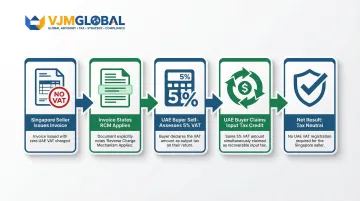
One step Singapore sellers must not skip: validate the buyer's TRN via the EmaraTax portal before applying RCM. If the buyer is not VAT-registered, RCM does not apply — and the Singapore seller must register for UAE VAT and charge it directly.
Input Tax Recovery
Once a UAE buyer self-assesses VAT under RCM, they recover it through the standard input tax mechanism. VAT-registered businesses offset VAT paid on purchases (input tax) against VAT collected from customers (output tax), remitting only the net difference to the FTA.
Note the recent rule change: effective 1 January 2026, the UAE introduced a five-year limit on claiming input VAT refunds. A transitional relief window applies, but it closes 31 December 2026.
Filing Requirements, Deadlines, and Penalties
Filing Schedule
Once registered, Singapore businesses must file on the following schedule:
- Businesses with annual taxable supplies below AED 150 million file quarterly
- Businesses with annual taxable supplies AED 150 million or more file monthly
- Returns (Form VAT201) and payments are due by the 28th day after each tax period ends
Record-Keeping Obligations
Filing obligations don't end with the return — accurate records must be maintained throughout. VAT-registered businesses must retain all tax invoices, credit notes, and supporting financial documents for 5 years (7 years for real estate records).
Each tax invoice must include:
- The words "Tax Invoice"
- Supplier's name, address, and TRN
- Recipient's name, address, and TRN (if VAT-registered)
- Date of issue and date of supply
- Description of goods/services, unit price, quantity, and VAT rate
- Amount payable in AED, total VAT amount, and gross amount payable
Key Penalties (Updated April 2026)
Non-compliance carries real financial consequences — the table below reflects the latest penalty structure for Singapore businesses operating under UAE VAT.
| Violation | Penalty |
|---|---|
| Late VAT registration | AED 10,000 |
| Late VAT return filing | AED 1,000 (first time); AED 2,000 (repeat within 24 months) |
| Late VAT payment | 14% per annum applied monthly (effective 14 April 2026) |
| Incorrect VAT return | AED 500 (effective 14 April 2026) |
| Improper record-keeping | AED 10,000 (first time); AED 20,000 (repeat) |
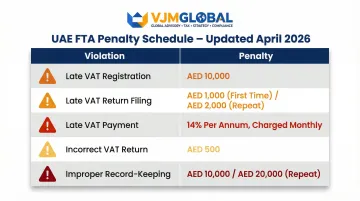
Cabinet Decision No. 129 of 2025 (effective 14 April 2026) reduced late payment penalties to a flat 14% annualized rate and lowered voluntary disclosure penalties.
Key Considerations for Singapore Businesses Expanding to Dubai
Singapore-UAE Free Trade Agreement
The Gulf Cooperation Council-Singapore Free Trade Agreement (GSFTA), which entered into force 1 September 2013, eliminates 99% of customs duties for qualifying Singapore-origin goods, providing significant cost advantages for Singapore exporters. That said, customs duty relief and VAT are distinct: while customs duties may be eliminated under GSFTA, the 5% UAE import VAT still applies to the customs value of goods upon importation into the UAE.
Singapore GST vs UAE VAT: Operational Comparison
Singapore businesses accustomed to 9% GST with quarterly filing will find UAE VAT structurally similar but operationally different:
- Rate: 5% UAE VAT vs. 9% Singapore GST
- Thresholds: UAE AED 375,000 mandatory threshold vs. Singapore SGD 1 million
- Administration: Arabic-language EmaraTax portal vs. English-language IRAS portal
- Currency: AED-denominated returns vs. SGD
- Emirate detail: Returns require specifying customer Emirate
Beyond VAT, the UAE has no personal income tax — unlike Singapore's progressive rates up to 24% — a factor worth considering when planning staff deployments to Dubai.
Proactive Steps Before Engaging in UAE Trade
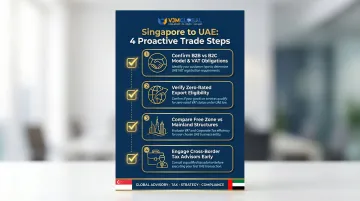
Understanding these differences early prevents costly missteps. Before entering UAE trade, Singapore businesses should:
- Confirm whether your model is B2B or B2C — this determines VAT registration obligations
- Check whether your goods or services qualify as zero-rated exports under UAE rules
- Compare Free Zone vs. mainland structures for both VAT treatment and 9% Corporate Tax efficiency
- Work with cross-border tax advisors before your first transaction, not after
VJM Global has supported businesses across multiple jurisdictions for 30+ years. If your expansion involves cross-border tax obligations — including structures that touch the Indian market — the team can help you map compliance requirements before they become problems.
Frequently Asked Questions
Is there VAT in Dubai and what is the current rate?
Yes, Dubai follows the UAE's federal VAT system introduced 1 January 2018. The standard rate is 5% and applies to most goods and services across all seven Emirates, including Dubai.
What is the VAT registration threshold in the UAE (who must register)?
UAE-resident businesses must register when taxable supplies exceed AED 375,000 annually (voluntary registration available at AED 187,500). Non-resident businesses making B2C sales must register from their first taxable supply with no revenue threshold.
What goods and services are subject to the 5% VAT in the UAE?
Most goods and services attract 5% VAT — retail, professional services, hospitality, and technology among them. Notably, exports, healthcare, and education are zero-rated, while financial services and residential property resales are exempt entirely.
Who is exempt from paying VAT in the UAE?
"Exempt" applies to specific supply categories — not businesses or individuals — covering financial services, residential property resales, and local passenger transport. In B2B cross-border transactions, the reverse charge mechanism shifts VAT liability to the UAE buyer, who self-assesses and pays directly.
What is the new VAT rule in the UAE for 2026?
From 1 January 2026, a five-year time limit applies to claiming input VAT refunds or offsetting excess input VAT against future output VAT. Businesses with older unclaimed balances can still recover them under a transitional relief window open until 31 December 2026.
Is Dubai really tax-free for individuals, and how does VAT fit into that?
There is no personal income tax in the UAE — residents keep their full salaries. However, 5% VAT applies to most goods and services purchased. For Singapore business owners relocating staff or operating in Dubai, this distinction matters: payroll costs won't carry income tax obligations, but VAT compliance on sales transactions still applies.