Introduction
Many UK sole traders and self-employed professionals face a recurring challenge: choosing the right accounting method whilst staying compliant with HMRC — a decision that directly affects how and when they pay tax. With 3.1 million sole proprietorships operating in the UK, representing 56% of all private sector businesses, getting this decision right matters.
As of April 2024, HMRC made cash basis accounting the default method for self-employed individuals and partnerships, making it the automatic starting point for most self-employed tax returns. An estimated 250,000 businesses will move to cash basis under the new rules — whether they realise it or not.
If your business is among them, understanding exactly how the method works — and where it falls short — is essential. This guide covers what cash basis accounting is, how HMRC's current rules apply, who qualifies, how it works in practice, and when it may not suit your business.
Key Takeaways
- Cash basis records income when received and expenses when paid — not when invoiced
- Default method for UK sole traders and partnerships from the 2024/25 tax year onwards
- No turnover limits or entry thresholds apply under the updated rules
- The £500 interest deduction cap is removed and full loss relief is now available
- Limited companies and LLPs cannot use cash basis
- Best suited to freelancers, consultants, and sole traders with no inventory or complex credit arrangements
What Is Cash Basis Accounting in the UK?
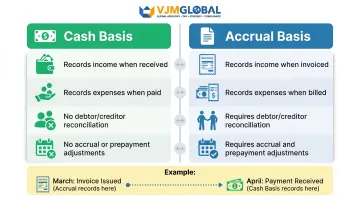
Cash basis accounting is a method of recording business income and expenses based on when money actually changes hands. Income is logged when you receive payment, and expenses are recorded when you pay them — rather than when you invoice customers or receive bills from suppliers.
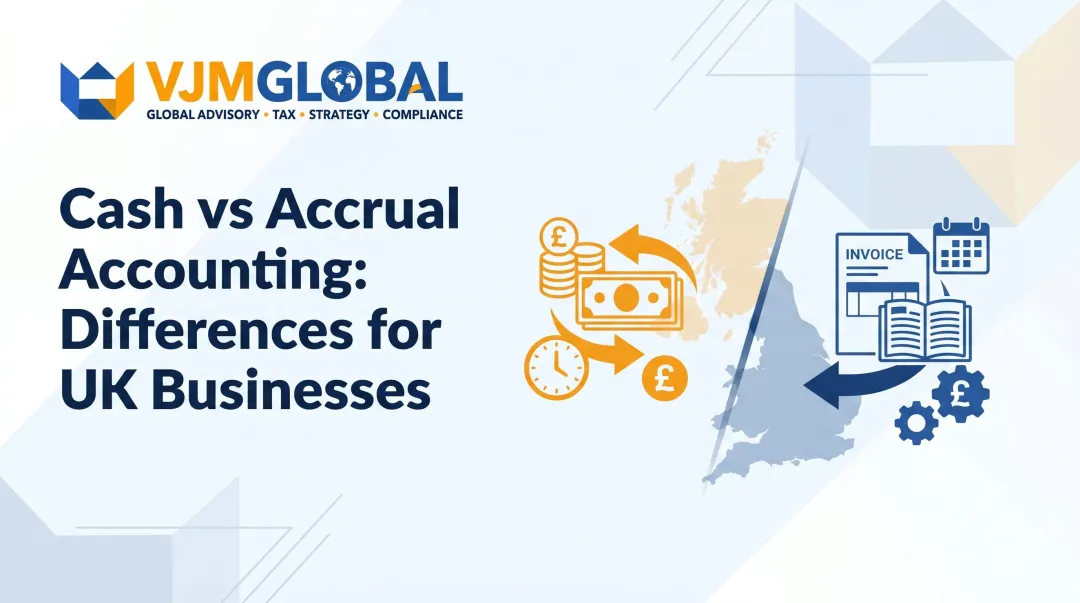
Under traditional (accrual) accounting, transactions are recorded on the invoice or bill date — regardless of when payment actually occurs. That distinction affects both your bookkeeping workload and the timing of your tax liability.
To see the difference in practice: a freelance consultant completes a project in March 2025 and invoices £1,500. The client pays in April 2025.
- Cash basis: Income recorded in April 2025 (2025/26 tax year)
- Accrual basis: Income recorded in March 2025 (2024/25 tax year)
By working on a cash basis, you can skip several year-end accounting tasks that accrual reporting requires:
- Debtor and creditor reconciliations
- Stock valuations
- Accrual adjustments
- Prepayment calculations
How Cash Basis Accounting Works: A Step-by-Step Example
Step 1: Recording Income
Record income only when payment is received, not when you issue an invoice.
Example: A small retailer invoices a customer £700 in March 2025 but receives payment in April 2025. The income is included in the 2025/26 tax year accounts, not 2024/25.
Timing decisions like this also apply to how you recognise receipts more broadly. HMRC requires a uniform approach: if you receive payments via an online platform, you must decide whether to record income when it enters the platform or when it transfers to your bank account. Whichever method you choose, apply it consistently across all tax returns.
Step 2: Recording Expenses
Record expenses only when payment is made.
Most capital equipment (excluding land, buildings, and cars) can be treated as a straightforward expense under cash basis. There's no need to calculate depreciation or claim capital allowances separately.
What can be expensed directly:
- Computers and laptops
- Machinery and tools
- Office furniture
- Vans and commercial vehicles (except cars)
What requires capital allowances:
- Cars (use capital allowances or simplified mileage rates)
- Land and buildings
- Assets with useful life exceeding 20 years
Step 3: Calculating Profit and Filing
At year-end, your taxable profit is:
Total cash received – Total cash paid = Taxable profit
This figure is reported on your Self Assessment tax return. Because cash basis is now the default, you don't need to tick any special election box — you only need to confirm if you're opting out to use traditional accounting instead.
One final point worth knowing: VAT can be included or excluded from your figures, provided you treat income and expenses identically. Most businesses find it simpler to exclude VAT entirely from their cash basis calculations.
HMRC Rules and the 2024/25 Changes You Need to Know
The April 2024 reform fundamentally changed cash basis accounting from an optional election to the default method for eligible businesses.
Cash Basis Is Now the Default
From the 2024/25 tax year onwards, cash basis became the standard method for self-employed individuals and partnerships preparing business accounts. Previously, businesses had to actively elect to use it on their Self Assessment return.
What Changed: Thresholds, Caps, and Loss Relief
Three specific restrictions were lifted when the 2024 reforms took effect:
| Rule | Pre-April 2024 | From 2024/25 |
|---|---|---|
| Turnover threshold | Entry: £150k / Exit: £300k | No limit applies |
| Interest deduction cap | Capped at £500/year | Fully deductible (no cap) |
| Loss relief options | Carry forward or cessation only | Same options as traditional accounting |
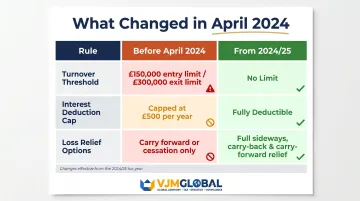
Turnover thresholds: Any eligible business can now use cash basis, regardless of annual turnover.
Interest costs: If your business loan incurs £800 in annual interest, the full £800 is deductible — not just £500 as before.
Trading losses: Cash basis users now have access to the same three relief options as traditional accounting users:
- Sideways relief: offset losses against other income in the same tax year
- Carry back: apply losses to the prior year
- Carry forward: apply to future profits (unchanged from before)
How to Opt Out of Cash Basis
If you prefer to use traditional accounting, you must actively elect to do so:
For 2024/25 and 2025/26 tax years:
- Tick the relevant box on your Self Assessment return (Box 8 on short pages; Box 10 on full pages)
- Deadline for the 2024/25 election: 31 January 2027
From 2026/27 onwards:
- Select your accounting method in MTD-compliant software
- This aligns with the rollout of Making Tax Digital for Income Tax (mandatory for income over £50,000 from April 2026)
Once made, your election applies to that year and all subsequent years until you revoke it or your trade becomes excluded.
If you're unsure whether opting out makes sense for your business, the decision usually comes down to your debt levels, loss position, and whether you're approaching MTD obligations — all factors worth reviewing before the January 2027 deadline.
Who Can (and Cannot) Use Cash Basis Accounting
Eligible Businesses
Eligible businesses include:
- Sole traders
- Partnerships where all partners are individuals
New flexibility from 2024/25:
If you operate multiple self-employed trades, you can now choose to apply cash basis to each trade independently — you're no longer required to use the same method across all trades.
Excluded Businesses (Cannot Use Cash Basis)
The following entities and scenarios are prohibited from using cash basis:
- Limited companies
- Limited Liability Partnerships (LLPs)
- Partnerships with at least one corporate partner
- Lloyd's underwriters
- Farming businesses with a current herd basis election
- Farming or creative businesses using profit-averaging elections (section 221 ITTOIA)
- Businesses that have claimed Business Premises Renovation Allowance within the previous seven years
- Businesses engaged in mineral extraction trades
- Businesses that have ever claimed Research and Development Allowance
When Cash Basis May Not Be Suitable
Even if technically eligible, cash basis may not suit:
- Businesses dealing in securities
- Lease premium arrangements
- Managed service companies
- Cemetery or crematorium businesses
- Ministers of religion
These businesses may benefit from specific tax rules under traditional accounting that are not available under cash basis.
VAT-Registered Businesses
VAT-registered businesses can still use cash basis for income tax purposes. That said, how you record income under cash basis can affect your Making Tax Digital for Income Tax (MTD for ITSA) obligations — so it's worth understanding where the two systems overlap before choosing your accounting method.
Cash Basis vs. Accrual Accounting: Benefits, Limitations, and When to Switch
Advantages of Cash Basis for Small Businesses
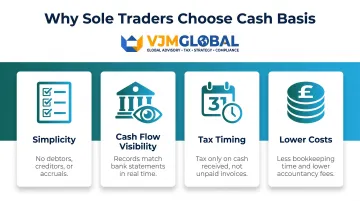
For sole traders and small partnerships, cash basis offers four practical advantages:
- Simplicity: No need to track debtors, creditors, accruals, or prepayments — year-end calculations stay straightforward
- Cash flow visibility: Records match bank statements directly, giving a real-time view of funds actually in hand
- Tax timing: No income tax due on unpaid invoices — tax liability aligns with cash actually received
- Lower costs: Less bookkeeping time, lower accountancy fees, and reduced need for specialised accounting software
Limitations and When Traditional Accounting May Be Better
Cash basis has real constraints worth understanding before committing to it.
Because it ignores unpaid invoices and outstanding supplier bills, it does not reflect your true financial position. That incomplete picture can complicate strategic planning — and it matters significantly when dealing with lenders. Banks and investors typically require accrual-based accounts when assessing loan applications, creditworthiness, or business valuation.
It is also poorly suited to certain business models:
- High or varied stock levels
- Significant credit sales with long payment cycles
- Complex supplier credit arrangements
- Businesses that need detailed financial projections for growth planning
Switching from Cash Basis to Traditional Accounting
Once cash basis no longer fits — whether due to growth, financing needs, or complexity — HMRC's transitional rules ensure you move across without double-counting income or missing expenses.
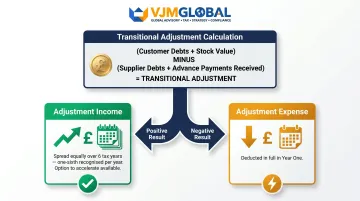
Transitional adjustment calculation:
(Customer debts owed + stock value) – (Supplier debts owed + advance payments received) = Adjustment
How that adjustment is treated depends on whether it is positive or negative:
- Positive (Adjustment Income): Spread over six tax years at one-sixth per year; you can elect to accelerate the full charge within one year of the filing deadline
- Negative (Adjustment Expense): Deducted in full in the first year after leaving cash basis
When traditional accounting is clearly better:
- Seeking external investment or bank financing
- Rapid growth requiring detailed financial reporting
- High inventory levels
- Complex credit arrangements
- Preparing for business sale or merger
If any of these situations apply, switching sooner rather than later gives lenders and investors the financial clarity they need — and reduces the risk of errors during transition.
Frequently Asked Questions
What is cash basis accounting in the UK?
Cash basis is an accounting method for sole traders and partnerships where income is recorded when received and expenses when paid. Since April 2024, it has been the HMRC default for self-employed individuals.
What is a cash basis accounting example?
A consultant invoices a client £1,200 in March 2025 but receives payment in May 2025. Under cash basis, the income is recorded in the 2025/26 tax year (when received), not the 2024/25 tax year (when invoiced).
What is the cash basis threshold in the UK?
From the 2024/25 tax year, there is no entry or exit turnover threshold for cash basis. Previously, there was a £150,000 entry limit and £300,000 exit limit, but these were removed when cash basis became the default method.
Can I change from accrual to cash basis in the UK?
Yes, eligible businesses can switch from traditional accounting to cash basis. Transitional rules apply to ensure income and expenses are not double-counted or missed during the switch, with adjustments made in the first year of using cash basis.
Is it better to use cash basis or accrual accounting?
Cash basis works well for simple, service-based sole traders and small partnerships with straightforward cash flow. Traditional accounting is the better fit if your business carries stock, operates on credit, or needs to present formal accounts to lenders or investors.
What is the cash accounting scheme in the UK?
The Cash Accounting Scheme is a VAT scheme (separate from income tax cash basis) that allows VAT-registered businesses to account for VAT based on payments received and made rather than invoices issued. The two schemes operate independently and are governed by separate legislation.