Accounting Principles in India: A Guide for Singapore Businesses

Published on:
May 8, 2026

Table of contents

Talk to Us
Thank you! Your submission has been received!
Oops! Something went wrong while submitting the form.

One Firm,
Global Solutions

We support cross-border business with confidence and clarity.
Book a Call

Introduction

Most Singapore businesses entering India discover—only after the fact—that their SFRS(I) knowledge covers surprisingly little ground here. India operates a dual-standard system covering Indian GAAP, Ind AS, GST compliance, and oversight from the Institute of Chartered Accountants of India (ICAI), the Ministry of Corporate Affairs (MCA), and the National Financial Reporting Authority (NFRA). Underestimating this complexity leads to compliance gaps, restatements, and penalties that could have been avoided.

This guide walks through India's core accounting principles, compares them to Singapore's SFRS framework, and maps out which standards apply to your entity based on net worth and listing status—from statutory audit requirements to transfer pricing documentation and dual-reporting obligations.

TLDR:

  • India uses Indian GAAP for smaller companies and Ind AS (IFRS-converged, with 10+ carve-outs) for larger and listed entities
  • Every Indian company requires statutory audit by an ICAI-registered CA—no small company exemption exists
  • Net worth above ₹250–500 crore triggers mandatory Ind AS adoption—with no reversion allowed
  • Singapore parent companies must maintain dual reporting: Indian statutory accounts (INR) plus SFRS group accounts (SGD)
  • Transfer pricing documentation failures incur 2% transaction value penalties

India's Accounting Framework: Understanding Indian GAAP and Ind AS

India operates a two-tier accounting system designed to balance global convergence with local regulatory needs. Smaller and unlisted companies follow legacy Indian GAAP (Accounting Standards AS 1–32), while larger companies and all listed entities adopt Ind AS (Indian Accounting Standards), which are converged with—but not identical to—IFRS.

For Singapore businesses setting up Indian subsidiaries, this distinction is critical. Your entity's net worth and ownership structure determine which framework applies, and the decision is irreversible once made.

Regulatory Bodies Governing Indian Accounting

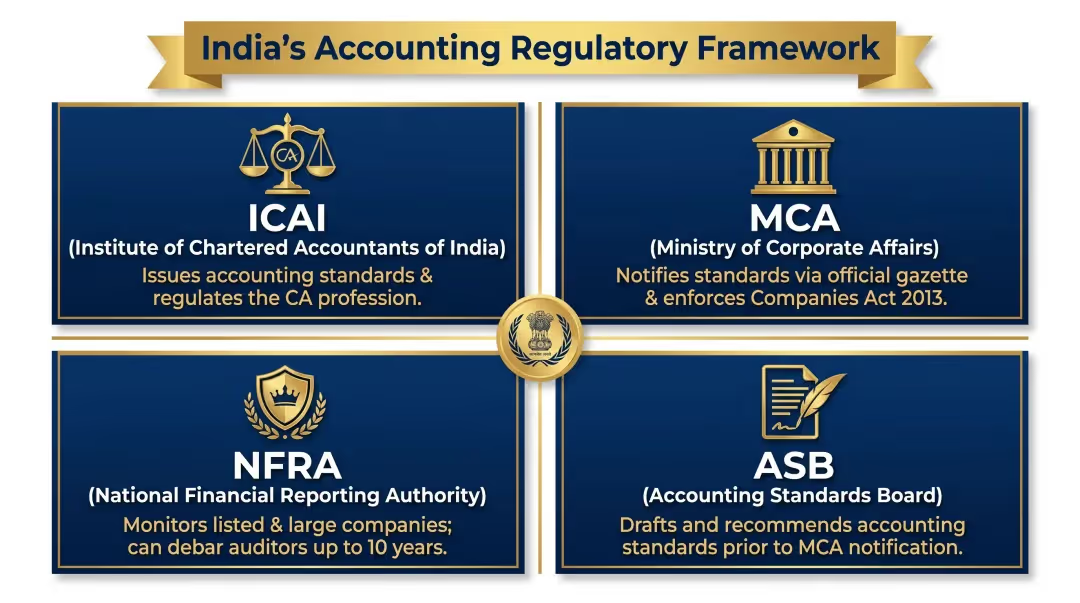
Four primary institutions shape India's accounting landscape:

  • ICAI (Institute of Chartered Accountants of India) issues accounting standards through its Accounting Standards Board and regulates the CA profession
  • MCA (Ministry of Corporate Affairs) notifies standards via gazette, making them legally enforceable under the Companies Act 2013
  • NFRA (National Financial Reporting Authority), established October 1, 2018 under Section 132, monitors compliance for listed and large public companies, investigates misconduct, and can debar auditors for up to 10 years
  • ASB (Accounting Standards Board) is ICAI's standard-setting committee — it drafts and recommends standards before MCA notification

If you're establishing a listed Indian subsidiary or a large unlisted entity, expect oversight from all four bodies—not just ICAI.

Indian GAAP (AS Standards)

Indian GAAP refers to the 27 operative Accounting Standards (AS 1–32) issued by ICAI and notified by MCA under the Companies (Accounting Standards) Rules, 2021. These apply to companies below the Ind AS thresholds.

Five standards are not operative:

StandardStatusReasonAS 6, AS 8WithdrawnMerged into AS 10 and AS 26AS 30, 31, 32Never notifiedSuperseded by Ind AS 109, 32, and 107

Indian GAAP is rules-based, rooted in domestic business practices, and emphasizes historical cost accounting. It's simpler than Ind AS but lacks the fair value measurements and disclosure granularity that IFRS-converged frameworks demand.

Ind AS (IFRS-Converged Standards)

Ind AS was introduced to align India's accounting with global norms, making Indian subsidiary financials easier to consolidate at the Singapore parent level. While largely aligned with IFRS, Ind AS includes 10+ India-specific carve-outs that create practical differences for Singapore parent companies consolidating Indian subsidiary results.

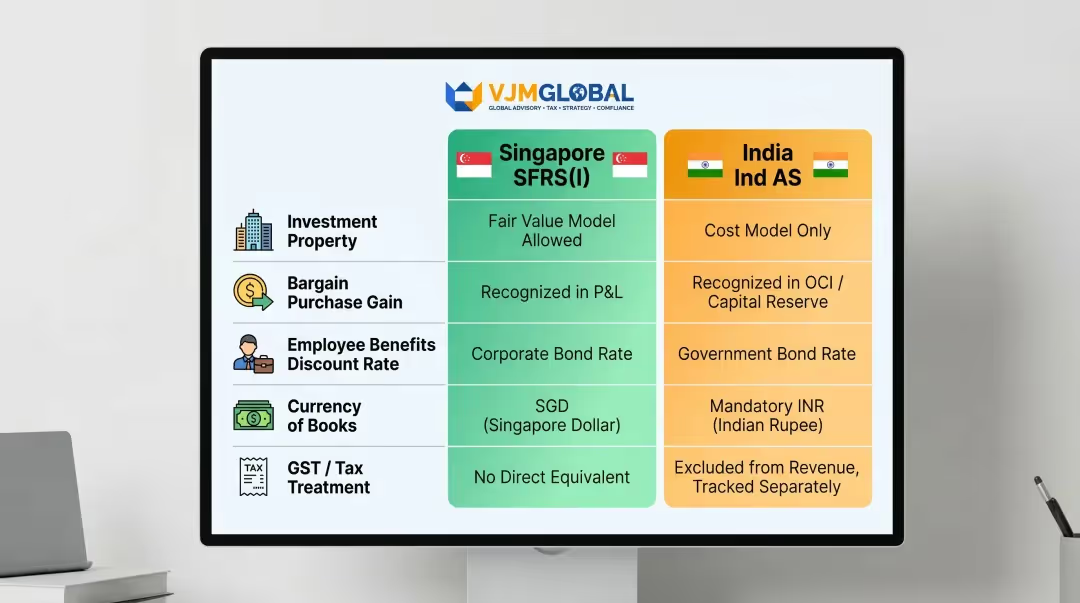
Key Ind AS carve-outs from IFRS:

  • Investment property must use the cost model only (Ind AS 40); IFRS also allows fair value
  • Bargain purchase gains go to OCI as Capital Reserve under business combinations (Ind AS 103); IFRS recognizes these in P&L
  • Exchange differences on long-term foreign currency items can be capitalized (Ind AS 101 Appendix D) — no IFRS equivalent exists
  • Employee benefit discount rates reference government bond yields (Ind AS 19); IFRS uses high-quality corporate bonds
  • FCCBs with a fixed exercise price are treated as equity (Ind AS 32); IFRS classifies the conversion option as a derivative liability

Mandatory applicability thresholds:

PhaseCriteriaEffective DatePhase IListed companies OR unlisted with net worth ≥ ₹500 croreApril 1, 2016Phase IIUnlisted companies with net worth ≥ ₹250 croreApril 1, 2017

These thresholds don't tell the full story. If your Indian subsidiary is a holding company, subsidiary, JV, or associate of an entity already covered under Ind AS, it must also adopt Ind AS—regardless of its own net worth. Once adopted, reversion to Indian GAAP is prohibited under Rule 4 of the Companies (Indian Accounting Standards) Rules, 2015.

Getting this classification wrong at incorporation can force costly restatements later. VJM Global helps Singapore businesses identify the correct framework for their specific entity structure before they register — not after.

Core Accounting Principles Every Singapore Business Must Understand

India's accounting standards—both Indian GAAP and Ind AS—are built on principles that directly affect how your Indian subsidiary records transactions and meets compliance obligations. Several of these interact with India's tax system in ways that catch Singapore businesses off guard.

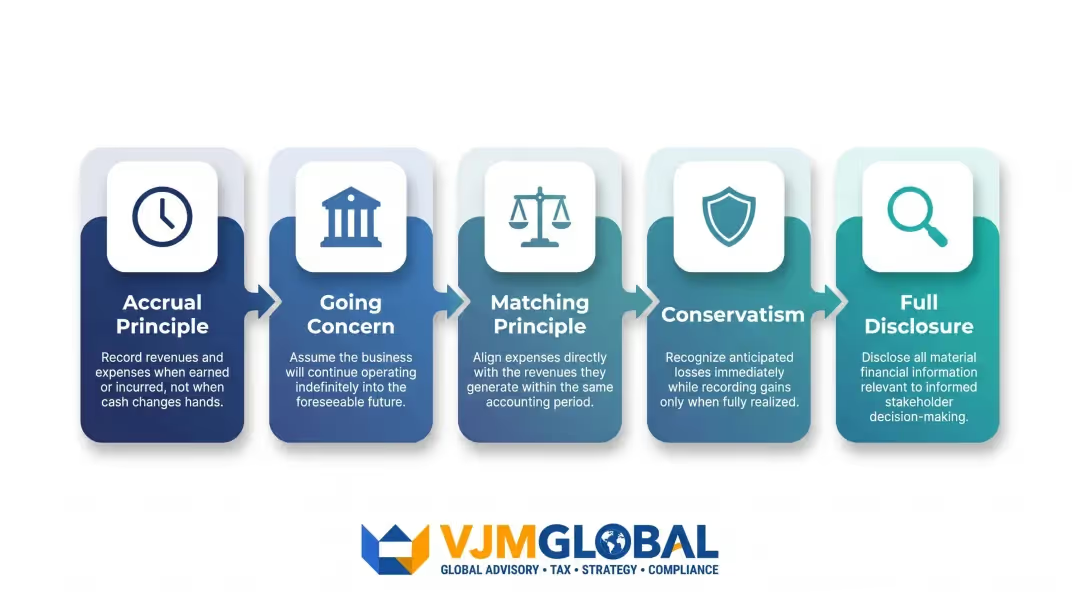
Accrual Principle

Income and expenses are recorded when earned or incurred, not when cash changes hands. Section 128(1) of the Companies Act 2013 mandates that all Indian companies maintain books on an accrual basis using double-entry accounting.

Why this matters in India:

  • GST compliance: Under Section 12 of the CGST Act 2017, GST liability arises at the earlier of invoice date or receipt of payment, which can create a timing mismatch with accrual revenue recognition
  • TDS tracking: Tax Deducted at Source (TDS) on payments creates receivables that must be tracked at invoice level, affecting how you record payables and receivables

Going Concern Principle

Financial statements assume the business will continue operating indefinitely, which affects asset and liability valuation. AS 1 codifies this as a fundamental assumption under Indian GAAP; departure requires explicit disclosure.

For Singapore businesses evaluating exit strategies or restructuring Indian operations, this matters practically: any indicators of discontinuance must be disclosed and can trigger different asset measurement bases entirely.

Matching Principle

Expenses must be recognized in the same period as the revenues they helped generate. Accurate matching also feeds directly into India's advance tax payment schedule, where estimation errors carry interest penalties:

Due DateCumulative % of Estimated Annual TaxJune 1515%September 1545%December 1575%March 15100%

Mismatched expense recognition can lead to advance tax estimation errors and interest penalties.

Conservatism (Prudence) Principle

Accountants recognize probable losses immediately but only record gains when realized. This prevents overstatement of financial position.

Key difference between frameworks:

  • Indian GAAP: Conservatism applies broadly across asset classes
  • Ind AS: Fair value measurement (Ind AS 113) allows mark-to-market gains on certain financial instruments, introducing more balance — though Ind AS 40 restricts investment property to cost-only treatment

Full Disclosure Principle

All material information affecting stakeholders' understanding must be disclosed. This is particularly critical for:

  • Related-party transactions: Ind AS 24 requires disclosure of all transactions between Singapore parent and Indian subsidiary, including nature, amounts, outstanding balances, and terms
  • Contingent liabilities: Must be disclosed even if not recognized on the balance sheet
  • Accounting policy changes: Any changes in methods or estimates require detailed disclosure

Other Foundational Principles

  • Keep personal and business finances strictly separate — the economic entity principle is legally enforced under Indian corporate law
  • Apply accounting methods consistently across periods; any justified change requires formal disclosure
  • Record assets at acquisition cost under Indian GAAP; Ind AS permits fair value in limited cases for financial instruments
  • Recognize revenue when control transfers under both Indian GAAP and Ind AS 115 (aligned with IFRS 15)
  • Disclose only information material enough to influence stakeholder decisions — immaterial items don't require separate treatment

Indian Accounting Standards vs Singapore's SFRS: Key Differences Singapore Businesses Must Know

Singapore's SFRS(I) is identical to IFRS as of January 1, 2018. India's Ind AS is converged with IFRS but includes carve-outs and local requirements that create practical reporting differences.

Baseline Similarity: Both Are IFRS-Aligned

Both frameworks follow the same conceptual foundation—accrual accounting, fair presentation, going concern, and materiality. Revenue recognition (SFRS(I) 15 / Ind AS 115), lease accounting (SFRS(I) 16 / Ind AS 116), and financial instruments (SFRS(I) 9 / Ind AS 109) are aligned at the standard level.

But: India's carve-outs mean identical transactions can produce different numbers.

Inventory Accounting: Aligned Method, Different Nuances

Both prohibit LIFO (Last-In, First-Out) and require FIFO or weighted average cost. Both measure inventory at lower of cost and net realizable value (NRV), with mandatory reversal of write-downs when NRV subsequently increases.

India-specific nuance: Ind AS 2 requires detailed disclosure of inventory write-down reversals, and ICAI has issued sector-specific guidance (for example, construction and pharmaceuticals) that Singapore accountants may not encounter under SFRS(I).

Revenue Recognition: Convergence With GST Implications

Both follow the five-step model under IFRS 15. However:

  • GST treatment: GST is excluded from revenue figures in India (recorded separately as liability)
  • Collectability threshold: Ind AS 115 interprets "probable" as >50% likelihood; Singapore practice typically interprets this threshold more conservatively
  • Sector guidance: ICAI issues interpretations for industries like real estate and software that may not have direct SFRS(I) equivalents

Beyond the areas of convergence, three compliance requirements apply exclusively in India—none have direct equivalents in Singapore's reporting framework.

TDS (Tax Deducted at Source) Accounting

Under Sections 194 and 195 of the Income Tax Act 1961, payers must deduct tax at source on specified payments, including all payments to non-residents if chargeable to tax in India. This creates:

  • TDS receivable for the payee (advance tax credit)
  • TDS payable for the payer (remittance to tax authorities)

Every invoice must track TDS deduction status—a requirement with no parallel in Singapore's GST system. For Singapore businesses with Indian subsidiaries, TDS compliance tracking needs to be built into both accounts payable and receivable processes from day one.

GST Input Tax Credit (ITC) Reconciliation

GSTR-2B is a monthly auto-generated statement (available on the 14th of every month) showing ITC available based on supplier filings. Claiming ITC for invoices not reflected in GSTR-2B is impermissible—creating a financial reporting obligation unique to India.

In practice, this means your books must reconcile against GSTR-3B returns monthly, with ineligible transactions identified and interest computed on any excess claims. VJM Global's GST reconciliation service handles this process for clients, reducing the risk of compliance gaps.

Statutory Books in Indian Rupees

Section 128(1) of the Companies Act 2013 requires every company to maintain books of account in India, on accrual basis, using double-entry accounting. Books must be maintained in Indian Rupees—no exceptions.

Singapore parent companies accustomed to maintaining consolidated records in SGD must ensure their Indian subsidiary maintains separate, compliant INR-denominated books.

Which Ind AS Standards Apply to Your Indian Entity?

Applicability depends on entity type, net worth, and ownership structure — and getting this wrong at incorporation creates compliance gaps that are costly to fix later. Singapore businesses typically establish one of three entity types in India, each with a different accounting obligation:

Entity Type Comparison

Entity TypeGoverning LawAccounting FrameworkKey Filing ObligationsWholly Owned SubsidiaryCompanies Act 2013, MCAInd AS or Indian GAAP (net worth-based)Statutory audit by ICAI-registered CA; AOC-4 (financials) and MGT-7 (annual return) with MCALiaison OfficeRBI/FEMANo Indian GAAP/Ind AS mandate (not a company)Annual Activity Certificate (AAC) from CA to RBI and AD Bank by September 30; cannot earn income in IndiaBranch OfficeRBI/FEMAMust maintain books and file accountsAAC from CA + audited Balance Sheet to RBI by September 30; file annual accounts with RBI and MCA

Net Worth Thresholds for Ind AS Applicability

If you're establishing a wholly owned subsidiary incorporated in India, the following thresholds apply:

  • Net worth ≥ ₹500 crore: Mandatory Ind AS from April 1, 2016
  • Net worth ≥ ₹250 crore: Mandatory Ind AS from April 1, 2017
  • Subsidiary/holding/JV/associate of a covered entity: Mandatory Ind AS regardless of own net worth

Critical: Once Ind AS is adopted (whether mandatory or voluntary), you cannot revert to Indian GAAP—even if net worth subsequently falls below the threshold.

VJM Global works with foreign businesses entering India to identify the correct accounting framework at incorporation and manage transitions when subsidiaries cross Ind AS thresholds — before a compliance gap appears on an auditor's report.

Compliance Obligations Singapore Businesses Often Overlook

Statutory Books Maintenance Under Companies Act 2013

Section 128(1) mandates that Indian companies maintain specific records:

  • Cash book
  • Journal
  • Ledger
  • Double-entry bookkeeping

Singapore businesses accustomed to flexible SME accounting practices often underestimate how rigid India's statutory book requirements are. Non-compliance can result in penalties and direct liability for company directors.

The most frequently missed obligations include:

  • Statutory register updates: Failure to update and maintain registers of members, directors, and charges
  • Director disclosures: Incomplete declarations of interest and other statutory obligations
  • Board resolution filings: Not filing board resolutions (Form MGT-14) with RoC in the prescribed format

Mandatory Statutory Audit: No Size-Based Exemption

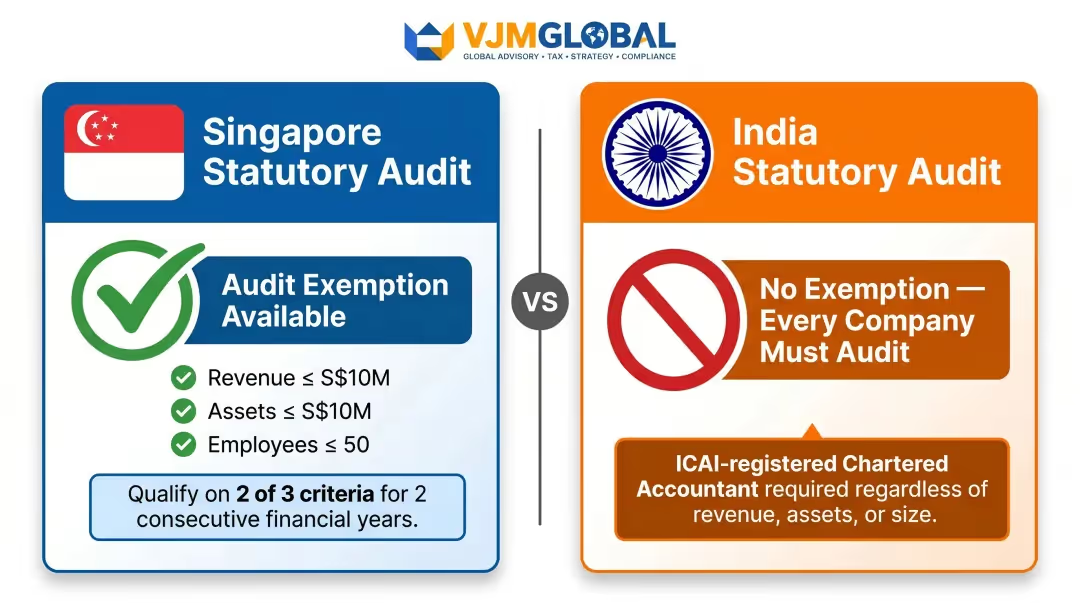
Under Section 139(1) of the Companies Act 2013, every company must appoint an auditor—regardless of revenue, assets, or employee count. Singapore businesses are often surprised by this — there is no equivalent small-company exemption in India.

Singapore's audit exemption (for comparison):

Under Section 205C, a Singapore private company qualifies for audit exemption if it meets 2 of 3 criteria for two consecutive years:

CriterionThresholdTotal annual revenue≤ S$10 millionTotal assets≤ S$10 millionNumber of employees≤ 50

India has no equivalent exemption. Every Indian company—including small subsidiaries with minimal revenue—must have statutory audit by an ICAI-registered Chartered Accountant.

VJM Global coordinates statutory audits for foreign-owned Indian companies, ensuring CA registration requirements are met and audit schedules align with both Indian statutory deadlines and Singapore parent reporting timelines.

Transfer Pricing Documentation and Penalties

Transactions between a Singapore parent and its Indian subsidiary are international related-party transactions governed by Sections 92–92F of the Income Tax Act 1961.

Documentation requirements (Rule 10D):

  • Enterprise description
  • Nature and terms of transactions
  • Transfer pricing methods considered and selected
  • Comparability analysis

Penalties under Section 271AA:

ViolationPenaltyFailure to maintain/furnish TP documentation2% of transaction valueFailure to furnish Master File (consolidated revenue > ₹500 crore)₹5,00,000 (fixed)Failure to furnish Form 3CEB (TP Audit Report)₹1,00,000 (fixed)

Ind AS 24 also requires disclosure of all related-party transactions in financial statements, including amounts, outstanding balances, and terms.

VJM Global supports Singapore parent companies with contemporaneous TP documentation, benchmarking studies, and Ind AS 24 disclosures — helping clients demonstrate that intercompany pricing reflects what unrelated parties would agree to and avoid the 2% transaction penalty.

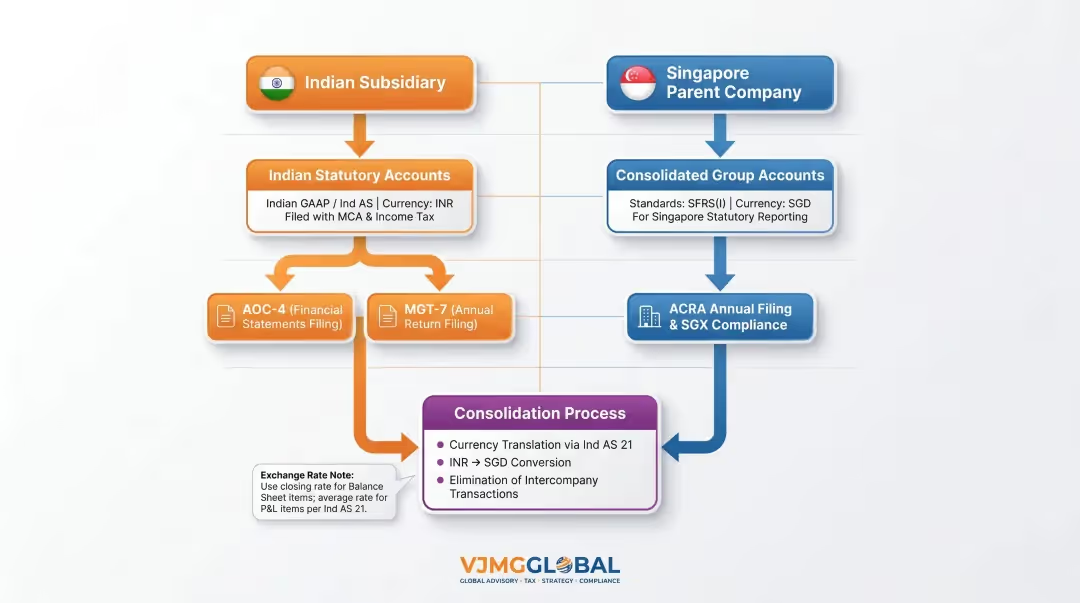
Managing Dual Reporting: Your Indian Books and Singapore HQ

Singapore parent companies typically need two sets of financials:

  1. Indian statutory accounts: Under Indian GAAP or Ind AS, in Indian Rupees, for MCA/tax compliance
  2. Consolidated group accounts: Under SFRS(I), in Singapore Dollars, for the Singapore parent's reporting

Foreign Currency Translation: Ind AS 21

Ind AS 21 prescribes how to translate foreign currency transactions and operations. For Indian subsidiaries:

  • Functional currency: Typically INR (currency of primary economic environment)
  • Presentation currency: SGD for Singapore parent consolidation
  • Translation differences: Recognized in Other Comprehensive Income (OCI) at consolidation

Exchange rate context: As of May 2026, the SGD/INR mid-market rate is approximately ₹74.27 per SGD, with a 6-month average around ₹71.25. The rate ranged from ₹67.75 (November 2025) to ₹74.60 (May 2026). That spread is meaningful volatility — plan for consolidation translation adjustments accordingly.

Practical Guidance for Dual Reporting

Use accounting software that supports:

  • Multi-currency ledgers (INR and SGD)
  • Multi-standard reporting (Ind AS and SFRS(I))
  • Automated consolidation adjustments for Ind AS carve-outs

Establish clear month-end close timelines:

Indian statutory deadlines:

FormPurposeDeadlineAOC-4Financial statementsWithin 30 days from AGMMGT-7Annual returnWithin 60 days from AGMAGMAnnual General MeetingWithin 6 months from year-end (by September 30 for March 31 year-end)

Singapore parent consolidation deadlines vary by company but typically align with quarterly reporting cycles.

Managing both sets of books across two jurisdictions is where many Singapore finance teams run into delays. VJM Global handles Indian subsidiary books (Ind AS/Indian GAAP in INR) while your Singapore team focuses on SFRS(I) group consolidation, keeping both sets of accounts audit-ready and deadline-compliant.

Frequently Asked Questions

Which accounting principles are used in India?

India uses two sets of standards: Indian GAAP (27 operative Accounting Standards AS 1–32) for smaller and unlisted companies, and Ind AS (IFRS-converged Indian Accounting Standards) for listed companies and unlisted entities with net worth ≥ ₹250 crore. Both are governed by ICAI and MCA, with NFRA providing independent oversight for listed entities.

What is the difference between US GAAP and Indian GAAP?

US GAAP is rules-based and developed by FASB for the US market; Indian GAAP is principles-based and shaped by India's regulatory environment. Key divergences include inventory methods (LIFO allowed under US GAAP, prohibited in India), lease accounting models, and financial instrument impairment approaches. Ind AS 109 uses a three-stage ECL model, while US GAAP applies lifetime expected losses immediately.

What are the 5 generally accepted accounting principles?

The five most commonly cited principles are accrual (record when earned/incurred), going concern (business continues indefinitely), matching (expenses recognized with related revenues), conservatism (recognize losses immediately, gains when realized), and full disclosure (all material information disclosed). India's ICAI-issued standards incorporate all five as foundational concepts.

What are the 7 basic principles of accounting?

The seven basic principles are economic entity, monetary unit, time period, historical cost, full disclosure, going concern, and matching. Indian standards recognize all seven; Ind AS introduces fair value exceptions to historical cost for specific asset classes such as financial instruments and investment properties.

What are the 12 GAAP principles?

The 12 GAAP principles are regularity, consistency, sincerity, permanence of methods, non-compensation, prudence, continuity, periodicity, materiality, utmost good faith, recognition, and disclosure. India's Ind AS incorporates all of these while layering in IFRS alignment — which matters directly to Singapore businesses managing dual-reporting obligations for Indian subsidiaries.

Ready to get your Indian subsidiary's accounting right from the start? VJM Global's ICAI-registered Chartered Accountants and cross-border specialists support Singapore businesses at every stage — from Ind AS applicability assessments to statutory audit coordination and management reporting. With 30+ years of experience helping foreign companies navigate India's accounting landscape, we bring practical expertise to every engagement. Reach us at info@vjmglobal.com or +91-9213397070 to discuss your India expansion needs.

VJM Global
探索 VJM Global 的专家家见解、提示和最新动态
Know More About The Author

Recent Blogs