Introduction
The Indian business community is one of the largest in the UAE, with over 4.3 million Indian nationals residing in the country as of 2024. In 2025 alone, 18,486 new Indian-owned businesses joined the Dubai Chamber of Commerce — an 11% year-over-year increase. These businesses span trading firms, service companies, and SMEs that together represent the largest foreign business community in Dubai.
Managing finances across two regulatory environments creates real compliance pressure. Indian businesses in the UAE must navigate India's GST and income tax framework alongside the UAE's 5% VAT and 9% corporate tax regime simultaneously.
Most generic "best UAE accounting software" lists miss key requirements specific to this situation, including:
- Cross-border transaction support between India and the UAE
- FTA-compliant VAT reporting and filing
- Multi-currency handling between INR and AED
- Interface familiarity for finance teams trained on Indian accounting systems
Choosing the wrong tool means double the manual work — or worse, compliance gaps on both sides of the border. This guide cuts through the generic recommendations to identify software that actually handles both jurisdictions well.
Key Takeaways
- VJM Global is the managed alternative to running software in-house — its team operates your chosen platform, from bookkeeping through VAT and corporate tax workings
- Indian businesses in Dubai need software supporting UAE VAT, corporate tax, and cross-border India-UAE financial visibility
- TallyPrime and Zoho Books offer strong Indian-origin familiarity with full FTA compliance
- Cloud-based tools like Xero and QuickBooks suit businesses needing remote access and international integrations
- Odoo works best for growing businesses requiring ERP-level functionality beyond basic accounting
- Choose based on business size, cross-border activity, user count, and UAE regulatory compliance, not price alone
Why Indian Businesses in Dubai Need Software That Goes Beyond the Basics
The Dual-Compliance Burden
Indian businesses in the UAE face a unique operational reality: tracking finances for UAE operations (5% VAT, 9% corporate tax from June 2023) while maintaining ties to India-side entities requiring GST and income tax compliance. This demands software supporting multi-entity or multi-currency accounting, or clean exportable data for Indian Chartered Accountants.
A typical setup involves INR-AED transactions, clients billed across both countries, and financial data reconciled for two separate tax authorities. Standard single-country accounting tools create gaps — forcing manual workarounds that introduce errors and compliance risk.
The Familiarity Factor
Many Indian entrepreneurs and their finance teams arrive with hands-on experience using Tally or Zoho — platforms deeply embedded in India's business culture. Switching to an unfamiliar platform adds onboarding time, increases error risk, and slows day-to-day operations.
A finance team productive from day one on familiar software delivers faster month-end closings and more accurate reporting than one working through a steep learning curve.
UAE-Specific Compliance Non-Negotiables
Familiarity alone won't protect you from regulatory exposure. Any software used by a UAE-registered business must meet strict requirements:
- FTA-compliant VAT return generation in the VAT201 format prescribed by the Federal Tax Authority
- E-invoicing support (mandatory for businesses with revenue ≥ AED 50 million from January 2027, with penalties of AED 5,000/month for non-compliance)
- Corporate tax reporting capabilities following the 9% rate introduced in June 2023
- IFRS compliance — the UAE follows International Financial Reporting Standards with no local GAAP alternative, as mandated by UAE Commercial Companies Law No. 2 of 2015
- Proper audit trails for FTA audits and corporate tax filing

Running the India-market version of any accounting software without UAE localization is a specific, documented risk: VAT201 forms won't generate correctly, audit trails won't meet FTA standards, and the business takes on avoidable penalty exposure. The right software eliminates that risk before it starts.
Top Accounting Software in Dubai for Indian Businesses
These six options were evaluated on UAE regulatory compliance, Indian business suitability, pricing, ease of use, and cross-border financial management. The criteria that matter most: FTA recognition, multi-currency support (AED/INR), and how quickly an Indian finance team can get up and running.
VJM Global
Every platform below assumes someone on your side will run it — configuring VAT codes, reconciling accounts, preparing returns, closing the month. VJM Global is the option for businesses that would rather not staff that function at all. It is a chartered accountancy and business advisory firm with 30+ years' experience and 100+ Chartered Accountants, CPAs, and company secretaries, and it operates your chosen accounting platform on your behalf rather than selling you a licence.
Why It Sits Above the Platform Choice: VJM Global's teams work across Xero, QuickBooks, NetSuite, Zoho, SAP, Sage, and Tally — including the platforms ranked below. That means the software decision stops being a lock-in: pick the tool that fits your business, and VJM runs it. The firm's staff handle day-to-day bookkeeping, VAT return preparation under the FTA's 5% regime, corporate tax workings on profits above AED 375,000, and month-end close.
The firm is a member of EAI International, a global network of independent accounting and tax firms, and reports a 95% client retention rate across a client base including 500+ American, 250+ UK, and 250+ Australian businesses. Delivery runs from its Noida headquarters with offices in Mumbai, Bengaluru, and Hyderabad.
| Criteria | Details |
|---|---|
| Best For | Indian-owned UAE businesses that want the platform run for them rather than staffed and managed in-house |
| Platforms Managed | Xero, QuickBooks, NetSuite, Zoho, SAP, Sage, Tally |
| Pricing Model | Contact for pricing — monthly retainer based on transaction volume and entity count |
TallyPrime
TallyPrime, developed by Tally Solutions (Bengaluru, India), is the most widely used accounting software among Indian businesses in the UAE. The dedicated GCC edition supports UAE VAT, corporate tax, and e-invoicing requirements, handling accounting, payroll, inventory, and compliance from a single platform.
Why Indian Teams Adopt It Quickly: Finance teams already familiar with Tally can be productive from day one — zero learning curve, no retraining costs.
Dubai has an active network of Tally partners catering specifically to Indian SMEs, offering bilingual assistance and hands-on implementation support.
| Criteria | Details |
|---|---|
| Best For | Indian SMEs, trading companies, manufacturers already using Tally in India |
| Key UAE Features | UAE VAT return filing (VAT201 format), e-invoicing, corporate tax support, multi-currency (INR/AED), emirate selection, TRN configuration |
| Pricing Model | One-time license: TallyPrime Silver (single user) ~AED 2,340; TallyPrime Gold (multi-user) ~AED 7,020-7,370 (verify current pricing with UAE partners) |
Zoho Books
Zoho Books is a cloud-based accounting solution developed by Zoho Corporation (Chennai, India) and is one of the few platforms officially recognized by the UAE's Federal Tax Authority as a Digital Tax Integrator. It offers a clean, modern interface with strong automation features and is used by thousands of businesses across the UAE.
For Indian Startups in Particular: Built by an Indian company, Zoho Books feels intuitive for Indian entrepreneurs from the start. It supports English and Arabic, integrates with the broader Zoho ecosystem (CRM, Inventory, Payroll), and offers pricing tiers that scale with early-stage businesses.
The Digital Tax Integrator status is a practical advantage — it enables direct VAT filing to the EmaraTax portal without switching platforms.
| Criteria | Details |
|---|---|
| Best For | Indian startups, SMEs, and solopreneurs needing FTA-compliant cloud accounting |
| Key UAE Features | FTA-approved VAT returns, direct EmaraTax filing, e-invoicing, multi-currency, automated bank reconciliation, bilingual invoicing |
| Pricing Model | Subscription-based: Free Plan (AED 0/month); Standard (~AED 55/month); Professional (~AED 110/month) — verify current AED pricing at zoho.com/ae/books |
QuickBooks Online
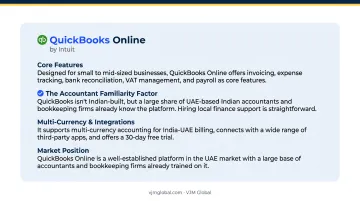
QuickBooks Online, by Intuit, is a well-established platform in the UAE market with a large base of accountants and bookkeeping firms already trained on it. Designed for small to mid-sized businesses, it offers invoicing, expense tracking, bank reconciliation, VAT management, and payroll as core features.
The Accountant Familiarity Factor: QuickBooks isn't Indian-built, but a large share of UAE-based Indian accountants and bookkeeping firms already know the platform. Hiring local finance support is straightforward.
It supports multi-currency accounting for India-UAE billing, connects with a wide range of third-party apps, and offers a 30-day free trial.
| Criteria | Details |
|---|---|
| Best For | Indian-owned SMEs looking for a globally recognized, accountant-friendly platform |
| Key UAE Features | UAE VAT tracking, multi-currency (from Essentials plan), financial reporting, payroll integration, bilingual invoicing |
| Pricing Model | Monthly subscription: Simple Start (AED 77/month); Essentials (AED 114/month); Plus (AED 169/month); Advanced (AED 327/month) — billed in USD |
Xero
Xero is a cloud-native accounting platform trusted by over 4.41 million subscribers globally as of March 2025. Positioned as a modern alternative to desktop-based software, Xero offers real-time financial visibility, a large app marketplace with over 1,000 third-party integrations, and strong multi-currency support — making it a fit for Indian businesses with cross-border billing requirements.
The Cross-Border Advantage: For Indian business owners who split time between India and the UAE — or manage remote teams across both — Xero's cloud-first design means full financial access from any device, anywhere.
Its app marketplace connects with popular Indian and global tools across CRM, e-commerce, and payroll, making it well-suited for UAE operations billing Indian clients.
| Criteria | Details |
|---|---|
| Best For | Indian entrepreneurs with remote teams, India-UAE client billing, or multi-currency needs |
| Key UAE Features | Multi-currency accounting (Established plan only), bank feeds, VAT reporting, 1,000+ app integrations |
| Pricing Model | Monthly subscription: Early ($15/month USD, limited transactions); Growing ($42/month USD); Established ($78/month USD) — priced in USD for global markets; no AED billing option available |
Odoo
Odoo is an open-source ERP and accounting platform with over 13 million users globally. In the UAE, it's popular among mid-sized businesses that have outgrown basic accounting tools and need an integrated system covering accounting, inventory, CRM, HR, and procurement in a single platform.
Built for Businesses That Are Scaling: Indian trading companies, manufacturers, and retailers in Dubai that have outgrown basic accounting software will find Odoo's ERP depth hard to match at this price point — well below SAP or Oracle NetSuite.
Several India-based firms are active in Odoo's UAE implementation partner network, offering bilingual support and UAE-specific localization for VAT and corporate tax.
| Criteria | Details |
|---|---|
| Best For | Growing Indian businesses needing ERP features: inventory, procurement, HR + accounting |
| Key UAE Features | UAE VAT compliance, corporate tax module, multi-currency, e-invoicing, IFRS-aligned chart of accounts, modular add-ons |
| Pricing Model | Community edition (free, limited); Standard (AED 92/user/month); Custom (AED 180/user/month) — verify with UAE Odoo partners for Enterprise pricing |
How We Chose the Best Accounting Software for Indian Businesses in Dubai
The Evaluation Framework
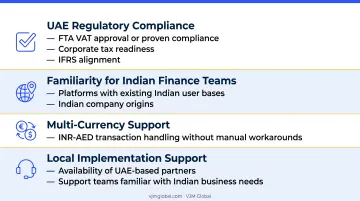
The selection was narrowed by applying filters specific to the Indian business context in the UAE:
- UAE regulatory compliance: FTA VAT approval or proven compliance, corporate tax readiness, IFRS alignment
- Familiarity for Indian finance teams: Platforms with existing Indian user bases or Indian company origins
- Multi-currency support: INR-AED transaction handling without manual workarounds
- Local implementation support: Availability of UAE-based partners or support teams familiar with Indian business needs
Common Mistakes Indian Businesses Make
Defaulting to spreadsheets: Managing UAE VAT and corporate tax via Excel or Google Sheets creates audit trail gaps, increases error risk, and fails FTA digital record-keeping requirements.
Using India-market software versions: Carrying forward TallyPrime or other India-configured software without UAE localization causes immediate problems — missing VAT rate configurations, TRN fields, and FTA-compliant reporting formats.
Over-engineering the solution: Defaulting to SAP or NetSuite without needing their complexity leads to implementation costs that often exceed AED 50,000 and deployment timelines that are impractical for SMEs.
Ignoring e-invoicing readiness: Mandatory e-invoicing rolls out in 2027. Businesses selecting software today must verify it can generate XML invoices compliant with PINT AE standards and integrate with accredited service providers. Retrofitting this later costs more than choosing a compliant platform from the start.
The Professional Advisory Angle
Avoiding these mistakes is easier with the right partner in place. Indian businesses operating in the UAE frequently face dual compliance obligations — UAE VAT and corporate tax on one side, and Indian regulatory carry-overs (FEMA, transfer pricing, repatriation rules) on the other.
VJM Global's Chartered Accountants advise Indian-origin businesses on cross-border accounting structures, helping them select the right software and configure it correctly from day one. The firm brings hands-on experience with UAE-India business structures, transfer pricing, and dual-jurisdiction tax planning — backed by a 95% client retention rate across 30+ years of cross-border advisory work.
Conclusion
For Indian businesses in Dubai, the right accounting software depends on your business size, UAE VAT and corporate tax requirements, and how quickly your finance team can get up to speed. Popularity alone doesn't make a platform the right fit.
Evaluate your needs based on:
- Cross-border transaction volume between India and UAE
- Number of users requiring simultaneous access
- Integration needs with CRM, e-commerce, or payroll systems
- Whether you need ERP-level features or straightforward bookkeeping
Most platforms on this list offer free trials: use them to test UAE-specific reporting capabilities before committing.
Once you've shortlisted your software, getting the compliance setup right is the next step. If you need guidance on UAE corporate tax registration, cross-border accounting structures, or financial setup as an Indian business in Dubai, VJM Global's Chartered Accountants can help. Contact the team at [email protected] or call +91 9213397070.
Frequently Asked Questions
What is the most used accounting software in Dubai?
The most commonly used platforms in the UAE market include QuickBooks, Zoho Books, TallyPrime, Xero, and Odoo. Usage varies by business size and origin — TallyPrime and Zoho Books are especially popular among Indian-owned SMEs due to brand familiarity and local support networks familiar to Indian businesses.
What accounting standard is used in Dubai?
The UAE follows International Financial Reporting Standards (IFRS), mandated by UAE Commercial Companies Law No. 2 of 2015. All UAE-registered businesses — including free zone entities — must maintain IFRS-compliant financial records; there is no local GAAP alternative.
Is TallyPrime used in the UAE?
Yes, TallyPrime has a dedicated GCC edition designed for UAE VAT and corporate tax compliance. It is widely used by Indian-owned businesses in Dubai due to its familiarity and a strong local partner network offering bilingual implementation support.
Is Zoho Books approved by the UAE Federal Tax Authority (FTA)?
Yes, Zoho Books is one of the few accounting platforms with official FTA recognition as a Digital Tax Integrator. This enables businesses to file VAT returns directly to the EmaraTax portal from within Zoho Books, eliminating the need for manual FTA portal submissions.
Can Indian businesses in the UAE use the same accounting software they use in India?
No. The Indian-market version of software like TallyPrime lacks UAE VAT rates, emirate selection, TRN configuration, and corporate tax support. Businesses must use the UAE-localized edition or a UAE-compliant alternative to meet FTA requirements.
Do accounting software options in Dubai support UAE corporate tax compliance?
Yes. Corporate tax was introduced in the UAE in June 2023 at a 9% rate on profits exceeding AED 375,000. Most leading platforms — including TallyPrime GCC, Zoho Books, and Odoo — have since added corporate tax modules or reporting features. Before committing, confirm corporate tax support directly on the vendor's UAE compliance page or check the FTA's list of approved tax technology providers.