
The Federal Tax Authority (FTA) issued FTA Decision No. 3 of 2024 specifying exactly when each category of taxable person must submit their CT registration application. Deadlines vary by entity type, incorporation date, and whether the business is resident or non-resident in the UAE — and missing them costs AED 10,000.
This guide breaks down which Indian firms must register, what deadlines apply to each, and what steps to take to stay compliant.
Key Takeaways
- Pre-March 2024 UAE entities face deadlines by license month — between 31 May and 31 December 2024
- Entities incorporated on or after 1 March 2024 must register within 3 months of incorporation
- UAE Permanent Establishments formed before 1 March 2024 get 9 months to register; those formed after get 6 months
- NRI-owned businesses crossing AED 1 million in UAE turnover must register by 31 March of the following year
- Missing the deadline costs AED 10,000 — and VAT registration does not count as CT registration
Which Indian Firms Must Register for UAE Corporate Tax?
Under Article 51 of the UAE CT Law, every "Taxable Person" must register with the FTA and obtain a Tax Registration Number (TRN). The classification of an Indian firm determines both its obligations and its deadline.
Three Categories That Apply to Indian Businesses
1. UAE-incorporated entities (Resident Juridical Persons)
Any company incorporated, established, or recognised under UAE law qualifies as a Resident Person and is taxed on worldwide income. This category includes:
- UAE subsidiaries of Indian parent companies
- NRI-run free zone companies in JAFZA or DMCC
- Joint ventures registered with UAE partners
2. Non-Resident Juridical Persons (Indian companies with UAE operations)
A Non-Resident Person is taxed only on income attributable to their UAE permanent establishment (PE) or nexus. Indian companies fall into this category if they operate through:
- A UAE branch, project office, or service PE
- UAE immovable property that creates a "nexus" under Cabinet Decision No. 56 of 2023
3. NRI natural persons exceeding the AED 1 million threshold
Under Cabinet Decision No. 49 of 2023, resident and non-resident natural persons are subject to UAE CT only when total UAE business turnover exceeds AED 1,000,000 in a Gregorian calendar year. Wages, personal investment income, and real estate investment income are excluded.
One Important Carve-Out
Non-resident Indian companies that earn only "State Sourced Income" — without a PE or nexus in the UAE — are exempt from CT registration under Ministerial Decision No. 43 of 2023. The exemption is not automatic. A single employee, contract, or recurring service engagement in the UAE can be enough to constitute a PE — which immediately removes this protection and triggers registration obligations.
UAE Corporate Tax Registration Deadlines for Indian Firms
All deadlines below come from FTA Decision No. 3 of 2024, effective 1 March 2024.
Resident UAE Companies (Indian-Owned or Indian-Promoted)
Incorporated before 1 March 2024: Deadlines are staggered by commercial license issuance month.
| License Issuance Month | Registration Deadline |
|---|---|
| January or February | 31 May 2024 |
| March or April | 30 June 2024 |
| May | 31 July 2024 |
| June | 31 August 2024 |
| July | 30 September 2024 |
| August or September | 31 October 2024 |
| October or November | 30 November 2024 |
| December | 31 December 2024 |
| No license held on 1 March 2024 | 31 May 2024 |
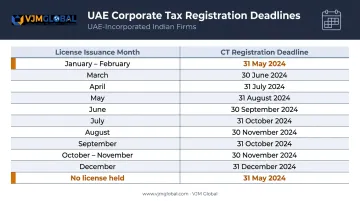
Where an entity holds multiple licenses, the earliest issuance date determines the applicable deadline.
Incorporated on or after 1 March 2024: Register within 3 months from the date of incorporation or recognition.
Foreign-incorporated but UAE-managed (for example, an Indian holding company whose strategic decisions are made in the UAE): Register within 3 months from the end of the financial year in which UAE management and control applies.
Non-Resident Indian Companies with UAE Presence
The deadlines below apply based on when your permanent establishment (PE) or UAE nexus was created.
| PE / Nexus Situation | Deadline |
|---|---|
| PE existed before 1 March 2024 | 9 months from date of PE existence |
| PE formed on or after 1 March 2024 | 6 months from date of PE existence |
| UAE nexus (immovable property income) before 1 March 2024 | 31 May 2024 |
| UAE nexus established on or after 1 March 2024 | 3 months from date of nexus |
A PE is triggered by any of the following:
- Fixed place of management or branch office in the UAE
- Project office or construction/installation project meeting duration thresholds
- Dependent agent habitually contracting on the Indian company's behalf in the UAE

NRI Natural Persons Conducting Business in the UAE
Two rules apply depending on tax residency status:
- UAE-resident NRIs: If UAE business turnover exceeds AED 1 million in a calendar year, register by 31 March of the following year (for example, turnover crossing the threshold in 2024 meant a 31 March 2025 deadline).
- Non-resident natural persons: Register within 3 months from the date the threshold is met.
Common Compliance Challenges for Indian Firms
The POEM Question
Many Indian parent companies direct day-to-day decisions for their UAE subsidiaries from India: board meetings in Mumbai, strategic calls from Delhi. Where management and control is genuinely exercised from India, the UAE entity is not a "resident person" by virtue of effective management.
The analysis cuts both ways, though. If strategic decisions for an Indian company are consistently made in the UAE, that company could itself trigger UAE CT registration as a resident.
Working with a cross-border tax advisor on Place of Effective Management (POEM) positioning is essential. Getting this classification wrong affects not just UAE CT obligations but also Indian domestic tax exposure under the Income Tax Act.
VAT Registration Does Not Equal CT Registration
This is the most common misconception among Indian businesses in the UAE. Many firms have been VAT-registered since 2018 and assume their EmaraTax profile already covers corporate tax. It does not.
The FTA maintains entirely separate service processes for VAT registration and CT registration — both require independent applications, different documentation sets, and separate TRNs. Being VAT-compliant for years offers zero protection against a CT late registration penalty.
Free Zone Entities Still Must Register
Indian businesses in JAFZA, DMCC, and other free zones often assume that 0% tax eligibility under the Qualifying Free Zone Person (QFZP) rules removes all CT obligations. It does not. The FTA Free Zone Persons Guide is explicit: QFZPs must register for CT, obtain a TRN, and file annual returns. Non-registration carries penalties regardless of whether any tax is owed.
Documentation Delays
The EmaraTax portal won't accept a CT registration application without a valid UAE trade license in place. For Indian-origin companies, two practical blockers commonly cause delays:
- Trade license renewals: Companies mid-renewal cannot proceed with CT registration until the license is reissued
- Apostilled Indian documents: Where an Indian parent company's details are required, certified and apostilled corporate documents are typically needed — procurement timelines can run several weeks
Plan for these lead times well before your CT registration deadline.
Penalties for Missing the UAE Corporate Tax Registration Deadline
Cabinet Decision No. 75 of 2023, as amended by Cabinet Decision No. 10 of 2024, sets the penalties clearly:
| Violation | Penalty |
|---|---|
| Failure to submit CT registration application on time | AED 10,000 AED 10,000 |
| Failure to update registration records within 20 business days of changes | AED 1,000 (first violation); AED 5,000 (repeat within 24 months) |
| Late CT return filing | AED 500/month for first 12 months; AED 1,000/month from month 13 |
Two details that catch Indian firms off guard:
- The deadline is for submitting the application, not for receiving the TRN. The FTA processes CT registration applications within approximately 20 business days of a completed submission — so apply well before the deadline, not on it.
- Changes to trade license details, ownership structure, or business activities must be reported to the FTA within 20 business days of the change. Letting these updates lapse creates additional penalty exposure — and Indian firms undergoing ownership restructuring between parent and UAE subsidiary are particularly exposed here.
How to Register: A Practical Checklist for Indian Firms
Step 1 – Determine your entity classification
Identify whether your UAE business falls into one of three categories:
- Resident Juridical Person — incorporated or effectively managed in the UAE
- Non-Resident Juridical Person — operating through a permanent establishment (PE) or nexus
- Natural person — approaching the AED 1 million turnover threshold
This classification determines which deadline applies and what supporting documents you'll need. If there's any ambiguity around POEM or PE status, resolve it before opening a registration application.
Step 2 – Prepare your documents
Gather the following before opening the EmaraTax portal:
- Valid UAE trade license (must be current and uploaded)
- Memorandum of Association and corporate registration documents
- Proof of business activities and ownership structure
- For Indian parent companies: apostilled/notarised corporate registration documents
- If multiple licenses exist: identify the one with the earliest issuance date
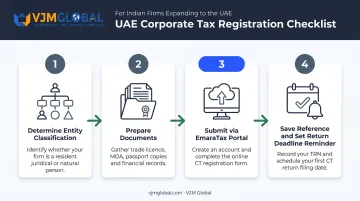
Step 3 – Submit via EmaraTax and track
- Access the FTA's EmaraTax portal and sign in or create your taxpayer profile
- Select the Corporate Tax registration option and complete the application form
- Save the application reference number — this is your evidence of timely submission
- Set calendar reminders for the CT return deadline (9 months from financial year end)
Frequently Asked Questions
What is the due date for filing a corporate tax return in UAE?
The CT return must be filed within 9 months from the end of the relevant tax period. For a company with a financial year ending 31 December, the return is due by 30 September of the following year.
What is the penalty for late registration of corporate tax in UAE?
The FTA imposes an administrative penalty of AED 10,000 for failure to submit the CT registration application within the prescribed deadline, per Cabinet Decision No. 10 of 2024. This is separate from any penalties for late return filing.
Is corporate tax filing mandatory in UAE even if no tax is payable?
Yes. All taxable persons — including those with zero liability, free zone entities, and businesses below the AED 375,000 taxable income threshold — must register and file annual CT returns. This obligation applies regardless of whether any tax is actually owed.
Do Indian companies with a UAE branch need to register separately for UAE corporate tax?
A UAE branch of an Indian company constitutes a Permanent Establishment and is treated as a Non-Resident Juridical Person — and must register separately for UAE CT. The deadline is 9 months from the PE's date of existence if it existed before 1 March 2024, or 6 months if formed after that date.
Does the India-UAE DTAA exempt Indian firms from UAE corporate tax registration?
No. The India-UAE DTAA governs how income is taxed across both countries and may affect how profits attributable to a UAE PE are computed or relieved — but it does not exempt Indian firms from UAE CT registration. That obligation arises directly under UAE domestic law (CT Law Article 51), independent of any treaty analysis.