
Introduction
Indian businesses entering the UAE market face a critical compliance hurdle that differs significantly from the familiar GST and PAN framework back home: obtaining a Tax Registration Number (TRN) from the Federal Tax Authority (FTA). Without a valid TRN, Indian companies cannot legally charge VAT to UAE customers, file tax returns, or clear goods through UAE customs. Non-compliance triggers a fixed AED 10,000 penalty under Cabinet Decision No. 49 of 2021.
The procedural nuances for Indian businesses are distinct. Non-resident Indian entities making taxable supplies in the UAE must register regardless of revenue threshold — a rule that catches many first-time entrants off guard.
Indian nationals applying from abroad face additional layers: attestation chains, passport-based verification, and certified translation requirements that UAE-resident applicants bypass entirely.
This guide covers what the UAE TIN (officially called a TRN) is, when your Indian business must register, and how to complete the application via the EmaraTax portal. It also addresses the India-specific documentation requirements that determine how quickly your application clears — or why it doesn't.
Key Takeaways
- The UAE TIN is a 15-digit Tax Registration Number (TRN) issued after VAT registration on the EmaraTax portal
- Indian businesses with UAE taxable turnover exceeding AED 375,000 must register; voluntary registration available above AED 187,500
- Non-resident Indian businesses making taxable supplies in the UAE face no minimum threshold and must register immediately
- Required documents include trade license, passport copies, incorporation papers, and bank details
- India-issued documents typically require attestation or apostille before submission
- Processing takes 5–20 business days; download your TRN certificate directly from the EmaraTax dashboard once the FTA approves
What is the UAE Tax Identification Number (TIN/TRN)?
The UAE Tax Identification Number is officially called the Tax Registration Number (TRN) — a 15-digit unique code issued by the Federal Tax Authority after completing VAT registration. In practice, you'll see it referred to interchangeably as the TRN, VAT number, or Tax Identification Number; all three terms mean the same identifier in the UAE system.
The TRN enables your business to:
- Legally charge 5% VAT on taxable supplies in the UAE
- File quarterly VAT returns and claim input tax refunds
- Issue compliant tax invoices that display your TRN
- Clear imports and exports through UAE customs
- Interact with UAE banks and government entities as a registered taxpayer
How the UAE TRN Differs from India's Tax Framework
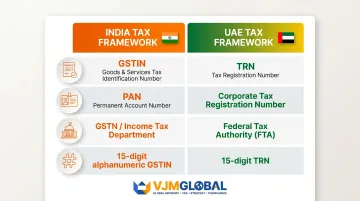
For Indian business owners accustomed to PAN cards for income tax and GSTIN for GST, the UAE TRN works like a GSTIN — it's your single identifier for all indirect tax obligations. Unlike India's separate PAN/GSTIN structure, the UAE issues one TRN that covers all VAT registrations.
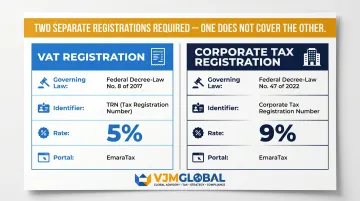
One important exception: since June 2023, businesses subject to the new 9% Corporate Tax must also register separately for a Corporate Tax Registration Number — a distinct requirement from the TRN.
The Federal Tax Authority defines the TRN as "a unique number issued by the Authority for each Person registered for Tax purposes." In practical terms, no UAE tax invoice, VAT return, or customs declaration is valid without it.
| Tax Framework | India | UAE |
|---|---|---|
| Indirect Tax ID | GSTIN | TRN (Tax Registration Number) |
| Income/Direct Tax ID | PAN | Corporate Tax Registration Number (since June 2023) |
| Issuing Authority | GSTN / Income Tax Dept. | Federal Tax Authority (FTA) |
| Number of Digits | 15 (GSTIN) | 15 (TRN) |
Why Indian Businesses Operating in the UAE Need a TIN
Legal Compliance and Penalty Avoidance
Operating without a valid TRN when legally required triggers severe penalties. Under Cabinet Decision No. 49 of 2021, failing to submit a VAT registration application within the required timeframe incurs a fixed AED 10,000 administrative penalty. If your business charges VAT to customers without being registered, you must remit those amounts to the FTA while also facing the non-registration penalty — a compounding compliance failure.
Late payment of any tax due adds further damage:
- 2% penalty on unpaid tax immediately after the due date
- 4% monthly penalty thereafter
- Maximum cumulative penalty: 300% of the tax amount
For an Indian business unfamiliar with UAE timelines, these penalties can accumulate rapidly before the business even realizes registration was mandatory.
Market Credibility and Business Relationships
UAE clients, suppliers, and banks routinely expect a valid TRN as proof of legitimate operations. For Indian businesses building relationships in a new market, producing a TRN certificate signals regulatory compliance, reduces friction in B2B negotiations, and improves eligibility for larger contracts.
Customs Clearance for Import/Export
Indian businesses trading goods between India and the UAE must provide a verified TRN for customs clearance. The FTA requires VAT-registered businesses to link their TRN with their Customs Registration Number (CRN) for all import/export transactions.
Without this linkage, UAE customs can delay or refuse those shipments — disrupting supply chains and delivery commitments.
India-UAE DTAA Context
A common misconception among Indian businesses is that the India-UAE Double Tax Avoidance Agreement (in force since 22 September 1993) reduces their UAE tax burden across the board. It does not. The DTAA covers income tax, corporation tax, and wealth tax only — VAT sits entirely outside its scope.
Indian businesses cannot rely on the DTAA to avoid or reduce UAE VAT obligations; the two systems operate independently. The DTAA helps prevent double taxation on profits, but UAE TRN registration remains a separate, non-negotiable requirement for indirect tax compliance.
Eligibility Criteria: When Does Your Indian Business Need to Register?
Mandatory Registration Threshold
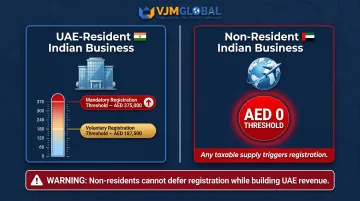
Any business with annual taxable supplies exceeding AED 375,000 in the past 12 months, or expected to exceed that threshold within the next 30 days, must register for a TRN. This applies to Indian-owned entities registered in the UAE (mainland companies or free zone entities) that meet the revenue test.
Voluntary Registration Threshold
Businesses with taxable supplies between AED 187,500 and AED 375,000 may voluntarily register. Voluntary registration makes sense early if your business:
- Expect rapid growth and will soon cross the mandatory threshold
- Want to reclaim input VAT from startup expenses immediately
- Require a TRN to establish credibility with UAE clients or banks
Non-Resident Indian Businesses: Zero Threshold Rule
Critical for Indian businesses: The FTA explicitly states that the AED 375,000 threshold "is not applicable to foreign businesses." This means non-resident Indian entities making any taxable supply in the UAE must register regardless of turnover. Even a single B2C transaction or digital service sale requires registration.
In practice, this rule catches many Indian businesses off guard. If you're testing the UAE market from India without a local entity, you cannot defer registration while building revenue: the obligation arises the moment you make a taxable supply.
| Business Type | Mandatory Registration Threshold | Voluntary Registration Threshold |
|---|---|---|
| UAE-resident entity (Indian-owned) | AED 375,000 (12-month lookback or 30-day forward) | AED 187,500 (12-month lookback or 30-day forward) |
| Non-resident Indian business | AED 0 (any taxable supply) | Not applicable — registration is mandatory |
How Indian Businesses Can Obtain a UAE TIN: Step-by-Step
Step 1 — Create an EmaraTax Account
All TRN applications are processed through the FTA's EmaraTax portal. Indian nationals sign up using their passport and email address (rather than Emirates ID). After entering your details:
- Verify your email before proceeding
- Use a business email address, not a personal one
- Save your login credentials securely — you'll need them for all future FTA interactions
Step 2 — Initiate VAT Registration
Once logged in, navigate to the VAT registration section on the EmaraTax dashboard. Indian businesses must select the correct entity type:
- Mainland company (UAE entity established in Dubai, Abu Dhabi, or other emirates)
- Free zone entity (established in JAFZA, DAFZA, or other designated zones)
- Non-resident (Indian business without a UAE legal entity)
This selection affects the form fields and document requirements, so choose carefully.
Step 3 — Complete the Application Form
The registration form covers:
- Business details (trade license number, date of incorporation, business activity)
- Turnover declarations (past 12 months and next 30-day projection)
- Banking information (UAE bank account details)
- Authorized signatory details (passport info for Indian nationals)
Indian business owners must enter passport details where Emirates ID would normally be required.
Any inconsistency between your passport, trade license, and incorporation documents can trigger immediate rejection.
Step 4 — Upload Supporting Documents
This step causes the most delays for Indian applicants. Documents must be:
- Scanned clearly (no blurry photos)
- In acceptable formats (PDF preferred)
- In English or Arabic (certified translations required for documents in Hindi or regional languages)
- Attested/apostilled if issued in India
The next section covers the full document checklist for Indian applicants.
Step 5 — Submit and Track Application
After submission, you receive an application reference number. The FTA officially allows 20 business days to review, though straightforward applications often resolve sooner. Monitor your EmaraTax dashboard for status updates:
- Drafted — application saved but not yet submitted
- Pending — under FTA review
- Issued — TRN assigned, pending final confirmation
- Approved — registration complete
- Rejected — application returned with reasons stated
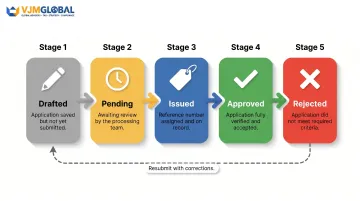
The FTA may request additional information, which extends the timeline. Check your dashboard daily and respond promptly to any FTA queries.
Step 6 — Receive TRN Certificate
Upon approval, three items become available in your EmaraTax dashboard:
- Tax Registration Number (TRN) — your 15-digit identifier
- VAT Registration Certificate — official FTA document
- GIBAN (Generated International Bank Account Number) — activated by the Central Bank within a couple of hours
Download and print all three. The TRN must appear on all tax invoices, and the VAT Registration Certificate is required for bank account updates and client verification.
Indian businesses unfamiliar with UAE tax procedures often encounter rejections at the document upload or entity selection stage. Working with a firm that handles cross-border tax compliance — such as VJM Global — can reduce back-and-forth with the FTA and help ensure first-time approval.
Documents Indian Businesses Need for TIN Registration
Core Documents (with India-Specific Notes):
- Trade License or Certificate of Incorporation — UAE-issued for resident entities; India-issued for non-residents (must be attested)
- Memorandum and Articles of Association — Required for all entities except sole establishments
- Passport copies of shareholders and authorized signatories — Indian businesses use passports in place of Emirates ID; passport names must match the trade license exactly
- Proof of UAE business address — Tenancy contract or Ejari certificate (mainland), or free zone license (JAFZA/DAFZA)
- Company bank account confirmation letter — From a UAE-licensed bank, confirming account name, number, IBAN, and branch
- Declaration of taxable turnover — Statement of past 12 months' turnover on company letterhead, signed and stamped
- Sample invoices — Signed and stamped sales and purchase invoices (if already trading)
India-Specific Preparation Tips
Getting these documents in order is only half the challenge — how they're prepared matters just as much. Three areas trip up Indian applicants most often:
- Attestation and apostille: Indian incorporation documents and Powers of Attorney typically require attestation through: India's Ministry of External Affairs → UAE Embassy in India → UAE Ministry of Foreign Affairs. Since July 2023, India is a Hague Apostille Convention member, which may simplify this process — but confirm current FTA requirements before applying.
- Certified translations: Any documents in Hindi or regional Indian languages must include certified English translations. The FTA accepts only English or Arabic; a non-certified translation will be rejected outright.
- Name consistency: The authorised signatory name on your passport must match your UAE trade license and incorporation documents letter-for-letter. Even minor spelling variations — "Kumar" vs. "Kumarr" — trigger rejection.
Common Mistakes Indian Businesses Make During TIN Registration
Three mistakes consistently delay or derail TIN registration for Indian businesses in the UAE. Understanding them upfront saves significant time and avoids rejection from the FTA.
Misconception: Free Zone Entities Are Exempt from VAT Registration
Many Indian businesses assume a UAE free zone license automatically exempts them from VAT registration. It does not. The FTA's Designated Zones VAT Guide specifies that businesses in free zones face the same VAT registration obligations as mainland entities. If your free zone business makes taxable supplies exceeding AED 375,000 — particularly to UAE mainland customers — you must register for VAT under normal rules.
Assuming One TIN Covers Both VAT and Corporate Tax
A separate but equally common error: assuming a VAT TRN also satisfies Corporate Tax obligations. Since June 2023, the UAE introduced 9% Corporate Tax under Federal Decree-Law No. 47 of 2022. Indian businesses subject to Corporate Tax must register separately for a Corporate Tax Registration Number in addition to their VAT TRN. Both are issued through the same EmaraTax portal, but they require separate applications — one does not fulfill the other.
| Tax Type | Governing Law | Identifier Issued | Rate | Portal |
|---|---|---|---|---|
| VAT | Federal Decree-Law No. 8 of 2017 | Tax Registration Number (TRN) | 5% | EmaraTax |
| Corporate Tax | Federal Decree-Law No. 47 of 2022 | Corporate Tax Registration Number | 9% | EmaraTax |
Document Mismatch and Outdated Papers
Indian business owners frequently submit:
- Outdated incorporation documents (issued years ago without recent amendments)
- Unattested certificates from India
- Passport copies that don't match the authorized signatory name on the trade license
- Bank letters missing required details (IBAN, branch name)
Document mismatches are one of the leading causes of FTA application rejection. Before uploading, verify that every document references the same legal entity name, authorized signatory, and registration details — even a minor name discrepancy between your trade license and passport copy can trigger a rejection and restart the process.
Frequently Asked Questions
What is the UAE tax identification number?
The UAE Tax Identification Number is officially called the Tax Registration Number (TRN) — a 15-digit code issued by the Federal Tax Authority after VAT registration. It is used for all tax filings, invoices, customs dealings, and FTA correspondence.
How can I get my TIN number online in UAE?
Register entirely online through the FTA's EmaraTax portal. Sign up, complete the VAT registration form, upload required documents, and submit for FTA review. Approval typically takes 5–20 business days.
Is there a revenue threshold for Indian businesses to register for UAE TIN?
Yes, but it depends on your residency status. UAE-resident Indian businesses must register above AED 375,000 taxable supplies (mandatory) or may register voluntarily above AED 187,500. Non-resident Indian businesses making taxable B2C supplies in the UAE face no threshold and must register immediately.
Can an Indian company register for UAE TIN without a physical office in the UAE?
Non-resident businesses can register with the FTA if they make taxable supplies in the UAE. Most Indian businesses find it simpler to establish a UAE entity (mainland or free zone) first, as this reduces documentation complexity significantly.
How long does it take to get a TIN in UAE?
The FTA's standard processing time is 5–20 business days from submission of a complete application. Incomplete or incorrectly attested documents — a common issue for Indian applicants — can extend this timeline to 4–6 weeks.
What are the penalties for operating in the UAE without a TIN?
Failing to register triggers a fixed AED 10,000 penalty under Cabinet Decision No. 49 of 2021. Businesses that charge VAT without a valid TRN must still remit those amounts to the FTA and face additional late-payment charges: 2% immediately, then 4% monthly — capped at 300% of tax due.
Ready to navigate UAE VAT registration with confidence? VJM Global's international tax team guides Indian businesses through every step — from document attestation and EmaraTax application support to ongoing tax filing and FTA correspondence. Contact us at [email protected] or call +91 9891576441 to ensure your TRN application is complete, accurate, and processed without delays.