Introduction
Most Singapore businesses entering Dubai expect the financial reporting to feel familiar — both jurisdictions use IFRS-based frameworks. What catches even experienced finance teams off-guard is the UAE's implementation layer: 5% VAT mechanics, 9% corporate tax rules effective June 2023, and free zone-specific compliance mandates that vary by authority.
The stakes are immediate. In Dubai, financial statement accuracy directly determines corporate tax liability, license renewal eligibility, and access to banking facilities.
Free zone companies in DMCC, DIFC, and DSO face mandatory annual audit requirements regardless of size. Mainland entities answer to both Department of Economic Development oversight and federal tax authority deadlines. For Singapore CFOs accustomed to SFRS consolidation cycles and SGX reporting timelines, Dubai's 9-month corporate tax filing window and free zone submission calendars demand planning from day one.
This guide is for Singapore-based business owners, CFOs, and finance managers operating — or planning to operate — in Dubai. It covers:
- The four financial statements required under UAE rules
- The end-to-end reporting and submission process
- Key differences from Singapore's SFRS framework
- Compliance traps that trigger FTA audits or jeopardize license renewals
Key Takeaways
- Dubai mandates IFRS for financial statements, but implementation differs from Singapore's SFRS in VAT integration, corporate tax disclosures, and free zone audit requirements
- Four core statements required: Balance Sheet, Income Statement, Cash Flow Statement, Statement of Changes in Equity—plus detailed notes
- Free zone entities face mandatory annual audits with zone-specific deadlines: 6 months for DMCC, 4–6 months for DSO—separate from federal tax obligations
- Corporate tax returns must be filed within 9 months of year-end; late filing triggers AED 500/month penalties (Cabinet Decision No. 129 of 2025)
- Qualifying Free Zone Persons on the 0% tax rate must still file returns, maintain audited statements, and document transfer pricing
What Financial Statements Are Required in Dubai?
Financial statements in the Dubai context are structured financial reports that summarize a company's financial position, performance, and cash flows, prepared in accordance with IFRS as mandated by UAE Commercial Companies Law (Federal Decree-Law No. 32 of 2021) and reinforced by relevant free zone authority requirements.
The Four Core Financial Statements in Dubai
The UAE follows the IAS 1 framework without modification. Every business operating in Dubai must prepare:
1. Statement of Financial Position (Balance Sheet) Required for free zone license renewal checks—authorities verify capital adequacy and financial stability through balance sheet review. Covers assets, liabilities, and equity at a specific point in time.
2. Statement of Profit or Loss and Other Comprehensive Income (Income Statement/P&L) Directly feeds taxable income calculations under the UAE's corporate tax regime, making revenue recognition and expense classification choices material to your tax liability. Covers revenues, costs, and net income over a reporting period.
3. Statement of Cash Flows Categorizes cash movements into operating, investing, and financing activities using the indirect method. UAE banks require this statement for credit facilities and operational account approvals.
4. Statement of Changes in Equity Tracks movements in owner equity, including capital contributions, dividends, and retained earnings. Critical for Singapore parent-subsidiary structures where intercompany dividends and capital repatriations must be documented.
Notes to Accounts are mandatory and form part of the complete financial statement set. They must include accounting policies, significant estimates, related-party disclosures, and tax disclosures—the last two being critical for Singapore-owned entities with intercompany transactions.
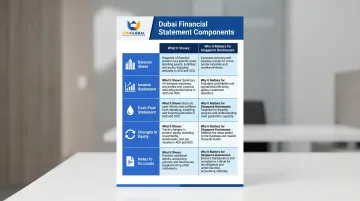
| Financial Statement | What It Shows | Why It Matters for Singapore Businesses in Dubai |
|---|---|---|
| Balance Sheet | Assets, liabilities, equity at a point in time | Required for free zone license renewal; banks verify capital adequacy |
| Income Statement | Revenues, costs, net income over a period | Determines taxable income under UAE's 9% corporate tax |
| Cash Flow Statement | Operating, investing, financing cash movements | Mandatory for banking relationships and credit facilities |
| Changes in Equity | Movements in share capital and retained earnings | Documents intercompany dividends and capital repatriations to Singapore parent |
| Notes to Accounts | Accounting policies, related-party transactions, tax disclosures | Critical for transfer pricing compliance and FTA audit defense |
Accounting Standards: IFRS in Dubai
The UAE mandates IFRS for most businesses under Federal Decree-Law No. 32 of 2021, Articles 27 and 347. The framework is tiered:
- Full IFRS: Required for entities with revenue exceeding AED 50 million
- IFRS for SMEs: Permitted for entities with revenue below AED 50 million
- Cash basis accounting: Allowed for entities with revenue below AED 3 million
Singapore uses SFRS (Singapore Financial Reporting Standards), which is substantially converged with IFRS. In practice, differences emerge in disclosure requirements and presentation formats preferred by UAE regulatory authorities. Singapore finance teams will encounter three new requirement areas not present in Singapore's GST framework: corporate tax disclosures (introduced June 2023), transfer pricing documentation for related-party transactions, and VAT reconciliation notes.
Ministerial Decision No. 114 of 2023 formally designates this tiered IFRS structure for corporate tax purposes. Your accounting standard choice therefore affects both financial statement preparation and tax compliance obligations simultaneously.
Free Zone vs. Mainland Reporting Obligations
The structural distinction matters operationally: mainland companies report to the UAE Ministry of Economy and Department of Economic Development, while free zone companies answer to their specific free zone authority. Most free zones impose mandatory annual audit requirements regardless of revenue.
DMCC (Dubai Multi Commodities Centre) All member companies—including subsidiaries and branches—must submit audited financial statements within 6 months of financial year-end. Auditors must appear on the DMCC Approved Auditors List. Note: DMCC clarifies that audited statements are "not required at time of license renewal," but annual submission remains a separate mandatory obligation.
DIFC (Dubai International Financial Centre) Annual audited financial statements are required for most companies. Small private companies (fewer than 20 shareholders, turnover not exceeding USD 5 million) may qualify for exemption under DIFC Law No. 5 of 2018. This exemption is narrow and typically does not apply to Singapore operations that choose DIFC specifically for its common-law framework.
DSO (Dubai Silicon Oasis) All registered companies must submit audited financial statements within 4–6 months of financial year-end, prepared by a DSO-approved auditor vetted by the Dubai Silicon Oasis Authority.
Across all three zones, the financial statements described above form the basis of every annual audit submission. Singapore businesses operating in these zones should budget for annual audit costs from inception—the obligation exists regardless of revenue scale.
How Financial Reporting Works in Dubai for Foreign-Owned Companies
The financial reporting cycle in Dubai follows a structured pattern: ongoing bookkeeping throughout the financial year, year-end close, preparation of draft financials, external audit (where required), and final submission or retention for tax and regulatory purposes. Each stage has specific requirements that Singapore-owned entities need to get right.
Step 1: Set Up the Chart of Accounts and Choose a Financial Year
Companies in Dubai can elect their financial year-end—calendar year (January 1–December 31) is common, but other periods are permitted. The choice matters because corporate tax filing deadlines run 9 months after year-end under Federal Tax Authority regulations. A December year-end triggers a September 30 tax return deadline the following year.
For newly incorporated entities (on or after June 1, 2023), the first financial year may be between 6 and 18 months in length without requiring FTA approval. Singapore parent companies often align their Dubai subsidiary's year-end with their own for consolidation purposes, which simplifies group reporting cycles and SGXNET disclosure timelines.
Step 2: Maintain Compliant Bookkeeping and Gather Documentation
UAE law requires businesses to retain financial records for a minimum of 7 years following the end of the relevant tax period under Federal Decree-Law No. 47 of 2022 (Corporate Tax Law). This exceeds the 5-year general commercial requirement and Singapore's own retention standards.
Required supporting documents include:
- Bank statements and reconciliations
- Sales invoices (VAT-compliant format required)
- Purchase invoices with valid VAT documentation
- Payroll records and employee contracts
- Fixed asset registers and depreciation schedules
- Intercompany agreements and contracts
- VAT return filings and supporting schedules
Accrual-basis accounting is required under IFRS—not cash-basis—matching Singapore's SFRS approach. The exception: businesses with revenue below AED 3 million may elect cash-basis accounting under Ministerial Decision No. 114 of 2023, Article 4.
Step 3: Reconcile Accounts and Prepare a Trial Balance
Before drafting financial statements, all ledger accounts must be reconciled. Priority reconciliations for Singapore-owned entities include:
- Bank accounts: Multi-currency reconciliation if operating in both AED and SGD
- Intercompany balances: Singapore parent receivables/payables must match on both books
- VAT accounts: Output VAT liability and input VAT recoverable must reconcile to filed VAT returns
The trial balance confirms total debits equal total credits and serves as the foundation for financial statement preparation. Intercompany balance mismatches are a frequent stumbling block for Singapore groups operating cross-border structures. Firms with experience in UAE-Singapore compliance, such as VJM Global, can help establish intercompany reconciliation processes that hold up under FTA scrutiny.
Step 4: Draft the Financial Statements
Financial statements are drafted from the trial balance in sequence:
- Income Statement (P&L) prepared first, determining net income
- Balance Sheet follows, incorporating the net income figure into equity
- Cash Flow Statement using the indirect method (starting with net income and adjusting for non-cash items)
- Statement of Changes in Equity tracking capital movements and retained earnings
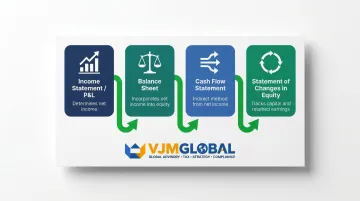
Each statement feeds into the next, so sequencing matters. Notes to accounts must also be prepared alongside the statements and must include:
- Accounting policy elections (revenue recognition, depreciation methods, inventory valuation)
- Significant estimates and judgments (useful lives, impairment assessments)
- Related party disclosures: Critical for Singapore parent-subsidiary structures. All intercompany transactions, loans, and management fees must be disclosed with amounts, terms, and balances outstanding
- Tax disclosures: Current and deferred tax calculations, reconciliation of accounting profit to taxable income, transfer pricing policies
FTA audits consistently scrutinize the notes section. Gaps in intercompany transaction documentation or missing transfer pricing disclosures are among the most direct triggers for audit follow-up.
Step 5: External Audit and Record Filing
External audit is mandatory for:
- Entities with revenue exceeding AED 50 million (Ministerial Decision No. 84 of 2025)
- All Qualifying Free Zone Persons (QFZPs), regardless of revenue
- Tax Groups preparing consolidated returns
- Free zone companies in DMCC, DIFC, DSO per zone regulations
- Publicly listed companies under Securities and Commodities Authority rules
- Mainland LLCs under Commercial Companies Law
Auditors must be registered with the relevant authority—DMCC maintains an Approved Auditors List, DIFC requires DIFC-approved auditors, and DSO vets auditors through DSOA.
While Ministerial Decision No. 84 requires entities to "prepare and maintain" audited statements, the FTA's Corporate Tax Returns Guide confirms that filing financial statements with the CT return is mandatory. The EmaraTax portal requires the auditor's name and audit opinion in the accounting schedule section.
Key Reporting Differences Singapore Businesses Must Understand
Singapore businesses often assume that IFRS convergence means seamless transition. In practice, Dubai's tax structure, VAT mechanics, and free zone rules create meaningful operational friction for finance teams.
SFRS vs. IFRS: Where Differences Actually Arise in Practice
SFRS is substantially based on IFRS, so statement formats and recognition principles are familiar territory. Three areas create the most friction in practice:
Tax-related disclosures: The FTA scrutinizes transfer pricing policies, related-party transaction documentation, and deferred tax reconciliations at a level of detail that often exceeds what Singapore's IRAS requires for comparable transactions.
VAT vs. GST mechanics: The UAE has no equivalent to Singapore's partial exemption calculations. VAT registration is mandatory above AED 375,000 in taxable supplies (approximately SGD 135,000) — a much lower bar than Singapore's SGD 1 million GST threshold. At 5%, the UAE rate is lower than Singapore's 9% (effective January 2024), but ledger separation requirements and reconciliation rigor are equally demanding.
Language and currency: Financial statements are prepared in AED. For mainland entities, the FTA requires tax data submitted in Arabic, though it generally accepts English with the right to request certified translation. Singapore businesses should budget for potential translation costs.
Corporate Tax and Its Impact on Financial Statement Preparation
The UAE introduced 9% federal corporate tax effective June 2023 on taxable income above AED 375,000. Financial statements now directly determine tax liability, meaning errors in revenue recognition, expense classification, or depreciation flow through to tax exposure.
Key mechanics:
- 0% rate applies to taxable income up to AED 375,000
- 9% rate applies to taxable income exceeding AED 375,000
- Qualifying Free Zone Persons benefit from 0% on qualifying income (with conditions detailed below)
For Singapore businesses, the transfer pricing implication is immediate: intercompany transactions between the Singapore parent and Dubai entity must be at arm's length and documented in the notes. The FTA's Transfer Pricing Guide (CTGTP1), published October 2023, follows OECD Transfer Pricing Guidelines — meaning Singapore businesses already familiar with OECD-standard documentation will find the framework recognizable, even if the FTA's enforcement posture is still developing.
Documentation requirements scale with size:
- All entities must maintain basic transfer pricing documentation
- Entities with revenue of AED 200 million or more must maintain Master File and Local File
- MNE groups with consolidated revenue of AED 3.15 billion or more must prepare country-by-country reporting
Even modest Singapore subsidiaries in Dubai with management fee arrangements or royalty payments to the parent must document the arm's length nature of these transactions from year one.
VAT Accounting and Its Integration into Financial Statements
UAE VAT at 5% must be accounted for separately in financial statements:
- Output VAT on sales appears as a current liability
- Input VAT on eligible purchases is a recoverable asset (current asset)
- Net VAT position should reconcile precisely to VAT returns filed with the FTA
The lower registration threshold catches Singapore SMEs earlier than they're used to — many find themselves VAT-registered in Dubai before they would have hit Singapore's GST threshold back home. This has cash flow implications: VAT collected must be remitted quarterly even during early-stage operations when revenue is still building.
The FTA cross-references filed VAT returns against financial statement disclosures during audits. VAT records must be retained for a minimum of 5 years; corporate tax records require 7 years. In practice, retain everything for 7 years to satisfy both obligations.
Audit Requirements and How They Differ by Structure
| Entity Type | Audit Requirement | Singapore Comparison |
|---|---|---|
| Free zone (DMCC, DIFC, DSO) | Mandatory annual audit regardless of size | Singapore's audit exemption (SGD 10M revenue / 50 employees / SGD 10M assets) does not apply |
| Mainland SMEs | May not require audit under Commercial Companies Law alone, but needed for corporate tax if above AED 50M threshold or if required by licensing authority or banks | Different rules govern—size thresholds don't transfer |
| QFZPs | Must maintain audited financial statements regardless of revenue as condition of 0% tax rate | No equivalent structure in Singapore |
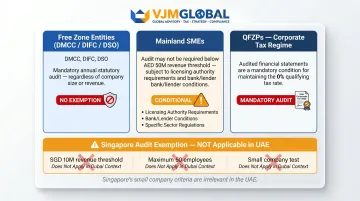
The practical implication: Singapore businesses accustomed to audit exemption for smaller operations will face mandatory audit costs in Dubai free zones from year one, regardless of revenue or employee count.
Consequences of Non-Compliance with Dubai Financial Reporting Rules
Regulatory Consequences
Failure to maintain proper books or submit required audited financial statements triggers direct penalties:
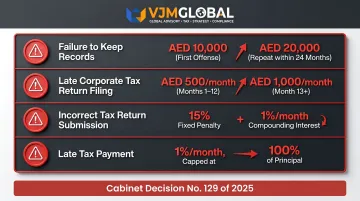
Federal Tax Authority penalties (Cabinet Decision No. 129 of 2025, effective April 14, 2026):
- Failure to keep required records: AED 10,000 (first offense), AED 20,000 (repeat within 24 months)
- Late filing of corporate tax return: AED 500/month for first 12 months, then AED 1,000/month from month 13 onward
- Incorrect tax return (discovered during FTA audit): 15% fixed penalty on tax difference plus 1%/month interest
- Late payment of tax: 1%/month on outstanding amount (capped at 100% of principal)
Free zone authority consequences:
- License non-renewal risk for failure to submit annual audited financial statements
- Compliance penalties and damaged standing with the zone authority
- Potential de-registration in cases of sustained non-compliance
Business Impact Consequences
Beyond regulatory penalties, non-compliance creates operational barriers:
Banking relationships: UAE banks require audited financial statements for account opening, loan applications, and credit facilities. A Singapore business establishing treasury operations in Dubai will struggle to secure banking facilities without compliant financial statements.
Investor and commercial relationships: Joint venture partners, government tenders, and significant commercial contracts in the UAE require audited accounts. Non-compliance limits business development opportunities.
Group consolidation issues: For Singapore-listed companies or those with Singapore parent entities, Dubai subsidiary financial statements feed into group consolidated accounts. Errors or delays in Dubai reporting cascade into SGXNET disclosure obligations or SFRS consolidation issues at group level, potentially triggering SGX queries or investor concern.
Common Mistakes Singapore Businesses Make with Dubai Financial Reporting
Assuming Direct Transplantation of Singapore Practices
The most common operational error is treating Dubai bookkeeping as a direct copy of Singapore processes. Specific failure points include:
- Failing to separate VAT on purchases and sales in the chart of accounts correctly (UAE VAT requires separate tracking of output tax liability and input tax asset)
- Not maintaining Arabic documentation where required by mainland authorities
- Applying Singapore GST partial exemption logic to UAE VAT incorrectly (the frameworks differ materially)
- Using Singapore-style financial year-end reporting timelines without adjusting for Dubai's 9-month corporate tax filing window
Underestimating Intercompany Documentation Requirements
Singapore businesses with parent-subsidiary structures frequently underestimate the documentation required for intercompany loans, management fees, and royalties. The UAE's transfer pricing rules require these transactions to be:
- Priced at arm's length based on comparable third-party transactions
- Formally documented in written agreements
- Disclosed in financial statement notes with amounts, terms, and balances outstanding
Missing this documentation is a common compliance gap that creates real FTA audit risk. During audits, the FTA will request supporting contracts, pricing benchmarking studies, and contemporaneous documentation showing how the arm's length price was determined.
Cross-border advisory firms with experience in both Singapore and UAE frameworks—such as VJM Global—can help businesses establish compliant intercompany policies and documentation structures from the outset.
Misunderstanding Free Zone Tax Compliance Obligations
A costly misconception among free zone operators: the 0% corporate tax rate does not eliminate reporting obligations. The FTA's bulletin on Free Zone Persons explicitly states that Qualifying Free Zone Persons must:
- Register for corporate tax with the FTA
- File a corporate tax return within 9 months of year-end
- Prepare and maintain audited financial statements
- Maintain records for 7 years
- Apply transfer pricing rules to related-party transactions
The reporting obligation does not disappear with the tax exemption. Non-compliance triggers loss of QFZP status for the current year and the following four tax periods. During that window, all income is taxed at 9% — a disproportionate cost for a single year of missed filings.
Frequently Asked Questions
What is a statement of account in Dubai?
A "statement of account" in Dubai refers to a document issued by a supplier or bank summarizing transactions and outstanding balances within a period. It is distinct from formal financial statements, which are IFRS-compliant reports prepared for regulatory, tax, and audit purposes.
Does Dubai use IFRS or GAAP for accounting statements?
Dubai mandates IFRS, not US GAAP, for financial statement preparation. This is governed by Federal Decree-Law No. 32 of 2021 (Commercial Companies Law) and reinforced by the FTA's corporate tax regulations, making IFRS the universal standard for all businesses operating in the UAE.
What are the main accounting statements used in Dubai?
The four core statements are: Balance Sheet (Statement of Financial Position), Income Statement (Profit & Loss), Cash Flow Statement, and Statement of Changes in Equity—plus accompanying Notes to Accounts, which are mandatory under IFRS.
Are financial statements in Dubai mandatory for all businesses?
All businesses must maintain proper accounting records under UAE law. Audited financial statements are mandatory for most free zone companies (required for license renewal) and for entities subject to corporate tax above the AED 375,000 threshold. All other businesses are strongly advised to maintain audited accounts for banking and compliance purposes.
How does Dubai's financial reporting differ from Singapore's requirements?
Both jurisdictions use IFRS-based frameworks, but Dubai introduces distinct practical requirements:
- Dubai's 5% VAT must be integrated into accounts
- The 9% corporate tax requires tax-linked financial disclosures
- Free zone companies face audit mandates regardless of size
- The UAE has no equivalent to Singapore's small-company audit exemption
When do Singapore companies in Dubai need to file financial statements?
Corporate tax returns and supporting financials must be filed within 9 months of the company's financial year-end with the FTA. Free zone license renewal submissions follow each zone's own calendar, typically 4-6 months after year-end.