This guide covers every step, fee, and Arizona-specific rule you need to complete the process correctly. Whether you're a local entrepreneur, a small business owner, or a foreign investor establishing a U.S. presence, you'll find everything required to form and maintain a compliant Arizona LLC.
Key Takeaways
- Arizona LLCs are formed by filing Articles of Organization with the ACC for a $50 state fee
- Standard processing takes 9–11 business days; expedited filing reduces this to 2–4 days
- LLCs outside Maricopa or Pima County must publish a Notice of Formation in an approved newspaper within 60 days
- No annual report is required — meaning no renewal fees or recurring paperwork once your LLC is active
- Arizona's flat 2.5% state income tax makes it one of the more tax-competitive states for pass-through entities
Why Form an LLC in Arizona?
Arizona had 1,345,050 active LLCs as of FY2023–24, according to the ACC's most recent annual report. That number reflects the state's reputation as a genuinely business-friendly environment—not just on paper.
Core LLC Advantages
- Limited liability protection — members' personal assets stay separate from business debts and legal claims
- Pass-through taxation — profits flow directly to members and are taxed once, avoiding corporate double taxation
- Flexible management — choose member-managed or manager-managed structure based on your needs
Arizona-Specific Benefits
| Feature | Arizona LLC |
|---|---|
| State filing fee | $50 |
| Annual report requirement | None |
| State income tax rate (flat) | 2.5% |
| Corporate income tax (if elected) | 4.9% |
| Processing time (standard) | 9–11 business days |
Two additional advantages stand out for founders comparing states:
- Arizona ranks 14th in the Tax Foundation's 2026 State Tax Competitiveness Index, reflecting a tax structure favorable to small business owners and pass-through entities alike
- Non-residents and foreign nationals can form an Arizona LLC with no residency requirement — the only condition is appointing a statutory agent with a physical Arizona address, a practical option for international founders evaluating U.S. market entry
Step-by-Step Guide to Forming an LLC in Arizona
Step 1: Choose and Reserve Your Business Name
Arizona's naming rules are specific. Your LLC name must:
- Be distinguishable from existing entities in the ACC database
- Include "Limited Liability Company," "Limited Company," "LLC," "L.L.C.," "LC," or "L.C."
- Exclude terms like "Corporation," "Incorporated," "Bank," "Trust," or "Credit Union" (the last two require regulatory approval)
Use the ACC's Entity Search tool to verify availability before filing.
Optional name reservation: Pay $10 to hold your chosen name for 120 days. This is worth doing if you're not ready to file immediately. Also check domain availability at the same time—securing a matching web address early protects your brand identity.
Step 2: Designate a Statutory Agent
Arizona calls this role a "statutory agent" rather than a "registered agent," but the function is identical: receiving legal documents, ACC notices, and official correspondence on behalf of the LLC.
Requirements:
- Must have a physical Arizona street address (P.O. boxes don't qualify)
- Must sign ACC Form M002 (Statutory Agent Acceptance) to formally consent
- The LLC itself cannot serve as its own statutory agent
Who qualifies:
- An adult Arizona resident
- An Arizona-formed LLC or corporation
- A foreign entity authorized to transact business in Arizona
Professional statutory agent services typically cost $99–$149 per year based on mainstream provider pricing. Beyond convenience, using a commercial agent whose address falls in Maricopa or Pima County can eliminate the newspaper publication requirement entirely, saving both publication costs and the compliance steps that come with it.
Step 3: File the Articles of Organization
The Articles of Organization is the core document that legally creates your LLC. File online through the Arizona Business Center (launched January 12, 2026), by mail, or in person with the ACC.
Required information:
- LLC name and principal address
- Statutory agent name and address
- Management structure (member-managed or manager-managed)
- Member/manager names and addresses (Arizona does not permit anonymous LLCs)
Disclosure note: Member-managed LLCs list every member. Manager-managed LLCs list every manager plus each member owning 20% or more of capital or profits.
Fees and timeline:
| Option | Fee | Processing Time |
|---|---|---|
| Standard filing | $50 | 9–11 business days |
| Expedited filing | $85 total ($50 + $35 surcharge) | 2–4 business days |
| Premium (next-day) | $150 total | Next business day |
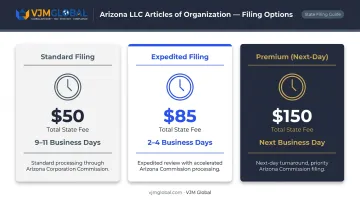
Keep a stamped copy of the approved Articles—banks typically require it when opening a business account.
Step 4: Publish the Notice of Formation (If Required)
This is Arizona's most distinctive requirement—and the one most likely to catch new owners off guard.
Who must publish: LLCs whose statutory agent's address is outside Maricopa or Pima County must publish a Notice of LLC Formation in an ACC-approved newspaper in the agent's county for three consecutive publications within 60 days of ACC approval.
What the notice must include:
- LLC name and ACC file number
- Principal address
- Statutory agent name and address
- Management structure
- Applicable member/manager names and addresses
Who is exempt: LLCs with a statutory agent in Maricopa or Pima County are automatically exempt. The ACC publishes their notice in its public database for at least 90 days at no cost.
Critical warning: Failure to meet the 60-day deadline can result in administrative dissolution under A.R.S. 29-3708. After publication, the newspaper issues an Affidavit of Publication—retain this in your business records. Filing it with the ACC is optional but recommended.
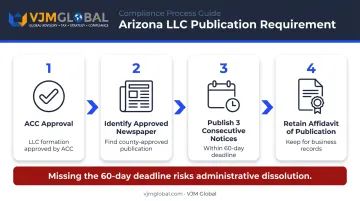
Newspaper publication costs vary by county and publication—the ACC lists approved newspapers but does not publish rates, so contact your county's approved paper directly for a quote.
Step 5: Obtain an Employer Identification Number (EIN)
An EIN is a nine-digit federal tax ID issued by the IRS—essentially a Social Security Number for your business.
When you need one:
- Multi-member LLCs are generally required to obtain an EIN
- Any LLC with employees or certain excise-tax obligations must have one
- Single-member LLCs without employees technically don't need one for federal income tax purposes—but most banks require it
How to get it: Apply free through the IRS EIN application portal. Approved applicants receive their EIN immediately online. Note that applicants whose principal place of business is outside the U.S. cannot use the online tool and must use IRS international channels.
Step 6: Draft an Operating Agreement
Arizona law does not require an operating agreement. Skipping it is a genuine risk, not a technicality.
Without one, Arizona's default LLC statutes govern your company's affairs, which may not reflect what you and your co-owners intended. A well-drafted agreement covers:
- Profit and loss distribution among members
- Voting rights and decision-making procedures
- Management authority and responsibilities
- What happens when a member exits or the LLC dissolves
For foreign nationals and non-resident owners, a tailored agreement matters even more. It can address manager-vs-member governance, income distribution, and ownership transfer restrictions that generic templates miss. VJM Global has helped 500+ US-based foreign business owners work through exactly these questions—visit vjmglobal.com to learn more.
Step 7: Obtain Required Licenses and Permits
Arizona has no single statewide general business license. That doesn't mean you're automatically cleared to operate—it means the requirement depends on your industry, location, and business activities.
Key requirements to check:
- Transaction Privilege Tax (TPT) license — required for businesses selling taxable goods or services; renew annually (the 2026 renewal deadline was January 1, 2026)
- City and county licenses — many municipalities require a local business license regardless of industry
- Industry-specific licenses — contractors, healthcare providers, financial services firms, and others face state-level licensing requirements
Use the Arizona Commerce Authority's Small Business Checklist and contact your local city or town office to identify what applies to your specific situation.
Arizona-Specific LLC Requirements and Costs
Fee Summary
| Filing | Standard Fee | Expedited Total |
|---|---|---|
| Name Reservation | $10 | $45 |
| Articles of Organization | $50 | $85 |
| Articles of Amendment | $25 | $60 |
| Statement of Change | $5 | $40 |
| Articles of Termination | $35 | $70 |
Newspaper publication costs are county- and publication-specific—no verified statewide range exists. Contact approved newspapers directly for quotes.
Ownership Disclosure
Arizona does not permit anonymous LLCs. Names and addresses of members or managers appear in the Articles of Organization and become part of the public record. For owners who prioritize privacy, selecting a manager-managed structure limits public disclosure to managers and members owning 20% or more.
Duration and Dissolution
Arizona LLCs exist in perpetuity by default unless the Articles specify an end date or dissolution trigger. To close an LLC, file Articles of Termination with the ACC ($35 fee). Name changes or structural amendments require Articles of Amendment ($25 fee).
Tax Obligations
Pass-through taxation means members pay Arizona's flat 2.5% state income tax on their share of LLC profits. LLCs that elect corporate taxation face the state's 4.9% corporate income tax rate instead.
Federal tax classification (sole proprietorship, partnership, S corp, or C corp) carries meaningful long-term consequences — especially for foreign or non-resident owners. Consulting a tax professional before filing is worth the cost.
Post-Formation Compliance for Your Arizona LLC
Filing your Articles of Organization gets your LLC on the books — but ongoing compliance is what keeps it in good standing. Here's what to track after formation:
BOI Reporting (Updated)
As of FinCEN's interim final rule effective March 26, 2025, all U.S.-created entities and their beneficial owners are currently exempt from Beneficial Ownership Information (BOI) reporting. The previous 30-day deadline no longer applies to Arizona-formed LLCs. Foreign-formed entities registered in the U.S. remain subject to reporting. Monitor FinCEN for updates, as this rule remains an interim measure.
Business Bank Account
Open a dedicated business account as soon as your EIN and Articles are approved. Mixing personal and business funds can pierce the liability protection your LLC structure provides.
Banks typically require:
- EIN confirmation letter
- Articles of Organization
- Operating agreement
- Government-issued ID
Ongoing obligations to track:
- Renew TPT licenses annually (calendar year basis)
- File a Statement of Change ($5) when your statutory agent or business address changes
- Renew any applicable city or county licenses
- Stay current on federal and state tax filing deadlines
Common Mistakes When Forming an LLC in Arizona
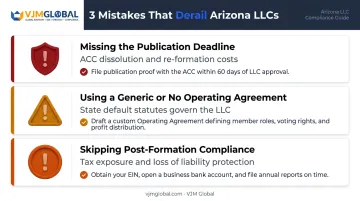
Most Arizona LLC formations fail not at the filing stage, but in the details that follow. These are the three mistakes that cause the most problems:
- Missing the publication deadline. LLCs outside Maricopa and Pima counties must publish within 60 days or risk ACC dissolution—meaning you'd re-form from scratch and pay all fees again. Not every amendment triggers republication: address changes and statutory agent name updates generally don't. Switching management type does.
- Using a generic operating agreement (or none at all). Without a customized agreement, Arizona courts default to the state's standard LLC statutes—which may not reflect your actual intentions around profit distribution or member exits.
- Skipping post-formation compliance. An EIN, TPT registration (if applicable), and a dedicated business account aren't administrative extras. Operating without them creates tax exposure and legal risk that defeats the purpose of forming an LLC.
Frequently Asked Questions
Frequently Asked Questions
How much does it cost to set up an LLC in Arizona?
The minimum cost is $50 for the Articles of Organization. Optional costs include $10 for name reservation, $35 for expedited processing, and variable newspaper publication fees for LLCs outside Maricopa and Pima counties. Professional statutory agent services typically add $99–$149 per year.
What is required to get an LLC in Arizona?
You need a unique business name, a statutory agent with a physical Arizona address, and completed Articles of Organization filed with the ACC. LLCs whose statutory agent is outside Maricopa or Pima County must also complete the newspaper publication requirement within 60 days of approval.
How long does it take to form an LLC in Arizona?
Standard processing takes approximately 9–11 business days from the next full business day after filing. Paying the $35 expedited surcharge reduces this to 2–4 business days. The LLC's effective date reverts to the date the Articles were originally filed.
Is Arizona a good state to form an LLC?
Generally yes. The $50 filing fee is low, there's no annual report requirement, and the flat 2.5% state income tax is competitive nationally. The main trade-off is the publication requirement, which adds cost and complexity for LLCs outside Maricopa and Pima counties—an obligation most other states don't impose.
Does an Arizona LLC need an operating agreement?
Arizona law does not require one, but a customized agreement is strongly advisable. Without it, the state's default LLC statutes govern your company, which may not reflect your intended ownership structure, profit-sharing terms, or exit provisions.
Do Arizona LLCs need to file annual reports?
No. Arizona is one of the few states that does not require LLCs to file annual reports or pay annual fees to the ACC. Ongoing compliance centers on tax filings, TPT license renewals, and notifying the ACC when your agent or address changes.