Introduction
From 1 July 2026, registering a new proprietary limited company in Australia costs $636 — up $25 from last year's $611. For many business owners, these annual ASIC fee adjustments arrive quietly, surfacing when budgeting for company setup or reviewing compliance costs mid-year.
The increases aren't random. ASIC indexes its fees against the Consumer Price Index (CPI) each March quarter, so fees rise most years regardless of broader policy decisions. The ABS reported CPI growth of 4.6% in the 12 months to March 2026, the highest annual figure since 2023. That's what's driving this year's noticeably larger adjustments.
This guide covers every key fee change effective from 1 July 2026 — registration fees, annual review charges, late payment penalties, business name costs, and voluntary deregistration. Whether you're incorporating now or managing existing entities, the figures below give you a clear picture of what's changed and what to budget for.
Key Takeaways
- Pty Ltd registration rises to $636 from 1 July 2026 (up from $611)
- Annual review fee for standard proprietary companies increases to $342
- Late payment fees now reach $428 if more than one month overdue, surpassing the annual review fee
- All ASIC fees are not subject to GST
- A 10-year advance payment option is available at a discounted rate
Why ASIC Fees Change Every Year
ASIC increases certain fees each 1 July, indexed against the CPI for the March quarter. This mechanism is baked into the underlying legislation — not subject to annual parliamentary debate — which is why fees move up most years regardless of the political environment.
The governing instruments are:
- Corporations (Fees) Regulations 2001 — covering company registration and transaction fees
- Corporations (Review Fees) Regulations 2003 — governing annual review charges
- Business Names Registration (Fees) Regulations 2022 — covering business name registration and renewal
These regulations also determine how fees are treated for tax purposes. ASIC fees are not subject to GST, under Division 81 of the A New Tax System (Goods and Services Tax) Act 1999. If you engage an accountant or registered agent to handle ASIC lodgements on your behalf, their professional service fees may attract GST separately — but the underlying government charge does not.
CPI indexation doesn't produce a uniform percentage increase across all fees. Rounding rules and the specific regulation involved mean some fees shift more than others — which is why comparing individual fee lines year-on-year is more reliable than applying a blanket percentage.
ASIC Company Registration Fees from 1 July 2026
Proprietary Limited (Pty Ltd) and Public Companies
The registration fee is the government charge paid to ASIC when lodging an application to incorporate a new Australian company. It's a one-off payment — separate from the annual review fees charged each year after incorporation.
| Company Type | 2025/26 Fee | 2026/27 Fee | Change |
|---|---|---|---|
| Proprietary company (Pty Ltd) / Public company limited by shares | $611 | $636 | +$25 |
| Public company limited by guarantee (e.g., not-for-profit) | $503 | $524 | +$21 |
For foreign companies and investors establishing an Australian entity, these government fees are just one part of the upfront setup budget. Professional advisory and compliance costs sit alongside them — factoring in both from the start prevents unwelcome surprises when the invoices arrive.
Name-Related Fees
Beyond the core registration charge, two name-related fees apply depending on your situation:
- Reserve a company name: $65 in 2026/27 (up from $62)
- Change a company name: $524 in 2026/27 (up from $503)
The name reservation option is useful when you want to lock in a specific name while finalising other incorporation details — it buys time without committing to the full registration process immediately.
ASIC Annual Review Fees for 2026/27
Every registered Australian company must pay an annual review fee to maintain its registration. ASIC sends an annual statement shortly after the company's review date — typically the anniversary of incorporation — and payment is due within two months of that review date. If it hasn't arrived within 15 business days of your review date, contact ASIC directly rather than waiting.
Fee Schedule by Entity Type
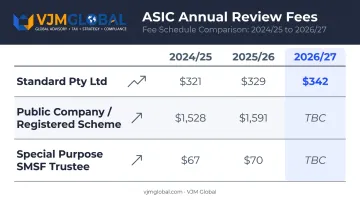
| Entity Type | 2024/25 | 2025/26 | 2026/27 |
|---|---|---|---|
| Standard proprietary company (Pty Ltd) | $321 | $329 | $342 |
| Public company or registered scheme | — | $1,528 | $1,591 |
| Special purpose SMSF trustee company | — | $67 | $70 |
SMSF Trustee Companies: Who Qualifies for the Reduced Fee
The $70 rate is not available to ordinary companies. To qualify, the company must meet specific criteria:
- Its sole purpose is acting as trustee of a regulated superannuation fund
- Its constitution prohibits the distribution of income or property to members
Standard trading companies, even those connected to an SMSF, don't qualify. When in doubt, check with your accountant or financial adviser — the eligibility test is specific, and applying the wrong rate can trigger late fees or compliance issues.
Other Key ASIC Fee Changes from 1 July 2026
Complete Fee Comparison Table
| Fee | 2025/26 | 2026/27 | Change |
|---|---|---|---|
| Voluntary deregistration | $50 | $52 | +$2 |
| Late payment — up to 1 month late | $98 | $102 | +$4 |
| Late payment — more than 1 month late | $411 | $428 | +$17 |
| Business name — 1 year registration/renewal | $45 | $47 | +$2 |
| Business name — 3 year registration/renewal | $104 | $108 | +$4 |
Voluntary Deregistration
At $52, voluntary deregistration is the lowest-cost way to formally close a company through ASIC, provided the company has no outstanding debts or assets. It's commonly used when winding up a company that previously held a corporate trustee role, such as an SMSF trustee company that's no longer needed.
Late Payment Fees: The Real Cost of Missing the Window
The late payment penalties carry the heaviest financial risk. Missing the two-month payment window triggers:
- $102 if you pay within one month after the deadline
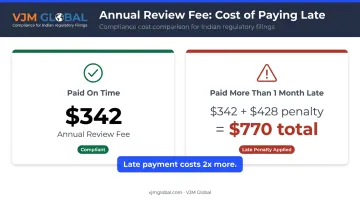
- $428 if you pay more than one month after the deadline
At $428, the penalty for a significantly overdue payment now exceeds the annual review fee itself ($342). The combined cost of ignoring an annual review invoice — $342 + $428 = $770 — is more than double what you'd pay on time.
10-Year Advance Payment Option
ASIC allows companies to prepay annual review fees up to 10 years in advance at a discounted rate. For eligible businesses planning to stay registered long-term, this option:
- Locks in fees before future annual increases apply
- Eliminates the risk of missed payments and late penalties
Current rates by entity type are available on ASIC's advance payment page.
ASIC Fee Trends: How Costs Have Grown
Year-on-year, each fee increase looks small. Across several years, those amounts compound — and that matters for long-term business planning.
Pty Ltd Registration Fee — Year-on-Year
| Financial Year | Registration Fee | Year-on-Year Increase |
|---|---|---|
| 2025/26 | $611 | — |
| 2026/27 | $636 | +$25 |
The two most recent figures are confirmed from ASIC's current fee schedules. For context, the annual review fee has increased by $13 over just two years ($329 → $342 from 2025/26 to 2026/27, up from $321 in 2024/25).
What Drives the Variation
The pace of increases depends directly on the March quarter CPI:
| March Period | Quarterly CPI | Annual CPI |
|---|---|---|
| 2024 | 1.0% | 3.6% |
| 2025 | 0.9% | 2.4% |
| 2026 | 1.4% | 4.6% |
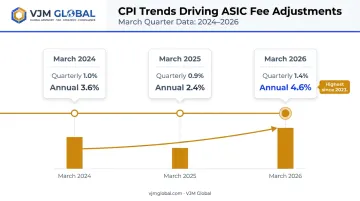
The 2026/27 increases are larger than those applied in 2025/26, driven by the March 2026 quarter CPI of 1.4% — the highest in the three-year comparison. If inflation pulls back by March 2027, the following year's adjustments should ease. ASIC's fee schedule ties increases to CPI, but the actual outcome depends on where inflation lands.
How to Manage ASIC Fees and Stay Compliant
Track Your Review Date
Your company's annual review date is typically the anniversary of its incorporation. Set a calendar reminder at least two months out — and check that ASIC has your current contact details so the annual statement reaches you without delay.
ASIC does not provide grace periods. Once the two-month window closes, late fees apply automatically.
Pay Through Official Channels Only
ASIC has published alerts about scammers impersonating ASIC to request fees or personal information. To stay safe:
- Pay only through ASIC's official online services portal or directly via the invoice received
- Be cautious of unsolicited invoices that resemble ASIC notices — verify via ASIC's website directly
- If using a service provider (accountant, registered agent), confirm they are authorised and reputable
Working With an Advisory Firm
Staying across ASIC deadlines while managing other business priorities is where many companies slip up. For businesses with multiple Australian entities — or those navigating their first Australian registration — an experienced adviser reduces the risk of missed deadlines and incorrect payments.
VJM Global has assisted 250+ Australian businesses with compliance and accounting support. For companies entering the Australian market or managing cross-border obligations, having a professional handle the administrative side of compliance is a straightforward way to avoid unnecessary penalties.
Frequently Asked Questions
How much is the ASIC annual review fee in 2024?
From 1 July 2024, the annual review fee for a standard proprietary company (Pty Ltd) was $321. This increased to $329 in 2025/26 and again to $342 in 2026/27.
How much does ASIC charge to register a company?
From 1 July 2026, ASIC charges $636 to register a new Pty Ltd or a public company limited by shares. Public companies limited by guarantee (typically not-for-profit structures) pay $524.
When do the 2026 ASIC fee changes take effect?
The new fees apply from 1 July 2026 and remain in effect until 30 June 2027. After that, fees will be re-indexed based on the March 2027 quarter CPI.
Are ASIC fees subject to GST?
No. ASIC fees are GST-free. If you engage an accountant or registered agent to handle lodgements on your behalf, their professional fees may attract GST separately.
What happens if I pay my ASIC annual review fee late?
If payment isn't made within two months of your annual review date, late fees apply on top of the original annual review fee: $102 for up to one month overdue, or $428 for more than one month overdue (2026/27 rates).
Can I prepay ASIC annual review fees in advance?
Yes. ASIC offers a 10-year advance payment option at a discounted rate, which locks in your fee and avoids annual increases and late payment penalties. Visit ASIC's advance payment page for current rates by entity type.