Many owners are asking a narrower question: does adding a Dubai offshore entity actually solve a market-access, tax, or asset-protection problem, or is it just another jurisdiction to manage? "Offshore company" gets thrown around loosely in most discussions. For a Singapore Pte Ltd owner, the real test is practical, not theoretical.
This article breaks down why Dubai offshore structures like RAK ICC and JAFZA Offshore are increasingly paired with Singapore entities, and what to check before adding one.
Key Takeaways
- Dubai offshore entities (RAK ICC, JAFZA) let Singapore firms hold assets and trade abroad without affecting ACRA compliance or tax residency
- Hold non-UAE profits tax-efficiently, reach MENA/GCC/Africa directly, and strengthen asset protection
- Offshore entities cannot trade on the UAE mainland—misuse risks penalties
- A cross-border advisor keeps both jurisdictions' compliance aligned from day one
What Is a Dubai Offshore Company?
A Dubai offshore company is a legal entity registered in a UAE offshore jurisdiction, most commonly Ras Al Khaimah International Corporate Centre (RAK ICC) or Jebel Ali Free Zone (JAFZA) Offshore. These structures support international trade, asset holding, and protection rather than day-to-day operations inside the UAE.
RAK ICC's own registry describes its structures as vehicles for holding shares in other companies, managing global investment portfolios, and supporting wealth preservation and banking relationships. JAFZA Offshore works similarly: it issues a certificate of incorporation rather than a trading licence, and it cannot conduct commercial activity with parties inside the UAE.
In practice, Singapore business owners use these entities to:
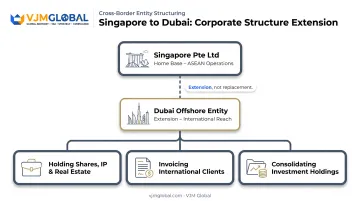
- Hold shares in subsidiaries, IP, or real estate outside Singapore
- Invoice international clients in regions where the Singapore entity has less direct presence
- Consolidate investment holdings under one confidential structure
None of this replaces a Singapore Pte Ltd. Think of the Dubai offshore entity as an extension: a tool for reach and protection, not a new home base. Your ACRA-registered company keeps running Singapore operations and ASEAN trade. The offshore entity handles a specific slice of international activity that sits better outside that structure.
Key Reasons Singapore Businesses Should Consider a Dubai Offshore Company
The reasons below aren't about generic offshore appeal. They're about three measurable outcomes: tax efficiency, market access, and risk protection. Singapore's territorial tax system already exempts certain unremitted foreign income, and Dubai's offshore tax treatment for non-UAE income can work alongside that rather than against it - which is why more Singapore SMEs are pairing the two.
Tax-Efficient Holding and Profit Repatriation
Dubai's tax treatment of non-UAE income is the headline reason many Singapore companies look at this structure.
The UAE's Ministry of Finance confirms a 0% withholding tax rate applies to relevant cross-border dividends, interest, and royalties paid to non-residents without a UAE permanent establishment, according to the UAE Ministry of Finance. That removes a layer of friction most jurisdictions add when profits move across borders.
A UAE-incorporated entity is still subject to UAE Corporate Tax on worldwide income, including income earned outside the UAE. Offshore status alone does not create a blanket exemption.
What helps instead is the Participation Exemption, which can cover foreign dividends and disposal gains if the entity holds at least 5% ownership (or spent AED 4 million acquiring the stake) for a minimum of 12 months.
In practice, this is how the structure gets used:
- Route non-ASEAN contracts, IP licensing fees, or investment holdings through the Dubai offshore entity rather than the Singapore Pte Ltd
- Foreign-sourced earnings consolidate under one entity with straightforward profit repatriation
- Singapore's own territorial system exempts foreign income from tax until it's remitted, transmitted, or brought into Singapore
Combine both rules correctly, and a Singapore group can hold non-ASEAN earnings offshore without immediate tax exposure in either jurisdiction, as long as the income genuinely qualifies as foreign-sourced and stays unremitted. Two territorial-style systems run in parallel here instead of colliding.
The setup pays off most when a meaningful share of revenue comes from non-ASEAN trade, licensing, or passive investments. It adds little when revenue is mostly Singapore- or ASEAN-sourced.
Track effective global tax rate, repatriation costs, and compliance overhead together. All three should move in the right direction, not just one.
Market Access to MENA, GCC, and Africa
Singapore's ASEAN trade agreements don't extend much advantage into the Gulf, Africa, or South Asia. Dubai fills that gap. A Dubai-linked entity gives a Singapore business a credible regional base for exactly the markets where a Singapore-only presence carries less weight.
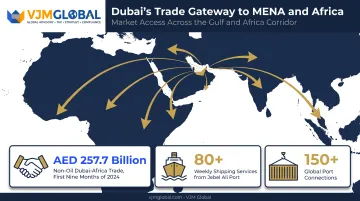
The scale of that opportunity is real. Non-oil trade between Dubai and African nations reached AED 257.7 billion in the first nine months of 2024 alone, according to Dubai Chambers.
Jebel Ali Port adds another layer: it connects 80+ weekly services to more than 150 ports globally. GCC and African counterparties tend to treat a Dubai-registered entity as a known quantity rather than an unfamiliar overseas supplier.
Why this shortens the sales cycle:
- MENA and African buyers often prefer contracting through a regional presence, even if operations remain elsewhere
- A JAFZA Offshore entity carries an implicit association with Jebel Ali's trade infrastructure, which reads as credibility during buyer due diligence
- Banking relationships and trade references build faster when counterparties recognise the jurisdiction
Nothing has to relocate. A Singapore trading, e-commerce, or consulting business can keep ASEAN operations as they are and use the Dubai entity purely as the contracting and invoicing point for GCC, African, or South Asian clients. That cuts reliance on local intermediaries who would otherwise charge for the "regional face" a Dubai entity can offer directly.
Prioritise this path if you are actively chasing new GCC, African, or South Asian clients. It matters far less if you are content to stay inside existing ASEAN corridors.
Useful signals: new-market revenue, partner conversion rates, and time-to-approval on new banking relationships.
Asset Protection, Privacy, and Risk Diversification
Dubai offshore structures separate personal and business risk cleanly. There's no public share register, and disclosure sits with the registered agent and regulator rather than open search. That is a meaningful difference from Singapore's ACRA records, which are publicly searchable.
That separation gives Singapore founders a genuine reason to hold real estate, IP, or investment portfolios in a distinct legal entity rather than inside the operating company:
- Litigation or creditor claims against the Singapore trading entity don't automatically expose assets sitting in the Dubai structure
- Political or regulatory risk concentrated in one jurisdiction gets diversified across two
- Long-term wealth planning gets easier when business risk and personal or family assets aren't tangled together
Privacy does not mean anonymity. RAK ICC and JAFZA both require registered agents to identify beneficial owners holding 25% or more, and banks run their own independent checks on top of that. What you get is confidentiality from public view, not exemption from scrutiny.
That distinction is also why Dubai remains a credible base rather than a flagged one. The Financial Action Task Force confirmed on 23 February 2024 that the UAE was no longer subject to increased monitoring, according to FATF. It has not reappeared on subsequent watch lists since.
Banks and counterparties now treat UAE entities as standard due-diligence cases rather than red flags.
This advantage carries the most weight for high-net-worth founders, holding companies, or any business with IP and real estate spread across more than one market.
Key Considerations Before Setting Up a Dubai Offshore Company
Adding a Dubai offshore entity isn't a plug-and-play decision. Three issues come up repeatedly.
Offshore doesn't mean UAE mainland. RAK ICC and JAFZA Offshore entities cannot trade within the UAE mainland market. Invoicing UAE-based customers directly through the offshore entity risks penalties and defeats the structure's purpose. Mainland access needs a different licence entirely.
Roles need to be defined, not assumed. Without a clear split between "holding" and "operating," a Singapore Pte Ltd and Dubai offshore entity can end up with duplicated or conflicting compliance obligations.
ACRA still expects Annual Returns, AGMs, and XBRL filings from the Singapore side regardless of UAE activity. The UAE side carries its own Ultimate Beneficial Owner filings and Economic Substance requirements.
Banking has become stricter, not looser. UAE banks now run detailed beneficial-ownership and source-of-funds checks before opening accounts. A structure with an unclear ownership chain or no obvious commercial purpose is exactly what banks and regulators are trained to flag.
None of these are dealbreakers. They're reasons to define the entity's purpose and documentation properly from the outset, rather than treating incorporation as the finish line.
How Singapore Businesses Can Set Up a Dubai Offshore Company
Setting up a Dubai offshore entity involves choosing the right registry, appointing an agent, and being specific about what the entity will actually do.
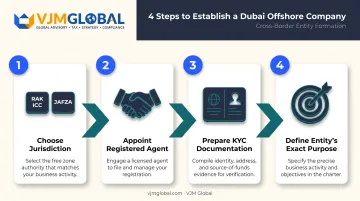
- Choose the jurisdiction. RAK ICC and JAFZA Offshore both work for holding and international trade. RAK ICC is generally faster and lower-cost; JAFZA ties more closely to Jebel Ali's port and logistics network.
- Appoint a registered agent. Neither registry accepts direct applications. Only a licensed registered agent can file the incorporation paperwork.
- Prepare KYC documentation. Expect passport copies, proof of address, and source-of-funds information for every shareholder and director. If the shareholder is a Singapore Pte Ltd, add its incorporation documents, constitutional documents, and an ownership chart showing anyone with 25%+ indirect ownership.
- Define the entity's exact purpose. Vague descriptions such as "general trading" or "management services" don't pass registry review. State clearly whether the entity is for holding shares, licensing IP, or invoicing international clients - and stick to that purpose.
Indicative registry fees (excluding agent and banking charges):
| Jurisdiction | Incorporation (1 year) | Annual renewal |
|---|---|---|
| RAK ICC | AED 3,250 | AED 3,950 |
| JAFZA Offshore | AED 10,000 | AED 2,500 |
The bigger long-term cost is restructuring later if the offshore entity's accounting was never aligned with your Singapore company's reporting. ACRA and IRAS deadlines don't pause while a UAE structure gets sorted out. Both sets of obligations need to run on parallel tracks without one derailing the other.
A firm that works across both jurisdictions can keep those tracks aligned from day one. VJM Global handles entity formation and compliance across the UAE and Singapore, so a RAK ICC or JAFZA setup is built with a clear path back into your existing Pte Ltd's accounting.
Conclusion
For a Singapore business, a Dubai offshore company is an addition that solves specific problems. It extends reach into MENA, GCC, and Africa where ASEAN trade agreements carry less weight.
Foreign-sourced earnings get a tax-efficient home without disturbing Singapore's territorial tax treatment, and personal and business risk sit apart in a way a single-jurisdiction structure cannot.
None of that happens automatically. Benefits compound only when the entity's purpose is defined clearly, Singapore and Dubai roles stay distinct, and both sides are reviewed regularly against ACRA, IRAS, and UAE rules.
Treat this as an ongoing structuring decision, not a one-off registration task. Work with an advisor who knows both jurisdictions—VJM Global supports entity formation and ongoing compliance across Singapore and the UAE.
Frequently Asked Questions
What is an offshore company in Dubai?
It's a legal entity registered in a UAE offshore jurisdiction, most commonly RAK ICC or JAFZA, used for international trade, asset holding, and investment. It cannot conduct business within the UAE mainland.
What are the requirements to open an offshore company in Dubai, UAE?
You'll need a registered agent, valid passport copies for shareholders and directors, a clearly defined business purpose, and incorporation documents submitted to the relevant free zone authority.
Can a Singapore company own a Dubai offshore company directly?
Yes. A Singapore Pte Ltd can act as a corporate shareholder, provided it supplies corporate KYC documents and its own incorporation details to the registered agent.
Do Dubai offshore companies affect my Singapore company's tax obligations?
Not automatically. Singapore taxes are based on its own territorial rules, and income earned through a properly structured Dubai offshore entity isn't taxed in Singapore unless it's remitted or attributed back.
Which Dubai offshore jurisdiction is best for Singapore-based businesses — RAK ICC or JAFZA?
RAK ICC is generally faster and cheaper to set up. JAFZA Offshore suits trade-focused businesses that benefit from its ties to Dubai's port and logistics network.
Can a Dubai offshore company open a bank account for use outside the UAE?
Usually, yes. Multi-currency accounts are common. Expect strict KYC checks, and approval can take a few weeks depending on ownership complexity.