Introduction
Dubai is increasingly becoming the international expansion destination of choice for Asian business owners, and Singapore entrepreneurs are leading this trend. DMCC reported a 13% year-on-year increase in Singaporean companies joining its free zone in 2025, reflecting accelerating interest from Singapore-based businesses. The draw is straightforward: zero personal income tax, 9% corporate tax versus Singapore's 17%, and 100% foreign ownership with no local sponsor requirements.
Singapore already offers one of the world's strongest business environments. Dubai builds on that foundation. For entrepreneurs looking to reach Middle East, Africa, and European markets, Dubai provides direct access to the approximately USD 5.09 trillion MENA region — a market that exceeds ASEAN's USD 3.95 trillion economy by over USD 1 trillion.
That scale of opportunity is what this article unpacks. The UAE-Singapore Double Taxation Avoidance Agreement (DTAA) also means cross-border income isn't taxed twice — an important structural advantage for Singapore entrepreneurs operating in both markets. What follows covers the practical benefits of starting a business in Dubai: tax structures, ownership rights, and strategic market positioning.
Key Takeaways
- Dubai's corporate tax sits at 9% (above AED 375,000) versus Singapore's 17% flat rate — free zones can offer 0% on qualifying income
- 100% foreign ownership is available across all Dubai free zones and most mainland categories, no local sponsor required
- Singapore + Dubai creates a dual-hub: Southeast Asia from one base, MENA, East Africa, and Europe from the other
- The UAE-Singapore DTAA shields cross-border income from double taxation
- Free zone setup takes roughly 10 working days via streamlined digital registration
Key Benefits of Starting a Business in Dubai for Singapore Entrepreneurs
The benefits below aren't abstract selling points. They represent measurable differences in cost, control, and market reach that Singapore entrepreneurs can quantify and act on immediately.
Benefit 1: Tax Efficiency That Directly Improves Business Profitability
Dubai's tax structure offers Singapore entrepreneurs genuine financial advantages that directly impact bottom-line profitability and personal take-home income.
Corporate Tax Comparison:
| Tax Category | UAE | Singapore |
|---|---|---|
| Corporate tax rate | 9% (above AED 375,000) | 17% (flat) |
| Free zone corporate tax | 0% (qualifying income) | N/A |
| Personal income tax | 0% | 0%-24% (progressive) |
| Withholding tax | 0% | 10%-15% |
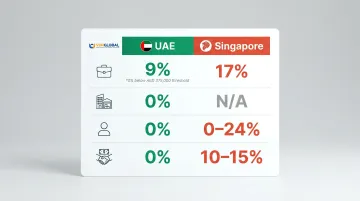
UAE's 9% corporate tax rate applies only to taxable income exceeding AED 375,000 (approximately SGD 138,000) — income below that threshold is taxed at 0%. This alone gives many early-stage businesses a meaningful cost advantage over Singapore's flat 17% rate.
Free zone companies can go further. Those qualifying as "Qualifying Free Zone Persons" (QFZP) pay 0% on qualifying income, provided they maintain adequate substance, derive income from qualifying activities, and keep non-qualifying revenue below 5% of total revenue or AED 5 million.
The personal income tax gap is where the real numbers emerge. Singapore's progressive system reaches 24% for income above SGD 1 million; the UAE charges zero. For high-earning founders, that difference translates directly into retained capital.
DTAA Protection and Profit Repatriation:
The UAE-Singapore DTAA, ratified with Multilateral Instrument (MLI) modifications in September 2019, prevents double taxation on cross-border income flows. This is particularly relevant for Singapore entrepreneurs maintaining business ties in both markets — income earned in Dubai isn't taxed again when repatriated to Singapore (subject to proper structuring and compliance).
Dubai imposes no restrictions on profit repatriation. Free zone companies can repatriate 100% of profits, with the AED pegged to the USD for currency stability. This gives Singapore entrepreneurs full financial flexibility to move capital between markets based on business needs.
Best Fit: High-Margin Service Businesses
Tax efficiency delivers the strongest returns for Singapore entrepreneurs in professional services, consulting, trading, and digital businesses — sectors where margins flow directly to the founder. A Singapore-based consultant earning SGD 500,000 annually could save over SGD 100,000 per year in personal income tax simply by relocating tax residency to Dubai while retaining their Singapore entity.
Benefit 2: 100% Foreign Ownership and Streamlined Business Setup
Singapore entrepreneurs can own 100% of their Dubai business without needing an Emirati local sponsor — a reform that fundamentally changed the UAE's competitiveness for foreign investors.
Ownership Reform:
Federal Decree-Law No. 32 of 2021, effective 1 June 2021, abolished the requirement for 51% Emirati ownership in mainland companies. Foreign investors may now establish and fully own onshore companies across most business categories without nominee structures or sponsor arrangements. For Singapore entrepreneurs accustomed to clean, unencumbered ownership at home, this removes the single biggest governance concern about entering the UAE market.
All Dubai free zones have always permitted 100% foreign ownership. The 2021 reform extended this to mainland operations, giving Singapore entrepreneurs two clear options:
- Free zone entities: Ideal for international trade, consulting, and digital services targeting markets outside the UAE
- Mainland entities: Necessary for direct UAE market access, government contracts, and local B2C operations
Setup Process and Timeline:
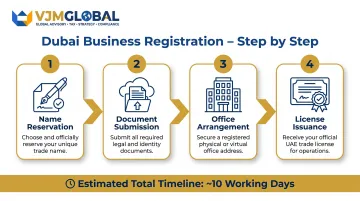
Dubai's business registration process is genuinely fast. DMCC reports a typical setup timeline of approximately 10 working days once documentation is complete. The process operates through digital portals with clear requirements:
- Name reservation and approval
- Document submission (passport copies, business plan, board resolutions)
- Office or flexi-desk arrangement confirmation
- License issuance and establishment card
Much of this can be initiated remotely before physically relocating or visiting Dubai, unlike the complexity many entrepreneurs face entering emerging markets in Africa or certain parts of Asia.
Competitive Context:
The UAE was included in the World Bank's inaugural B-READY 2024 report assessing business environment quality — a successor to the discontinued Doing Business index. Earlier benchmarks reinforced the picture: the UAE ranked 25th globally in the 2019 WEF Global Competitiveness Report, placing 1st in the Arab region with top-five finishes in macroeconomic stability, ICT adoption, and product market efficiency.
Best Fit: Founders Scaling Fast or Raising Capital
Full ownership with fast setup timelines is most valuable when speed and clean cap tables matter — scaling into new sectors, establishing holding structures, or preparing for investor due diligence. No sponsor complexity means no governance ambiguity at exit or during fundraising.
Beyond ownership structure, Dubai's physical and human infrastructure gives Singapore entrepreneurs an immediate operational foundation that most emerging markets simply can't match.
Benefit 3: Access to World-Class Infrastructure and a Global Talent Pool
Dubai offers purpose-built free zones aligned to specific industries, giving Singapore entrepreneurs sector-specific infrastructure and regulatory frameworks from day one.
Free Zone Ecosystem:
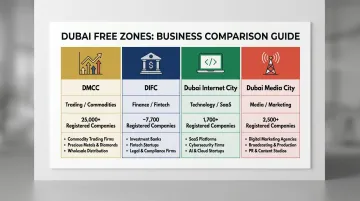
The UAE operates more than 40 specialised free zones, each designed around industry verticals:
- DMCC: Trading and commodities (25,000+ registered companies)
- DIFC: Finance and financial services (~7,700 active companies as of H1 2025)
- Dubai Internet City: Technology and innovation (contributed AED 100 billion to Dubai's GDP over 15 years)
- Dubai Media City: Media sector
- Dubai Healthcare City: Healthcare services
Singapore entrepreneurs can select an environment precisely matched to their sector and immediately benefit from co-located networks, shared infrastructure, and regulatory support tailored to their industry.
Infrastructure Advantages:
Dubai's operational infrastructure compares favourably to barriers encountered in other Middle East or African markets:
- Connectivity: High-speed internet, 5G coverage, and digital government services
- Logistics: Dubai International Airport is the world's busiest for international passenger traffic, while Jebel Ali Port ranks as the 9th busiest container port globally
- Workspace: Flexible office solutions, co-working spaces, and Grade A commercial buildings available immediately
- Banking: Streamlined corporate account opening with international banks
Talent Pool:
Expatriates comprise approximately 88% of the UAE's 11+ million population, creating a genuinely multicultural English-speaking workforce. Singapore entrepreneurs can find familiar skill profiles from South Asia, Southeast Asia, Europe, and the Arab world — often at more competitive salary levels than Singapore while maintaining high skill quality.

Best Fit: Logistics, Fintech, and SaaS Operators
Infrastructure and talent depth matter most for businesses where execution speed determines competitive position — logistics, fintech, e-commerce, and professional services chief among them. A Singapore-based SaaS company expanding to MENA, for instance, gains immediate access in Dubai Internet City to tech talent, investor networks, and regulatory frameworks built specifically for digital businesses.
The Singapore-Dubai Dual Hub Strategy: Covering the World Between Two Cities
Singapore is already an established hub for Southeast Asia and the broader Asia-Pacific. Dubai adds coverage of the Middle East, North Africa, East Africa, and a gateway to Europe, creating a dual-hub model that gives Singapore-based entrepreneurs a genuinely global footprint.
Strategic Complementarity:
The two markets are complementary rather than redundant:
- Both are cosmopolitan, English-friendly, rule-of-law jurisdictions with comparable ease of doing business
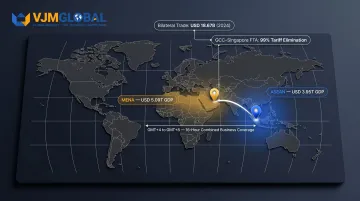
- Together they span nearly the full global business day (Singapore GMT+8, Dubai GMT+4), enabling 24-hour operational coverage
- Singapore covers the approximately USD 3.95 trillion ASEAN economy; Dubai provides access to the approximately USD 5.09 trillion MENA region
Proven Bilateral Relationship:
The UAE-Singapore corridor demonstrates substantial commercial activity:
- Bilateral merchandise trade reached USD 18.67 billion in 2024
- The UAE is Singapore's largest trading partner and investment destination in the MENA region
- The GCC-Singapore Free Trade Agreement (GSFTA), in force since September 2013, eliminates up to 99% of tariffs on Singapore exports to GCC countries
- Both countries signed a Comprehensive Partnership in 2019 and are exploring a bilateral CEPA
Practical Dual-Hub Structure:
That bilateral foundation makes the operational case straightforward. Singapore entrepreneurs typically maintain their Singapore entity for Asia-Pacific operations while using a Dubai free zone or mainland entity for MENA and international operations. This structure offers several concrete advantages:
- Structures income flows to leverage both jurisdictions' tax advantages while maintaining DTAA compliance
- A Dubai entity signals serious commitment to MENA clients; a Singapore entity does the same for Asian markets
- Time zone coverage allows customer support, sales, and operations to span global business hours
For cross-border compliance between the two entities, working with an experienced international advisory firm ensures clean transfer pricing documentation, proper DTAA application, and compliant multi-jurisdiction tax filings.
High-Value Sectors:
The dual-hub model delivers the clearest advantage for:
- Trading companies: Source from Asia, sell to MENA and Africa
- Logistics providers: Leverage Singapore's port and Dubai's airport/port infrastructure
- Professional services: Consulting, accounting, legal advisory serving multinational clients
- SaaS/tech companies: Target emerging markets across Asia and MENA simultaneously
- Family offices: Manage international investments with presence in two major financial centres
What Singapore Entrepreneurs Risk By Overlooking Dubai
The question isn't whether Dubai is worth exploring — it's whether competitors and peers from Singapore are already using Dubai to gain market share in regions that Singapore alone cannot efficiently serve.
The MENA region's GDP of approximately USD 5.09 trillion exceeds ASEAN's USD 3.95 trillion by over USD 1 trillion. Yet many Singapore-based entrepreneurs focus exclusively on Southeast Asian expansion, leaving MENA market opportunities to competitors who establish Dubai bases.
The MENA project pipeline is estimated at USD 3.7 trillion, with 84% (USD 3.1 trillion) concentrated in the GCC. This represents infrastructure, construction, services, and technology opportunities directly accessible through a Dubai base.
Operating without a Dubai presence creates specific disadvantages:
- Tax inefficiency: International earnings that could be structured through a Dubai entity to benefit from 0%-9% rates continue to bear Singapore's 17% corporate tax
- Regional credibility gap: MENA clients and government procurement processes often favour or require regional headquarters presence
- Competitive positioning: Singapore peers who've established Dubai operations gain first-mover advantages in relationship-building and market knowledge
Geography compounds these disadvantages further. Singapore's geographic advantage diminishes for companies targeting West Asia, Africa, and Southern Europe. Dubai sits closer to these markets across every practical measure: time zone, flight time, and cultural proximity. Every quarter without a Dubai presence is market position ceded to competitors who moved first.
How to Set Up Your Business in Dubai as a Singapore Entrepreneur
Setting up a Dubai business requires making informed decisions about jurisdiction, license type, and company structure before beginning the registration process.
Key Decision Points:
1. Free Zone vs. Mainland:
- Free zone: Choose this for international trade, consulting, and digital services targeting markets outside the UAE. Benefits include 100% foreign ownership (always permitted), 0% corporate tax on qualifying income, and simpler setup
- Mainland: Necessary for direct UAE market access, local B2C sales, and government contracts. Now permits 100% foreign ownership under the 2021 reforms
2. Free Zone Selection (if applicable):
| Free Zone | Best For | Companies Registered |
|---|---|---|
| DMCC | Trading, commodities, precious metals | 25,000+ |
| DIFC | Finance, fintech, asset management | ~7,700 |
| Dubai Internet City | Technology, SaaS, digital services | Not disclosed |
| Dubai Media City | Media, marketing, content production | Not disclosed |
3. Business Activity and License Type:
Select the specific business activities your license will cover. This determines permissible revenue streams and regulatory requirements. Most free zones offer commercial, professional, and industrial license categories.
Practical Setup Steps:
Step 1: Name Reservation Submit your proposed company name for approval through the relevant free zone or mainland authority portal.
Step 2: Document Submission Prepare and submit required documents, typically including passport copies, business plan or activity description, and board resolutions (if applicable). Much of this can be completed digitally before visiting Dubai.
Step 3: Office Arrangement Secure physical office space, flexi-desk arrangement, or virtual office (depending on license type). Most free zones offer flexible options suitable for early-stage operations.
Step 4: License Issuance Once documents are verified and fees paid, authorities issue the business license and establishment card. DMCC reports this process typically takes approximately 10 working days.
Getting your license is only the beginning — ongoing compliance is equally important once your business is operational.
Ongoing Compliance Requirements:
After setup, maintaining compliance requires attention to several ongoing obligations:
- Register for corporate tax if your taxable revenue exceeds AED 375,000 (small business relief threshold); all taxable persons must register regardless of size
- Register for VAT if taxable supplies exceed AED 375,000 over any 12-month period (5% standard rate applies)
- Renew your free zone or mainland license annually and budget for the associated renewal fees
- Maintain proper transfer pricing documentation and DTAA compliance if operating entities in both Singapore and Dubai
Working with an experienced advisory firm helps Singapore entrepreneurs avoid compliance gaps and penalties across both markets.
VJM Global has 30+ years of international compliance and business setup expertise, assisting clients with DTAA application, transfer pricing compliance, and cross-border accounting between Singapore and Dubai entities, ensuring requirements in both jurisdictions are met efficiently.
Conclusion
Dubai offers Singapore entrepreneurs a rare combination of tax efficiency, full ownership, world-class infrastructure, and strategic market access that no other single jurisdiction matches. For most Singapore businesses, Dubai works alongside their existing base — not instead of it.
As MENA markets grow and global trade routes continue to shift toward Asia and the Gulf, an early Dubai presence translates into supplier relationships, client networks, and market familiarity that take years to build. The 13% year-on-year growth in Singaporean companies joining DMCC reflects this momentum — Singapore's business community is already moving.
The setup process is fast, the regulatory environment is clear, and the opportunity cost of waiting is real. For Singapore entrepreneurs ready to expand beyond Asia-Pacific markets, the practical next step is mapping out which free zone, ownership structure, and operational setup fits your business — then acting on it.
Frequently Asked Questions
What are the benefits of opening a business in Dubai?
Dubai offers zero personal income tax, 9% corporate tax (with free zone entities potentially qualifying for 0% on qualifying income), and 100% foreign ownership in free zones and most mainland categories. For Singapore entrepreneurs specifically, the UAE-Singapore DTAA provides protection from double taxation on cross-border income flows.
Is Dubai better than Singapore for starting a business?
This isn't an either-or question. Dubai and Singapore serve different geographic markets and are most powerful when used together as a dual-hub strategy. Singapore excels for Asia-Pacific access; Dubai provides a gateway to MENA, East Africa, and Europe.
Do Singapore entrepreneurs need a local sponsor to set up a business in Dubai?
No. 100% foreign ownership is available in all Dubai free zones and for most business activities on the mainland following UAE regulatory reforms in 2021. No Emirati sponsor is required for most business categories.
Does the UAE have a Double Taxation Agreement with Singapore?
Yes. The UAE-Singapore DTAA is in force, ratified with MLI modifications in September 2019. Singapore entrepreneurs with business income in both countries are protected from being taxed twice on the same earnings.
Can a Singapore entrepreneur get residency in Dubai by starting a business?
Yes. Company formation in Dubai qualifies owners for UAE residency visas. Long-term options like the Golden Visa are also available for investors and entrepreneurs who meet eligibility thresholds, making dual residency across both hubs achievable.
What is the best free zone in Dubai for Singapore entrepreneurs?
The best free zone depends on your sector. DMCC suits trading and commodities, DIFC is built for finance and fintech, and Dubai Internet City targets technology firms. Aligning your free zone to your industry gives you the most relevant licensing structure and peer ecosystem.