These structural advantages draw a diverse group of entrepreneurs: foreign investors, Non-Resident Indians (NRIs), Indian business owners seeking a regional gateway, and multinationals eyeing ASEAN access. Singapore's 29 implemented Free Trade Agreements — spanning ASEAN, CPTPP, RCEP, and the EU — deliver preferential tariff treatment across major global markets, while transparent regulations and minimal bureaucracy make company formation accessible beyond the traditional corporate giants.
This guide walks through exactly what a trading company is, what you need to know before launching, why Singapore remains a compelling jurisdiction, and the precise steps to establish your import/export operation legally and operationally.
Key Takeaways
- Trading companies in Singapore import/export physical goods and must register with both ACRA and Singapore Customs
- Incorporation costs S$315 with ACRA; you'll also need a Customs account, a declaring agent, TradeNet permits, and an Inter-Bank GIRO to operate
- Corporate tax is flat at 17%, with new companies qualifying for significant exemptions; GST is 9% on imports but can be suspended via Zero-GST warehousing
- Incorporation can take as few as 1–3 days, though ongoing compliance — permits, ACRA filings, tax submissions — continues well beyond launch
What Is a Trading Company in Singapore?
A trading company is a business entity established to buy and sell physical goods across international borders — importing into Singapore, exporting to overseas markets, or both. This is distinct from retail businesses serving local walk-in customers or financial firms trading in securities.
Trading companies operate in two core formats:
- Importing goods from foreign suppliers for local sale or re-export
- Exporting locally produced or sourced goods to international buyers
Many companies operate in both directions at once, positioning Singapore as a hub between their supply sources and end markets — a setup Singapore's infrastructure and trade agreements are specifically built to support.
What to Know Before You Start a Trading Company in Singapore
Trading Companies Face More Compliance Layers Than Standard Businesses
Starting a trading company involves more regulatory layers than a typical service business. Beyond ACRA company registration, you must navigate Singapore Customs processes, goods classification rules, and permit compliance — each with real timelines and recurring obligations.
Key Operational Realities
- Permit-per-shipment requirement: Every import requires an IN Permit; every export requires an OUT Permit via TradeNet (approximately S$3.19 per permit)
- Controlled goods: Items classified as "controlled" (food, pharmaceuticals, tobacco, petrochemicals) require additional approvals from agencies like HSA, SFA, or NEA
- Strategic goods: Military and dual-use goods fall under the Strategic Goods Control Act, requiring separate permits
- Non-compliance consequences: Permit rejections, fines, or suspension of trading privileges
- HS/CA Product Code Checker: Use Singapore Customs' free tool to confirm whether your goods need extra approvals before your first shipment
Compliance obligations directly shape your cost structure — and recurring fees add up faster than most founders expect.
Recurring Costs That Catch New Traders Off Guard
Total startup costs extend well beyond the S$315 ACRA incorporation fee:
- Customs duties on dutiable goods (tobacco, alcohol, vehicles, petroleum)
- GST at 9% on the CIF (Cost, Insurance, Freight) value of imports
- Declaring agent fees for TradeNet permit submissions
- Security lodgement requirements for certain high-risk goods
- Trade credit insurance to protect against buyer default
- Warehousing costs if goods are held in Singapore before re-export
Model these costs against your expected shipment volume before finalizing your break-even timeline — most traders underestimate recurring compliance fees by 15–20%.
Why Start a Trading Company in Singapore?
Singapore consistently ranks among the world's easiest places to do business — and for trading companies specifically, the combination of infrastructure, tax efficiency, and regulatory simplicity is hard to match.
Strategic Trade Infrastructure
Singapore's trading advantage comes from infrastructure that few countries can replicate:
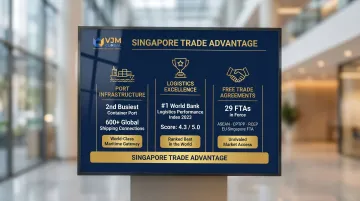
- Port infrastructure: The world's second-busiest container port by throughput, with seamless connectivity to 600+ ports globally
- Logistics excellence: Ranked #1 globally on the World Bank Logistics Performance Index 2023 (score 4.3), ensuring minimal transit delays
- Free Trade Agreements: 29 implemented FTAs covering ASEAN, CPTPP (12 economies), RCEP (15 countries), and the EU-Singapore FTA — delivering preferential tariff access across the majority of global trade flows
Business-Friendly Regulatory Environment
- Digital company registration: ACRA's BizFile+ portal processes incorporations in as little as one business day
- Free Customs account activation: Takes as little as 4 working hours with no application fees
- Transparent procedures: Zero tolerance for corruption; clear, publicly accessible regulations
- Free Trade Zone access: Bonded warehouses and FTZ facilities are available to registered traders, supporting efficient re-export operations
Financial Incentives
- Competitive tax: Flat 17% corporate income tax rate
- Startup tax exemptions: New companies receive 75% exemption on the first S$100,000 and 50% on the next S$100,000 of chargeable income for the first three years (total exemption: S$125,000 per year)
- GST suspension schemes: Zero-GST Warehouses and Free Trade Zones allow companies to defer 9% GST on goods held for re-export, which directly improves working capital
- Low transaction costs: TradeNet permit fees average just S$3.19, making per-transaction regulatory overhead negligible
How to Start a Trading Company in Singapore – Step by Step
Follow these steps sequentially. Skipping or delaying any step — particularly Customs registration — will delay your first shipment.
Step 1 – Choose Your Business Structure
Three structures are available for trading companies:
| Structure | Liability | Scalability | Bank/Supplier Credibility |
|---|---|---|---|
| Sole Proprietorship | Unlimited personal liability | Limited | Low |
| Partnership | Shared unlimited liability | Moderate | Moderate |
| Private Limited (Pte. Ltd.) | Limited to share capital | High | High |
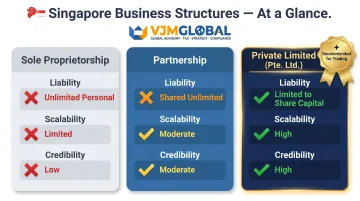
Recommendation: The Private Limited Company (Pte. Ltd.) structure is best for trading companies due to:
- Shareholders' losses are capped at their share capital (limited liability)
- Adding shareholders, raising capital, or bringing in investors is straightforward
- Suppliers and banks prefer dealing with incorporated entities
Minimum requirements for a Pte. Ltd.:
- At least 1 shareholder (individual or corporate; foreigners permitted)
- At least 1 locally resident director (Singapore Citizen, PR, or Employment Pass holder)
- 1 company secretary (must be Singapore resident; cannot be the sole director)
- Minimum paid-up capital: S$1
- A registered Singapore office address
Foreign founder note: Can't meet the local director requirement? A nominee director service typically adds S$1,000–S$3,000 annually to your setup costs.
Step 2 – Incorporate with ACRA
Process (via ACRA's BizFile+ portal):
- Reserve company name (S$15 fee)
- Submit incorporation documents:
- Business activity description (use appropriate SSIC codes for wholesale trade)
- Director and shareholder details with identification
- Company secretary appointment
- Pay S$300 registration fee
- Receive approval and Unique Entity Number (UEN) — typically within 1–2 business days
The UEN is mandatory for all subsequent registrations, including Singapore Customs.
Total ACRA cost: S$315
Step 3 – Activate Your Singapore Customs Account and Appoint a Declaring Agent
Customs Account Activation:
- Cost: Free
- Timeline: 4 working hours if no supporting documents required; 3 working days with documents
- Process: New ACRA entities can activate directly through the ACRA portal upon incorporation; use your UEN
Declaring Agent:
Since customs permit applications must be submitted through TradeNet by an authorized agent, most trading companies appoint a licensed declaring agent (freight forwarder or cargo agent) to handle submissions.
Options:
- Appoint a third-party declaring agent (charges service fees per permit, typically S$30–S$80 depending on complexity)
- Register as your own declaring agent and apply for a TradeNet User ID (requires technical knowledge of customs procedures)
Find licensed declaring agents via Singapore Customs' Directory of Service Providers.
Step 4 – Classify Your Goods and Apply for Customs Permits
Goods Classification (Three Categories):
- Non-controlled goods: No additional permits required beyond standard TradeNet IN/OUT permit
- Controlled goods: Require approvals from Competent Authorities such as:
- Health Sciences Authority (HSA) — pharmaceuticals, medical devices
- Singapore Food Agency (SFA) — food products
- National Environment Agency (NEA) — hazardous substances
- Strategic goods: Military or dual-use items regulated under the Strategic Goods Control Act
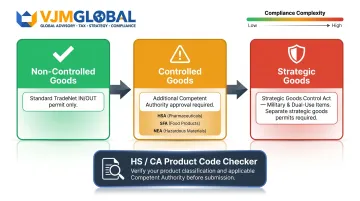
Use the HS/CA Product Code Checker (TradeNet portal) to identify your 8-digit HS code and check for controlling authorities.
Permit Application Requirements:
- IN Permit required for all imports
- OUT Permit required for all exports
- Timing rules:
- Road/rail shipments or controlled goods: Obtain permit before shipment
- Sea/air non-controlled goods: Obtain permit within 3 days of export
Certificate of Origin (CO):
If your buyers need proof of Singapore origin to claim FTA preferential tariffs, apply for a Preferential Certificate of Origin via TradeNet or through self-certification schemes under specific FTAs (e.g., ASEAN Form D, EODES for China).
Permit validity: IN-Payment permits are valid for 9 working days from approval; plan shipment clearance accordingly.
Step 5 – Set Up Financial Infrastructure
1. Inter-Bank GIRO (IBG) for Singapore Customs
IBG links your company's bank account directly to Singapore Customs, automating GST, duty, and permit fee payments.
Why it matters: Without an IBG, fees default to your declaring agent's GIRO, creating dependency and additional charges.
Process:
- Download the IBG application form from Singapore Customs
- Mail the completed form physically to the address stated (email/digital submission not accepted)
- Receive confirmation
Timeline: 3–4 weeks
2. Corporate Bank Account
Open a dedicated business account for:
- Trade payments: Letters of Credit and telegraphic transfers
- Trade financing: inventory financing and revolving credit lines
- GST and duty payments to Singapore Customs
Recommendation: If you have recurring international payments in multiple currencies, explore multi-currency accounts to reduce foreign exchange costs.
3. GST Registration (If Applicable)
If your annual taxable turnover exceeds S$1 million, GST registration with IRAS is mandatory. GST-registered companies can claim back the 9% GST paid on imports that are subsequently re-exported, directly improving cash flow.
Professional support: GST compliance, quarterly filings, and customs documentation add up quickly. Working with a cross-border accounting firm like VJM Global can help trading companies — especially those managing operations across multiple jurisdictions — structure their compliance obligations, coordinate bookkeeping, and avoid costly filing errors.
Taxes, Costs, and Ongoing Compliance for Trading Companies
Singapore's tax framework for trading companies covers three main areas: customs duties on dutiable goods, GST on imports, and corporate income tax. Here's what each means in practice.
Customs Duties
Duties apply to four categories of dutiable goods:
| Category | Sample Duty Rate |
|---|---|
| Tobacco (non-cigarette) | S$535 per kg |
| Cigarettes | S$0.589 per gram |
| Intoxicating liquors | S$60 per litre of alcohol (excise) + S$16 per litre (customs) |
| Motor vehicles | 20% of customs value |
| Petroleum products (unleaded RON 97+) | S$7.90 per decalitre |
All other goods are non-dutiable.
GST on Imports
- Rate: 9% (effective 1 January 2024)
- Charged on: CIF (Cost, Insurance, Freight) value of imported goods
- Collection: By Singapore Customs at the point of import
GST Suspension Mechanisms (Cash Flow Advantage):
- Zero-GST Warehouse Scheme (ZGS): Store imported non-dutiable goods indefinitely with GST suspended; GST payable only when goods are removed for local consumption (not when re-exported)
- Licensed Warehouses: Duty and GST suspended while goods remain in the warehouse
- Free Trade Zones: GST-free storage for goods intended for re-export
GST-registered traders can claim back the 9% GST paid on imports that are re-exported, making registration advantageous for high-volume exporters.
Corporate Income Tax
- Rate: Flat 17% on chargeable income
- Start-Up Tax Exemption (SUTE): For the first 3 consecutive Years of Assessment, qualifying new companies receive:
- 75% exemption on the first S$100,000 of chargeable income (saves S$75,000 in tax)
- 50% exemption on the next S$100,000 (saves S$50,000 in tax)
- Total exemption: Up to S$125,000 per year
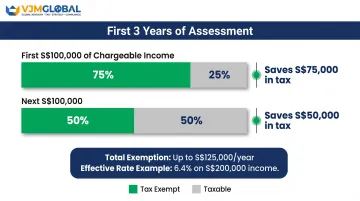
Example: A new trading company earning S$200,000 in chargeable income in Year 1 pays tax on only S$75,000 (S$12,750 tax on S$200,000 = effective rate of 6.4%).
Qualifying conditions — the company must:
- Be incorporated and tax resident in Singapore
- Have no more than 20 shareholders (all individuals, or at least one individual holding 10%+ of ordinary shares)
- Not be an investment holding or property development company
YA 2026 CIT Rebate: Enhanced to 50% of tax payable, capped at S$40,000 (including S$2,000 Cash Grant for qualifying companies).
Ongoing Compliance Requirements
Annual Filings:
- ACRA Annual Return: File each year; S$60 filing fee
- ECI (Estimated Chargeable Income): Submit within 3 months of financial year-end
- Form C/C-S (Corporate Tax Return): Due by 30 November annually
- GST Return: File quarterly if GST-registered
Document Retention:
Both the importer/exporter and the declaring agent must keep all documents related to the purchase, import, sale, or export of goods for at least 5 years from the permit approval date. Non-compliance can result in penalties or loss of trading privileges.
Managing these filings in-house takes time away from running the business. Many trading companies work with a cross-border accounting partner — particularly useful when operations span Singapore and other markets — to keep filings on schedule and avoid penalties.
Conclusion
Starting a trading company in Singapore is straightforward when each step is followed in sequence. The combination of same-day digital company registration, free Customs account activation, and transparent permit procedures makes Singapore one of the most accessible jurisdictions for establishing an import/export business.
Long-term success, though, depends less on setup speed and more on ongoing compliance, financial discipline, and regulatory awareness. Founders who understand permits, taxes, and documentation requirements from the start — and engage professional accounting support where needed — keep their operations clean and their shipments moving. That preparation is what separates businesses that scale from those that stall at their first customs query.
Frequently Asked Questions
Is $5,000 enough to start a trading business in Singapore?
S$5,000 covers the minimum ACRA registration costs (S$315) and initial declaring agent fees, but operational costs vary significantly by goods type and volume. Budget for GST (9% of import value), customs duties on dutiable goods, warehousing, and declaring agent fees before committing capital.
How do I start a trading business in Singapore?
The core steps are:
- Incorporate a Pte. Ltd. with ACRA (S$315) and activate a Singapore Customs account using your UEN
- Appoint a declaring agent and classify your goods using the HS/CA Product Code tool
- Apply for IN/OUT permits via TradeNet and set up an Inter-Bank GIRO for duty payments
Can a foreigner start a trading company in Singapore?
Yes, foreigners can be sole shareholders. However, you must appoint at least one locally resident director (Singapore Citizen, PR, or Employment Pass holder). If based abroad, engage a nominee director service to satisfy this requirement.
Do I need a license to import and export goods in Singapore?
All imports require an IN Permit and all exports require an OUT Permit via TradeNet. Additional licenses apply only to controlled or strategic goods. Use the HS/CA Product Code search tool on Singapore Customs' website to check your product classification.
What is the corporate tax rate for trading companies in Singapore?
The corporate tax rate is a flat 17% on chargeable income. Newly incorporated companies may qualify for the Start-Up Tax Exemption (SUTE), which offers up to S$125,000 in partial exemption on the first S$200,000 of income annually for the first three assessment years.
How long does it take to register a trading company in Singapore?
ACRA incorporation takes 1–2 business days and Singapore Customs account activation can be completed the same working day. Full trade operations — including your first customs permit and Inter-Bank GIRO setup — typically begin within 2–4 weeks.