This guide is for UK company directors, sole traders who incorporated, and small business owners weighing up closure. Getting the process right matters. Rush it, and you risk director liability, financial penalties, or compliance headaches years down the line.
The strike-off process looks easy on paper. Underneath, there are eligibility rules, notice periods, and tax settlement requirements that trip up a surprising number of directors. This article covers what cancellation actually means, the step-by-step DS01 process, costs and timelines, common mistakes, and when strike-off isn't the right route at all.
Key Takeaways
- Form DS01 is the standard route to cancel a UK company registration for solvent, non-trading businesses
- You must settle debts, close bank accounts, and notify stakeholders before applying
- The current filing fee is £13 online or £18 by post
- A two-month statutory notice in The Gazette follows before dissolution is final
- Companies with debts or disputes can't use strike-off and need liquidation instead
What Does It Mean to Cancel a Company Registration in the UK?
Cancelling a company registration means applying to Companies House to strike the company off the register under the Companies Act 2006. Once approved, the company stops existing as a legal entity.
After dissolution, the company can no longer trade, own assets, or enter contracts. Here's the part that catches people off guard: any money or property still owned by the company automatically passes to the Crown as ownerless property, known as bona vacantia. This rule is detailed in Companies House guidance on bona vacantia.
Ceasing to trade is not the same as dissolution. A dormant company still has ongoing filing obligations at Companies House until it's officially struck off. Simply stopping trading, letting invoices lapse, or ignoring the business doesn't end its legal duties.
Strike-off and liquidation solve different problems. Voluntary strike-off suits solvent companies with no debts and minimal assets, while liquidation (either Members' Voluntary or Creditors' Voluntary) applies where debts exist or assets need formal distribution.
Who Is Eligible to Apply for Voluntary Strike-Off?
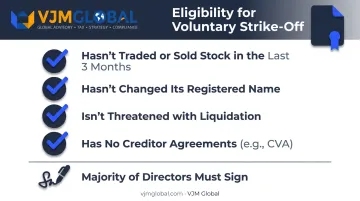
Not every company can use this route. To qualify, the company must meet all of the following in the 3 months before applying:
- Hasn't traded or sold stock
- Hasn't changed its registered name
- Isn't threatened with liquidation
- Has no creditor agreements in place, such as a CVA
A majority of directors must agree to and sign the application, though a sole director can sign alone and two directors must both sign. Statutory notice must also go to shareholders, creditors, employees, and pension fund trustees within 7 days of submitting the form.
Step-by-Step Guide to Cancel Company Registration
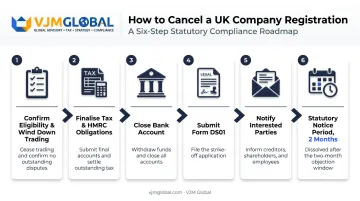
The process runs from settling financial and legal affairs through to submitting the application, then waiting out the statutory objection period before dissolution is confirmed. Skip a step, and Companies House can reject or delay the whole thing.
Step 1: Confirm Eligibility and Wind Down Trading
Trading must stop completely, and you'll need to sell or dispose of business assets and stock while settling outstanding invoices before you apply. Any activity beyond winding down affairs, such as continued sales, breaks the eligibility rules and can invalidate your application.
Step 2: Finalise Tax, Payroll and HMRC Obligations
This is where most applications go wrong. Before applying:
- Deregister for PAYE if you employed staff, submitting a final Full Payment Submission marked as your last
- Cancel VAT registration if you're no longer eligible, which HMRC requires within 30 days of ceasing eligibility
- File your final Corporation Tax return (CT600) and pay any tax owed
HMRC cannot issue a refund to a company once it's dissolved, so resolve outstanding tax matters first.
Step 3: Close the Company Bank Account
Withdraw and distribute all funds before dissolution, since once the company is struck off, the account is frozen and any leftover balance vests in the Crown. Recovering it later usually means restoring the company through the courts, an expensive and slow process.
Step 4: Complete and Submit Form DS01
File online via Companies House WebFiling or by post. The form must be signed by a majority of directors, with the company name and number matching the register exactly.
| Filing Method | Fee |
|---|---|
| Online (WebFiling) | £13 |
| Paper (post) | £18 |
Filing online saves £5 and typically processes faster than paper applications, according to Companies House's DS01 guidance. Paper payments must be made by cheque or postal order, never from the company's own bank account.
Step 5: Notify All Interested Parties
Send a copy of the DS01 form, within 7 days of submitting it, to:
- Shareholders and members
- Creditors, including HMRC
- Employees
- All directors, including any who didn't sign
- Pension fund trustees
Failing to notify these parties is a legal offence and can lead to prosecution.
Step 6: Wait Through the Statutory Notice Period
Once accepted, Companies House publishes a proposed strike-off notice in The Gazette. If nobody objects within two months, and there's no reason to delay, the company is formally dissolved. Creditors, HMRC, or other interested parties can object during this window, which suspends or halts the process until resolved.
Common Mistakes and Compliance Risks to Avoid
Even straightforward closures go sideways. Here's what commonly causes rejections or trouble later:
- Unfiled tax returns or unresolved HMRC debts: HMRC is a creditor and can object to your strike-off, or the company can be restored later for compliance action
- Overlooked overseas entities: a UK business with a subsidiary or branch office in India can't simply strike off the parent and walk away. That entity needs its own ROC closure, plus separate GST and income tax deregistration
- Money left in the bank account: once dissolved, any remaining balance becomes Crown property (bona vacantia), and getting it back typically requires costly court-ordered restoration
The cross-border piece deserves more attention than it usually gets. UK companies with Indian subsidiaries often assume closing the UK entity automatically resolves the Indian side. It doesn't. ROC filings, GST deregistration, and final tax clearances in India run on entirely separate timelines and requirements from a Companies House strike-off.
This is exactly the kind of parallel closure that specialist cross-border firms like VJM Global help manage. They coordinate Indian regulatory sign-off alongside your UK dissolution, so nothing is left unresolved on either side.
When Strike-Off Isn't the Right Option
Strike-off isn't a universal exit button. Two scenarios call for a different approach entirely.
If your company has outstanding debts, voluntary strike-off is off the table. You'll need Creditors' Voluntary Liquidation (CVL), where a licensed insolvency practitioner takes over, realises assets, and pays creditors according to insolvency priorities.
If your company is solvent but holds significant assets to distribute, strike-off usually isn't the best fit either. Members' Voluntary Liquidation (MVL) offers a more formal, often more tax-efficient wind-up, with a licensed liquidator handling the distribution to shareholders, as outlined in the government's MVL guidance for directors.
Watch for these warning signs that strike-off is being used as a shortcut rather than the right tool:
- Unresolved disputes or pending legal claims
- Simply wanting to dodge annual filing fees
- Assets that need proper, documented distribution to shareholders
Filing a DS01 for any of these reasons risks rejection or personal liability down the line. Get professional advice before you submit the form.
Final Thoughts on Cancelling Your Company Registration
Cancelling a company registration involves a structured, multi-step legal process with real consequences if you get it wrong.
Settling your finances, tax obligations, and stakeholder notifications correctly before applying prevents rejected applications and protects directors from personal liability down the line.
If your business has cross-border operations, such as a subsidiary in India, coordinate the UK dissolution with proper closure of the overseas entity. VJM Global supports UK businesses on the India side of this process, managing compliance and accounting through to final closure. This keeps the Indian entity from becoming an open liability after your UK company is gone.
Frequently Asked Questions
How do I remove a company from the register?
Submit Form DS01 to Companies House, provided your company meets eligibility requirements. A two-month statutory notice period in The Gazette follows before dissolution is finalised.
Can I cancel my LLC if I am no longer using it?
In UK terms, this means applying for voluntary strike-off of a limited company. A dormant or unused company can apply if it hasn't traded for at least 3 months and has no outstanding debts.
How hard is it to cancel an LLC?
It's straightforward via DS01 if you meet the eligibility criteria. It becomes far more complex when debts, disputes, or unfiled tax returns are involved.
How long does it take to dissolve a company in the UK?
Beyond the time needed to settle accounts beforehand, the statutory process adds at least eight weeks once Companies House publishes your notice in The Gazette.
What's the difference between striking off and liquidation?
Strike-off suits solvent, asset-free companies. Liquidation, either MVL or CVL, applies when a company has assets to distribute or debts to settle.
Do I need to settle tax obligations with HMRC before closing my company?
Yes. File your final Corporation Tax return, deregister for VAT and PAYE, and pay any outstanding tax before submitting your strike-off application.