This guide is written for NRIs, OCIs, and foreign business owners in the US, UK, and Australia who registered an LLP in India but now need to exit, whether the business never took off, became financially unviable, or the compliance workload outweighs the benefit.
Here's the part most people miss: LLP closure is often confused with "stopping operations." But if you don't file the proper closure forms, partners stay on the hook for penalties and compliance requirements indefinitely, even if the LLP hasn't done a single transaction in years.
This article walks through eligibility conditions, the step-by-step Form 24 procedure, required documents, and when voluntary winding up makes more sense than strike-off.
Key Takeaways
- LLP closure happens via Form 24 strike-off for dormant LLPs with no liabilities, or voluntary winding up when creditors or assets remain
- Late Form 8/11 filings now cost 15x-30x the normal fee plus uncapped daily charges beyond 360 days
- Form 24 requires stopped business, closed bank accounts, and all pending filings cleared first
- Partners remain personally liable for undisclosed debts even after the LLP is struck off
- Foreign partners often need help with DSC filings and CA certifications instead of visiting India
What Is LLP Closure? Understanding the Two Legal Routes
LLP closure is the formal process of removing an LLP's name from ROC records, ending its legal existence and every compliance obligation tied to it. Once struck off, the LLP stops existing as a legal entity. No more annual returns, no more penalties, no more paperwork.
Here's where people go wrong: an LLP that simply stops filing returns is not "closed." It's still legally active and still accruing daily penalties. Registrars can, and do, strike off such LLPs involuntarily, but that process doesn't erase the fines already accumulated in the interim.
There are two distinct legal routes to shut an LLP down properly.
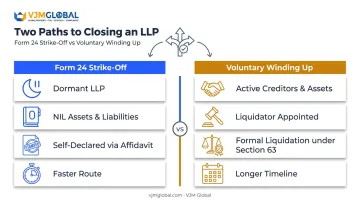
Striking Off via Form 24
This is the faster, simpler route introduced under the LLP (Amendment) Rules, 2017. It's designed for LLPs that either never commenced business or have ceased all operations, provided there are no assets and no liabilities left on the books. Most foreign-owned LLPs that registered but never really got going in India use this route.
Voluntary Winding Up
Voluntary winding up is the formal liquidation route under Section 63 of the LLP Act, 2008. It applies when the LLP still has creditors, assets to distribute, or ongoing liabilities.
An appointed liquidator manages the process, realizes assets, settles claims, and reports to the relevant authority before the LLP can be dissolved. It takes longer and costs more, but it's the only legally valid option when money or obligations are still outstanding.
Why and When You Should Close an LLP: Eligibility Conditions
Most closures happen for one of these reasons:
- Prolonged inactivity with no realistic plan to resume business
- Financial unviability or inability to scale in the Indian market
- Partners mutually deciding to exit the venture
- Compliance costs outweighing any benefit the entity provides
Before filing Form 24, check whether your LLP actually qualifies. The eligibility checklist is short but strict:
- No business activity for at least one year (or none since incorporation)
- NIL assets and NIL liabilities on the books
- All partners consent to the closure application
- All overdue statutory filings are cleared, including Form 8, Form 11, and income tax returns up to the cessation date
The ROC will reject an incomplete application outright. This is the single biggest cause of delayed closures among foreign-owned LLPs.
The Cost of Not Closing Properly
Here's the number that surprises most clients: defaulting on Form 8/11 instead of closing formally gets expensive fast. The additional fee structure introduced by the MCA in February 2022 applies steep penalties, with no stated cap on the daily component:
- Small LLP: 15 times the normal fee, plus ₹10 per day beyond 360 days
- Any other LLP: 30 times the fee, plus ₹20 per day beyond 360 days
A dormant LLP that "forgets" to file for a few years can rack up fees far exceeding what the closure process itself would have cost.
When Form 24 Isn't an Option
If your LLP has any creditors, secured or unsecured, Form 24 strike-off simply isn't available. You'll need voluntary winding up with creditor consent instead. There's no workaround here, and attempting to file Form 24 anyway just wastes time and invites rejection.
C-PACE: A Faster Processing Authority
A 2024 amendment brought LLPs under the Centre for Processing Accelerated Corporate Exit (C-PACE), a centralized authority that now processes strike-off applications alongside the Registrar. According to the Ministry of Corporate Affairs' 2025 update, voluntary closure applications through C-PACE now average under two months, compared to more than two years under the older system.
Step-by-Step Procedure for Closing an LLP via Form 24
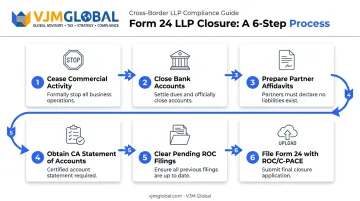
The process moves through a predictable sequence: stop operations, clean up the balance sheet, prepare affidavits, clear pending filings, then submit Form 24 with a CA certificate. Every designated partner must digitally sign the form using a valid Digital Signature Certificate (DSC), which is often the biggest logistical hurdle for NRI and foreign partners who can't easily visit India to complete formalities. Firms like VJM Global routinely help NRI and foreign partners obtain DSCs remotely, removing the need for an India visit just to sign paperwork.
Step 1: Cease All Commercial Activity
Each designated partner affirms, via affidavit, that the LLP either never commenced business or stopped all revenue-generating activity from a specific date. This date matters. It anchors every subsequent filing requirement.
Step 2: Close Bank Accounts
Every bank account opened in the LLP's name must be closed. A bank-issued closure letter is required as proof for the ROC filing. If no account was ever opened, that's stated in the affidavit instead.
Step 3: Prepare Partner Affidavits and Indemnity Declarations
Designated partners jointly or severally affirm three things:
- Business has ceased (or never started)
- Liabilities are NIL
- Indemnify any liability that surfaces after strike-off
This indemnity clause is worth reading carefully. It doesn't disappear just because the LLP does.
Step 4: Obtain a Chartered Accountant's Statement of Accounts
A practicing CA must certify a statement showing NIL assets and NIL liabilities. This statement can't be dated more than 30 days before the Form 24 filing, so timing your paperwork matters here.
Step 5: Clear Pending ROC Filings
Any unfiled LLP Agreement, Form 8, or Form 11 up to the cessation date needs to be submitted before Form 24 will be accepted. This is where most delays happen for clients who let compliance slide for a year or two before deciding to close.
Step 6: File Form 24 with Supporting Documents
Submit Form 24 along with the affidavits, CA certificate, and income tax return acknowledgment. The ROC (or C-PACE) then publishes a public notice inviting objections before finalizing the strike-off. If no objections surface, the LLP is formally dissolved.
Documents Required for LLP Closure
Keep this list handy before you start the process:
- Form 24 application, signed by all designated partners
- Consent affidavits from every partner confirming cessation and NIL liabilities
- Chartered Accountant (CA)-certified NIL statement of accounts, dated within 30 days of filing
- Indemnity declaration covering post-closure liabilities
- Latest Income Tax Return (ITR) acknowledgment, where a return was filed
If the LLP never filed any income tax return because it had zero activity from day one, this specific requirement can be waived. Include a written justification explaining why no ITR exists.
One more thing that trips up foreign partners: Digital Signature Certificates (DSCs) for all designated partners are mandatory for online filing. Arrange these well in advance. DSC issuance for someone based in California or London takes longer than for someone sitting in Delhi, and delays here stall the entire filing.
Common Mistakes and Choosing the Right Closure Method
A few misconceptions come up again and again with foreign-owned LLPs.
"Going dormant" closes the LLP automatically. It doesn't. Letting an LLP sit inactive without formal closure means it stays on the register, penalties keep accruing, and the Registrar can eventually strike it off involuntarily, but that doesn't retroactively erase the fines already owed.
Strike-off ends all future accountability. Not quite. Closure doesn't extinguish a partner's personal liability for undisclosed debts or fraud. If a creditor surfaces after strike-off with a legitimate claim that wasn't disclosed, partners can still be pursued individually.
Form 24 works for any LLP that wants to shut down. It doesn't, if there are active creditors, ongoing contracts, or unresolved disputes. Those situations require voluntary winding up with a liquidator, not the strike-off route.
Here's a quick comparison to help decide which route fits:
| Factor | Form 24 Strike-Off | Voluntary Winding Up |
|---|---|---|
| Best for | Dormant LLPs, NIL assets/liabilities | LLPs with creditors or assets to distribute |
| Typical timeline | A few months via C-PACE | Considerably longer, often a year or more |
| Requires liquidator | No | Yes |
| Creditor consent needed | No (must have zero creditors) | Yes |
For NRIs, OCIs, and foreign partners unfamiliar with ROC procedures or CA certification requirements, this isn't a process worth navigating solo from another time zone.
VJM Global works with foreign-owned entities on India closure and compliance, handling the CA certification, ROC liaison, and DSC logistics that most often trip up cross-border clients.

Frequently Asked Questions
How do I close an LLP in India?
Closure happens either via Form 24 strike-off (for dormant LLPs with no liabilities) or voluntary winding up (for LLPs with assets or creditors). Each route requires specific ROC filings and unanimous partner consent.
What is the fee for LLP closure?
Government filing fees for Form 24 are ₹500 for a Small LLP and ₹1,000 for other LLPs, per the ICSI's FAQs on Limited Liability Partnership. Professional/CA certification charges and any pending penalty clearance add to this base cost.
How do I withdraw from an LLP?
An individual partner's exit differs from LLP closure. It involves reviewing the LLP agreement, filing Form 3/Form 4 for retirement, and updating ROC records, without dissolving the entity itself.
How long does the LLP closure process take?
Form 24 strike-off typically takes a few months once documents are complete, especially through C-PACE. Voluntary winding up can take considerably longer due to creditor consent and liquidator formalities.
Can a struck-off LLP be restored after closure?
Restoration is possible by applying to the NCLT with valid reasons, provided pending filings and fees are cleared. Since LLP law sets no fixed restoration window, act quickly and consult a professional early.
Is a Chartered Accountant's certificate mandatory for closing an LLP?
Yes. A CA-certified NIL statement of assets and liabilities is a mandatory attachment to Form 24, and it must be dated within 30 days of the filing date.