
Introduction
A profitable business can still fail if it runs out of cash. This paradox is why the cash flow statement exists : it's one of the three core financial reports required under Singapore's financial reporting framework, alongside the income statement and balance sheet.
22% of Singapore businesses face a moderate to severe credit or cash crunch, with SMEs experiencing even higher pressure. While your profit and loss statement might show healthy margins, delayed customer payments or heavy capital investments can leave you short on cash. The cash flow statement reveals this gap by tracking actual cash movements rather than just accounting profits, giving you a clearer picture of your business's ability to meet obligations. This guide covers what each section means, how to read it, and what your P&L statement alone won't show.
Key Takeaways
- A cash flow statement tracks actual cash inflows and outflows — showing whether your business can meet its financial obligations
- It's divided into three sections: operating, investing, and financing activities
- Singapore companies must comply with FRS 7 when preparing cash flow statements
- Both direct and indirect methods are acceptable; the indirect method is more commonly used
- Regular analysis of your cash flow statement strengthens liquidity planning, investment decisions, and regulatory compliance
What Is a Cash Flow Statement in Singapore?
A cash flow statement is a financial report that records all cash received and paid out by a business during a given accounting period. Unlike profit-based reporting, which uses the accrual method, the cash flow statement focuses solely on actual cash movements.
How It Differs from the Income Statement
The income statement includes non-cash items like depreciation or credit sales. If your Singapore-based trading company records S$100,000 in credit sales for the month, the income statement shows that revenue immediately — even if customers haven't paid yet. The cash flow statement only reflects money when it actually arrives in your bank account.
This distinction matters in practice. A Singapore tech firm might report strong quarterly profits from multi-year contracts but struggle to cover salaries if clients delay payment. The income statement shows profitability; the cash flow statement shows whether the business can actually meet its obligations.
Its Role Within the Full Set of Financial Statements
The cash flow statement bridges the opening and closing cash balances shown on the balance sheet. It provides context the income statement alone cannot: your cash position changed for a reason, and this statement shows exactly what drove that change. For investors and lenders, it's often the most reliable indicator of financial health — cash flows are harder to manipulate than accounting profits.
The Three Key Components of a Cash Flow Statement
FRS 7 mandates a three-section structure: operating activities, investing activities, and financing activities. Each section captures a distinct type of cash movement, and together they give a complete picture of cash health.

Operating Activities
This section captures cash flows from your core day-to-day business operations:
- Cash received from customers
- Cash paid to suppliers
- Employee wages
- Rent and utilities
- Taxes paid
Under the indirect method — most common in Singapore — this section starts with net profit from the income statement and adjusts for:
- Non-cash items — depreciation is added back because it reduces profit but doesn't consume cash
- Working capital changes — an increase in accounts receivable means cash hasn't been collected yet, so it's deducted; an increase in accounts payable means you've delayed paying suppliers, so it's added
Consider a Singapore boutique retail store reporting S$80,000 net profit. If accounts receivable increased by S$15,000 and inventory by S$10,000 during the same period, operating cash flow would be approximately S$55,000 — profit adjusted downward for cash not yet collected and stock already purchased.
Investing Activities
This section covers cash used for or generated from long-term asset transactions:
- Outflows: Purchase of equipment, property, or investments
- Inflows: Proceeds from asset sales
Negative cash flow here doesn't automatically signal financial distress — it often reflects growth investment. A Singapore logistics firm buying three new delivery trucks for S$150,000 shows a substantial outflow, but that's a strategic capacity decision, not a red flag.
For example, a Singapore tech startup that purchases S$50,000 worth of servers and sells old computers for S$5,000 would show a net investing outflow of S$45,000.
Financing Activities
Financing activities include cash flows from:
- Inflows: Bank loans, bond issuances, equity raises
- Outflows: Loan repayments, dividend payments to shareholders
This section reveals how a business funds its growth and returns value to investors. A Singapore fintech company completing a Series B round of S$2 million would record that as a financing inflow; paying S$50,000 in dividends to early investors is a financing outflow.
The distinction worth watching: heavy reliance on financing inflows to cover operating shortfalls signals trouble. Using financing to fund deliberate expansion is entirely normal.
Direct vs. Indirect Method: How to Prepare a Cash Flow Statement
FRS 7 allows two preparation methods for the operating activities section: direct and indirect. The overall three-section structure remains the same under both.
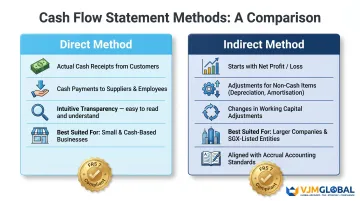
Direct method:
Lists every actual cash receipt and payment:
- Cash received from customers: S$120,000
- Cash paid to suppliers: (S$60,000)
- Cash paid for wages: (S$30,000)
- Cash paid for rent: (S$10,000)
- Net cash from operating activities: S$20,000
The direct method is intuitive and transparent, especially for smaller or cash-based businesses like a local café or boutique in Singapore.
Indirect method:
Starts with net profit from the income statement and adjusts for non-cash items and working capital changes:
- Net profit: S$25,000
- Add back: Depreciation S$8,000
- Deduct: Increase in accounts receivable (S$15,000)
- Add: Increase in accounts payable S$2,000
- Net cash from operating activities: S$20,000
This method is preferred by most larger companies and those listed on SGX due to its efficiency and alignment with accrual-based accounting records.
Comparison of Both Methods
| Factor | Direct Method | Indirect Method |
|---|---|---|
| Ease of Preparation | Requires detailed cash transaction records | Works from existing accrual-based accounts |
| Transparency | Clear, intuitive for non-accountants | Requires understanding of adjustments |
| Suitability | Small, cash-based businesses | Larger companies, SGX-listed entities |
| Compliance | FRS 7 compliant | FRS 7 compliant (more commonly used) |
For foreign companies entering Singapore, choosing between these methods adds another layer of complexity — particularly when consolidating multiple entities or adapting from a different home-country accounting framework. Firms with cross-border compliance experience, such as VJM Global, can help map your existing records to FRS 7 requirements and prepare cash flow statements that satisfy both local regulators and parent-company reporting standards.
Singapore's FRS 7 Compliance: What Businesses Need to Know
FRS 7 (Financial Reporting Standard 7) is Singapore's accounting standard governing cash flow statements, aligned with IAS 7. It requires entities to prepare a statement of cash flows as an integral part of their financial statements.
All Singapore-incorporated companies filing full financial statements with ACRA must include a cash flow statement under FRS 7. Three categories of companies are exempt:
- Dormant relevant companies (total assets not exceeding S$500,000 at any time, with no significant accounting transactions, and not listed) are exempt from preparing and filing financial statements
- Solvent Exempt Private Companies (EPCs) with fewer than 20 members and no corporate shareholders are exempt from filing with ACRA but must still prepare financial statements
- Small company audit exemption (revenue and assets each under S$10 million, fewer than 50 employees for two consecutive years) exempts companies from audit but not from preparing the cash flow statement
Key FRS 7 Requirements Often Overlooked
Classification decisions are where many businesses make costly errors. Three areas require particular attention:
- Bank overdrafts repayable on demand that form part of cash management are included as cash and cash equivalents — not recorded as borrowings
- Interest paid, dividends received, and dividends paid each carry multiple valid classification options (operating, financing, or investing). Whichever treatment you choose must be applied consistently across every reporting period
- Income taxes are classified as operating activities unless they are specifically identifiable with financing or investing transactions
ACRA requires companies to submit a full set of financial statements — including the cash flow statement, balance sheet, and income statement — as part of annual filing. Inconsistencies across these documents are one of the most common triggers for qualified audit opinions, so alignment between all three is not optional.
If your classification choices shift between years without documented justification, auditors will flag it. Locking in your treatment early — and documenting the rationale — prevents restatements down the line.
How to Read and Analyse Your Cash Flow Statement
Step 1: Check Operating Cash Flow
Determine whether operating cash flow is positive. Consistently positive operating cash flow signals that your business is self-sustaining through core activities — a key indicator of financial health.
A business that relies on asset sales or financing inflows just to cover daily operations warrants closer scrutiny. 46% of Singapore businesses manage liquidity by controlling outgoing payments and minimising non-essential outflows, indicating widespread cash flow pressure.
Step 2: Calculate Free Cash Flow (FCF)
Free Cash Flow = Operating Cash Flow – Capital Expenditures
FCF reflects the true cash a business generates after maintaining or expanding its asset base. Investors and lenders focus on FCF because it's harder to manipulate than reported earnings.
Example: A Singapore technology services firm has operating cash flow of S$200,000 and capital expenditures of S$80,000. Free cash flow is S$120,000 — money available for debt repayment, dividends, or expansion.
Step 3: Use Practical Cash Flow Ratios
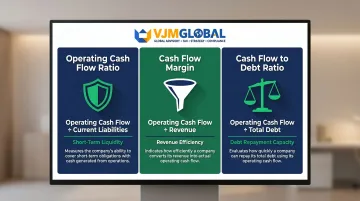
Three ratios business owners can calculate:
- Operating Cash Flow Ratio = Operating Cash Flow ÷ Current Liabilities
- Measures short-term liquidity and ability to cover immediate obligations
- Cash Flow Margin = Operating Cash Flow ÷ Revenue
- Measures efficiency of converting revenue to cash
- Cash Flow to Debt Ratio = Operating Cash Flow ÷ Total Debt
- Measures capacity to repay debt from operations
Warning Signs to Watch For
- Persistent negative operating cash flow — suggests core business isn't generating cash
- Significant divergence between net profit and operating cash flow — may indicate accounting aggressiveness or working capital problems
- Heavy reliance on financing inflows for day-to-day operations — signals unsustainable cash burn
- Declining free cash flow over consecutive periods — even if revenue is growing
35% of Singapore B2B credit sales invoices are currently overdue, and 35% of businesses in a credit crunch lack enough reserves to operate for 3–6 months. Spotting these warning signs early — before a cash shortfall compounds — is what separates businesses that recover from those that don't.
Frequently Asked Questions
What are the 4 quadrants of cash flow?
The "4 quadrants" framing comes from financial literacy frameworks, not formal accounting standards. Under FRS 7 — Singapore's governing standard — cash flow statements use three sections: operating activities, investing activities, and financing activities. The net change in cash (opening to closing balance) is the resulting figure, not a separate section.
Is a cash flow statement mandatory for all Singapore companies?
Most Singapore-incorporated companies filing full financial statements with ACRA must include a cash flow statement under FRS 7. Small companies qualifying under SFRS for Small Entities are also required to prepare one, though separate audit exemptions may apply.
What is the difference between a cash flow statement and an income statement?
The income statement shows profitability using the accrual method, including non-cash items like depreciation and credit sales. The cash flow statement shows only actual cash movements, making it a more direct indicator of liquidity and short-term financial health.
What is the indirect method of preparing a cash flow statement?
The indirect method starts with net profit and adjusts for non-cash items like depreciation and working capital changes — receivables, payables, and inventory — to arrive at net cash from operating activities. It is the most commonly used method in Singapore.
What is free cash flow and why does it matter?
Free cash flow is operating cash flow minus capital expenditures. It shows how much cash a business generates after investing in its assets. Investors and lenders watch this closely because it reflects cash available for growth, dividends, or debt repayment.
How does FRS 7 apply to Singapore businesses?
FRS 7 is Singapore's financial reporting standard for cash flow statements, requiring companies to classify cash flows into operating, investing, and financing activities. It governs how items like dividends, interest, and taxes are disclosed, so stakeholders can compare cash flow data reliably across companies and reporting periods.