Many promoters, especially foreign entities setting up Indian subsidiaries, get stuck on one question: do you expense these immediately, capitalize them, or spread them over several years? The confusion is understandable. Books of account and tax returns treat these costs completely differently, and mixing up the two rules is a common mistake we see at VJM Global when advising US, UK, and Australian businesses entering India.
This guide walks through the accounting treatment under AS-26 and Ind AS, the tax treatment under Section 35D, practical journal entries, and compliance tips specifically relevant to foreign entities setting up shop in India.
Key Takeaways
- Books of account: Write off preliminary expenses fully in the year incurred; they can't sit as an asset under AS-26 or Ind AS 38.
- Tax return: Section 35D allows eligible preliminary expenses to be amortized over 5 equal annual instalments, subject to a monetary ceiling.
- Common examples: ROC fees, MOA/AOA drafting and stamp duty, legal/professional fees, and share issue costs.
- Timing difference: Book write-off and the 5-year tax spread diverge, so a deferred tax adjustment under AS-22 or Ind AS 12 is required.
What Are Preliminary Expenses?
Preliminary expenses are costs a promoter incurs to bring a company into legal existence — before incorporation is complete or before business operations begin. Since the company doesn't legally exist yet at the time these costs arise, they're typically paid personally by the promoters or directors and reimbursed once the company is registered.
You'll also see these called pre-incorporation expenses. Both terms refer to the same category of cost: money spent purely to get the legal entity off the ground.
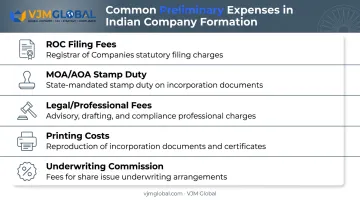
Common examples in Indian company formation include:
- Government and ROC filing fees for incorporation
- Stamp duty on the Memorandum of Association (MOA) and Articles of Association (AOA)
- Legal and professional fees for drafting incorporation documents
- Printing costs for the MOA and AOA
- Underwriting commission or brokerage connected to a share or debenture issue
Under the Companies Act 2013, Table F (Schedule I), Article 62 authorizes the board to pay all expenses incurred in getting up and registering the company. That gives the company the power to reimburse promoters. It doesn't, however, determine how those costs get accounted for or taxed — the accounting treatment and tax rules follow a different set of provisions, which we cover next.
Examples Specific to Foreign Companies Setting Up in India
For US, UK, or Australian entities establishing an Indian subsidiary or wholly-owned subsidiary (WOS), preliminary expenses often extend beyond the basics:
- Consultancy fees for market-entry advice and structuring decisions
- Legal fees for choosing between a private limited company, LLP, or branch office
- FEMA/RBI compliance-related costs incurred before incorporation
Documentation matters here. Since these expenses are reimbursed only after incorporation, promoters need to keep invoices and receipts organized from day one. Indian tax assessments routinely scrutinize these reimbursements, and a missing invoice can turn into a disallowed deduction.
Accounting Treatment of Preliminary Expenses in India
From "Fictitious Asset" to Mandatory Write-Off
Older financial statements under the Companies Act 1956 (Schedule VI) showed preliminary expenses under "Miscellaneous Expenditure (to the extent not written off or adjusted)", informally called a fictitious asset, since it had no realizable value but sat on the balance sheet anyway, written off gradually over several years.
That approach no longer applies: AS-26 "Intangible Assets" and Ind AS 38 both require preliminary expenses to be expensed fully in the profit and loss account in the year they're incurred. Schedule III of the Companies Act, 2013 doesn't even include a line item for preliminary expenses on the balance sheet — reinforcing that capitalization isn't an option anymore.
Why the Rule Exists
The accounting logic is straightforward: preliminary expenses don't generate future economic benefits on their own. They fail the recognition test for an intangible asset because:
- There's no separately identifiable, controllable resource
- No future cash flows can be reliably attributed to the expenditure itself
- The cost is incurred once, for entity formation, not ongoing operations
Since the expense doesn't meet the definition of an asset, it goes straight to the P&L statement.
The Book-Tax Divergence
Here's where it gets tricky. Books expense the entire amount in year one, while tax returns under Section 35D spread the deduction over 5 years (details below).
| Aspect | Books (Financial Statements) | Tax (Section 35D) |
|---|---|---|
| Timing | Fully expensed in year one | Spread over 5 years |
| Impact | Reduces year-one profit | Reduces taxable income gradually |
| Treatment | Immediate P&L write-off | Amortized deduction |
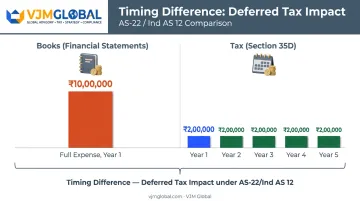
That mismatch is a timing difference, not a permanent one, and it needs to be recognized as a deferred tax asset under AS-22 or Ind AS 12.
This applies regardless of company size. Private companies and small companies must still follow this treatment consistently across financial years — auditors and ROC filings expect it.
Tax Treatment Under Section 35D of the Income Tax Act
Section 35D answers the question most foreign promoters actually ask: can incorporation costs be amortized for tax purposes? Yes — but only within defined categories and limits.
What Qualifies
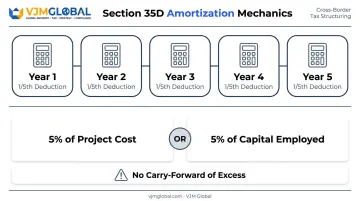
Eligible companies can claim one-fifth of qualifying preliminary expenditure as a deduction in each of 5 successive years, starting from the year business commences. Categories include:
- Feasibility reports, project reports, market surveys, and engineering services (performed by the assessee or a CBDT-approved concern)
- Legal charges for drafting agreements related to setting up or conducting the business
- Legal charges for drafting the MOA and AOA
- Printing costs for the MOA and AOA
- Company registration fees paid to the ROC
- Expenses connected with a public subscription issue of shares or debentures — underwriting commission, brokerage, and prospectus printing/drafting/advertising costs
A word of caution: not everything labelled "professional fees" automatically qualifies. Section 35D names specific categories — legal, survey, engineering, registration, and public-issue costs. General advisory fees that don't fall into these buckets aren't automatically deductible under this section, even though they're genuine preliminary expenses in accounting terms.
The Monetary Ceiling
The aggregate deduction under Section 35D is capped at:
- 5% of the cost of the project, or
- 5% of capital employed (for Indian companies only, as an election)
Any expenditure exceeding this ceiling simply isn't allowed as a deduction — there's no carry-forward for the excess.
Can Pre-Incorporation Expenses Be Included?
Yes, provided they fall within Section 35D's specified categories. The section refers to expenditure incurred "before the commencement of business," not "before incorporation" — and its company-specific list explicitly covers MOA/AOA drafting, printing, and registration fees, all of which are inherently pre-incorporation costs.
The company must still formally record and adopt the liability for these amounts, and each expense needs to be substantiated against the Section 35D categories. Simply having a promoter pay for something isn't the test.
Even with proper documentation, not every entity in the corporate chain can claim this deduction. Important limitation for foreign entities: this amortization benefit applies to Indian companies (as defined under Section 2(26) of the Income Tax Act) and resident non-corporate assessees. A subsidiary incorporated in India qualifies as an Indian company in its own right. The foreign parent itself does not qualify merely because it set up the subsidiary — foreign companies without an Indian business connection should get separate advice before assuming eligibility.
Journal Entries and Practical Example
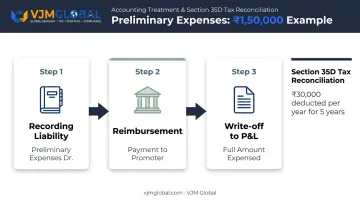
Say a promoter pays ₹1,50,000 in professional and ROC fees before the company is incorporated. The company later reimburses this amount. Here's how the entries typically flow:
Step 1: Recording the liability
Preliminary Expenses A/c        Dr.  ₹1,50,000
    To Amount Due to Promoter/Director A/c    ₹1,50,000
Step 2: Reimbursement
Amount Due to Promoter/Director A/c   Dr.  ₹1,50,000
    To Bank A/c                                 ₹1,50,000
Step 3: Write-off to P&L (same financial year, per AS-26)
Profit & Loss A/c (or Statement of P&L)   Dr.  ₹1,50,000
    To Preliminary Expenses A/c                  ₹1,50,000
This third step may not need a separate entry if the expense was recognized straight to the P&L during initial recording. Whether a separate entry is required depends on how the bookkeeping is structured.
On the tax side, a separate reconciliation working is maintained outside the books. If the full ₹1,50,000 qualifies under Section 35D, the company claims ₹30,000 per year for 5 years as a tax deduction. This differs from the books, where the entire amount was already expensed in year one. This reconciliation is essential for accurate tax return filing and for tracking the deferred tax asset over the 5-year period.
Preliminary Expenses vs. Preoperative Expenses & Getting Expert Help
These two terms get confused constantly, and misclassifying them can trigger incorrect tax deductions or compliance issues during audits.
| Aspect | Preliminary Expenses | Preoperative Expenses |
|---|---|---|
| Stage | Before/during legal incorporation | After incorporation, before commercial operations |
| Examples | ROC fees, MOA/AOA costs, incorporation legal fees | Trial production costs, pre-launch marketing, staff hiring before launch |
| Section 35D | Specifically listed categories qualify | Generic "preoperative" label alone doesn't guarantee eligibility |
| Accounting | Expensed when incurred (AS-26/Ind AS 38) | Expensed when incurred, unless capitalizable under another standard (like AS-10 for asset-related costs) |
Preliminary expenses relate strictly to bringing the legal entity into existence. Preoperative expenses cover the gap between incorporation and the start of actual business activity, a separate phase with its own rules on what gets capitalized versus expensed.
For foreign promoters, this classification directly affects how much tax deduction you can legitimately claim and how clean your compliance record looks during an assessment. VJM Global's team of Chartered Accountants works specifically with US, UK, and Australian companies setting up in India, handling preliminary expense classification, Section 35D amortization tracking, and ROC/incorporation compliance from the very first invoice.
Frequently Asked Questions
How to treat incorporation expenses?
Incorporation expenses must be written off in full in the profit and loss account in the year incurred, as required under AS-26/Ind AS. This accounting treatment differs from the tax treatment under Section 35D, covered below.
Can incorporation costs be amortized?
Not for accounting purposes — they must be expensed immediately in the year incurred. For income tax purposes, however, specified incorporation costs can be amortized equally over 5 successive years under Section 35D.
Can you include pre-incorporation expenses?
Yes, pre-incorporation expenses can be claimed under Section 35D if they fall within the specified categories — legal fees, feasibility reports, share issue expenses — and are properly documented.
What is the journal entry for preliminary expenses?
Debit "Preliminary Expenses" and credit the promoter or director account for reimbursement, then write off the full amount to the Profit & Loss Account in the same financial year as required by AS-26.
Is GST applicable on preliminary expenses like professional fees?
Yes, GST charged by professionals or consultants on their fees is applicable. Input tax credit eligibility depends on GST registration status and whether the invoice was issued to the company (not the promoter personally) after registration.
What is the difference between preliminary expenses and preoperative expenses?
Preliminary expenses relate strictly to company formation and incorporation. Preoperative expenses cover the period after incorporation but before business operations actually commence, such as trial runs or pre-launch marketing.