This guide is for foreign entrepreneurs, NRIs, OCIs, and international businesses (particularly those based in India, the USA, UK, and Australia) evaluating the UAE as a market entry or expansion destination. It covers what 100% ownership means in practice, where it applies, the step-by-step registration process, and the costs and documents involved.
Key Takeaways
- 100% foreign ownership is now legally permitted for most mainland and freezone business activities following the 2021 Commercial Companies Law
- Two primary structures — mainland (DED-licensed) and freezone — both allow full ownership but differ significantly in market access
- A defined list of strategic-impact sectors (banking, defence, telecoms, fisheries) still requires UAE national participation
- Registration follows a clear sequence: confirm activity, choose structure, reserve trade name, obtain approvals, draft MOA, secure premises, collect licence
- Post-registration steps (corporate tax, MOHRE compliance, investor visas) are separate processes requiring their own timelines
What 100% Foreign Ownership in the UAE Means
100% foreign ownership means a foreign national or company holds all issued shares of a UAE-registered entity. No UAE national partner, nominee arrangement, or local sponsor is required in the shareholding structure.
Before the 2020 reform, Article 10 of Federal Law No. 2 of 2015 required UAE nationals to hold at least 51% of mainland company capital, capping foreign ownership at 49%. Federal Decree-Law No. 26 of 2020 removed this requirement for most commercial activities.
That change has real consequences for how you structure, run, and eventually exit your business. Full ownership means:
- Complete decision-making authority — no partner approval needed for operational or strategic decisions
- Full profit entitlement — no mandatory profit-sharing with a local sponsor
- Unencumbered exit rights — share transfers and wind-downs don't require a local partner's consent
Which Business Activities Allow 100% Foreign Ownership?
Most commercial, trading, services, professional, and technology activities qualify — retail trading, e-commerce, consulting, manufacturing, and IT services among them.
Cabinet Resolution No. 55 of 2021 defines the exceptions — strategic-impact activities that remain subject to UAE national participation requirements or additional regulatory controls:
| Strategic-Impact Activity | Participation Rule |
|---|---|
| Security and defence | Competent authority determines participation |
| Banking, exchange houses, finance, and insurance | Competent authority determines participation |
| Telecoms | Competent authority determines participation |
| Money printing | Competent authority determines participation |
| Hajj and Umra services | General Authority of Islamic Affairs determines participation |
| Quran memorisation centres | General Authority of Islamic Affairs determines participation |
| Fisheries services | 100% national participation required |
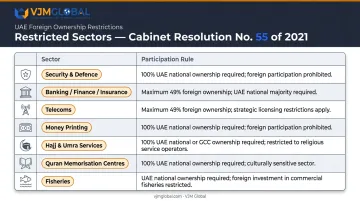
Always verify your specific activity against the official DED activity list or Ministry of Economy guidance before assuming full ownership eligibility.
Mainland vs. Freezone: Where 100% Ownership Applies
Both mainland and freezone structures permit 100% foreign ownership — but they operate very differently. The UAE has more than 40 multidisciplinary free zones where expatriates and foreign investors can hold full company ownership. Mainland licences are issued by the emirate-level Department of Economic Development (or equivalent authority).
Mainland Advantages
A 100% foreign-owned mainland LLC can:
- Trade directly across the UAE market without geographic restrictions
- Bid for government contracts
- Open physical retail or commercial locations anywhere in the UAE
- Engage UAE-based clients without an intermediary
This makes the mainland structure the natural choice for businesses targeting local consumers or physical operations.
Freezone Advantages
Freezone companies offer:
- Streamlined, often online or app-based setup processes
- Lower entry costs in many cases (RAKEZ packages, for example, start from AED 6,000)
- 100% foreign ownership as the default — no exceptions for commercial activities within the zone
The trade-off: freezone companies operate within defined geographic boundaries. Selling goods or services directly to UAE mainland customers may require appointing a mainland distributor, paying applicable duties, or obtaining a dual licence — details worth confirming before committing to a freezone structure.
Side-by-Side Comparison
| Factor | Mainland LLC | Freezone Company |
|---|---|---|
| Foreign ownership | 100% (most activities) | 100% by default |
| UAE market access | Unrestricted | May need dual licence or distributor |
| Government contracts | Eligible | Generally not eligible |
| Setup speed | Typically 1–2 weeks | Can be days or faster for digital-first zones |
| Office requirement | Physical premises required | Flexi-desk or virtual options available |
| Entry cost range | Higher (varies by activity and premises) | Lower starting point in many zones |
| Corporate tax | Applies from FY beginning 1 June 2023 | Applies from FY beginning 1 June 2023 |
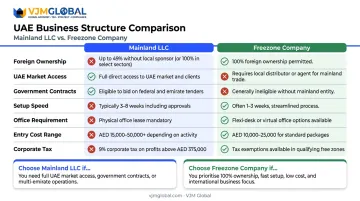
A consulting firm serving international clients may find a freezone sufficient. A trading business selling directly to UAE consumers almost always needs a mainland licence.
Step-by-Step: How to Register a 100% Owned Company in UAE
The UAE Government outlines a defined mainland registration sequence applicable across all emirates, with emirate-specific portals (such as Invest in Dubai) used for online submission. Freezone registrations follow a similar sequence processed through the respective freezone authority.
Step 1: Define Your Business Activity
Activity selection determines everything: the licensing authority, available legal forms, ownership eligibility, and whether sector approvals are needed. Confirm your chosen activity qualifies for 100% foreign ownership using the relevant DED or freezone activity lists before proceeding.
Step 2: Choose Your Legal Structure
For mainland 100% foreign-owned entities, the main options are:
- Limited Liability Company (LLC) — the most common mainland structure; personal liability is capped at share capital value
- Sole establishment — single owner, full personal liability
- Civil company — used for professional activities (doctors, lawyers, engineers)
- Branch of a foreign company — extends an existing overseas entity into the UAE
For freezones, founders choose between a Free Zone Company (FZC) with multiple shareholders or a Free Zone Establishment (FZE) for a single shareholder.
The LLC is the preferred choice for most investors because of its liability protection and flexibility.
Step 3: Reserve a Trade Name
Submit your proposed company name to the relevant DED (mainland) or freezone authority. Key naming rules:
- Must not be offensive or duplicate existing registered names
- Should reflect the business activity
- In Dubai, trade name reservations are valid for 6 months via the Invest in Dubai portal
Step 4: Obtain Initial Approvals
Regulated activities require initial approvals or no-objection certificates from sector authorities before the licence is issued. Examples include:
- Healthcare — Ministry of Health and Prevention
- Education — Ministry of Education / KHDA
- Legal services — Ministry of Justice
- Transport — Roads and Transport Authority (RTA)
Standard commercial and service activities typically proceed without additional approvals.
Step 5: Sign Constitutional Documents and Secure Office Premises
The Memorandum of Association (MOA) must be drafted and signed, reflecting the foreign investor's 100% shareholding, capital contribution, management powers, and profit distribution arrangements.
Mainland registrations also require a registered business address: a tenancy contract registered via Ejari (Dubai's official tenancy registration system) before the DED will issue a licence. Freezone entities may use flexi-desk or virtual office arrangements, depending on the zone's requirements.
Step 6: Submit the Application and Receive the Trade Licence
Once all documents are in order — MOA, sector approvals, premises documentation, and shareholder ID — submit to the DED or freezone authority.
Timeline expectations:
- Freezone digital-first processes (such as RAKEZ's instant licence) can complete in minutes for standard activities
- Dubai's Invest in Dubai portal quotes 10 minutes for a normal licence issuance service
- Mainland regulated activities requiring external approvals will take longer — one to two weeks end-to-end is the standard range
Once licensed, the company opens a corporate bank account, registers for corporate tax, and applies for investor visas.
Key Documents, Requirements, and Costs
Standard Document Checklist
- Valid passport copies of all shareholders
- Passport-sized photographs
- Completed application forms
- Business plan or activity description
- Memorandum of Association (duly attested)
- Proof of business premises (tenancy contract / Ejari where required)
- Sector-specific approvals where applicable
Requirements vary slightly by emirate and legal structure — confirm with the relevant authority before submission.
Cost Components
Costs depend on emirate, activity type, legal structure, and office arrangements. Typical components include:
- Trade licence fees: vary by emirate and activity; freezone licences generally start lower than mainland LLCs
- DED or freezone registration fees
- MOA notarisation and attestation fees
- Office rent: physical premises for mainland; flexi-desk options for many freezones
- Visa application fees: covers investor residency and employee visas
As a reference point, RAKEZ freezone packages start from AED 6,000, while DMCC lists annual licence fees around AED 20,265 for specific licence types. Mainland LLC costs vary more widely based on activity complexity and premises.
Use the official DED or Invest in Dubai calculators for accurate estimates before committing to a structure.
Post-Registration Obligations
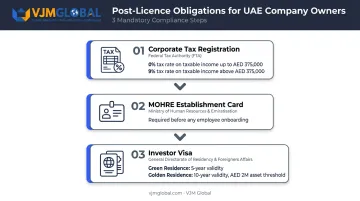
Securing the licence is step one. These three compliance obligations follow directly and cannot be deferred:
Corporate tax registration: Register via the Federal Tax Authority's EmaraTax portal. Corporate tax rates are 0% on taxable income up to AED 375,000 and 9% above that threshold, applying to financial years beginning on or after 1 June 2023.
MOHRE Establishment Card: Complete this registration with the Ministry of Human Resources and Emiratisation before initiating any work permit or employee onboarding processes.
Investor visa: Your trade licence qualifies you to apply for a Green Residence Permit (5 years, renewable, self-sponsored) or a Golden Residence Permit (10 years) if you hold qualifying assets of at least AED 2 million. Note that residency requires a separate GDRFA/ICP application — the licence itself does not grant UAE residency.
Common Misconceptions About 100% UAE Ownership
Misconception 1: 100% ownership applies universally. The reform is broad, but not absolute. Strategic-impact sectors retain UAE participation requirements, and each emirate applies its own activity-level eligibility rules. Verify ownership eligibility for your specific activity before proceeding — eligibility is not automatic.
Misconception 2: A freezone company can trade freely on the UAE mainland. Setting up in a freezone does not grant unrestricted access to mainland customers. Founders selling goods or services directly to UAE mainland clients may need to appoint a mainland distributor, pay import duties, or obtain a dual licence. Many new business owners overlook this until they're already operational.
Misconception 3: A trade licence equals UAE residency. The licence makes you eligible to apply for an investor visa but does not grant residency automatically. The visa application involves separate documentation, fees, and timelines through GDRFA or ICP. Entrepreneurs, particularly those from India and other high-outflow markets, should plan visa timelines independently from the incorporation process.
For Indian entrepreneurs, these misconceptions carry real financial consequences — particularly where UAE corporate structure intersects with POEM rules, DTAA benefits under the India-UAE treaty, FEMA compliance, and transfer pricing. Getting the structure right from the start matters on both sides of the border. VJM Global's cross-border advisory team helps clients navigate exactly this complexity.
Frequently Asked Questions
How much does it cost to register a company in the UAE?
Costs vary by structure and emirate. Freezone licences start from around AED 6,000 in zones like RAKEZ, while mainland LLC costs are higher and depend on activity, legal structure, and office premises — with additional fees for visas, MOA notarisation, and office rent.
Can a foreigner own 100% of a UAE mainland company without a local sponsor?
Yes. Since the 2020 reform (formalised in the 2021 Commercial Companies Law), most mainland business activities allow full foreign ownership with no local sponsor required — except for the defined list of strategic-impact sectors under Cabinet Resolution No. 55 of 2021.
What is the difference between a mainland and a freezone company?
Both permit 100% foreign ownership. Mainland companies can trade freely across the UAE market and bid for government contracts. Freezone companies operate within defined zones and face restrictions on direct mainland trading. They typically need a distributor or a dual licence to sell into the broader UAE market.
Which activities still require a local partner in the UAE?
Strategic or restricted activities — including banking, exchange houses, insurance, defence and security, telecoms, money printing, fisheries, and Hajj/Umra services — require UAE national participation or additional government approvals under Cabinet Resolution No. 55 of 2021.
What documents are needed to register a 100% owned company in the UAE?
Standard requirements include:
- Valid passport copies and photographs of all shareholders
- Memorandum of Association and business activity description
- Proof of business premises
- Sector-specific approvals where applicable
How long does it take to register a 100% owned company in the UAE?
Freezone registrations with digital-first processes can complete within one to a few business days for standard activities. Mainland LLC registrations typically take one to two weeks, depending on the activity, emirate, and whether external sector approvals are needed.