Most registration guides walk through the generic Indian process. Few mention what UK businesses actually struggle with: apostille requirements under the Hague Convention, FEMA reporting obligations, or how to use the India-UK Double Taxation Avoidance Agreement (DTAA) to your advantage.
Bilateral trade between the two countries reached £47.9 billion in the four quarters to Q4 2025, up 10% year-on-year, with UK exports to India at £19.3 billion. That growth is pulling more UK firms toward Indian cities like Hyderabad. This guide covers the entity options, the step-by-step filing process, current fees and stamp duty, and the compliance traps that catch UK founders off guard.
Key Takeaways
- UK investors typically choose between a subsidiary, LLP, or branch/liaison office, each with distinct FEMA rules
- Registration runs through SPICe+, but foreign entities face added time for apostille and FDI paperwork
- Telangana stamp duty on MOA/AOA is capped at 0.15% of authorised capital, minimum ₹1,000
- FC-GPR filing with the RBI is mandatory within 30 days of share allotment, and often gets missed
- Specialist FEMA and RBI advisory closes the gap between a domestic filing and a foreign-owned one
Why UK Businesses Should Register a Company in Hyderabad
Hyderabad has built one of India's strongest IT, pharma, and fintech clusters. Telangana's Genome Valley alone hosts over 15,000 skilled professionals and forms part of a state ecosystem with more than 2,000 life-sciences companies and 269+ USFDA-approved facilities. For a UK life sciences or tech firm, that's a deep talent pool already speaking your regulatory language.
Investment momentum backs this up. Telangana pulled in ₹25,350.84 crore (roughly $2,994 million) in FDI equity during FY2024-25, ranking seventh among Indian states and accounting for nearly 6% of the national total. Cumulative inflows from October 2019 to June 2025 topped ₹89,591 crore.
Cost and Infrastructure Advantages
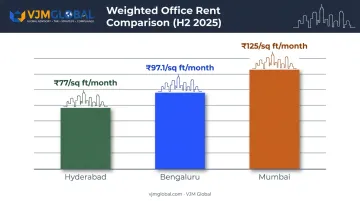
Office space is where Hyderabad undercuts its rivals:
- Hyderabad weighted office rent: ₹77/sq ft/month (H2 2025)
- Bengaluru: ₹97.1/sq ft/month
- Mumbai: ₹125/sq ft/month
Combine that with Telangana's TS-iPASS single-window clearance system, which promises approvals within 15 working days with deemed clearance if deadlines lapse, and the state has simplified its side of the process. Telangana has also ranked among India's top three states for ease of doing business since 2016.
A Familiar Legal and Trade Backdrop
India and the UK share common-law roots, so contract structures, director duties, and dispute resolution concepts won't feel entirely foreign to UK founders. Add the India-UK trade and investment factsheet showing UK FDI stock in India at £19.1 billion by end-2024, and the corridor is only getting busier. The UK-India Comprehensive Economic and Trade Agreement, now in force, adds further momentum.
Business Structures Available for UK Companies Entering Hyderabad
Choosing the right entity determines your control, tax exposure, and how easily you can repatriate profits later. There isn't a universal "best" answer here. It depends on what your parent company needs.
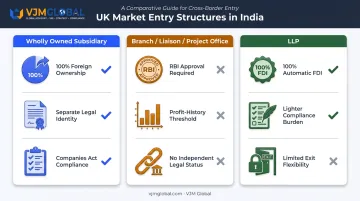
Wholly Owned Subsidiary (Private Limited Company)
This is the most common route for UK businesses wanting full operational control. 100% FDI is allowed under the automatic route in most sectors, meaning no prior government approval is needed before investing. You get:
- Complete ownership and management control
- Separate legal identity from the UK parent
- Standard Companies Act, 2013 compliance obligations
Branch, Liaison, or Project Office
These structures remain legally part of the UK parent, not new Indian entities, and require RBI approval through an authorised dealer bank.
- Liaison Office – Representation and promotion only. No commercial income allowed. Requires a 3-year profit history and $50,000 net worth.
- Branch Office – Suited to consultancy, R&D, or export/import activity. Requires a 5-year profit record and $100,000 net worth.
- Project Office – Time-bound, tied to a specific Indian contract.
LLP Structure
LLPs permit 100% FDI automatically, but only in sectors where there are no FDI-linked performance conditions attached. Compliance is lighter than a private limited company, but investor flexibility and exit options are more restrictive, which matters if you're planning future fundraising rounds.
The right choice hinges on your parent company's repatriation needs and long-term India strategy. Get FEMA-specific advice before filing, not after—converting structures later costs far more than choosing correctly upfront. VJM Global's FEMA advisory team regularly helps UK parent companies map the right entity structure before registration begins, avoiding costly conversions down the line.
Step-by-Step Company Registration Process for UK Businesses
The end-to-end flow runs through the MCA's integrated SPICe+ form, from name reservation to your Certificate of Incorporation and bank account opening. UK applicants face one extra layer at nearly every stage: apostilled documentation.
Before filing anything, gather:
- Apostilled certificate of incorporation of the UK parent
- Board resolution authorising the Indian subsidiary
- An FDI eligibility check for your specific sector
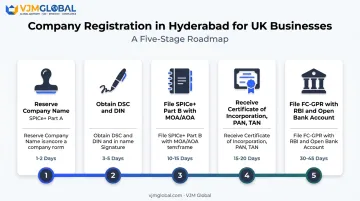
The process runs through five distinct stages:
Reserve the Company Name: File SPICe+ Part A to reserve your name. UK applicants must apostille the parent company's incorporation documents under the Hague Convention before the Registrar of Companies accepts them, and approved names stay valid for 20 days.
Obtain DSC and DIN for Directors: Every signing director needs a Digital Signature Certificate. Foreign directors must submit notarised and apostilled identity and address proof from the UK, which typically costs more and takes longer than a resident director's DSC.
File SPICe+ Part B with MOA and AOA: This filing covers incorporation, DIN allotment, and PAN/TAN together. For a UK-backed entity, the MOA and AOA must reflect FDI-compliant object clauses and match your declared authorised capital exactly.
Receive Certificate of Incorporation, PAN, and TAN: These three arrive together through SPICe+ once the Registrar approves your filing. Domestic filings can close in under two weeks; foreign-parented filings usually run longer once apostille turnaround is factored in.
File FC-GPR with RBI and Open a Bank Account: Once shares are allotted to your UK parent, you must file Form FC-GPR within 30 days to report the foreign investment to the RBI. This is the step UK businesses most often overlook, and missing the deadline triggers penalty proceedings under FEMA.
Registration Fees, Stamp Duty & Documents Required
Government fees are only part of the cost picture. For UK-backed entities, apostille, notarisation, and FEMA advisory costs add materially to the total spend.
Government Fees
- SPICe+ filing fee: Waived for companies with authorised capital up to ₹15 lakh
- Name reservation (Part A, standalone): ₹1,000
- PAN: ₹66
- TAN: ₹65
Telangana Stamp Duty
Under the Telangana stamp duty schedule, AOA duty is 0.15% of authorised share capital, with a minimum of ₹1,000 and a cap of ₹500,000. MOA filed alongside an AOA attracts a flat ₹500.
| Authorised Capital | MCA Filing Fee | Telangana Stamp Duty (approx.) |
|---|---|---|
| ₹1 lakh | Nil (concession) | ₹1,000 (minimum) |
| ₹10 lakh | Nil (concession) | ₹1,500 |
| ₹50 lakh | Payable (check MCA calculator) | ₹7,500 |
Digital Signature Costs
Foreign director DSCs cost significantly more than domestic ones. eMudhra's published pricing lists foreign Class 3 certificates at ₹9,000-₹15,000 for 1-3 years, against ₹1,350-₹2,250 for domestic applicants, reflecting the added notarisation and apostille verification work.
Documents Required from the UK Entity
- Parent company's apostilled certificate of incorporation
- Board resolution authorising Indian subsidiary formation
- Apostilled KYC documents (passport, address proof) for all directors
- Registered office proof in Hyderabad (a virtual office is acceptable for this purpose)
Professional firms handling end-to-end setup, including FEMA and RBI compliance, typically charge a service fee on top of government costs. VJM Global bundles incorporation with the FDI reporting that UK founders must file with the RBI after the subsidiary is registered.
Post-Registration Compliance & Common Pitfalls for UK Businesses
Getting your Certificate of Incorporation is the start, not the finish line. Several filings follow immediately after.
Standard post-incorporation steps:
- File INC-20A (commencement of business) within 180 days of incorporation
- Register for GST if turnover crosses ₹40 lakh (goods) or ₹20 lakh (services)
- Open a current bank account and maintain statutory registers
UK-specific obligations that are easy to miss:
- FC-GPR reporting to the RBI within 30 days of share allotment
- Annual FLA return, due by 15 July each year, covering foreign liabilities and assets
- Transfer pricing documentation (Form 3CEB) for transactions with the UK parent, required under Section 92E once thresholds are crossed
Across 250+ UK client engagements, VJM Global sees the same pitfalls recur:
- Missed apostille requirements on UK-issued documents
- Name rejections from unchecked trademark conflicts
- Delayed FDI reporting that triggers RBI penalty notices
Building a compliance calendar from day one catches these issues before they turn into penalty notices.
Frequently Asked Questions
How much is the registration fee in Hyderabad?
Government filing fees are waived for companies with authorised capital up to ₹15 lakh. Above that threshold, fees apply on a sliding scale plus PAN, TAN, and Telangana stamp duty charges.
What is the stamp duty for company registration in Telangana?
Articles of Association (AOA) stamp duty is 0.15% of authorised share capital, with a ₹1,000 minimum and ₹5,00,000 cap. A Memorandum of Association (MOA) filed with an AOA attracts a flat ₹500 charge.
Can a UK company own 100% of its Indian subsidiary in Hyderabad?
Yes. Most sectors allow 100% FDI under the automatic route, meaning no prior government approval is needed to fully own an Indian subsidiary.
How long does company registration take for UK businesses in Hyderabad?
Domestic filings can complete in under two weeks, but UK-backed entities usually take longer once apostille processing and FDI documentation checks are factored in.
Is FDI approval required for UK companies registering in Hyderabad?
Most sectors fall under the automatic route, requiring no prior approval. A smaller list of sectors, such as brownfield pharma above certain limits, still needs government clearance.
What is the minimum capital required to register a company in Hyderabad?
There's no statutory minimum paid-up capital under the Companies Act, 2013. The 2015 amendment removed the earlier ₹1 lakh requirement for private companies entirely.