The catch? US market entry doesn't work like regional ASEAN expansion. Many businesses struggle with layered federal-state regulations, unfamiliar tax obligations, and visa requirements that feel far more complex than setting up shop in Malaysia or Indonesia.
This guide breaks down the entry structures available, the registration process, trade and tax obligations (including the US-Singapore Free Trade Agreement), visa pathways for founders and staff, and the pitfalls that trip up otherwise well-prepared companies.
Key Takeaways
- The USSFTA eliminates tariffs on nearly all goods traded between the two countries, cutting cost friction for exporters
- Entity choice depends on your goal: fundraising needs a C-Corp, flexibility favors an LLC, testing favors an EOR
- No US-Singapore income tax treaty exists, so full federal and state corporate tax rates apply
- Singapore nationals qualify for the E-2 Treaty Investor Visa specifically because of the USSFTA
- Missing Form 5472 carries a $25,000 penalty, making early tax setup non-negotiable
Why the US Market Is a Natural Next Step for Singapore Businesses
Singapore and the US already have one of the deepest trade relationships in Asia-Pacific. The US-Singapore Free Trade Agreement (USSFTA), in force since January 1, 2004, was the first FTA the US signed with any Asian nation.
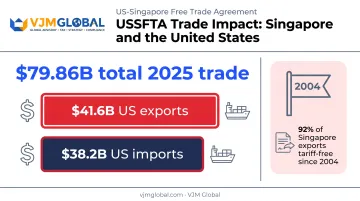
When the agreement took effect, the United States eliminated tariffs on 92% of Singapore's goods exports, while Singapore removed duties on all US products immediately. The remaining US tariffs phased out over 3 to 10 years, meaning most goods moving between the two countries now cross the border duty-free, provided they meet the agreement's origin rules.
That trade relationship isn't small. Full-year 2025 US-Singapore goods trade reached $79.86 billion, split between $41.6 billion in US exports and $38.2 billion in US imports. That's a mature, high-volume corridor, not an emerging one.
Several structural factors make US expansion a logical next step for Singapore companies:
- Singapore already functions as a regional HQ for countless multinationals, so US expansion mirrors a model founders already understand
- The US offers access to the world's largest consumer base by spending power
- Tech and growth-stage companies gain access to US venture capital and public capital markets that simply don't exist at the same scale in Asia
For a manufacturer, exporter, or SaaS company that has already built regional traction in Singapore, the US is the next logical market.
Choosing the Right US Market Entry Structure
Not every business needs to incorporate immediately. The right structure depends on whether you're testing demand, hiring a first employee, or preparing to raise a Series A.
Wholly Owned Subsidiary (C-Corporation or LLC)
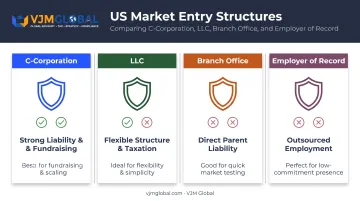
A Delaware or state-specific C-Corporation is the standard choice for companies planning to raise US venture capital. Investors expect it, and it's the structure most familiar to US counsel and cap table software.
An LLC suits businesses that want pass-through taxation and more operational flexibility, without VC fundraising ambitions.
Both create a separate US legal entity. That matters: it shields the Singapore parent from direct liability for US operations, lawsuits, and debts.
Branch Office
A branch is simpler to set up because it isn't a separate legal entity. It is a direct extension of the Singapore parent. That simplicity comes at a cost: the parent's worldwide assets become exposed to US liability, and branches face branch profits tax reporting requirements that subsidiaries don't.
Distributor, Agent, or Representative Arrangements
This is the low-commitment path: sell through local distributors or sales agents before committing to incorporation. It mirrors how US exporters often test the Singapore market through local agents first — no US entity required, minimal upfront cost, and a genuine read on demand before bigger decisions.
Employer of Record as a Market-Testing Bridge
An Employer of Record (EOR) lets a Singapore business hire a US-based sales or business development lead without incorporating first. VJM Global's EOR service, for example, covers 100+ countries including the US. It acts as the legal employer and handles US payroll, statutory contributions, and benefits administration on the client's behalf.
| Objective | Best-fit structure |
|---|---|
| Long-term presence, fundraising | C-Corporation |
| Operational flexibility, no VC plans | LLC |
| Quick market testing, one hire | Employer of Record |
| Product distribution only | Distributor/agent arrangement |
Step-by-Step Process to Register and Set Up in the US
Once you've decided to incorporate, the process usually runs in this order:
- Select your state of incorporation. Delaware offers deep corporate case law and investor familiarity; Wyoming offers lower annual costs; your operating state may be better if that is where you will actually do business. Delaware LLCs pay a $400 annual tax; Wyoming’s license tax is the greater of $60 or 0.0002 of in-state assets.
- Appoint a registered agent. Every US state requires one — it's the party legally authorized to receive service of process and official correspondence on your entity's behalf.
- Obtain an EIN from the IRS. This federal Employer Identification Number is required before you can open a bank account, hire staff, or file any tax return.
- Open a US business bank account. Foreign-owned entities without a US Social Security Number often hit friction here. Cross-border advisors such as VJM Global help founders finish EIN and account setup remotely.
- Register for state/local licenses and sales tax permits. Requirements depend on where your business has economic nexus, not just physical presence.
- Set up US-compliant bookkeeping from day one. Waiting until tax season to sort the books usually means a costly cleanup.
Delaware's expedited filing options can turn entity formation around in as little as one hour for a fee, but EIN issuance and bank setup typically take longer — plan for weeks, not days, for the full process.
Trade Agreement, Tax, and Compliance Obligations
The USSFTA covers more than tariffs. Its chapters address goods (Chapter 2), cross-border services (Chapter 8), financial services (Chapter 10), e-commerce (Chapter 14), and intellectual property (Chapter 16) — a comprehensive framework that reduces friction well beyond customs duties.
Here's what often catches Singapore founders off guard.
No bilateral income tax treaty. Unlike many trade agreements, the USSFTA doesn't include treaty-based withholding relief. Singapore businesses generally can't reduce US withholding tax through treaty provisions and are subject to standard US federal corporate tax (21%) plus applicable state tax.
Economic nexus (no physical presence required). Since the Supreme Court's Wayfair decision, sales tax obligations can arise purely from revenue or transaction volume in a state. California, for instance, requires registration once combined taxable sales exceed $500,000 in a calendar year, with no office or warehouse needed.
Transfer pricing (arm's-length basis). Transactions between a Singapore parent and US subsidiary need supporting documentation under IRC Section 482. A typical process:
- Identify the nature and taxability of the intercompany transaction
- Select and justify the most appropriate pricing method (CUP, Cost Plus, Resale Price, Profit Split, or TNMM)
- Benchmark against comparable transactions
- Maintain Master File and Local File documentation, ready within 30 days of an IRS request
Form 5472 filing is mandatory for 25%-foreign-owned US corporations with reportable related-party transactions. Missing this filing triggers an initial $25,000 penalty, with additional $25,000 penalties possible for continued non-compliance after IRS notice. Deadlines like this are why early engagement with cross-border tax advisors is worth the cost.
Visa and Immigration Pathways for Singapore Founders and Staff
Getting the entity right solves half the problem. Moving people is the other half.
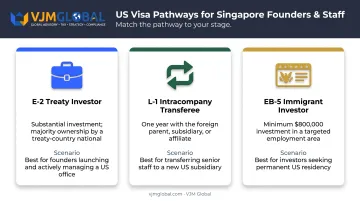
- E-2 Treaty Investor Visa: Open to Singapore nationals under the USSFTA. No fixed dollar minimum, but the investment must be substantial for the business type and genuinely at risk in a non-marginal US enterprise.
- L-1 Intracompany Transferee Visa: For executives or managers moving from the Singapore parent to a related US entity. You generally need one continuous year abroad in the prior three years. New-office petitions also need premises that can support the role within year one.
- EB-5 Immigrant Investor Program: A path to permanent residency for larger capital commitments. Minimums are $1.05 million generally, or $800,000 in targeted employment areas, with at least 10 full-time jobs created.
Match the pathway to your stage: E-2 for active operators, L-1 for transferring existing staff, and EB-5 when a green card matters more than operational control.
Common Pitfalls Singapore Businesses Should Avoid When Entering the US
Singapore companies entering the US often trip on the same avoidable mistakes. Three come up most often:
Treating the US as one market. Tax rates, licensing rules, and business practices vary state to state. What works in Delaware for incorporation may not match California sales tax rules or Texas licensing requirements.
Delaying tax and compliance setup. Form 5472 penalties start at $25,000, and franchise tax deadlines don't move. Treat compliance as a "later" problem and you spend the first year cleaning up gaps instead of growing.
Piecing together separate local providers. A registered agent, tax preparer, and payroll provider working in silos leaves gaps—nobody owns the full picture. One integrated team for entity formation, tax, and payroll closes those gaps. VJM Global supports US market entry this way, with a dedicated CPA team and experience serving 500+ American business owners.
Frequently Asked Questions
What is the trade agreement between Singapore and the US?
The US-Singapore Free Trade Agreement (USSFTA), in force since 2004, was the first FTA between the US and an Asian nation. It eliminates tariffs on nearly all goods while covering services, e-commerce, and IP protections.
Do I need to set up a US company to sell to US customers?
Early-stage selling can happen through distributors or online marketplaces without incorporation. Scaling operations, hiring staff, or limiting liability typically requires a formal US entity.
Which US state is best for a Singapore company to incorporate in?
Delaware is the most common choice thanks to established corporate law and investor familiarity. The ideal state still depends on where the business will actually operate.
Is there a tax treaty between Singapore and the US?
No comprehensive bilateral income tax treaty exists between the two countries. Standard US federal and state tax rates generally apply without treaty-based withholding relief.
Can a Singapore citizen get a US visa to run their own business?
Yes. Singapore nationals can apply for the E-2 Treaty Investor Visa specifically due to USSFTA provisions, provided they make a substantial investment in a genuine operating business.
How long does it take to register a US company from Singapore?
Entity formation itself can be completed within days to a few weeks. EIN issuance, bank account setup, and licensing typically extend the full setup timeline further.