Introduction
You just formed your Delaware LLC or corporation. The paperwork arrives, and there it is: a string of digits labeled "file number" that nobody explained during signup.
Is it your tax ID? A random reference code? Something you'll need later?
This number is Delaware's own identifier for your business, issued by the Division of Corporations the moment your entity is formed. It's separate from your Federal EIN, and mixing the two up can create headaches with banks, vendors, or state filings down the road.
This guide covers what the number actually is, where to find it, and how you'll use it. It also explains why the number matters even more once you start operating across borders, including for founders who later register a business in India.
Key Takeaways
- Delaware assigns a file number of up to nine digits to every entity, used for state filings throughout its life.
- The file number comes from Delaware's Division of Corporations, not the IRS, which issues a separate EIN.
- You can search for the number for free at corp.delaware.gov's entity search tool.
- Corporations need it to file annual reports; LLCs and LPs need it to pay their annual tax.
- International banks and partners sometimes request it to verify a US entity during due diligence.
What Is a Delaware Company Registration Number?
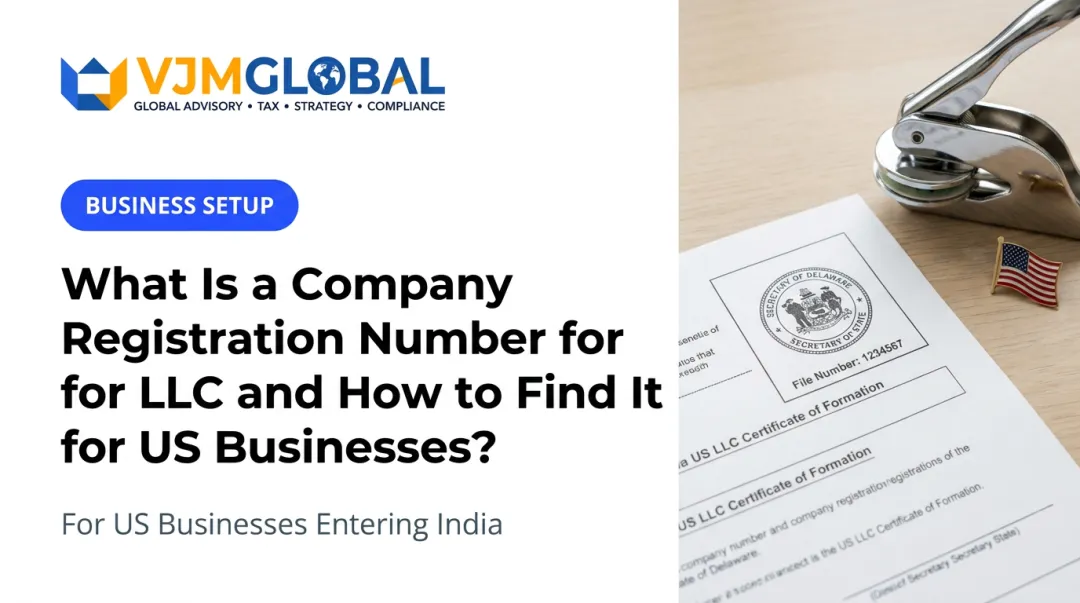
Delaware's Division of Corporations assigns a file number (officially called the "Business Entity File Number") to every LLC, corporation, LP, and other registered entity at the moment of formation. You'll find it printed directly on your stamped Certificate of Formation or Certificate of Incorporation, right in the state's filing stamp.
Format: The number can run up to nine digits. On an actual filed certificate, you'd see something like this in the Secretary of State's stamp:
"FILED 01:58 PM 06/30/2017 — File Number 6463033"
Each new entity gets its own number when it's registered with the state. In practice, this number tends to stay tied to your original filing record for the life of the entity, even through registered agent changes or business name updates. Forming an entirely new entity is what generates a brand-new number, not restructuring an existing one.
A quick but important note on terminology: Delaware calls it a file number. Other states use different labels for the same concept:
- California: Entity Number
- Tennessee: Secretary of State control number
- Other states: charter number, document number, or registration number
If you're managing entities across multiple states, don't assume the terminology (or the number itself) transfers between them. It doesn't.
Delaware Registration Number vs. EIN: Quick Comparison
This is the single most common point of confusion for new founders. Here's the breakdown:
| Delaware File Number | Federal EIN | |
|---|---|---|
| Issued by | Delaware Division of Corporations | Internal Revenue Service |
| Purpose | State-level entity tracking and filings | Federal tax administration |
| Used for | Annual reports, franchise tax, certificates | Tax returns, opening bank accounts, hiring employees |
| Format | Up to 9 digits | 9 digits (XX-XXXXXXX format) |
If a bank asks for your "tax ID," they almost always mean your EIN, per the IRS's own EIN guidance. If Delaware's annual report portal asks for your file number, that's a completely separate lookup.
Where to Find Your Delaware Company Registration Number
Before you go digging through old emails, check these three places first:
- The approval cover letter Delaware sends after formation: the file number usually appears near the top.
- The filing receipt from your registered agent or formation service.
- The stamped Certificate of Formation or Incorporation itself: look at the Secretary of State's filing stamp, typically in the upper corner of the first page.
Lost Your Paperwork? Here's What to Do
If none of the above turn up, you have two options:
- Ask your registered agent or formation service: most keep records on file indefinitely.
- Use Delaware's free Entity Search tool at corp.delaware.gov's entity search.
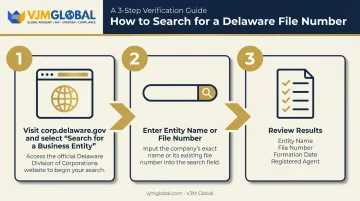
Here's the walkthrough:
- Go to corp.delaware.gov and select "Search for a Business Entity."
- Search by entity name (or file number, if you already have it).
- Review the results: entity name, file number, formation date, registered agent details, and entity kind/type.
One catch: entity status isn't included in the free search. Delaware charges $10 for online status alone, or $20 for status plus tax and filing history. Certified copies and full record searches run separately, typically around $50 per document.
If you're registered in multiple states, remember each state issues its own separate number. There's no single national US business registry that ties them together, so managing multi-state entities means tracking multiple identifiers.
How the Delaware Registration Number Is Used
Once you have the number, here's where it actually comes into play.
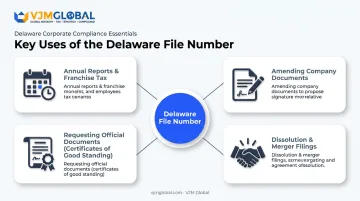
Annual reports and franchise tax. Corporations file annual reports; LLCs, LPs, and general partnerships instead pay a flat annual tax. Either way, Delaware's filing portal requires your file number just to log in and start the process.
Amending company documents. Changing your registered agent or business name means Delaware needs to locate your original record first. The file number is how they do that, though current filing memos allow the field to be left blank if you genuinely don't know it.
Requesting official documents. Certificates of Good Standing and certified copies are often requested when:
- Opening a bank account overseas
- Applying for local business licenses
- Expanding operations into a new country
Dissolution and merger filings. These filings reference the file number to identify which entity record is being closed or combined.
Business Verification and Due Diligence
This is where it gets relevant for founders operating internationally. International banks, investors, or local compliance teams sometimes ask for your Delaware file number to confirm your US entity actually exists and is properly registered.
This comes up frequently for founders expanding into markets like India, where local banking KYC processes and company registration checks often request verified proof of the foreign parent entity's formation.
One clarification worth noting: your file number supports these processes, but it typically doesn't replace core requirements like your EIN or the formation documents themselves. Think of it as supporting evidence, not the main credential.
Delaware Registration Number vs. Other Business Identifiers
Delaware isn't unique in assigning entity numbers; it's just one of fifty different systems.
- California calls it an Entity Number
- Tennessee refers to a Secretary of State control number
- Every other state uses its own label and database
The Small Business Administration confirms most entity registration happens at the state level, which is exactly why there's no unified federal lookup for company numbers the way there is for EINs.
How this compares internationally: India uses a Corporate Identification Number (CIN), a 21-character alphanumeric code assigned by the Ministry of Corporate Affairs (MCA) when a company registers under the Companies Act. Founders who've dealt with a Delaware file number will recognize the concept immediately: it's a unique registry identifier tied to one company record, just with a longer format and different issuing body.
Quick reference for which identifier gets requested where:
| Situation | Identifier typically requested |
|---|---|
| Opening a US bank account | EIN |
| Delaware state filings | File number |
| Foreign qualification in another state | That state's own entity number |
| Registering or banking in India | Delaware file number (as supporting proof) plus EIN |
Why Businesses Register in Delaware — And What It Means for Global Expansion
Delaware's appeal isn't accidental. Its General Corporation Law is specifically built for business flexibility. The state also runs the Court of Chancery, a specialized court that handles corporate disputes without juries, resulting in faster, more predictable rulings for business matters.
Add in strong privacy protections for owners and no state corporate income tax on companies that don't operate within Delaware, and the incentives stack up quickly.
The numbers back this up. According to Delaware's Division of Corporations 2024 Annual Report, 66.7% of Fortune 500 companies and 81.4% of US-based IPOs were incorporated in Delaware that year.

Here's where it connects to global expansion: many Delaware-registered founders are international entrepreneurs by nature, and a large share eventually look to expand into markets like India. When they do, their US formation documents, including that Delaware file number, often get requested during:
- Local company registration in India
- Bank KYC verification
- FDI and regulatory compliance checks
This is exactly the kind of cross-border handoff VJM Global works through daily. With 30+ years in tax, audit, and advisory experience, including support for 500+ American business owners entering the Indian market, the team covers:
- Entity structuring and registration
- RBI and FEMA compliance
- Bank account setup
- Ongoing accounting once the Indian entity is live
If you're a Delaware-registered founder considering India as your next market, VJM Global's team has already mapped this exact path for hundreds of founders, so there's no need to piece it together alone.
Frequently Asked Questions
Where can I find my company registration number in the USA?
Check your Certificate of Formation, filing receipt, or state approval letter for the number. If those documents are missing, look it up directly through your state's Secretary of State database.
Do Delaware corporations have a registration number?
Yes. Every Delaware corporation and LLC receives a unique file number at formation, used for annual reports, franchise tax filings, and other state-level records.
What is Delaware registration?
Delaware registration is the process of legally forming an entity with the Delaware Division of Corporations. Once approved, the state issues official recognition along with your file number.
Why are US companies registered in Delaware?
Delaware offers business-friendly corporate law, a specialized Court of Chancery for disputes, strong owner privacy, and no state income tax on companies operating outside Delaware.
Is the Delaware file number the same as my EIN or Tax ID?
No. The EIN is issued federally by the IRS for tax purposes, while the file number is state-specific. You'll likely need both, just for different situations.
Can I look up a Delaware registration number for free?
Yes, basic details like name, file number, and formation date are free through corp.delaware.gov's entity search. Status checks and certified documents require a paid request.