Introduction
Picture this: You've built a thriving Singapore Pte Ltd, your business is humming, and now the Middle East, GCC, or African markets are calling. Your next question is natural—should I set up a Dubai Free Zone LLC as my launchpad?
For Singapore entrepreneurs, the timing is compelling. UAE-Singapore bilateral trade reached SGD 27.9 billion in 2025, up from SGD 24.05 billion — making the UAE Singapore's largest trading partner in the MENA region.
Dubai's business-friendly regulations, strategic time zone overlap with Singapore, and a Double Tax Agreement in force since 1996 give Asia-Pacific founders a practical base for Middle East and African expansion.
This guide covers what an FZ LLC is, how it compares structurally and financially to your Singapore Pte Ltd, the complete setup process, and the tax and compliance obligations to understand before committing.
TLDR: Key Takeaways
- 100% foreign ownership allowed with no local sponsor required
- 0% corporate tax for Qualifying Free Zone Persons (conditions apply)
- Operates under specific free zone regulations, not UAE mainland law
- Cannot trade directly with UAE mainland without dual licensing or a local distributor
- Singapore-UAE Double Tax Agreement (effective since 1996) prevents double taxation
- Enables UAE residency visa sponsorship for founders and employees
What Is an FZ LLC in Dubai?
An FZ LLC (Free Zone Limited Liability Company) is a legal entity registered within one of Dubai's designated free zones—not on the UAE mainland. This structure allows full foreign ownership and limits personal liability in the same way your Singapore Pte Ltd does: shareholders' financial risk is capped at their invested capital.
Key structural features:
- Shareholder limits: Minimum 1, maximum 50 (individuals or corporate entities)
- Registered office: Must maintain a physical address within the chosen free zone
- Trade license: Operations are governed by an approved license tied to specific business activities
- Legal suffix: Must use "FZ LLC" in the registered name
What Is a Free Zone?
A free zone is a designated economic area in the UAE with its own regulatory authority, tax incentives, and licensing rules—entirely separate from mainland UAE. Dubai alone has over 20 free zones, each catering to specific industries:
- Dubai Multi Commodities Centre (DMCC): Commodities trading, general trade
- Dubai Internet City (DIC): Technology and ICT
- Meydan Free Zone: General commerce, e-commerce, known for quick incorporation timelines
- Dubai Airport Free Zone (DAFZ): Logistics and aviation
Operational Scope and Limitations
What an FZ LLC can do:
- Operate internationally and within the free zone
- Open UAE corporate bank accounts
- Sponsor employee and investor visas
- Repatriate 100% of profits with no restrictions on transfers
One key restriction: an FZ LLC cannot sell directly to UAE mainland customers. To do so, you'll need a local distributor, a dual license, or a separate mainland entity. For Singapore entrepreneurs whose clients include domestic UAE businesses, this adds structural complexity worth planning for early.
FZ LLC vs. Singapore Pte Ltd: Key Differences
| Dimension | Singapore Pte Ltd | Dubai FZ LLC |
|---|---|---|
| Incorporation Authority | ACRA | Relevant Free Zone Authority |
| Foreign Ownership | 100% allowed | 100% allowed |
| Minimum Paid-Up Capital | SGD 1 | Varies (AED 10,000–50,000 typical) |
| Corporate Tax Rate | 17% (with exemptions) | 0% for Qualifying Free Zone Persons; 9% standard |
| Annual Audit | Mandatory above SGD 10M revenue | Mandatory regardless of size |
| Mainland Market Access | Unrestricted | Restricted (free zone/international only) |
Tax Rate Comparison
Singapore has a headline corporate tax rate of 17%, but startups benefit from a Startup Tax Exemption of up to SGD 125,000 per year for the first three consecutive years of assessment. The exemption applies at 75% on the first SGD 100,000 of chargeable income and 50% on the next SGD 100,000.
UAE applies a standard corporate tax rate of 9% on taxable income exceeding AED 375,000, effective since June 2023. Qualifying Free Zone Persons (QFZPs), however, pay 0% on qualifying income — provided they meet all conditions.
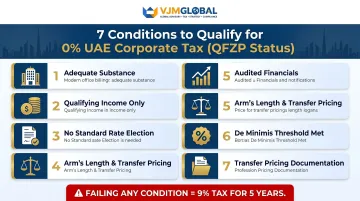
To qualify for 0%, you must meet seven simultaneous conditions, including:
- Maintaining adequate substance in a free zone (employees, assets, expenditures)
- Deriving qualifying income (specific transaction types with other FZ persons or qualifying activities)
- Not electing to be subject to standard rates
- Complying with the arm's length principle and transfer pricing documentation
- Maintaining audited financial statements
- Meeting de minimis requirements: non-qualifying revenue must not exceed the lower of 5% of total revenue or AED 5,000,000
- Preparing and maintaining transfer pricing documentation
⚠️ Critical caveat: Failing ANY single condition strips QFZP status for the current tax period plus 4 subsequent periods (5 years total). During this window, all income is taxed at 9% with no benefit from the AED 375,000 zero-rate threshold.
Compliance Burden
Singapore Pte Ltd:
- ACRA annual return (within 7 months of financial year-end for non-listed companies)
- IRAS corporate tax filing (Form C-S/C due by 30 November of Year of Assessment)
- AGM or written resolution
Dubai FZ LLC:
- Annual trade license renewal
- Audited financial statements (typically due within 6 months of financial year-end; varies by free zone)
- UBO (Ultimate Beneficial Owner) registration
- VAT registration if taxable supplies exceed AED 375,000 annually
- Annual general meeting if multiple shareholders
Banking and Visa Considerations
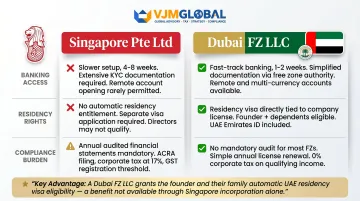
Banking: Singapore offers one of Asia's deepest banking ecosystems, with relatively fast account opening for Pte Ltd structures. UAE free zone accounts require more documentation and take longer to open, particularly for single-shareholder FZEs. Banks generally prefer FZ LLCs with formal governance structures.
Residency: A Singapore Pte Ltd carries no residency entitlement. A Dubai FZ LLC allows the founder and employees to apply for UAE residency visas — a meaningful advantage for entrepreneurs considering relocation or building a regional base.
Why Singapore Entrepreneurs Are Choosing Dubai's Free Zones
For Singapore entrepreneurs, Dubai is more than a tax-friendly jurisdiction—it's a practical base to serve markets that are hard to reach from Southeast Asia alone. Three factors drive most of the interest: market geography, tax structure, and day-to-day operational fit.
Market Access
Dubai sits at the intersection of MENA, South Asia, and Africa—a natural extension for businesses already serving Asia-Pacific. The UAE is Singapore's largest trading partner in the MENA region, with bilateral merchandise trade reaching SGD 27.9 billion in 2025.
Tax Structure
Free zone entities benefit from a low-tax environment by design:
- 0% corporate tax for qualifying free zone entities
- No capital gains tax
- No withholding tax on dividends (currently set at 0%)
- UAE-Singapore Double Tax Agreement (DTA) prevents double taxation on cross-jurisdictional income (signed 1995, updated 2016)
Operational Fit
Beyond taxes, Dubai works well as a base for internationally mobile teams:
- UAE residency visa access for founders and key staff
- Modern infrastructure and strong regional connectivity
- English as the primary business language
- Time zone overlap with both Singapore (GMT+8) and Europe (GMT+1 to +2), useful for businesses serving clients across multiple regions
How to Set Up an FZ LLC in Dubai: Step-by-Step
Step 1 — Choose the Right Free Zone
Your choice depends on industry, visa requirements, cost, and proximity to clients. Popular options for Singapore entrepreneurs include:
- DMCC: Commodities, trading; minimum capital AED 50,000
- Meydan Free Zone: General activities, e-commerce; fast digital setup
- Dubai Internet City: Technology and ICT; minimum capital AED 10,000 for FZ-LLCs
- DAFZ: Logistics and aviation
Each free zone has its own authority, fee structure, and minimum capital rules. Research your industry requirements before committing.
Step 2 — Select Business Activities and Reserve a Trade Name
- Activities must be pre-approved and listed on the license
- Company name must include the "FZ LLC" suffix
- Must not conflict with existing registrations
- Must align with licensed activities
- Most free zones offer an online name-check portal
Step 3 — Prepare and Submit Required Documents
Typical documents include:
- Passport copies of all shareholders and directors
- Proof of residential address (utility bill not older than 6 months)
- Business plan (if required for specific activity types)
- Completed application form
- For corporate shareholders: Notarised constitutional documents from the parent company
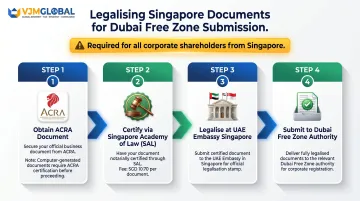
Singapore-specific requirement: ACRA-issued documents must be apostilled through the Singapore Academy of Law (SAL) at SGD 10.70 per document, then legalised by the UAE Embassy in Singapore before submission to any Dubai free zone. ACRA computer-generated documents (Business Profiles, extracts) must first be certified by ACRA before SAL will process them.
Step 4 — Secure Office Space and Pay Fees
All FZ LLCs must maintain a registered office within the free zone. Options include:
- Flexi-desk: Shared workspace arrangement, typically the lowest-cost option and included in most entry-level packages
- Private office: Dedicated space that unlocks higher employee visa quotas
Visa quota is tied directly to office type and package tier — confirm your requirements with the free zone authority before selecting.
Step 5 — Receive Trade License, Apply for Visas and Bank Account
Once office space is confirmed and fees are settled, the free zone authority issues the trade license and incorporation documents. From here, you can:
- Apply for a UAE investor/residency visa
- Open a corporate bank account
- Begin operations
Post-incorporation steps — including VAT registration, accounting setup, and ongoing compliance — are where many founders lose time. Getting these right from day one avoids penalties and reporting gaps down the line.
Tax and Compliance Considerations for Singapore Entrepreneurs
UAE Corporate Tax (9%) and QFZP Status
Free zone companies can benefit from a 0% rate on qualifying income if they meet substance requirements, do not conduct business with the UAE mainland, and maintain adequate economic presence.
Qualifying Free Zone Person (QFZP) conditions:
- Adequate substance in a free zone (core income-generating activities, qualified employees, operating expenditures, physical assets)
- Deriving qualifying income only
- Audited financial statements prepared annually
- Transfer pricing documentation maintained
- De minimis threshold met (non-qualifying revenue does not exceed lower of 5% of total revenue or AED 5,000,000)
- Arm's length principle compliance
Loss of QFZP status triggers:
- Failure to meet any single condition
- Breach of de minimis threshold
Consequence: Loss for current tax period plus 4 subsequent tax periods—all income taxed at 9% with no AED 375,000 zero-rate threshold benefit.
Singapore Tax Residency Implications
Securing QFZP status solves the UAE side of the tax equation — but Singapore residency creates a separate obligation that many entrepreneurs overlook.
A Singapore entrepreneur who incorporates an FZ LLC but remains tax resident in Singapore may still owe IRAS tax on income remitted to Singapore. The UAE-Singapore DTA does provide relief — typically through a credit mechanism that offsets UAE tax paid against Singapore liability — but it does not eliminate all Singapore obligations, particularly for income taxed at 0% in the UAE.
Get advice from a cross-border tax specialist who understands both IRAS rules and UAE free zone regulations before assuming your Singapore tax liability disappears.
Annual Compliance Obligations
- Trade license renewal: Annual requirement
- Audited financial statements: Due within 6 months of financial year-end (timeline varies by free zone)
- UBO register updates: Required under UAE AML regulations
- VAT registration: Mandatory if taxable supplies exceed AED 375,000 over 12 months
Missing any of these deadlines — particularly the UBO register or audit filings — can trigger penalties and, in some free zones, jeopardize your trade license renewal.
FZ LLC vs. FZE vs. FZCO: Which Structure Fits Your Business?
Dubai free zones offer three primary company structures. The right choice depends on your ownership setup, growth plans, and whether you're setting up as an individual or with a Singapore holding company as shareholder.
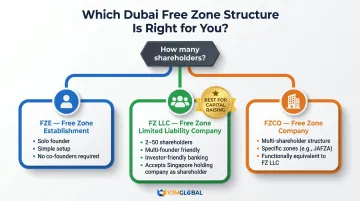
FZE (Free Zone Establishment)
- Shareholders: Exactly 1 (individual or corporate entity)
- Governance: Simpler, faster setup
- Best for: Solo founders, consultants, freelancers
- Limitation: Cannot accommodate co-founders or investors without converting to FZ LLC
FZ LLC (Free Zone Limited Liability Company)
- Shareholders: 1 to 50 (individuals or corporate entities)
- Governance: Supports formal structures (board, shareholder agreements)
- Banking: Preferred by UAE banks for corporate account opening
- Best for: Multi-founder setups, businesses expecting to raise capital, or Singapore holding companies as shareholders
FZCO (Free Zone Company)
- Used in specific free zones (such as JAFZA) as an equivalent to FZ LLC
- Functionally similar in terms of multi-shareholder structure
- Naming convention varies by free zone authority
Quick decision guide:
- Solo founder, no co-founders, no near-term fundraising: choose FZE
- Two or more founders, or a Singapore holding company as shareholder: choose FZ LLC or FZCO
- Raising capital or seeking investor-friendly banking: FZ LLC is the stronger choice
Frequently Asked Questions
What is FZ LLC in UAE?
An FZ LLC is a Free Zone Limited Liability Company registered within a UAE designated free zone, allowing 100% foreign ownership, limited personal liability, and access to UAE residency visas and corporate banking.
What is the difference between FZ LLC and FZE LLC?
The primary difference is shareholder count: an FZE is restricted to a single shareholder, while an FZ LLC allows 2 to 50 shareholders. FZ LLCs are generally preferred by banks and better suited for multi-founder setups or businesses with a corporate shareholder.
What is a FZE company in Dubai?
An FZE (Free Zone Establishment) is a single-owner free zone entity, simpler to set up and govern than an FZ LLC, but cannot accommodate additional shareholders without converting to FZ LLC.
What is FZC LLC?
FZC (Free Zone Company) or FZCO is a designation used in specific free zones (such as JAFZA) for a multi-shareholder entity that operates identically to an FZ LLC but carries a different name depending on the free zone authority.
Can I work on a freezone visa?
A UAE free zone residency visa allows the holder to live and work in the UAE, primarily within the free zone. To work outside the free zone on the UAE mainland, you'll need a separate mainland work permit or employment visa from a mainland-registered entity.
Is a freezone visa better?
A free zone visa is ideal for entrepreneurs and employees whose work is based within the free zone or internationally. It offers a cost-effective path to UAE residency, though those requiring broad access to the UAE mainland market will need a mainland visa instead.