Introduction
Bilateral trade between Singapore and the UAE hit SGD 27.9 billion in 2025, up from SGD 24.05 billion the year before — and Singapore companies are increasingly following that capital flow by planting a flag in Dubai. For businesses already established in Asia, the UAE offers direct access to Gulf markets, a zero-tax environment, and a business infrastructure built around international operators.
Most Singapore business owners recognize the opportunity but hit a wall on specifics: what does branch office setup actually involve, what will it cost, and which Singapore documents need preparation?
Unlike a subsidiary, a branch office extends your existing Singapore entity into the UAE — no new company is created. Here's what Singapore companies need to know: the process, costs, required documents, and key decisions at each stage.
Key Takeaways
- A branch office is your Singapore parent company's legal extension in Dubai — same brand, same entity, with full ownership retained by the parent
- Choose between mainland registration (full UAE market access, requires Local Service Agent in some cases) or free zone registration (faster setup, no LSA, operations restricted to zone)
- Singapore documents require notarization, apostille, and UAE Embassy attestation
- Total setup costs range from AED 25,000–75,000 depending on jurisdiction and activity
- Timeline is typically 4–8 weeks once documents are ready
Why Singapore Companies Are Expanding to Dubai
The Singapore-Dubai corridor delivers broad emerging market coverage: Singapore serves Southeast Asia, while Dubai provides access to the Middle East, Africa, and South Asia. The numbers back this up — the UAE attracted USD 45.6 billion in FDI in 2024, a 48.7% increase from 2023, ranking it 10th globally for foreign direct investment.
Regulatory and business alignment strengthens the case:
- Both jurisdictions rank in the global top 10 for competitiveness — Singapore #1 and UAE #7 in the 2024 IMD World Competitiveness Ranking
- The Double Taxation Avoidance Agreement (DTAA) between Singapore and the UAE has been in force since 27 September 1996 (modified by the Multilateral Instrument in 2019), providing treaty-backed certainty on business income, dividends, and royalties
- Over 600 Singaporean companies already operate in the UAE, concentrated in fintech, healthcare, infrastructure, and education
Dubai's free zones align directly with these sectors — offering sector-specific licensing structures in fintech, healthcare, and logistics that let Singapore companies enter the market quickly under their existing brand and corporate identity.
Branch Office vs. Subsidiary in Dubai: Key Differences
A branch office is not a separate legal entity. It operates under your Singapore parent company's name, legal identity, and liability structure. The parent bears full responsibility for all branch obligations in the UAE — the parent company cannot isolate itself from the branch's legal or financial exposure.
Key structural differences:
| Dimension | Branch Office | Subsidiary (LLC) |
|---|---|---|
| Legal identity | Extension of parent company | Independent UAE-incorporated entity |
| Liability | Parent directly liable | Limited to subsidiary's assets |
| Ownership | 100% parent-controlled | Separate shareholding structure |
| Setup speed | 4–8 weeks typical | 8–12 weeks typical |
| Capital requirement | None | Varies by activity |
| MOEC registration | Required | Not required |
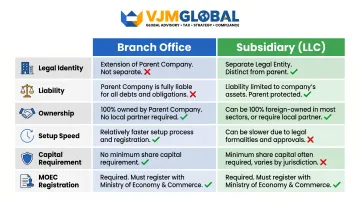
These differences matter most when deciding how much exposure your Singapore parent is willing to carry. A branch office suits companies that want speed and simplicity:
When a branch office is the better fit:
- Market-testing before committing to full incorporation
- Maintaining Singapore brand continuity across markets
- Lower setup complexity and faster time-to-operate
- Activities that don't require significant standalone UAE operations
If you're planning large-scale UAE operations, a joint venture with local partners, or need clean liability separation between Singapore and Dubai, a subsidiary is the stronger structure to pursue.
How to Set Up a Branch Office in Dubai: Step-by-Step
Choose Your Jurisdiction (Mainland or Free Zone)
Your first decision shapes everything downstream: mainland or free zone registration.
| Mainland (DET) | Free Zone (DMCC, DIFC, DWTC) | |
|---|---|---|
| Market Access | Full UAE market + government contracts | Zone/international only; mainland requires add-on license |
| Regulator | DET + Ministry of Economy (MOEC) | Free zone authority only |
| LSA Requirement | Sometimes (see below) | Generally not required |
| Speed | Moderate | Faster |
Reserve Your Trade Name
The branch typically operates under your Singapore parent company's name or an approved variation. UAE trade name rules require that names be distinct from existing Dubai brands, government projects, and international trademarks. Names must be written literally — abbreviations require specific approval. Reserve the name before proceeding with other approvals.
With your name reserved, you can move to the next structural requirement that catches many Singapore companies off guard.
Appoint a Local Service Agent (Mainland Only, When Required)
Recent amendments under Federal Decree-Law No. 26 of 2020 removed the LSA requirement for most mainland branches. However, an LSA is still required if:
- The branch manager does not hold a valid Emirates ID
- You need to apply for immigration or MOHRE files
- Your activity falls under specific professional service categories
Where required, the LSA is a UAE national or UAE-owned company handling government liaison and administrative functions. Per Dubai Law No. 13 of 2011, the LSA has 0% equity, no operational authority, and bears no civil or financial liability for the business. A corporate LSA is preferable for transparency and control.
Obtain Initial Approvals and Submit Documents
Submit your application and Singapore parent company documents to DET (mainland) or your chosen free zone authority. Standard document requirements include the parent company's certificate of incorporation, audited financials, board resolution, and attested power of attorney.
Regulated industries — finance, healthcare, education — require additional sectoral approvals from relevant ministries, adding 2–4 weeks to your timeline.
Secure Office Space
Most jurisdictions require a physical office or flexi-desk. Virtual offices are available in select free zones. The tenancy agreement must be registered through Ejari (for mainland) — a mandatory requirement under Law No. 26 of 2007. Registration costs AED 160 per contract and must be submitted as part of your license application.
Receive Your Branch License and Commence Operations
Once all approvals are in place, your branch office license is issued for one year (renewable annually). Post-licensing steps include:
- Opening a UAE corporate bank account (expect thorough KYC documentation)
- Applying for employee residence visas
- Registering for VAT if applicable (mandatory threshold: AED 375,000 in annual taxable supplies)
- Commencing commercial activity
Documents Singapore Companies Need for Dubai Branch Registration
Core Singapore-Origin Documents
Required from ACRA:
- Certificate of Incorporation
- Memorandum and Articles of Association
- Board Resolution authorizing the Dubai branch establishment and appointing a branch manager
- Power of Attorney for the branch manager
- Certificate of Good Standing (fee: SGD 11 per copy)
Having these ready before you begin saves time — the attestation process that follows is where delays typically occur.
Attestation Process for Singapore Documents
Singapore's accession to the Hague Apostille Convention on 16 September 2021 simplified document legalization, but UAE branch registration still requires a multi-step attestation chain:
- Notarization in Singapore
- Apostille (available since Singapore joined the Convention)
- UAE Embassy attestation in Singapore
- UAE Ministry of Foreign Affairs attestation
- Arabic translation and attestation by UAE Ministry of Justice
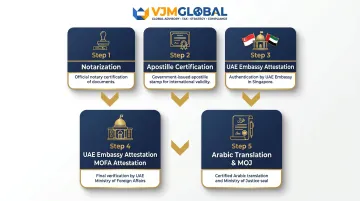
This sequence takes 1–2 weeks and is the most common cause of delays. Start early and verify each step is completed correctly — missing one step requires restarting the entire process.
Additional Supporting Documents
- Audited financial statements of the Singapore parent company (preceding two years)
- Passport copies of directors and proposed branch manager
- Company profile or business activity description
- Local Service Agent agreement (if applicable for mainland branches) — must be notarized
Ongoing Compliance Requirements
After setup, your branch must maintain:
- Annual audited accounts
- Annual trade license renewal
- UAE VAT registration and filing (if revenue exceeds AED 375,000)
- MOEC registration within one month of DET license issuance (failure to comply incurs a AED 100,000 fine)
Managing attestation timelines, VAT thresholds, and MOEC deadlines across two jurisdictions is where many companies run into trouble. VJM Global works with Singapore businesses at each stage — from document preparation through ongoing UAE compliance — to keep filings on track and avoid costly penalties.
Costs and Timeline for Setting Up a Dubai Branch from Singapore
Cost Breakdown
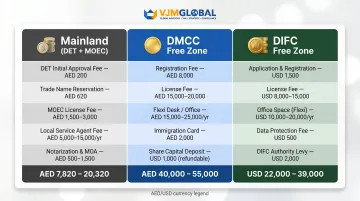
Mainland (DET + MOEC) Government Fees:
- MOEC initial approval: AED 3,500
- MOEC registration: AED 7,500
- Bank guarantee: AED 50,000 (refundable deposit)
- Ejari registration: AED 160 per contract
Free Zone Fee Comparison:
| Free Zone | Registration Fee | Annual License Fee |
|---|---|---|
| DMCC | AED 9,000 + AED 1,035 application | AED 20,285 |
| DIFC (non-retail) | USD 8,000 | USD 12,000 |
| DIFC (retail) | USD 3,400 | USD 5,100 |
Additional Costs:
- Office lease: AED 15,000–50,000 annually (flexi-desks are more affordable than dedicated mainland offices)
- Document attestation and professional services: AED 5,000–15,000
- Employee visa costs: AED 3,000–5,000 per employee
Total estimated range: AED 25,000–75,000 depending on jurisdiction, activity type, and office requirements.
No paid-up share capital is required for a branch office — which keeps upfront costs lower than full incorporation. Once you've mapped out your budget, the next step is understanding how long the process actually takes.
Timeline Expectations
Overall process: 4–8 weeks once all documents are in order
Singapore document attestation: 1–2 weeks (often the bottleneck)
Mainland branch approval: 7–14 working days after document submission
Free zone branch approval: 5–30 days depending on the zone
Regulated industries: Add 2–4 weeks for ministerial approvals
Start document attestation before filing the formal license application. Notarization, apostille, and UAE Embassy attestation are consistently the longest steps and can stall your timeline if left until later.
Common Mistakes Singapore Companies Make When Setting Up a Dubai Branch
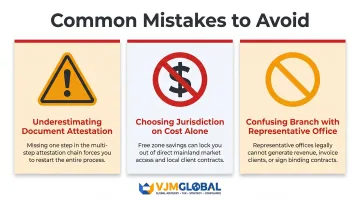
Three mistakes consistently derail Dubai branch setups for Singapore companies — and all three are avoidable with the right preparation.
Underestimating the Document Attestation Process
Many Singapore companies assume their ACRA documents are ready to submit as-is. The reality is more involved: your documents must go through notarization, then apostille certification, then UAE Embassy attestation — in that exact order. Missing one step means restarting the entire chain, which can add 4–8 weeks to your timeline.
Choosing Jurisdiction Based on Cost Alone
Free zones are cheaper and faster, but if your business model requires direct UAE market access or government contracts, you need a mainland branch. Selecting the wrong jurisdiction forces costly restructuring later. Locking in your go-to-market strategy first — before comparing setup fees — prevents that expensive reversal.
Confusing a Branch Office with a Representative Office
A representative office can only conduct marketing and liaison activities — it cannot generate revenue, sign commercial contracts, or invoice UAE clients. Only a branch office or subsidiary can conduct commercial business. Companies that set up a representative office expecting full commercial operations typically discover the gap within their first quarter — and face an unplanned restructuring cost to correct it.
Frequently Asked Questions
What is a branch office in the UAE?
A UAE branch office is a legal extension of a foreign parent company — not a separate entity. It operates under the parent's name and legal identity, is authorized to conduct commercial activities, and holds the parent company fully liable for all branch obligations.
How do I set up a branch office in Dubai?
The core steps are:
- Choose mainland or free zone jurisdiction
- Prepare and attest Singapore parent company documents (notarization, apostille, UAE Embassy attestation)
- Appoint a Local Service Agent if required (mainland only)
- Obtain DET and MOEC approvals
- Lease office space and register Ejari
- Receive your branch license
How much does it cost to set up a branch office in Dubai?
Total costs depend on jurisdiction and business activity. Expect AED 25,000–75,000 covering licensing fees, LSA fees (if applicable), office space, document attestation, and professional fees. Free zone branches (DMCC, DIFC) generally run lower in total cost than mainland branches.
What is the difference between a branch and a subsidiary in the UAE?
A branch is a legal extension of the parent company — the same legal entity, with the parent bearing full liability. A subsidiary is a separate UAE-incorporated entity with its own legal standing and limited liability protection. Branches set up faster; subsidiaries give you greater operational independence and insulate the parent from local risk.
Do Singapore companies need a local service agent to open a branch in Dubai?
A Local Service Agent is only required for mainland branch offices in specific cases — not for free zone branches. Post-2020 rule changes removed the LSA requirement for most activities. You'll still need one if the branch manager lacks an Emirates ID or if the activity falls under certain specialized professional categories.
How long does it take for a Singapore company to register a branch office in Dubai?
The typical timeline is 4–8 weeks once all documents are ready. Singapore companies should factor in an additional 1–2 weeks for notarization, apostille, and UAE Embassy attestation of ACRA-issued documents — this attestation sequence is usually the longest part of the process.