Introduction
Singapore construction firms face financial complexity that general accounting simply can't handle. The Building and Construction Authority projects total construction demand to reach S$47–53 billion in 2025 — and managing that volume means operating across long-term contracts, progressive billing cycles, and Singapore-specific compliance requirements like FRS 115 and IRAS corporate tax rules.
For most contractors, this means simultaneously tracking foreign worker levies, subcontractor retention clauses, and multi-project cost structures that shift every month.
Generic accounting practices fail here because construction is structurally different from most industries. Common pain points include:
- Fluctuating profits from improper revenue recognition
- Poor job-level cost visibility across concurrent projects
- Cash flow strain from 5–10% retention holdbacks
- Tax penalties from non-compliant bookkeeping
Construction revenue spans multiple accounting periods, every project runs as its own profit centre, and specialist items like work-in-progress balances, variation orders, and retention sums each require deliberate treatment.
Here's what this guide covers:
- Construction accounting in Singapore is project-centric — every best practice ties revenue, cost, and profitability tracking back to individual contracts
- FRS 115 mandates progressive revenue recognition using the Percentage of Completion method; IRAS explicitly rejects the Completed Contract Method for tax purposes
- Job costing, WIP tracking, and project-specific reconciliation are non-negotiable for financial accuracy and audit readiness
- IRAS imposes specific rules for construction income, retention sums, provisions, and deductible expenses that differ from general corporate tax treatment
What Makes Construction Accounting Different in Singapore
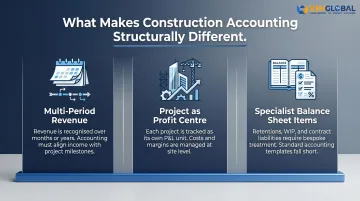
Construction accounting operates on fundamentally different principles from standard business accounting:
- Revenue spans multiple accounting periods — a 24-month build doesn't generate income in month 24; it is recognised progressively as work milestones are completed
- Each project is a unique profit centre — a contractor running five concurrent sites must track revenue, costs, and margins as fully separate financial units
- Industry-specific balance sheet items — retention sums, variation orders, subcontractor claims, contract assets/liabilities, and WIP balances require dedicated treatment that standard general ledger categories aren't built to handle
For contractors operating in Singapore, these structural differences are compounded by a specific regulatory framework:
- FRS 115 (Revenue from Contracts with Customers) governs how and when revenue is recognised
- IRAS corporate income tax rules for construction companies set specific requirements for POC thresholds, retention sum treatment, and project-level record-keeping
- GST treatment for construction services dictates tax points for progress billing and retention release
- CPF contributions and foreign worker levy accounting must be allocated to specific projects, not pooled as general overhead
Each of these requirements shapes how contractors must structure their chart of accounts, billing cycles, and reporting — which is why the best practices covered below are Singapore-specific rather than general accounting principles.
Revenue Recognition Under FRS 115: Getting It Right
FRS 115 replaced FRS 11 (Construction Contracts) with effect from 1 January 2018. It requires construction companies to recognise revenue over time as performance obligations are fulfilled — not when invoices are raised or when projects reach 100% completion.
Percentage of Completion vs. Completed Contract Method
The Percentage of Completion (POC) method recognises revenue progressively based on measurable progress. Most contractors use the cost-to-cost method:
Revenue recognised to date = (Costs incurred to date ÷ Total estimated contract costs) × Total contract price
IRAS accepts POC as the standard approach for tax reporting. No fixed minimum threshold (such as 20%) is mandated, but contractors must provide supporting evidence — internal reviews or independent assessments from professional engineers or surveyors — to justify whatever threshold they adopt.
The Completed Contract Method (CCM) defers all revenue and profit recognition until project completion. IRAS explicitly rejects CCM for tax purposes because it violates the principle that income must be recognised when it accrues. Consequences include:
- Artificial losses in early years
- Inflated profits in completion years
- Potential tax overpayment due to timing mismatches
- Audit findings and penalties during IRAS reviews
Contract Assets and Liabilities
Under FRS 115, contractors must disclose:
- Contract assets (unbilled revenue): Work performed exceeds invoices raised. This represents your entitlement to payment for completed work not yet billed.
- Contract liabilities (advance payments): Invoices raised exceed work performed. This represents your obligation to deliver future services.
Failure to record these correctly distorts your balance sheet, overstates or understates working capital, and triggers audit findings.
Retention sums receivable:
IRAS treats retention sums as part of contract revenue to be recognised based on POC — they cannot be deferred until the retention is released. If your project is 80% complete, you must recognise 80% of the total contract value, including retention. This applies regardless of whether the client has released the retention sum.
Retention sums payable to sub-contractors:
Tax-deductible when incurred under POC, not when paid.
Job Costing and Project-Level Cost Allocation
Job costing is the practice of assigning all direct and indirect costs to individual projects. It is the single most critical best practice in construction accounting.
Without it, per-project profitability is invisible, cost overruns go undetected until damage is done, and your records fall short of IRAS requirements for project-by-project profit and loss reporting.
Direct vs. Indirect Cost Allocation
Direct costs must be coded to the correct project at the time of incurrence — not retrospectively. These typically include:
- Labour (site workers, supervisors)
- Materials (cement, steel, fixtures)
- Subcontractor payments
- Equipment hire
Delayed cost recording is the most common cause of misstated WIP balances.
Indirect project-related costs are frequently misclassified. Many contractors book the following as general operating expenses when they should be allocated per project:
- Dormitory expenses for foreign workers
- Foreign worker levies
- Foreign worker salaries
These costs are directly tied to labour deployed on specific contracts. Treating them as job costs gives a truer picture of project profitability and aligns with IRAS record-keeping expectations.
Getting this allocation right is the foundation for everything else — which is why the implementation mechanics matter.
Implementation Best Practices
- Set up a separate cost centre or project account for each contract within your accounting system
- Use construction-specific software (Xero Projects, QuickBooks for Contractors, or Sage 300 Construction) to track costs and generate project-level reports
- Run monthly project financial reviews — compare actuals against budget, flag loss-making contracts early, and make provisions before they compound
For contractors managing several projects simultaneously, the biggest risk is cost data falling through the gaps between projects. Firms without a dedicated accounts team often find that specialist outsourcing — where a single provider handles job costing, WIP tracking, and IRAS compliance across all contracts — produces cleaner records than trying to manage it piecemeal in-house.
Cash Flow Management, WIP Tracking, and Retainage
Cash flow management is structurally challenging in construction:
- High upfront costs (materials, labour, sub-contractor mobilisation) are incurred long before invoices are approved and paid
- Retention clauses typically hold back 5–10% of contract value until project completion or defect rectification
- Multi-year projects can tie up significant working capital
Managing these pressures starts with accurate WIP tracking — the foundation of both FRS 115 compliance and day-to-day cash flow forecasting.
WIP (Work-in-Progress) Tracking
WIP measures the gap between work performed and revenue billed.
Two WIP scenarios:
- Overbilling (contract liability): invoiced more than earned — cash looks healthy, but undelivered work creates refund exposure if you fall short.
- Underbilling (contract asset): earned more than invoiced — profit is real, but the cash gap creates working capital strain until billing catches up.
Identifying which scenario you're in early gives you room to act. These practices help keep cash flow predictable throughout the project lifecycle:
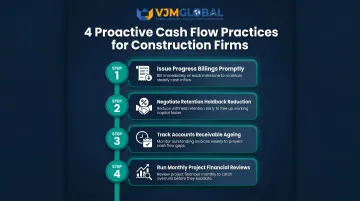
Proactive cash flow practices:
- Issue progress billings promptly at each milestone
- Negotiate payment terms that reduce retention holdback rates as projects progress (for example, dropping from 10% to 5% once the project passes the midpoint)
- Track accounts receivable ageing to identify clients with delayed approvals
- Run monthly project-level financial reviews comparing actual costs against budget — catching loss-making contracts before they escalate
IRAS Tax Compliance for Singapore Construction Companies
Income Tax Rules for Construction Projects
IRAS generally accepts revenue recognised under FRS 115 for income tax purposes, unless the accounting treatment deviates significantly from tax principles.
Expense deductibility rules:
- Provisions are not tax-deductible: Provisions for foreseeable losses, defects, warranty, or liquidated damages are anticipatory in nature. IRAS allows deductions only when actual expenses are incurred or liquidated damages become due and payable.
- All private car expenses are disallowed: Regardless of business use. This includes petrol, insurance, road tax, parking, and ERP charges for S-plated, Q-plated, RU-plated cars, and private hire cars. Only goods/commercial vehicles (vans, lorries, buses) qualify.
- Private and personal expenses: Any private or personal expenses mixed into company accounts must be excluded via tax adjustments.
Project-Level Records and Retention
IRAS requires construction companies to maintain project-by-project profit/loss records in a specific format. The Format of Computation of Attributable Profit/(Loss) for Construction Company (XLS template) is available on iras.gov.sg.
Companies must maintain proper records for at least 5 years from the relevant Year of Assessment. Non-compliance can result in disallowed expenses or additional income assessments.
GST Treatment for Construction Contracts
Construction services in Singapore are standard-rated supplies subject to 9% GST (effective 1 January 2024).
For progress billing arrangements, GST is triggered at the earlier of invoice issuance or payment received. Contractors should:
- Issue a tax invoice upon certification of work done by the client (not at the letter of claim stage)
- Maintain "certificate of work done" as documentary evidence
- Account for GST on retention sums at the earlier of invoice issuance or payment received
Change Order and Contract Variation Management
Construction projects frequently undergo scope changes through variation orders (VOs) or contract modifications — and each change carries direct accounting consequences that affect revenue recognition and contract profitability.
FRS 115 contract modifications:
A modification is treated as a separate contract only if both conditions are met:
- The scope increases through the addition of distinct goods or services
- The price increases by an amount reflecting the standalone selling price of those additions
When these conditions are not both satisfied, the modification is treated as either:
- A termination of the existing contract and creation of a new one (if remaining goods/services are distinct)
- A cumulative catch-up adjustment to the current contract (if not distinct)
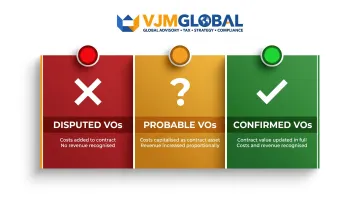
Accounting treatment by VO status:
- Disputed VOs (unlikely to be approved): Add costs to direct costs without recognising additional revenue
- Probable VOs (likely to be approved): Capitalise costs as a contract asset, or add costs and increase anticipated revenue by the same amount
- Confirmed VOs: Update total contract value and costs accordingly
Best practices:
- Establish a formal VO management process at the contract stage
- Use standard templates for change order documentation and approval workflows
- Ensure approved VOs are automatically reflected in the accounting system to prevent revenue leakage
- Avoid commencing work on variations without a signed agreement — Singapore courts strictly enforce contractual requirements on the form and timeframe for variation claims
Frequently Asked Questions
What type of accounting is used in construction?
Construction accounting primarily uses accrual-based accounting combined with the Percentage of Completion (POC) method for long-term contracts. Revenue and costs are recognised progressively over the project lifecycle, rather than at a single point in time.
Can a Chartered Accountant (CA) work in Singapore and what is the local equivalent title?
The local equivalent title in Singapore is Chartered Accountant of Singapore (CA Singapore), awarded by the Institute of Singapore Chartered Accountants (ISCA). Foreign CAs may work in Singapore but must meet ISCA's requirements or obtain recognition through Reciprocal or Mutual Recognition Agreements.
What is FRS 115 and how does it affect construction companies in Singapore?
FRS 115 (Revenue from Contracts with Customers) replaced FRS 11 as Singapore's standard for revenue recognition. Construction firms must recognise revenue over time as performance obligations are fulfilled — an approach IRAS also accepts for income tax purposes.
What are the IRAS record-keeping requirements for Singapore construction companies?
IRAS requires construction companies to retain general business records for at least 5 years. Additionally, project-specific profit/loss records must be maintained per contract using IRAS's prescribed format and made available upon request.
Is the Completed Contract Method acceptable for income tax in Singapore?
No. IRAS does not accept the Completed Contract Method for tax purposes. Revenue must be recognised progressively in line with FRS 115 — using CCM risks deferred tax liabilities and penalties during an IRAS audit.