Introduction
The UAE offers Singapore entrepreneurs something rare: 0% personal income tax, a 9% corporate tax rate (with qualifying free zone entities paying 0% on certain income), and a geographic bridge between Asian and Middle Eastern markets. For businesses feeling the pressure of Singapore's mature, competitive landscape, Dubai registration opens access to faster-growing economies with a lighter tax burden.
Bilateral trade between Singapore and the UAE reached S$27.94 billion in 2025, reflecting a well-established business corridor. Even so, registering remotely means navigating three jurisdiction types — Mainland, Free Zone, and Offshore — each with distinct ownership rules, trade rights, and cost structures.
This guide covers the full process: choosing the right structure, completing registration, and opening a corporate bank account, with a focus on requirements specific to Singapore residents.
Key Takeaways
- Singapore residents can own 100% of a Dubai company through Free Zone or Mainland structures
- Choose between Mainland (UAE-wide trade), Free Zone (tax benefits, full ownership), or Offshore (holding and asset protection)
- Registration takes 1–4 weeks and costs AED 12,000–30,000+ depending on jurisdiction
- Most steps can be completed remotely, though bank account opening may require an in-person visit
- The Singapore-UAE Double Taxation Agreement eliminates dividend withholding tax for qualifying cross-border structures
Why Singapore-Based Entrepreneurs Choose Dubai for Business Expansion
Dubai has become a serious expansion destination for Singapore founders—driven by tax structure, full foreign ownership rights, and direct access to GCC markets that Singapore alone can't provide.
Tax Benefits and Treaty Protections
The UAE introduced a federal corporate tax on 1 June 2023, but the structure remains highly competitive:
- 0% tax on taxable income up to AED 375,000
- 9% tax on income above AED 375,000
- 0% tax for Qualifying Free Zone Persons on qualifying income
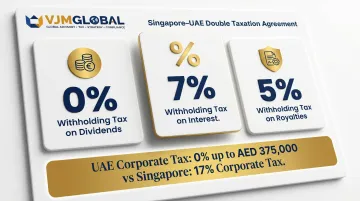
Personal income tax remains at 0% for employment income, dividends, and capital gains. Against Singapore's 17% corporate tax rate, the difference is material for businesses consistently generating profits above AED 375,000.
The Singapore-UAE Double Taxation Agreement (signed 23 November 2011, effective 28 December 2012) further reduces friction:
| Income Type | Withholding Rate Under DTA |
|---|---|
| Dividends | 0% |
| Interest | 7% |
| Royalties | 5% |
This treaty eliminates double taxation on cross-border income and makes Dubai particularly attractive for Singapore-based holding companies or service providers earning royalties and dividends.
Full Foreign Ownership and Profit Repatriation
Following the 2021 reforms under Federal Decree-Law No. 32 of 2021, most Mainland sectors now permit 100% foreign ownership—eliminating the previous requirement for a 51% UAE national partner. Free Zones have always offered this benefit, along with full profit repatriation, no currency restrictions, and no capital transfer limits.
For Singapore entrepreneurs accustomed to transparent ownership structures, this regulatory alignment removes a major barrier to entry.
Strategic Market Access
That ownership ease pairs with geography: Dubai sits at the intersection of Asia and the Middle East, giving Singaporean companies a natural base for reaching GCC markets, East Africa, and European clients. UAE exports to Singapore reached US$3.38 billion in 2024, reflecting a trade relationship that's already well-established.
The UAE's 45 Free Trade Zones provide sector-specific ecosystems to accelerate that reach. DMCC serves commodities traders; DIFC caters to financial services firms. Singapore founders can plug into existing business networks rather than build from scratch.
Choosing the Right Business Structure in Dubai
Your choice of jurisdiction determines ownership limits, trade rights, tax treatment, and setup costs. Foreign investors setting up in Dubai can choose from three structures — and your operating model will largely determine which one fits.
Mainland Company
A mainland license gives you the broadest operating rights — you can trade anywhere in the UAE and internationally, access government tenders, and work directly with local businesses. Since 2021, 100% foreign ownership is permitted in most sectors, though a physical office with Ejari registration is required.
Key features:
- Trade freely across the UAE and internationally
- 100% foreign ownership in most sectors
- Required: physical office with Ejari registration
- Eligible for government tenders and mainland contracts
Best for: Businesses selling directly to UAE consumers, service providers needing local credentials, and companies requiring a physical UAE presence.
Note on restricted sectors: Oil and gas, telecommunications, defense, banking, insurance, and utilities still require UAE national partners or carry ownership caps.
Typical costs: AED 15,000–30,000 annually (license fees, office rental, and service agent fees)
Free Zone Company
Free zones are the most popular choice for Singaporean founders — they offer 100% foreign ownership, zero corporate tax on qualifying income, and fast setup timelines with virtual office options. The trade-off: you cannot sell directly on the UAE mainland without a local distributor or a separate dual license.
Key features:
- 100% foreign ownership universally
- 0% corporate tax on qualifying income (for Qualifying Free Zone Persons)
- No import/export duties
- Virtual office options available
- Mainland trading requires a local distributor or dual license
Best for: International traders, consultants, e-commerce businesses, technology companies, and digital service providers with clients outside the UAE.
Popular Free Zones for Singaporean Founders:
| Free Zone | Best Suited For | Annual License Fee (Approx.) |
|---|---|---|
| DMCC | General trading, commodities | AED 20,265+ |
| IFZA | Startups, consultancy, cost-conscious setups | AED 14,900+ |
| DAFZA | Aviation, pharma, logistics, IT | AED 15,020+ |
| DIFC | Financial services, fintech, wealth management | AED 30,000+ (premium) |
Offshore Company
An offshore company is not a trading entity — it cannot operate within the UAE domestic market or sponsor residency visas. What it does offer is a low-cost structure for holding assets, protecting IP, and managing international trade flows from a UAE-registered entity.
Key features:
- No UAE domestic trading rights
- No residency visa eligibility
- Can hold UAE real estate and shares in UAE companies
- Lowest setup costs of the three structures
Best for: Holding companies, IP protection vehicles, and international trade entities that don't need a UAE physical presence.
Typical costs: AED 5,000–12,000 annually (RAK ICC and JAFZA Offshore are the two main authorities)
Comparison Table
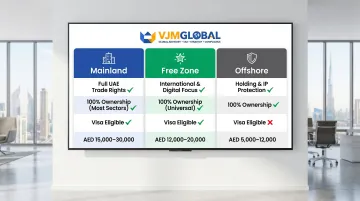
| Feature | Mainland | Free Zone | Offshore |
|---|---|---|---|
| Foreign Ownership | 100% (most sectors) | 100% | 100% |
| UAE Trade Rights | Full mainland access | Restricted (dual license available) | None |
| Visa Eligibility | Yes | Yes | No |
| Typical Cost Range | AED 15,000–30,000 | AED 12,000–20,000 | AED 5,000–12,000 |
| Best Suited For | Local UAE trade | International business, digital services | Holding structures, IP protection |
Step-by-Step: How to Register a Company in Dubai from Singapore
The registration process involves seven stages, most of which can be handled remotely. A business setup advisor is worth engaging early — document errors and jurisdiction mismatches are the most common causes of delays.
Step 1: Choose Your Business Activity and Jurisdiction
Define your business activity first—this determines your license type and governing authority.
License Types:
- Commercial License: Trading, import/export, distribution
- Professional License: Consulting, accounting, legal, IT services
- Industrial License: Manufacturing, assembly, production
The UAE offers over 2,000 licensed business activities across categories. Search activities on the Invest in Dubai portal.
If your primary revenue comes from UAE mainland clients, choose a Mainland setup. If you serve international clients or operate digitally, a Free Zone offers lower cost and simpler compliance.
Step 2: Select and Register a Company Name
UAE Naming Rules:
- Must be unique (not similar to existing registered businesses)
- Cannot include religious, political, or government-related terms
- Must include legal structure designation ("LLC" for Limited Liability Companies)
- Submit at least three preferred name options
- Cannot contain offensive language or mislead about business scope
Name reservation is completed through the relevant authority's portal (DED for Mainland, or the specific Free Zone portal).
Step 3: Apply for Initial Approval
Initial approval is the government's confirmation that your proposed business can be registered. It does not yet authorize operations but is required before proceeding.
For regulated sectors (healthcare, education, financial services), additional ministry approvals are required at this stage, which can extend timelines by 2–4 weeks.
Step 4: Prepare and Submit Legal Documents
Required Documents:
- Memorandum of Association (MOA): Must be drafted in Arabic and English for Mainland LLCs, signed before a Notary Public
- Local Service Agent Agreement (if applicable): For certain Mainland structures
- Singapore-issued documents: Must be attested through the five-step chain (see Documents section below)
Free Zones provide standardized MOA templates that shareholders sign electronically.
Once documents are submitted and approved, you'll need a registered address before the license can be issued.
Step 5: Secure a Business Address
A registered business address is mandatory for license issuance.
Options:
- Free Zone Flexi-Desk: AED 16,650–19,000 annually (DAFZA Smart Desk, DMCC Flexi-Desk)
- Free Zone Virtual Office: Lower cost, no physical workspace
- Mainland Physical Office: Requires formal lease agreement registered via Ejari (Dubai Land Department's online tenancy registration system)
Ejari registration requires the original tenancy contract, Emirates ID, passport copies, and title deed.
Step 6: Pay Fees and Collect the Trade License
Final payment triggers license issuance. The trade license (commercial, professional, or industrial) is your official authorization to commence business.
Typical Processing Times:
| Setup Type | Processing Time |
|---|---|
| Free Zone | 5–30 working days |
| Mainland | 7–14 working days |
| Offshore | 1–3 weeks |
With your trade license in hand, the final step is opening a corporate bank account — often where the timeline stalls.
Step 7: Open a Corporate Bank Account
After receiving your trade license, you must open a UAE corporate bank account. This is often the most time-consuming step for overseas founders.
Required Documents:
- Trade license or certificate of incorporation
- Memorandum of Association
- Passport copies of all shareholders and directors
- Proof of residential address from Singapore
- Business plan
Most UAE banks require at least one signatory to appear in person. Non-resident founders face heightened KYC and AML scrutiny, which extends processing time compared to UAE-resident applicants.
Timeline: 2–6 weeks (account opening is frequently the bottleneck in the overall setup process)
Documents and Requirements for Singapore-Based Applicants
Before submitting your application, gather documents across two categories: personal identification and business paperwork. Singapore-issued documents also require a separate attestation process, detailed below.
Personal Documents
- Valid passport copies (all shareholders and directors, minimum 6 months validity)
- Passport-sized photographs (white background)
- Proof of residential address from Singapore (utility bill or bank statement)
Business Documents
- Completed application form (authority-specific)
- Company name approval certificate
- Chosen business activity description
- Memorandum of Association or Local Service Agent agreement
- Lease or virtual office agreement
- Singapore Certificate of Incorporation (if applicable, must be attested)
- Singapore ACRA BizFile (recent printout)
- Business plan (required by some free zones and all banks)
Document Attestation for Singapore-Issued Documents
Singapore-issued documents must pass through a five-step attestation chain:
- Notarization by a Singapore Notary Public
- Authentication by the Singapore Academy of Law (SAL)
- Legalization by the Singapore Ministry of Foreign Affairs (MFA)
- Endorsement by the UAE Embassy in Singapore (submission Mon-Fri, 9:00–11:30 AM; processing 0–3 working days)
- Final attestation by the UAE Ministry of Foreign Affairs (MOFA) in the UAE
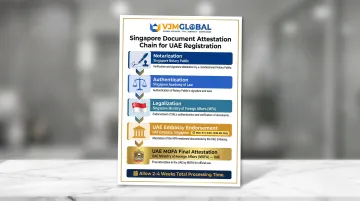
Fees vary by document category. Pay them through the UAE MOFA eGate portal before submission.
Timeline: Allow 2–4 weeks for the full attestation chain. Initiating this in parallel with your application filing keeps your overall setup on schedule.
Cost Breakdown
Costs vary by jurisdiction and activity type. These figures are estimates and subject to change; 5% VAT may apply to some fees.
Free Zone Setup Costs:
| Free Zone | Annual License Fee | Registration Fee | Total First-Year (Approx.) |
|---|---|---|---|
| DMCC (Service/Trading) | AED 20,265 | AED 9,020 | AED 29,285+ |
| IFZA (1-visa package) | AED 14,900 | Included | AED 14,900+ |
| DAFZA | AED 15,020 | AED 7,000 | AED 22,020+ |
Mainland Setup Costs:
| Component | Estimated Cost (AED) |
|---|---|
| Trade Name Reservation | 620–720 |
| Initial Approval | 120 |
| Trade License (1 year) | 10,000–15,000 |
| Local Service Agent Fee | 5,000–10,000 |
| Office Rental / Ejari | 15,000–50,000+ |
| MOA Drafting/Notarization | 1,000–2,500 |
| Total (excluding visa) | 15,000–25,000 |
Offshore Setup Costs:
| Authority | Setup Cost | Annual Renewal |
|---|---|---|
| RAK ICC | AED 7,360–12,880 | AED 5,520–9,200 |
| JAFZA Offshore | AED 14,720–22,080 | AED 11,040–16,560 |
Additional Costs:
| Item | Estimated Cost (AED) |
|---|---|
| DMCC Flexi-Desk (annual) | 17,000–19,000 |
| DAFZA Smart Desk (annual) | 16,650 |
| Investor/Residence Visa (per person) | 3,500–7,000 |
| Medical Fitness Test | 450–850 |
| Emirates ID | 370–395 |
| Establishment Card | 1,800–2,020 |
| Document Attestation (varies) | 1,000–3,000 |
Total Estimated First-Year Cost:
- Free Zone: AED 12,000–20,000 (minimal setup)
- Mainland: AED 15,000–30,000 (standard setup)
- Offshore: AED 5,000–12,000 (no visa)
Common Mistakes to Avoid When Registering from Singapore
Choosing the Wrong Jurisdiction
Many Singapore founders default to a Free Zone without realizing it restricts UAE mainland trading. If you plan to sell directly to UAE consumers or businesses, a Mainland setup is more appropriate.
Example: A Singapore-based e-commerce company selling consumer electronics planned to use a Free Zone setup to minimize costs. After registration, they discovered they could not ship directly to Dubai mainland customers without appointing a local distributor—adding unexpected costs and delays. A Mainland LLC would have allowed direct-to-consumer sales from day one.
Underestimating Document Attestation Requirements
Singapore-issued documents (incorporation certificates, board resolutions, power of attorney) require the full five-step attestation chain. Skipping or delaying this process leads to registration delays of 2-4 weeks.
Start attestation immediately after deciding to register in Dubai, even before selecting your jurisdiction—corporate documents are required regardless of which structure you choose.
Neglecting Post-Registration Compliance
Getting registered is only the first hurdle. After incorporation, companies must actively track:
- Renew your trade license annually; penalties escalate sharply after a 30-day grace period
- Register for VAT once annual taxable turnover hits AED 375,000 — this applies to mainland and free zone entities alike
- File corporate tax returns; all UAE companies are required to register, including free zone businesses
- Submit annual audited financial statements if you're a Qualifying Free Zone Person maintaining 0% tax status
Non-compliance can result in AED 5,000+ fines, license suspension, visa revocation, and in severe cases, travel bans.

Frequently Asked Questions
Can a foreigner set up or register a company in Dubai?
Yes. Foreigners, including Singapore residents, can fully own and register a company in Dubai. Free Zones offer 100% foreign ownership universally, and Mainland permits 100% foreign ownership in most sectors following the 2021 reforms.
Can you own 100% of a company in Dubai?
Yes. 100% foreign ownership is permitted in all Free Zones and in most Mainland sectors under Federal Decree-Law No. 32 of 2021. Strategic sectors such as oil/gas, telecom, defense, and financial services may still require a UAE national partner.
What are the requirements to register a company in Dubai?
Requirements include a valid passport, proof of Singapore residential address, an approved company name, chosen business activity, Memorandum of Association, and a registered business address in Dubai. Singapore-issued documents must be attested through the UAE Embassy.
How much does it cost to register a company in Dubai?
Costs vary by jurisdiction:
- Free Zone: AED 12,000–20,000
- Mainland: AED 15,000–30,000
- Offshore: AED 5,000–12,000
Visa fees add AED 3,500–7,000 per person, plus office rental costs.
How do I get a company registration certificate (Certificate of Incorporation) in Dubai?
The Certificate of Incorporation (or trade license) is issued by the relevant authority: the DED for Mainland companies, or the applicable Free Zone authority. It is released after registration, document submission, and fee payment, typically within 5–30 working days.
How can I check if a company is registered in Dubai?
Mainland companies can be verified through the Dubai DED Business Verification Portal. Free zone companies can be checked through the respective free zone's public register (e.g., DMCC Public Register, DIFC Public Register).