Many investors assume that filing LLC or corporation paperwork with a Secretary of State satisfies the consulate's requirements. It doesn't. Confusing the two processes is one of the most common reasons E2 renewals get delayed, or why a returning investor gets stopped at the border on re-entry.
This guide breaks down what E2 company registration actually means, walks through the steps for setting up a qualifying business, explains what it takes to stay in good standing, and flags the mistakes that cause the most denials.
Key Takeaways
- E-2 visas require a real U.S. business with majority investor ownership or control.
- "E2 Company Registration" is a consular system, separate from LLC formation, that speeds up filings.
- Consulates review E2 companies every five years, requiring one employee in valid E status.
- Clean financials and professional accounting support prevent most E-2 visa delays and denials.
What Is E2 Visa Company Registration?
The E-2 Treaty Investor Visa is available to nationals of countries holding a qualifying trade or commerce treaty with the United States. To qualify, an investor must develop and direct a business, not just fund it passively.
According to USCIS's E-2 Treaty Investors guidance, the investor must also commit a substantial amount of capital that's genuinely at risk in a real, operating commercial enterprise.
"E2 Company Registration" refers to something different: an internal record that a U.S. consulate or embassy keeps for businesses that have already had at least one employee approved for an E visa. It's a case-management tool for the post, not a nationwide corporate registry.
What Consulates Track in a Registered Company File
Once a business clears its first E2 adjudication, posts typically log:
- Company or enterprise name
- Date of the most recent registration review
- Number of U.S.-based staff
- Total E2 investment amount
- Operating and net income figures
- Ownership nationality
- Date and outcome of the most recent adjudication
Formation Happens at the State Level, Registration Happens After
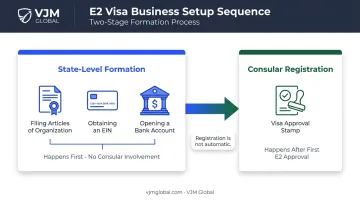
Here's the distinction investors miss most often: forming an LLC or C-Corp happens at the state level, long before any consulate gets involved. "Registration" with the consulate only happens after the first employee's E2 visa is actually approved.
Filing Articles of Organization does not put a company in any consular database. Only a successful adjudication does.
Once registered, the practical payoff is real. Future employees at that same company, and renewal applicants, generally move through interviews faster because the officer already has verified data on file. Being in the database, though, is neither an endorsement of eligibility nor an obstacle to it. Each applicant still gets adjudicated on individual merit.
Step-by-Step Process to Register Your Business for an E2 Visa
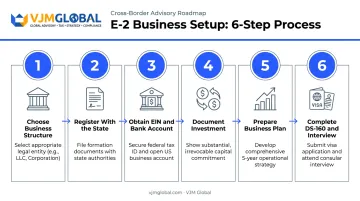
Setting up a qualifying business involves six practical steps, each building the paper trail consular officers expect to see.
Step 1: Choose the Right Business Structure
Most E2 investors form either an LLC or a C-Corporation. Neither USCIS nor State Department guidance mandates a specific entity type. What matters is documentation: ownership records must clearly show the treaty investor holds at least 50% of the company, or otherwise controls it operationally through a board seat, managing member role, or similar mechanism.
Step 2: Register Your Business With the State
Once you've picked a structure, file formation documents with the Secretary of State where you'll operate. This typically means:
- Appointing a registered agent with a physical address in that state
- Filing Articles of Organization (LLC) or Incorporation (C-Corp)
- Obtaining any local or industry-specific business licenses
None of this is E2-specific, but inconsistent filings here create mismatches later that raise questions at the interview.
Step 3: Obtain an EIN and Open a U.S. Business Bank Account
An Employer Identification Number from the IRS lets your business file taxes, hire staff, and open a dedicated bank account. That account matters more than people realize: it's how you demonstrate invested funds are genuinely separate from personal finances, and actually at risk in the business, rather than sitting untouched in a personal account.
Step 4: Make and Document Your Qualifying Investment
Consular officers need to see a clear, traceable transfer of capital into the business, not just a bank balance. Keep every piece of supporting evidence:
- Wire transfer confirmations and bank statements showing the money moving from you to the business
- Lease agreements for commercial space
- Equipment invoices and purchase receipts
- Escrow documentation, if funds are held pending visa approval
A broken paper trail, even for legitimately sourced money, tends to raise more questions than it answers.
Step 5: Prepare a Comprehensive Business Plan and Financial Projections
Consular officers expect a plan showing realistic job creation and a credible path to profitability, not boilerplate projections copied from a template. This is where experienced accountants earn their fee.
VJM Global's team of CPAs and Chartered Accountants helps investors translate a business concept into financial statements and projections that hold up to consular scrutiny. The numbers need to reconcile with the investment amount and staffing plan described elsewhere in the application.
Step 6: Complete the DS-160 and Attend the Consular Interview
The DS-160 is the standard nonimmigrant visa application, but many posts also require a separate enterprise package specific to E2 cases. The business details you enter, including company name and formation date, need to match your legal formation documents exactly. This submission is effectively what triggers the consulate's company registration record once the visa is approved.
Maintaining Good Standing and Renewing Your E2 Company Registration
Getting your first E2 approval is not the finish line. Consulates expect registered companies to stay active and compliant if they want streamlined processing to continue.
Keep at least one E-status employee on staff. For registration to stay active, the company generally needs at least one employee holding valid E status at all times, whether that's the original investor or another qualifying employee. Once a company has zero remaining E status employees, its registration effectively lapses.
Expect a review at least every five years. The State Department's Foreign Affairs Manual directs posts to periodically re-examine registered companies, confirming the business and its E visa holders still meet eligibility requirements like ownership nationality and non-marginal operation (9 FAM 402.9).
A missed review by a busy post doesn't automatically disqualify you, but assume the file will eventually be reopened.
Know what happens if registration lapses. If a company loses its last E status employee and its registration expires, the next applicant for that business has to start company registration over from scratch, as though no prior adjudication ever happened.
Documentation habits matter just as much as staffing. Keep financial records current, since consular officers can ask for updated proof at any point:
- Income statements and balance sheets
- Payroll reports showing current staffing
- Recent tax filings
Businesses that treat these as living documents, updated quarterly rather than assembled last-minute, have an easier time.
Ownership and structural changes deserve the same attention. Disclose material changes: any significant shift in ownership percentages, business structure, or investor nationality status needs to be reported, since it can directly affect the registration and underlying eligibility.
Common Mistakes E2 Investors Make During Company Registration
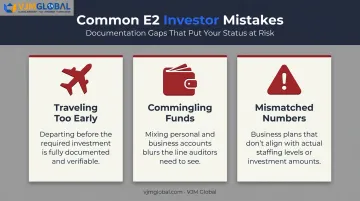
Most E2 denials trace back to one of a handful of recurring errors. Three show up more than any others.
Traveling before the investment is fully documented. Some investors change status to E2 while already in the U.S. on an F or B visa, then leave the country before the business has enough investment or revenue on record.
Departing while a change-of-status request is pending can cause USCIS to treat the request as abandoned. Reentry then requires a full consular visa rather than a status change, per Fragomen's 2026 travel guidance for foreign nationals. Wait until the investment and business activity are clearly documented before booking that flight home.
Commingling personal and business funds. Mixing accounts doesn't automatically disqualify an application, but it makes proving that capital is genuinely "at risk" much harder. Once transfers can't be cleanly traced from source to enterprise, officers start asking where the money actually came from.
Submitting numbers that don't add up. Business plans and financial projections that don't match the actual investment amount, staffing levels, or operating activity are among the fastest ways to trigger red flags. If the plan claims five employees within a year but current payroll shows one part-time hire, that gap needs a real explanation, not an updated PDF.
How VJM Global Supports E2 Investors With Business Setup and Compliance
E2 company registration sits at the intersection of immigration law and accounting, and the financial side is where applications most often fall apart. This is where VJM Global's background matters.
With more than 30 years in tax, audit, and advisory work, VJM Global's team of CPAs and Chartered Accountants helps foreign investors build the U.S.-compliant bookkeeping and financial statements that consular officers expect to see.
Having served over 500 American business owners, the firm knows what a credible business plan needs: numbers that reconcile with the investment amount and staffing plan on paper, not just look polished.
Beyond the initial filing, VJM Global's ongoing accounting outsourcing and back-office support keep those records current for whenever a five-year registration review comes around. That support includes:
- Reconciling books each month
- Processing accurate payroll reporting
- Preparing audit-ready financial statements
That combination, working alongside your immigration attorney rather than in place of one, keeps a growing business compliant long after the first visa is stamped. Investors weighing which advisor to bring in can learn more about VJM Global's accounting and compliance services directly.
Frequently Asked Questions
How do I get my e-visa number?
Your "e-visa number" is printed on your approved visa foil or DS-160 confirmation page, not on the consulate's E2 Company Registration file. That file tracks the business itself, not your individual visa.
What is the minimum investment required for an E2 visa?
There's no fixed dollar minimum—your investment must match the business's actual cost, so lower-cost ventures need a proportionately higher stake. Check your consulate's current guidance for typical ranges.
Can I register more than one company under my E2 visa?
Generally, no. Each qualifying business needs its own separate registration and supporting documentation with the consulate, since the file tracks a specific enterprise, not your overall portfolio.
How long does the E2 company registration process take?
Timing depends on how quickly you can form the business and current consular wait times, which vary significantly by post and season. Check your specific consulate's posted wait times before planning your timeline.
Do I need a lawyer or accountant to register my company for an E2 visa?
It's not legally required, but skipping professional help raises your risk of documentation errors, mismatched financials, or a rejected application.
What happens if my E2 company registration expires?
An expired registration means the next applicant for that business has to restart the full company registration process at a U.S. consulate or embassy, with no shortcut from the prior approval.