Introduction
Dubai's ecommerce market hit approximately $7 billion in GMV in 2024 and is projected to reach $11.5 billion by 2029 — making it one of the most accessible high-growth markets for Singapore companies looking beyond Southeast Asia. From Dubai, businesses gain direct reach into consumer bases across the Middle East, Africa, and South Asia.
Singapore businesses are particularly well-positioned to capitalise on this opportunity. With bilateral trade between Singapore and the UAE reaching S$27.94 billion in 2025, the UAE now serves as Singapore's largest trading partner in the Middle East. Both jurisdictions offer low-tax environments, strong rule of law, and world-class digital infrastructure.
Operating legally in Dubai requires a valid trade license — and for Singapore-registered companies, the documentation requirements and regulatory steps differ from those applying as individuals. This guide covers exactly what Singapore companies need to know before filing.
Key Takeaways
- Free Zone setups are the top choice for Singapore companies — they offer 100% foreign ownership, faster processing, and simpler corporate structures than Mainland options
- Setup steps include choosing a free zone, registering a trade name, submitting Singapore corporate documents, and opening a UAE bank account
- License fees typically range from AED 6,000 to AED 20,000+ annually, depending on the free zone, with issuance timelines as short as 1-3 working days for free zones
- Singapore companies benefit from zero personal income tax, 100% profit repatriation, and protection under the UAE-Singapore Double Tax Agreement (DTA)
- VAT registration and 9% corporate tax both trigger at AED 375,000 in annual revenue/taxable income; records must be retained for 7 years
Why Singapore Companies Are Expanding Ecommerce Operations to Dubai
Dubai sits at the crossroads of Europe, Africa, and Asia, offering Singapore companies access to a vast consumer base. The UAE's ecommerce sector is growing at 12.9% annually—making it one of the more concrete expansion cases for digital commerce operators looking beyond Southeast Asia.
Singapore and Dubai share a common orientation: both jurisdictions prioritize business-friendly regulation, transparency, and international connectivity. That alignment reduces the friction Singapore operators typically face when entering new markets. The UAE-Singapore Double Tax Agreement (DTA), in force since 1993 and updated by the Multilateral Instrument (MLI) in 2019, ensures Singapore companies aren't taxed twice on income earned in Dubai.
This means dividends, interest, royalties, and business profits are covered under treaty provisions—reducing tax uncertainty for cross-border operations from day one.
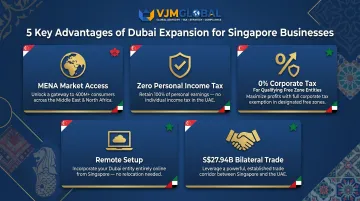
Key advantages for Singapore businesses expanding to Dubai:
- Access to the broader MENA region's fast-expanding digital economy
- Zero personal income tax and 100% profit repatriation
- Qualifying free zone entities may pay 0% corporate tax on qualifying income
- No physical presence required—most free zone licenses can be set up entirely remotely from Singapore
- Strong bilateral trade relationship (S$27.94 billion in 2025) reduces market-entry friction
For Singapore companies considering this move, the structural and tax groundwork is already favorable. The practical steps—choosing the right free zone, obtaining the correct license type, and aligning the Dubai entity with the Singapore parent—are where the complexity typically begins.
Types of Ecommerce Licenses Available in Dubai
Dubai offers two primary jurisdictional frameworks for ecommerce businesses: Mainland (regulated by the Department of Economy and Tourism, or DET) and Free Zone. The right choice depends on whether you plan to sell directly to UAE consumers or focus on international markets.
Mainland Ecommerce License
The Mainland ecommerce license allows direct trading with the UAE domestic market without requiring a local distributor. Recent reforms under Federal Decree-Law No. 32 of 2021 now permit 100% foreign ownership in most sectors, removing a historic barrier for foreign companies.
However, Mainland setup typically requires:
- A physical office address in Dubai
- Higher operational costs and longer approval timelines (2-6 weeks)
- More extensive documentation and DET approval processes
Mainland works well for companies targeting UAE retail consumers directly, such as those running physical storefronts or working with government entities. For Singapore companies focused primarily on online sales, however, it tends to be more complex and expensive than necessary.
Free Zone Ecommerce License
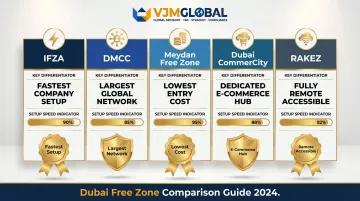
Free Zone ecommerce licenses are offered by authorities such as IFZA, DMCC, Meydan Free Zone, Dubai CommerCity, and RAKEZ.
Key advantages include:
- 100% foreign ownership with no local sponsor required
- Zero import/export customs duties within the free zone
- 100% repatriation of capital and profits
- Faster setup (1-3 working days in many cases)
- No physical office visit required—99% of processes can be executed remotely
Key limitation: Free zone companies cannot sell directly to UAE mainland consumers without a local distributor or additional arrangements. This matters for retail-focused businesses but is largely irrelevant for cross-border digital services, international marketplaces, or B2B ecommerce.
Popular free zones for ecommerce include:
| Free Zone | Key Differentiator |
|---|---|
| IFZA | 99% remote processing; fast digital issuance |
| DMCC | 25,000+ member companies; co-working and storage included |
| Meydan Free Zone | Fawri service (under 60 minutes); Amazon/Noon seller setup support |
| Dubai CommerCity | Dedicated ecommerce free zone; Dual License option with DET |
| RAKEZ | From AED 6,000; Amazon partnership for seller onboarding |
E-Trader License vs. Ecommerce License
The e-Trader license is designed for individuals—not companies—and is restricted to UAE residents holding a valid Emirates ID. It covers small home-based online operations, typically run by UAE or GCC nationals.
Singapore companies need a full ecommerce license. Here's how the two options differ:
- e-Trader license: Individuals only; requires Emirates ID; limited to home-based operations
- Full ecommerce license: Corporate entities; multiple shareholders permitted; covers full commercial activity scope
Step-by-Step: How to Get an Ecommerce License in Dubai as a Singapore Company
Step 1 — Choose Your Jurisdiction and Free Zone
Evaluate free zones based on:
- License fees range from AED 6,000 at RAKEZ to AED 20,000+ at DMCC or Dubai CommerCity
- Setup speed varies — Meydan issues licenses in under 60 minutes via its Fawri service; most others take 1-3 working days
- Visa allocation, if you need UAE residency visas for staff or directors
- Activity coverage — confirm your specific ecommerce activities (online retail, digital marketing, dropshipping) are explicitly listed in the free zone's permitted activity register
Popular choices for Singapore companies include IFZA, Meydan, and RAKEZ due to remote setup capabilities and competitive pricing.
Step 2 — Select Your Business Activity and Trade Name
Your ecommerce license will only cover activities explicitly listed. Common examples include online retail trading, electronic marketing, and digital services. Register all relevant activities upfront to avoid requiring license amendments later.
Trade name requirements under UAE law:
- Must be followed by the business structure acronym (FZE, FZCO)
- Must be compatible with your business activity
- Cannot contain religious references or country names without approval
- Cannot violate public morals or have been previously registered
- Must be available in both English and Arabic transliteration
Check name availability with your chosen free zone before submitting the application.
Step 3 — Prepare and Submit the Application with Corporate Shareholder Documents
Since a Singapore company is a corporate shareholder (not an individual), documentation requirements are more extensive. The free zone authority needs to verify the legitimacy of the parent company.
Required documents:
Individual signatory documents (for each director/manager):
- Valid passport copy
- Digital passport photo
- Emirates ID and visa copy (if UAE resident; not required for Singapore-based signatories)
Corporate shareholder documents (Singapore parent company):
- Certificate of Incorporation
- Memorandum and Articles of Association (or Constitution under Singapore company law)
- Valid business registration certificate from ACRA (BizFile extract, current within 6-12 months)
- Board Resolution authorising Dubai entity formation and naming the authorised signatory
- Ultimate Beneficial Owner (UBO) declaration form (provided by the UAE free zone)
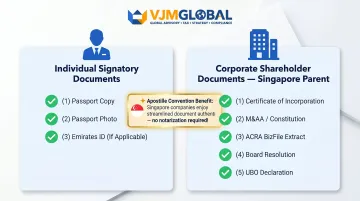
Important note: Singapore is a member of the Hague Apostille Convention (entered into force 16 September 2021). Singapore-issued corporate documents can be apostilled locally and accepted in the UAE without full embassy legalisation, cutting weeks off the process and eliminating embassy legalisation fees.
Documents not in English require certified Arabic translation. Requirements vary by free zone — confirm the exact checklist before submitting your application.
Step 4 — Obtain Initial Approval, Pay License Fees, and Receive Your License
Free zone authorities issue initial approval electronically. Once approved, you pay the license fee and receive your digital license, typically within 1-3 working days at most free zones.
Some business activities require additional regulatory approvals. For example:
- Selling food products requires health and safety clearances
- Cosmetics require Dubai Municipality approvals
- Financial products require regulatory oversight from the Central Bank or other authorities
Your free zone will advise if additional approvals are needed based on your selected activities.
Step 5 — Open a UAE Corporate Bank Account and Set Up Your Ecommerce Platform
A UAE corporate bank account is essential for:
- Receiving customer payments
- Paying suppliers and operational expenses
- Demonstrating financial credibility to payment gateways and partners
Bank account opening typically requires:
- Trade license copy
- Certificate of Incorporation (UAE entity)
- Passport copies of shareholders and directors
- Proof of address
- UBO declaration
- Business plan or description of activities
- Initial deposit (varies by bank)
Account opening takes 2-8 weeks depending on the bank's compliance procedures. Some banks have stricter requirements for ecommerce businesses due to anti-money laundering (AML) regulations.
Once your account is active, your ecommerce platform also needs to meet UAE regulatory standards. Your website must display the trade license number and comply with Federal Decree-Law No. 14 of 2023 on Modern Technology-Based Trade and Federal Decree-Law No. 45 of 2021 on Personal Data Protection.
Singapore companies unfamiliar with UAE banking procedures may benefit from working with an international business advisory firm like VJM Global, which provides cross-border structuring, documentation coordination, and tax planning for companies building operations across multiple jurisdictions.
Documents Singapore Companies Need to Apply
Singapore-registered companies face a more document-intensive process than individual applicants because UAE free zone authorities must verify the legitimacy of the parent company.
Individual Signatory Documents
For each shareholder, director, and General Manager named in the application:
- Valid passport copy
- Digital passport photo (passport-style)
- Emirates ID and visa copy (if UAE resident—not mandatory for Singapore-based signatories)
Corporate Shareholder Documents (Singapore Company)
From the Singapore parent company:
- Certificate of Incorporation issued by ACRA
- Memorandum and Articles of Association or Constitution (as applicable under Singapore Companies Act)
- Valid business registration certificate (BizFile extract from ACRA, current within 6-12 months)
- Board Resolution authorising the establishment of the Dubai entity and naming the authorised signatory
- Ultimate Beneficial Owner (UBO) declaration form (provided by the UAE free zone authority)
Document preparation tips:
- Ensure all documents are current (typically within the last 6-12 months)
- Documents not in English must be translated into Arabic by a certified translator
- Singapore is a member of the Hague Apostille Convention, so apostilled documents are accepted in the UAE without embassy legalisation—cutting processing time considerably
- Some free zones may require notarisation in addition to apostille; confirm exact requirements with your chosen authority
If you need support coordinating apostilles or confirming free zone-specific requirements, VJM Global's advisory team works across both Singapore and UAE regulatory frameworks.
Costs, Timelines, and Ongoing Compliance Obligations
Costs
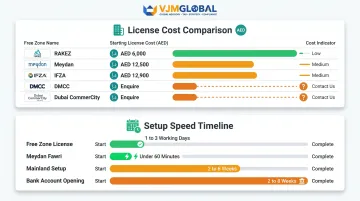
Ecommerce license fees vary widely depending on the free zone, number of activities, and visa allocation:
| Free Zone | Indicative Starting Price (AED) | Notes |
|---|---|---|
| RAKEZ | From AED 6,000 | Includes 1 visa, co-working membership, Amazon services |
| IFZA | From approximately AED 12,900 | For license with no residency visa, 3 business activities |
| Meydan Free Zone | From AED 12,500 | Pricing varies by activities and visa requirements |
| DMCC | Not publicly listed | Three ecommerce packages (Basic/Starter/Premium); 50% renewal discount |
| Dubai CommerCity | Not publicly listed | Enquiry required for pricing |
Beyond the license itself, budget for these additional setup costs:
- Visa processing: AED 2,500–4,800 per visa
- Emirates ID issuance and establishment card
- Office or flexi-desk fees (if required by the free zone)
- Corporate bank account setup
- Activity-specific approvals (food, cosmetics, financial services)
- Advisory and documentation services
License fees represent one component of total setup costs. Verify current pricing directly with each free zone before committing.
Timelines
Free Zone licenses: Issued in as little as 1-3 working days once documents are complete. Meydan's Fawri service can issue licenses in under 60 minutes for pre-approved activities.
Mainland licenses: Typically take 2-6 weeks due to additional DET approval steps and physical office requirements.
Corporate bank account opening: 2-8 weeks depending on the bank's compliance and AML procedures.
Ongoing Compliance Obligations
Getting licensed is only the beginning. Once your ecommerce entity is active, Singapore companies must meet recurring obligations across tax, operations, and data governance.
Annual License Renewal
- License fees are paid annually; late renewals incur penalties
- Renewal typically requires updated corporate documents and UBO declarations
VAT Registration
- Mandatory if annual taxable supplies exceed AED 375,000
- Foreign businesses making taxable supplies in the UAE must register regardless of turnover
- VAT returns are filed quarterly or monthly depending on turnover
Corporate Tax
- 9% on taxable income above AED 375,000; 0% on income up to that threshold
- Qualifying Free Zone Persons (QFZP) may benefit from a 0% rate on qualifying income — consult a tax advisor to confirm eligibility
Record-Keeping Requirements
- Minimum 7 years under UAE Federal Tax Authority regulations (not 5 years)
- Applies to both tax and corporate records: invoices, contracts, financial statements, and transaction records
Consumer Protection and Data Privacy
- Display your trade license number on the ecommerce platform
- Issue clear digital invoices for every transaction
- Protect customer data under Federal Decree-Law No. 45 of 2021 on Personal Data Protection
- Meet cybersecurity standards under Federal Decree-Law No. 14 of 2023
Penalties for Non-Compliance
Under Cabinet Resolution No. 200 of 2025, penalties for ecommerce violations include:
- Administrative fines from AED 2,000 to AED 100,000 depending on violation type
- Temporary closures of 20–90 days
- Permanent closure for serious or repeat offenders
- Written warnings with 15-day rectification periods for first-time offenses
Managing these obligations remotely from Singapore adds complexity. VJM Global supports Dubai-registered entities with VAT filing, corporate tax advisory, and license renewal coordination — so compliance doesn't become a bottleneck to your operations.
Frequently Asked Questions
Do I need a license to sell online in the UAE?
Yes. All businesses selling goods or services online in the UAE must hold a valid ecommerce license under Federal Decree-Law No. 14 of 2023. Operating without one can result in fines ranging from AED 2,000 to AED 100,000, plus temporary or permanent closure.
How to get an e-commerce business license in Dubai?
Choose a jurisdiction (Mainland or Free Zone), register a trade name, submit required corporate and individual documents, pay the license fee, and set up a UAE corporate bank account. Free zone licenses can be issued in 1-3 working days.
How much does it cost to register an online business in Dubai?
Costs vary by free zone and setup type. License fees typically range from AED 6,000 (RAKEZ) to AED 20,000+ (DMCC, Dubai CommerCity) annually. Additional costs include visas, bank accounts, and activity-specific approvals.
What license is best for an online business?
A Free Zone ecommerce license is best for most foreign companies, including Singapore businesses, due to 100% ownership, lower costs, faster setup, and remote processing. Mainland is preferable only if you need direct access to UAE retail consumers.
Do I need an LLC for e-commerce in Dubai?
No. In free zones, Singapore companies set up as a Free Zone Establishment (FZE) or Free Zone Company (FZCO), not an LLC. The LLC structure applies to Mainland entities only and is rarely needed for foreign ecommerce operators.
What online businesses can I start in the UAE?
Permitted activities include online retail, digital services, dropshipping, subscription services, fashion, electronics, and beauty products. Food, pharmaceuticals, and financial services require additional approvals from regulators such as MOHAP or the UAE Central Bank.
Ready to establish your Dubai ecommerce operation? VJM Global helps Singapore companies handle cross-border licensing, documentation, tax planning, and compliance from start to finish. Reach us at [email protected] or +91 98915 76441 to begin your Dubai expansion.