
Introduction
UK companies are increasingly looking to India's talent market to access highly skilled professionals in technology, finance, and operations – often at 40-60% of equivalent UK salaries. An Employer of Record (EOR) makes this accessible without the complexity and cost of establishing a local entity.
The challenge? Most UK finance teams budget only for the agreed salary figure, then discover that India's mandatory statutory contributions, EOR platform fees, and additional costs push the true monthly outlay 25-35% higher than expected.
A software engineer hired at ₹1,50,000/month (approximately £1,170) can easily cost £1,600–1,700 all-in. That gap compounds across every hire, every month.
This guide breaks down every cost layer so UK companies can budget accurately from the start.
Key Takeaways
- EOR fees range from £150/month (basic compliance-only providers) to £1,150+/month (full-service premium providers)
- Statutory contributions add 15-20% on top of gross salary regardless of provider
- Total employer cost typically runs 25-35% above the negotiated salary figure
- EOR remains more cost-effective than entity setup for teams under 15 employees
- GBP/INR rate shifts of 10-15% — common over 2-3 year horizons — can materially change your effective cost per hire
How Much Does an EOR in India Cost?
EOR pricing in India varies widely based on provider tier, employee salary, location, and statutory thresholds. Platform fees are only part of the equation — statutory costs like EPF, ESI, and Professional Tax apply regardless of which provider you choose.
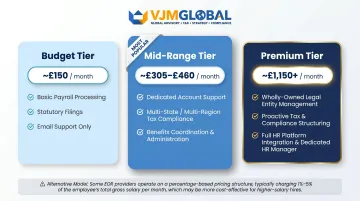
Budget EOR Tier
Budget providers like RemoFirst and Skuad advertise from $199/month per employee (approximately £150 at current exchange rates).
What's included:
- Basic payroll processing and salary disbursement
- Statutory filings (EPF, ESI, Professional Tax)
- Standard employment contract templates
- Email or ticket-based support
What's typically excluded:
- Deep compliance consulting or salary structuring advice
- Dedicated account management
- Premium HR platform features or background verification
Best for: Companies making 1-2 initial hires on a trial basis, where price sensitivity is high and hands-on compliance support is less critical.
Mid-Range EOR Tier
Mid-range providers cluster around $400-$599/month (£305-£460), with Multiplier at the lower end (~$400) and Deel, Oyster, and Remote typically charging $599.
What's included:
- Everything in budget tier, plus:
- Stronger compliance infrastructure and dedicated support teams
- Multi-state Professional Tax handling
- Better onboarding workflows (typically 7-10 business days)
- Employee benefits coordination
What's typically excluded:
- Wholly-owned Indian entity (most use third-party partners)
- Proactive tax structuring or senior HR advisory
Best for: Teams of 3-10 employees in India where reliable compliance and dedicated support matter, but premium global rates aren't justified.
Premium EOR Tier
Premium providers like Globalization Partners charge approximately $1,499/month (£1,150+), while Velocity Global sits at $599-$799.
What's included:
- Wholly-owned Indian entities (no third-party intermediaries)
- Dedicated compliance and HR teams
- Proactive salary structuring for tax optimisation
- Background verification and pre-employment screening
- Full HR platform with employee self-service features
Best for: Larger teams of 10+ employees, or any situation where the financial and reputational cost of a compliance failure would far exceed the fee premium.
Percentage-Based Pricing: An Alternative Model
Some providers price on a percentage of gross salary (typically 10-15%) rather than flat monthly fees. At 12% of a ₹1,50,000/month salary (around £1,350), the EOR fee comes to roughly £160/month — potentially cheaper than flat fees for mid-level roles, but more expensive for senior hires on higher salaries. Factor this in when comparing provider quotes directly.
What Makes Up the True Cost of an EOR in India?
The EOR platform fee is the visible cost. India's statutory employer contributions are the ones that determine your actual monthly spend — and they apply regardless of which provider you choose.
Mandatory Statutory Employer Contributions
Every UK employer hiring in India must budget for these non-negotiable costs:
Employer Provident Fund (EPF):
- 12% of basic salary + dearness allowance
- Applies to basic wages up to ₹15,000/month (voluntary above this)
- Split: 8.33% to Employee Pension Scheme, 3.67% to EPF
Employee State Insurance (ESI):
- 3.25% of gross wages
- Applies only to employees earning below ₹21,000/month
- Most tech and mid-level roles exceed this threshold, so ESI typically doesn't apply
Gratuity:
- Accrues at approximately 4.81% of annual basic + DA
- Payable after 5 years for permanent employees, 1 year for fixed-term contracts (under new Labour Codes effective November 2025)
- Treated as a liability at exit, not a monthly cash expense
Professional Tax:
- State-level levy, capped at ₹2,500/year (approximately £20)
- Varies by state: ₹200–300/month in Karnataka (Bangalore), ₹175–200/month in Maharashtra (Pune/Mumbai)
Total statutory burden: 16–20% of salary for roles above the ESI threshold; closer to 20% for entry-level roles below ₹21,000/month.
Worked Example: Mid-Level Software Engineer in Bangalore
- Gross monthly salary: ₹1,50,000 (~£1,170)
- Basic salary component (50%): ₹75,000
- EPF (12% of basic): ₹9,000 (~£70)
- ESI: Nil (salary exceeds ₹21,000 threshold)
- Gratuity accrual (~4.81% of basic annually): ₹3,000/month (~£23)
- Professional Tax: ₹200/month (~£1.50)
- Statutory total: ₹12,200/month (~£95)
- EOR fee (mid-range at $599): ~£460/month
- Total employer cost: £1,170 + £95 + £460 = £1,725/month
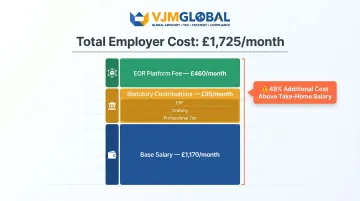
The employee receives £1,170; you pay £555 (48%) more in EOR fees and statutory costs.
Benefits and Insurance
Statutory benefits cover minimums. Competitive 2026 hiring — especially for tech roles — requires additional spend on:
- Group health insurance (basic): ₹10,000–25,000/employee/year (£80–£195)
- Group health insurance (premium plans): ₹40,000–50,000/year (£310–£390)
- Metro city premiums run 40–50% higher than Tier 2 locations
- Meal vouchers: up to ₹2,200/month tax-free
- Internet/home-office allowances for remote workers
One-Time and Exit Costs
Onboarding:
- Budget providers (RemoFirst, Skuad): Typically £0 setup fees
- Background checks/verification: $50–$200 per employee (~£40–£155)
Equipment:
- Standard development laptop: $800–$1,500 (£615–£1,150)
- High-spec configurations: $2,000+ (£1,540+)
Offboarding:
Notice periods run 30–90 days (or payment in lieu). Exit payments are calculated as follows:
- Earned leave encashment: (Basic + DA) ÷ 30 × Unused leave days
- Gratuity settlement: (Last drawn Basic + DA) × 15 × Years of service ÷ 26 — payable after 1 year (fixed-term) or 5 years (permanent)
A senior hire with 3 years' tenure at ₹2,00,000/month basic could generate a gratuity liability of around ₹3,46,000 (~£2,700) at exit.
Key Factors That Affect Your EOR Cost in India
Two UK companies using the same EOR provider and fee plan can see total costs differ by 30-40%.
Salary Level and Role Type
Statutory costs scale with salary. EPF and gratuity both calculate from basic salary, so a ₹2,00,000/month senior hire generates higher absolute contributions than a ₹80,000/month junior, even under a flat EOR fee.
Typical salary ranges for common UK hires in India:
- Entry/Mid-level Software Engineer: ₹5,00,000–15,00,000/year (£3,900–11,700)
- Senior Software Engineer: ₹10,00,000–27,00,000/year (£7,800–21,100)
- Mid-level Finance/Accounting: ₹6,00,000–15,00,000/year (£4,700–11,700)
- Operations Manager: ₹10,00,000/year average (£7,800)
Percentage-based EOR pricing (10–15% of salary) compounds this effect — a ₹2,00,000/month hire at 12% generates ₹24,000/month in EOR fees versus ₹9,600 for a ₹80,000 hire.
Location Within India
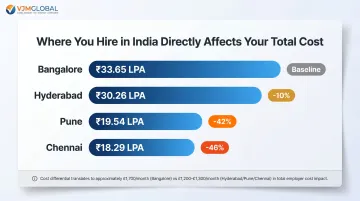
Indian cities command dramatically different salary premiums:
| City | Average Software Engineer Salary | Premium vs Tier 2 Cities |
|---|---|---|
| Bangalore | ₹33.65 LPA | Baseline (100%) |
| Hyderabad | ₹30.26 LPA | -10% |
| Pune | ₹19.54 LPA | -42% |
| Chennai | ₹18.29 LPA | -46% |
That data tells a clear cost story. Bangalore's 40–70% salary premium over Pune or Chennai flows directly into your total employer cost — a role running £1,700/month all-in in Bangalore might cost £1,200–1,300 in a Tier 2 city.
Team Size and Contract Terms
EOR fees are negotiable at volume:
- Most providers reduce per-employee rates for 10+ headcount
- Deel reportedly drops from $599 to $400–500/month for teams of 20+
- Annual commitments typically cost less than month-to-month flexibility
Ask for volume pricing upfront. Finding out at 15 employees that a discount was always available means months of unnecessary overspend.
GBP/INR Exchange Rate Risk
EOR fees are typically quoted in USD while salaries are paid in INR, leaving UK companies exposed on two currency fronts simultaneously.
Recent GBP/INR movement:
- 2022 average: 97.05 INR per £1
- May 2026: ~128–129 INR per £1
- 32% appreciation in under four years
This tailwind has made Indian hiring cheaper in sterling terms. But the 2022 crash (102 to 87 INR in months) shows this can reverse rapidly. Budget multi-year plans with a 10–15% currency buffer.
EOR vs Setting Up Your Own Entity in India
What Entity Setup Involves
Establishing a Private Limited Company in India requires:
Upfront costs:
- Government filing fees: Rs 2,000–7,000
- Professional/legal fees (foreign parent structure): Rs 30,000–80,000
- RBI/FEMA compliance advisory: Rs 5,000–15,000
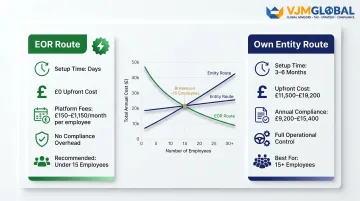
- Total initial investment: £11,500–£19,200
Timeline: 3–6 months (longer if RBI approval is required)
Ongoing annual compliance:
- Statutory audit: Rs 15,000–60,000
- ROC filings (MGT-7, AOC-4): Rs 10,000–25,000
- Accounting/bookkeeping: Rs 12,000–1,20,000/year
- Total annual cost: £9,200–£15,400
The Breakeven Question
Sources disagree sharply on the breakeven headcount:
- KRPR Associates: 5–8 employees
- Gloroots (EOR provider): 25–30 employees
The divergence reflects different assumptions about EOR fee levels and compliance overhead. Depending on the EOR provider you choose, the numbers shift dramatically. At the lower end ($199/month per employee), 10 employees cost roughly £18,200/year in platform fees — barely exceeding entity compliance costs. At the premium end ($1,499/month), that same team costs approximately £137,500/year, making the subsidiary route significantly cheaper.
General guidance: EOR makes sense for teams under 15 employees. Above this, entity costs begin to favour the subsidiary route — though many UK companies maintain EOR relationships well beyond this threshold to avoid PE risk and ongoing compliance burden.
Permanent Establishment (PE) Risk
Under Article 5 of the India-UK Double Taxation Avoidance Agreement, a service PE is triggered after 90 days of service provision in India within any 12-month period.
Using an EOR keeps employees on the EOR's Indian entity — not yours. This structure:
- Removes your company from direct Indian payroll and statutory obligations
- Mitigates PE exposure by avoiding a taxable presence trigger
- Makes the EOR fee partly an insurance premium against Indian tax liability
For UK companies not ready to commit to a permanent Indian presence, this protection often outweighs the cost difference versus entity setup. VJM Global has helped 250+ UK businesses navigate exactly this decision — from assessing PE risk to structuring Indian operations in line with FEMA and DTAA obligations.
Common Budgeting Mistakes UK Companies Make
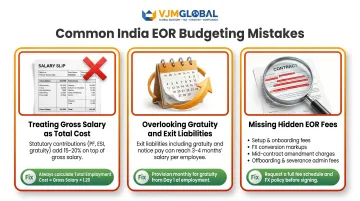
Treating gross salary as total cost: UK finance teams often build India headcount budgets around the negotiated salary, ignoring the 15–20% statutory employer contributions. A ₹10,00,000/month payroll budget accommodates only ₹8,30,000–₹8,70,000 in actual salaries once EPF, gratuity, and Professional Tax are factored in.
Overlooking gratuity and exit liabilities: Gratuity doesn't appear on monthly invoices but accrues month by month without a line item on your invoice. When an employee exits, the total bill — notice pay, leave encashment, and gratuity — can reach 3–4 months' salary for a long-tenured hire. These are real cash costs that rarely appear in first-year budgets.
Missing hidden EOR fees: Ask providers explicitly about:
- Setup/onboarding fees (some charge, some don't)
- Security deposits or advance payment requirements
- Currency exchange markups on payroll processing
- Exit/offboarding fees (some providers charge none; always confirm in writing)
Request a fully itemised cost breakdown before signing.
Frequently Asked Questions
What is the cost of an employer of record (EOR) in India?
EOR costs have two parts: the platform fee (£150-£1,150/month depending on tier) and mandatory statutory contributions (15-20% of gross salary). Total monthly employer cost typically runs 25-35% above the employee's gross salary.
How much does it cost to hire an employee in India?
Total employer cost includes gross salary, statutory contributions (EPF at 12%, gratuity 4.81%, Professional Tax), and any EOR fee. A mid-level hire at ₹1,50,000/month (£1,170) typically costs £1,600-£1,700 all-in with a mid-range EOR.
Is an employer of record (EOR) legal in India?
Yes. EOR services are legal and widely used. The EOR becomes the legal employer under Indian law, managing employment contracts, payroll, and statutory compliance while you control day-to-day work.
Who can act as an employer of record in India?
Any company with a legally registered Indian entity can act as an EOR. Verify whether your provider owns their Indian entity directly or operates through a local partner – direct ownership improves compliance accountability.
Is it better for a UK company to use an EOR or set up its own entity in India?
EOR is typically better for teams under 15 employees, offering faster setup (days versus 3-6 months), zero upfront costs, and full compliance management. Entity setup makes sense at larger scale or when permanent operational presence is the strategic goal.
What Indian statutory costs do UK employers need to budget for beyond the EOR fee?
EPF (12% of basic salary), ESI (3.25% for employees below ₹21,000/month), gratuity accrual (~4.81% of basic), and state Professional Tax (₹2,400-2,500/year). These collectively add 15-20% on top of gross salary regardless of EOR provider.