Getting the registration right matters. It determines whether your entity qualifies for NABARD and SFAC support schemes, whether your tax filings hold up under scrutiny, and whether buyers and financiers treat your organisation as a legitimate market player. Many first-time promoters struggle with exactly this — confusing capital rules, missing producer-proof documents, and vague timelines.
This article covers eligibility, the complete SPICe+ registration process, required documents, capital rules, and mistakes to avoid.
Key Takeaways
- FPC registration requires a minimum of 10 individual producers or 2 producer institutions, plus at least 5 directors, capped at 15
- Indian law sets no minimum capital requirement for FPCs — authorised or paid-up capital must simply match what's stated in your incorporation documents
- Registration happens entirely online through SPICe+ Part A & B and AGILE-PRO-S on the MCA portal
- An FPC can never convert into a public company, though it remains eligible for NABARD and SFAC equity support
What Is a Farmer Producer Company (FPC)?
An FPC is a hybrid legal structure. It borrows the corporate governance of a private limited company but retains the member-ownership spirit of a cooperative. The rules sit in Chapter XXIA of the Companies Act, 2013, Sections 378A through 378ZU, inserted by the 2020 amendment.
The design goal is straightforward: small and marginal farmers rarely have the bargaining power to negotiate fair prices alone. An FPC lets them pool produce, share processing infrastructure, and sell directly to bulk buyers — cutting out layers of middlemen.
FPC vs. FPO vs. Cooperative Society
People often use "FPO" and "FPC" interchangeably. They aren't the same thing.
| Term | What it actually is | Governed by |
|---|---|---|
| FPO | Umbrella term for any farmer collective | Can be registered as a company, society, or trust |
| FPC | A specific corporate structure | Companies Act, 2013 (Sections 378A-378ZU) |
| Cooperative Society | State-regulated collective | Respective State Cooperative Societies Act |
FPCs also open doors to institutional support. SFAC's equity grant scheme offers matching equity of up to ₹15 lakh per FPC, alongside NABARD-backed credit guarantee cover for eligible loans.
One caveat worth flagging: the Section 80PA tax deduction for producer companies only applied through assessment years ending before 1 April 2025. It no longer applies as a current benefit, so don't rely on outdated blog posts that still market it as active.
Who Can Register an FPC? Eligibility Criteria
Before you touch the SPICe+ form, confirm you meet the underlying membership and governance thresholds.
Membership requirement:
- Minimum 10 individual producers, each genuinely engaged in agricultural production, OR
- Minimum 2 producer institutions (existing producer companies or similar bodies), OR
- A qualifying combination of individuals and producer institutions
Director requirement:
- Minimum 5 directors, maximum 15
- Individuals only; corporate directors aren't permitted
- One-year exception to the 15-director cap for inter-state cooperative societies converting into an FPC
Producer-proof documentation: Subscribers need to demonstrate genuine producer status. In practice, Registrars commonly accept:
- Khasra-Khatauni or other land ownership/tenancy records
- Agricultural income proof, such as an ITR reflecting farm income
- A certificate from the village Sarpanch or local revenue authority
These requirements aren't uniformly codified nationally, so confirm the accepted list with your jurisdictional ROC before filing — expectations can vary by state.
You'll also need a valid registered office address in India, backed by a recent utility bill and either a rent agreement or a No Objection Certificate (NOC) from the property owner.
Beyond the address, your stated objects must align with the permitted producer activities under Section 378B: production, harvesting, processing, marketing, and related technical or financial services for members.
Farmer Producer Company Registration Process (Step-by-Step)
The entire incorporation journey runs digitally through the MCA's SPICe+ web form, which bundles name reservation, incorporation, DIN allotment, and PAN/TAN applications into a single filing window. Here's how it plays out in practice.
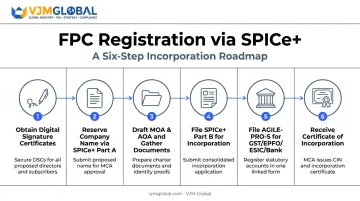
Step 1: Obtain Digital Signature Certificates (DSC)
Every subscriber and proposed director needs a valid DSC to digitally sign the incorporation forms: INC-9, SPICe+, and AGILE-PRO-S. Without it, you can't submit anything. For NRI or overseas promoters, this step often takes longer, since it requires notarised identity documents routed through the Indian Embassy in their country of residence.
Step 2: Reserve the Company Name via SPICe+ Part A
Propose two names, both ending with "Producer Company Limited," as Section 378F mandates. The MCA charges a flat ₹1,000 reservation fee, and an approved name stays valid for 20 days, extendable up to 60 days under Rule 9A if you need more runway.
Step 3: Prepare Supporting Documents and Draft MOA & AOA
While the name reservation processes, get your Memorandum and Articles of Association drafted. Alongside these, gather:
- Producer-proof documents for all subscribers
- Identity and address proof for directors
- NOC for the registered office
Step 4: File SPICe+ Part B for Incorporation
This is where you enter registered office details, apply for PAN and TAN, and submit director particulars. Attach your MOA, AOA, and INC-9 declarations here.
Step 5: File AGILE-PRO-S for GST, EPFO, ESIC, and Bank Account
This linked form auto-populates data from Part B. GST registration is optional at this stage, while EPFO and ESIC registration, along with the corporate bank account application, are mandatory components of the same filing.
Step 6: Certificate of Incorporation
Once the Registrar of Companies clears your application, it issues the Certificate of Incorporation (Form INC-11) with a unique Corporate Identification Number (CIN). That CIN marks your FPC's legal existence — you don't need a separate application for this certificate; the ROC generates it automatically on approval.
Capital Requirements and Documents Needed for FPC Registration
There's genuine confusion floating around online about whether an FPC needs ₹1 lakh or ₹5 lakh in capital. Neither figure is currently accurate as a statutory floor.
Section 378D requires an FPC's share capital to consist only of equity shares, with no preference shares or debentures counted as capital. The old ₹1 lakh minimum that once applied to private companies under Section 2(68) was removed by the Companies (Amendment) Act, 2015.
There's no separate ₹5 lakh rule specific to FPCs either. Your paid-up capital just needs to match the amount your subscribers actually commit to in the incorporation documents.
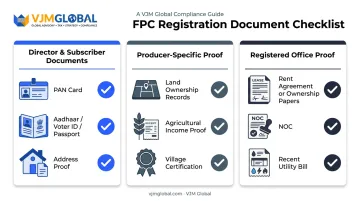
With that settled, here's the documentation you'll need to prepare:
Documents needed for all directors and subscribers:
- PAN card
- Aadhaar, Voter ID, or Passport
- Recent utility bill or bank statement (address proof)
Producer-specific proof:
- Land ownership or tenancy records
- Proof of agricultural income
- Village-level certification of producer status where applicable
Registered office proof:
- Rent agreement or property ownership papers
- NOC from the property owner
- Utility bill not older than two months
For NRIs and first-time promoters unfamiliar with Indian compliance norms, this documentation stage is often where delays creep in. Notarisation of overseas documents and getting producer-proof paperwork accepted by a specific Registrar cause the most holdups. Firms such as VJM Global help with drafting MOA and AOA, preparing compliant documentation sets, and coordinating with the ROC to keep incorporation on track.
Common Mistakes and Misconceptions in FPC Registration
A few recurring errors trip up otherwise well-prepared applicants.
Treating FPO and FPC as identical. FPO is a broad label for any farmer collective, while FPC refers to one specific legal form under company law. Registering the wrong entity type wastes time and money.
Confusing authorised and paid-up capital. Since there's no fixed statutory minimum, promoters sometimes under-capitalise at incorporation, then struggle to fund early operations. Decide your working capital needs first, then set your subscribed capital accordingly.
Skipping producer-proof documents. Applications that lack land records, income proof, or local certification frequently get sent back for resubmission, adding weeks to the timeline.
Assuming unlimited membership means no governance burden. An FPC has no member cap, but that doesn't relax its obligations. Post-incorporation, you must:
- Hold your first AGM within 90 days of incorporation
- Conduct at least 4 board meetings a year, one every quarter
- Appoint a full-time CEO who isn't a member
Missing these obligations exposes directors to compliance penalties down the line.
Frequently Asked Questions
What are the steps to register a farmer producer company in India?
The process begins with DSC acquisition and name reservation via SPICe+ Part A, followed by MOA/AOA drafting and SPICe+ Part B filing for incorporation. It wraps up with AGILE-PRO-S for GST and bank account setup, ending with the Certificate of Incorporation from the ROC.
What is the minimum paid-up capital required for a farmer producer company?
Current company law sets no fixed rupee minimum for FPC paid-up capital. Your paid-up capital must simply match the amount your subscribers commit to in the incorporation documents; older claims of ₹1 lakh or ₹5 lakh minimums no longer apply.
Who is eligible to form a farmer producer company in India?
You need a minimum of 10 individual producers, or 2 producer institutions, or a qualifying combination of both. The company must also have at least 5 directors, capped at 15.
How long does it take to get a Farmer Producer Company registration certificate?
There's no official standard timeline, since it depends on name approval speed, document completeness, and ROC workload. Delays typically stem from incomplete producer-proof documentation rather than the SPICe+ process itself.
What is the difference between an FPO and an FPC?
FPO is a general term describing any organised farmer collective, regardless of its legal form. FPC refers specifically to a company incorporated under Sections 378A-378ZU of the Companies Act, 2013.
Can a cooperative society be converted into a Producer Company?
Only an inter-state cooperative society whose activities span more than one state is eligible for conversion under Section 378J. A cooperative operating within a single state cannot use this route.