Introduction
Dubai stands as one of the world's premier trade hubs, strategically positioned at the crossroads of Asia, Europe, and Africa. For Singapore companies, the opportunity is concrete: the UAE is Singapore's largest trading partner in the MENA region and 13th globally, with bilateral trade reaching SGD 27.94 billion in 2025 and over 600 Singaporean firms already operating in the UAE.
That scale of trade activity makes licensing costs a practical concern from day one. The Singapore-UAE Comprehensive Economic Partnership (signed in 2019) has reduced barriers — but many Singapore businesses still find the total cost of setting up trade operations in Dubai significantly higher than the headline license fee suggests.
Understanding what drives those costs — and what's negotiable — is what separates companies that budget accurately from those that face unexpected capital gaps mid-setup.
Key Takeaways
- Import export license costs range from AED 5,500 in budget free zones to AED 29,685+ for all-inclusive mainland setup
- Free zones offer lower fees and 100% foreign ownership, making them the top choice for Singapore re-exporters
- Hidden costs beyond the license fee (visa processing, office space, customs registration) can easily double your initial budget
- Goods category, number of activities, and jurisdiction choice (mainland vs free zone) are the primary cost drivers
- Total Year 1 costs routinely run 2x the license fee — budget for the full picture from the start
How Much Does an Import Export License Cost in Dubai?
There is no single fixed price for an import export license in Dubai. Costs vary significantly based on jurisdiction, license type, number of trade activities, and whether you register on the mainland or in a free zone.
Singapore companies will encounter two primary licensing pathways: registering with the Department of Economic Development (DED) on the Dubai mainland, or registering through one of Dubai's free trade zones.
Mainland License Cost Range
The base license fee for a Commercial or General Trading License issued by the DED on the Dubai mainland starts from AED 12,000 to 15,000 annually. However, the total all-in first-year cost reaches approximately AED 29,685 when you include:
- Trade name registration: AED 620
- DED activity fees: AED 15,000 for general trading activities
- Initial approval fees and government charges
Overall, expect to budget AED 15,000 to 50,000 for complete mainland registration, approvals, and additional government charges. The initial DED approval fee alone is AED 120.
One structural change also affects total cost planning for Singapore companies: the 2021 UAE Commercial Companies Law amendment (Federal Decree-Law No. 32 of 2021) now permits 100% foreign ownership in most mainland sectors. This removes the Emirati local sponsor requirement that previously added both cost and complexity to mainland setups.
Free Zone License Cost Range
Free zone license costs vary considerably across Dubai's multiple jurisdictions:
| Free Zone | Base License Fee (AED) | What's Included |
|---|---|---|
| RAKEZ | 6,000 - 16,500 | Basic package: 1 activity + co-working; All-Inclusive: 5 activities + 1 visa |
| Ajman Free Zone | 9,000+ | Commercial license + registration |
| SHAMS | 11,000 - 13,000 | License with 0-1 visa allocation |
| DMCC | 29,205 - 43,780 | Packaged setup: license + flexi-desk + visa eligibility |
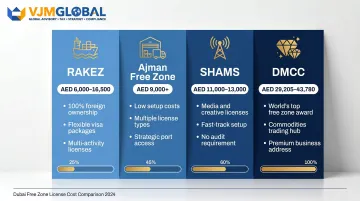
Free zone licenses include business registration, one visa allocation, and access to customs-bonded zones. Additional visas, physical office upgrades, and product-specific regulatory approvals are not covered and should be budgeted separately.
General Trading vs Specific Commodity License
The license type you choose significantly affects DED activity fees on the mainland:
- General Trading License: Covers import/export across a broad range of goods categories; aggregate DED activity fees run approximately AED 15,000
- Specific Activity License: Covers a single commodity or product category; activity fees start from AED 150 to 500 per activity
Singapore companies trading across multiple product categories typically choose a general trading license, since a single license covers all activity rather than requiring separate filings per commodity. In free zones, the activity-based fee structure varies by zone — so comparing total package costs (not just base license fees) is the more reliable approach when budgeting.
Key Factors That Affect Your Import Export License Cost
Licensing costs in Dubai are shaped by more than just the base fee. The nature of your business, jurisdiction choice, goods category, and operational scale all influence the total cost.
Type of License and Business Activities Listed
Each trade activity listed on a mainland license adds to the DED activity fee, so the more activities registered, the higher the cost. Per-activity fees typically range from AED 150 to 500 depending on the category, with a general trading license bundling multiple activities at an aggregate fee of approximately AED 15,000.
In free zones, RAKEZ's Basic Package (AED 6,000) covers 1 activity, while the All-Inclusive package (AED 16,500) covers up to 5 activities. Which jurisdiction you choose determines how far that activity fee stretches.
Jurisdiction: Mainland vs Free Zone
Mainland and free zone licenses carry different cost structures — and different market access rules.
Mainland licenses allow unrestricted sales to UAE customers, direct dealings with local buyers, and 100% foreign ownership in most trading sectors. Free zones offer lower base fees (potentially 50–75% less), guaranteed 100% ownership across all zones, and zero customs duty on goods held for re-export, with a simpler setup process.
The practical trade-off: free zone companies cannot sell directly to UAE mainland customers. They must either work through a licensed mainland distributor or establish a mainland branch under the permit system introduced by Executive Council Resolution No. 11 of 2025.
Goods Category and Regulatory Approvals
Certain product categories require additional approvals from government authorities, adding both cost and time:
| Authority | Goods Category | Typical Fees |
|---|---|---|
| Dubai Municipality | Food and food products | Foodwatch platform registration + PIC certificate |
| Ministry of Health | Pharmaceuticals, health products | Prior approval required |
| TDRA | Electronics, telecom equipment | Application: AED 500; Issuance: AED 200; Testing: AED 1,400–8,100 |
| MOIAT | General product conformity | Registration: AED 600; Technical review: AED 620 |
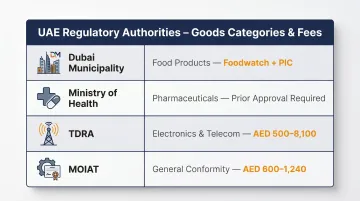
For Singapore electronics exporters, TDRA testing fees can add up fast — a single device with WiFi and Bluetooth capability could exceed AED 10,000 in testing fees alone.
Company Structure and Visa Allocation
The number of investor and employee visas tied to your license directly affects costs. Each visa allocation in Year 1 costs approximately AED 5,000 to 8,500 per employee, including:
- MoHRE work permit: AED 1,000–2,000
- ICP entry permit: AED 800–1,200
- Emirates ID: AED 370
- Medical fitness test: AED 320–400
- Mandatory health insurance: AED 1,500–3,500
Flexi-desk or business centre arrangements typically allow 1–3 visas, while physical office space in areas like JLT (DMCC) provides approximately 1 visa per 9 square metres.
Annual Renewal Costs
Import export licenses in Dubai must be renewed annually. Typical renewal ranges:
- Mainland: AED 8,000–15,000 for the license; AED 10,000–20,000 total including office and visas
- Free zone: AED 10,000–25,000 depending on the zone and license type
For cost predictability, DMCC offers multi-year packages — 2-year packages start at AED 81,881 and 3-year Jump Start packages from AED 120,000.
Full Cost Breakdown: What Singapore Companies Need to Budget For
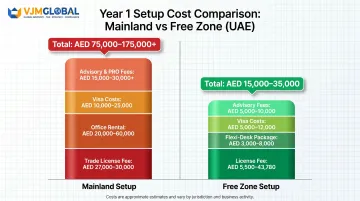
The license fee covers only the right to operate — not the full cost of being operational. Total first-year spend typically runs two to three times the license fee alone once office, visa, and advisory costs are included.
License Fee (Annual)
The primary government fee payable to DED or the relevant free zone authority covers the legal right to conduct import-export activities and must be renewed annually:
- Mainland: AED 12,000-15,000 base + AED 15,000 activity fees = AED 27,000-30,000
- Free zones: AED 5,500 (RAKEZ basic) to AED 43,780 (DMCC Jump Start package)
Customs Registration Fee (One-Time)
Any company using Dubai Customs services must register and obtain a Customs Business Code. The registration fee is AED 120 (AED 100 registration + AED 20 Knowledge and Innovation fee), with processing completed in 1 working day.
Visa and Immigration Fees (Per Employee)
The establishment card renewal fee is AED 100 per year. Per-employee visa costs in Year 1 total AED 5,000 to 8,500 as detailed above. Under Federal Decree-Law No. 33 of 2021, employers must bear all visa sponsorship costs — employers cannot deduct these from employee salaries.
Office / Physical Presence Requirement (Recurring)
Both mainland and most free zone licenses require a registered office address. This represents the largest recurring cost after the license itself:
Mainland office rental:
- Average market rent: AED 255 per square foot (Q4 2025)
- Year-on-year rental increase: 32.4%
- For a 500 sq ft office: AED 40,000-127,500 annually depending on district
Free zone flexi-desks cost a fraction of mainland office space and suit most Singapore companies building an initial trading presence:
- DMCC: AED 15,000-20,000 annually
- Ajman Free Zone: AED 8,000-12,000 annually
- General free zones: AED 3,000-7,000 annually
That translates to AED 30,000–100,000+ in annual savings versus a physical mainland office.
Professional and Advisory Fees (One-Time)
Singapore companies unfamiliar with UAE regulatory requirements typically engage local business setup consultants or PRO (Public Relations Officer) services:
- Business setup consultancy: AED 2,000-10,000 (one-time)
- PRO service fee per visa: AED 1,500-2,500
- Corporate bank account opening assistance: AED 2,000-5,000
- Document attestation: AED 150 per document (UAE Ministry of Foreign Affairs)
For most Singapore companies, advisory fees add AED 5,000-20,000 to first-year costs — but they typically prevent more expensive errors in jurisdiction selection or documentation.
Mainland vs Free Zone: Which Option Suits Singapore Companies?
Singapore companies expanding into Dubai face a binary choice: mainland DED registration or free zone registration. The right answer depends on your target market, not just upfront cost.
When to Choose a Free Zone
Free zones are better suited to Singapore companies that intend to:
- Re-export goods internationally to markets across the Middle East, Africa, and CIS
- Trade within free zone ecosystems with other zone-registered entities
- Test the UAE market without committing to a full mainland presence
- Minimise upfront setup costs and ongoing rental expenses
Core advantages of free zone registration:
- 100% foreign ownership with no local partner requirement
- Zero customs duty on goods moving within free zone ecosystems
- Setup costs typically 50–75% lower than equivalent mainland registration
- Streamlined registration with fewer bureaucratic steps
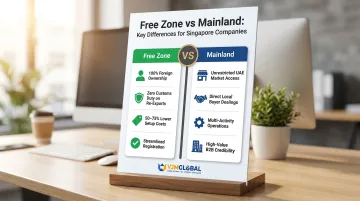
That said, selling directly to UAE consumers still requires a mainland distributor — or a mainland permit under the Resolution No. 11 of 2025 framework.
When to Choose the Mainland
Mainland setup makes more sense for companies that:
- Target UAE domestic buyers directly and generate significant revenue from local sales
- Operate complex multi-activity operations requiring unrestricted market access
- Want to establish a visible, credible presence for high-value B2B relationships in the Gulf
- Plan to build long-term operations with significant local staff and office presence
The 2021 foreign ownership law change has made mainland registration more accessible for Singapore companies, eliminating the historical requirement for a local Emirati partner in most sectors. While upfront costs are higher, unrestricted market access can justify the investment for domestically-focused businesses.
Budgeting Mistakes Singapore Companies Often Make
Focusing Only on the Base License Fee
The total Year 1 cost for a mainland import export business in Dubai can run two to three times the license fee. Hidden line items add up fast. Singapore companies should budget for:
- Customs registration: AED 120
- Visa fees: AED 5,000–8,500 per employee
- Office rental or flexi-desk: AED 3,000–127,500
- Document attestation: AED 150 per document
- Annual renewal costs from Year 2 onwards
Underestimating Product-Specific Regulatory Costs
Beyond the license itself, Singapore companies trading in food, health products, or electronics often face surprise delays and extra fees from sectoral authorities. For example:
- TDRA testing for a WiFi-enabled device: AED 8,100
- MOIAT product registration: AED 600 + AED 620 technical review
- Dubai Municipality food registration: Variable costs for Foodwatch platform and PIC certification
These costs are not included in the standard license fee and can add AED 5,000–15,000+ to the total.
Choosing the Cheapest Free Zone Without Checking Operational Fit
Regulatory costs aside, the choice of jurisdiction matters too. Some ultra-low-cost free zones outside Dubai — such as RAKEZ in Ras Al Khaimah — have limited customs infrastructure and fewer banking options. For Singapore companies working with high-value B2B clients in the Gulf, this can affect perceived credibility.
The AED 10,000–20,000 saved on license fees can quickly be offset by:
- Longer logistics times due to limited port access
- Reduced banking options and account opening difficulty
- Lower zone credibility with Gulf-region enterprise clients
Research zone reputation, infrastructure quality, and proximity to key customers alongside cost — not just the headline license fee.
Frequently Asked Questions
How much does an import export license cost in Dubai?
Base fees range from approximately AED 5,500 in budget free zones like RAKEZ to AED 29,685+ for all-inclusive mainland DED setup. Free zone licenses from DMCC start at AED 29,205 for packaged options. The total depends on license type, jurisdiction, number of activities, and additional regulatory requirements for specific goods.
How much does it cost to start an import-export business in Dubai?
The license fee alone ranges from AED 5,500 to AED 30,000. Total Year 1 costs — including visa processing, office space, customs registration, and advisory fees — run AED 15,000–35,000 for a basic free zone setup, or AED 75,000–175,000+ for mainland operations with a physical office.
How do I get an import export license in Dubai?
The core steps are:
- Choose mainland (DED) or a free zone authority
- Register your company name with the chosen authority
- Apply for a trade license with DED or your selected free zone
- Register with Dubai Customs to get a Customs Business Code (AED 120)
- Complete any product-specific regulatory approvals for your goods category
Can a foreigner get a trade license in Dubai?
Yes. Singapore nationals can obtain a trade license in Dubai with 100% foreign ownership — in all free zones, and in most mainland sectors following the 2021 Commercial Companies Law reform. Security, defense, banking, and a handful of strategic sectors remain restricted.
What is the import fee in Dubai?
Dubai applies a standard customs duty of 5% on CIF (Cost, Insurance, Freight) value for most goods, as part of the GCC Common Customs Tariff. Exceptions include alcohol (50% duty) and cigarettes (100% duty). Goods traded within free zones and stored for re-export are duty-exempt. Moving goods from a free zone into the mainland market triggers the 5% duty.
What is a Category 4 license in the UAE?
Category 4 refers to a classification specific to the Dubai International Financial Centre (DIFC) for financial services licenses related to asset management, fund management, and investment advisory. It is not a general import/export trade license classification and is not relevant to standard trading operations regulated by DED or commercial free zones.