Yet the licensing cost structure remains one of the most misunderstood aspects of Dubai market entry. Singapore founders often budget for the headline license fee—AED 5,750 to AED 15,000 in many Free Zones—only to discover their actual first-year cost runs 40-60% higher once visas, office requirements, and compliance fees are factored in.
This guide breaks down the complete cost picture specifically for Singapore companies, covering pricing tiers across Mainland and Free Zone jurisdictions, hidden cost drivers most founders miss, and Singapore-specific considerations including document attestation requirements and the Singapore-UAE tax treaty advantages.
Key Takeaways
- Dubai business license costs range from AED 5,750 to AED 50,000+ (approximately SGD 1,984 to SGD 17,250+) depending on jurisdiction and business activity
- Free Zone packages like SHAMS start at AED 5,750, while Mainland DED licenses average AED 24,500—but these are base fees only
- Total first-year cost including license, visas, office, and compliance typically runs 40-60% above the headline license fee
- Singapore companies qualify for 100% foreign ownership in all Free Zones and most Mainland sectors with no local sponsor required
- Singapore corporate documents require multi-step legalisation before Dubai authorities will accept them — budget time and cost for this upfront
- Annual compliance and bank account setup add AED 15,000–40,000+ to ongoing costs; bank approvals alone take 2–6 weeks
How Much Does a Dubai Business License Cost for Singapore Companies?
There is no single fixed price for a Dubai business license. Costs vary significantly based on license type (Commercial, Professional, Industrial, General Trading)and jurisdiction (Mainland vs Free Zone). Additional variables include the number of business activities listed, office requirements, and visa allocation.
Singapore companies frequently underbudget by focusing solely on the advertised license fee without accounting for mandatory add-ons. The most common mistake is treating an AED 12,500 Free Zone package as the all-in cost.
In reality, you still need to add visa fees (AED 3,000–7,500 per person), office space or flexi-desk (AED 3,000–15,000 annually), and compliance support (AED 6,000–24,000 annually).
What goes wrong when costs are misunderstood:
- The base license fee covers only 40–50% of true first-year setup cost
- Mainland licenses appear cheaper upfront, but mandatory office leases add AED 15,000–100,000+ annually
- Renewal fees, visa renewals, and compliance costs all land together in year two
- Singapore incorporation certificates require 5-step legalisation (not Apostille), adding 7–10 working days and multiple fees
Typical Cost Ranges by Setup Type
| Setup Type | License Cost (AED) | Approx. SGD | What's Included |
|---|---|---|---|
| Entry-Level Free Zone (Ajman, SHAMS) | AED 5,750–6,000 | SGD 1,984–2,070 | Trade license only; virtual office; zero visas |
| Mid-Range Free Zone (IFZA, Meydan, RAKEZ) | AED 12,500–16,500 | SGD 4,313–5,693 | License + 1 visa allocation + flexi-desk |
| Mainland – Professional (DED) | From AED 9,950 | From SGD 3,432 | License and trade name only |
| Mainland – Commercial (DED) | Avg. AED 24,500 | Avg. SGD 8,452 | License and trade name only |
| Mainland – General Trading (DED) | AED 29,685 | SGD 10,237 | License and trade name only |
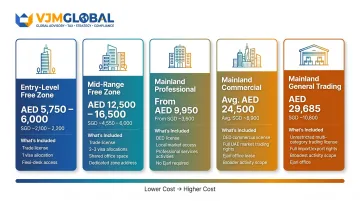
Entry-level Free Zone packages suit solo founders testing the Dubai market — but factor in at least one visa (AED 4,000–6,000) and a flexi-desk upgrade (AED 3,000–6,000 annually) before finalising your budget.
Mid-range Free Zone packages are the most common starting point for Singapore founders. IFZA's 1-visa package costs AED 14,900; RAKEZ's all-inclusive offering starts at AED 16,500.
Mainland licenses carry a different cost structure. The license fee excludes a mandatory physical office lease (AED 15,000–100,000+ annually depending on location) and Ejari registration — costs that don't appear in any headline figure.
Critical exclusions across all tiers:
- Investor/employee visas beyond the package allocation
- Physical office lease or flexi-desk upgrades
- Government approvals for regulated activities (fintech, healthcare, food services)
- PRO (Public Relations Officer) service fees
- Document attestation and legalisation
- Corporate bank account setup
- Annual accounting and VAT/corporate tax compliance
Key Factors That Affect Dubai Business License Costs
Pricing depends on a combination of legal, operational, and business-specific factors. Singapore companies should evaluate all of them before selecting a setup structure, as choosing the wrong configuration can add 30-50% to annual operating costs.
License Type and Business Activity
The UAE recognizes several distinct license types, each carrying different fee structures:
- Professional License (AED 9,950+): Consultants, freelancers, professional services
- Commercial License (AED 24,500 average): Retail/wholesale trade, import/export
- Industrial License (AED 25,000 average): Manufacturing, processing operations
- General Trading License (AED 29,685 average): Broad trading scope across multiple product categories
Each additional business activity listed on your license increases the fee. Certain regulated activities also trigger mandatory government approvals that extend your setup timeline by 1-3 weeks and add approval fees:
- Fintech: Central Bank of UAE (CBUAE) approval required
- Healthcare: Dubai Health Authority (DHA) clearance
- Food services: Dubai Municipality health and safety approvals
- Education: Knowledge and Human Development Authority (KHDA) licensing
- Legal services: Dubai Legal Affairs Department registration
Mainland vs Free Zone Jurisdiction
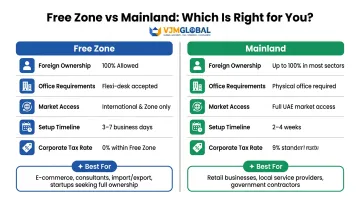
Free Zones allow 100% foreign ownership with no local sponsor, faster setup (typically 1-2 weeks), and lower entry costs starting from AED 5,750. The trade-off: you cannot trade directly within the UAE mainland market.
Free Zone companies can sell to other Free Zone entities, export internationally, or serve MENA clients remotely — but reaching mainland customers requires a Mainland license or a distributor arrangement.
Mainland licenses provide unrestricted access to the entire UAE market, government contract eligibility, and direct B2C customer access. Since the 2021 Commercial Companies Law reforms, most activities no longer require a 51% Emirati partner.
That said, Mainland setup requires a physical office lease (not just a flexi-desk) plus Ejari tenancy registration — and typically costs 2-4x more than comparable Free Zone packages.
Singapore companies serving international or MENA clients remotely—such as SaaS providers, digital marketing agencies, or professional consultancies—often find Free Zones more cost-efficient. Those planning retail outlets, physical distribution, or direct UAE customer sales need Mainland access.
Office and Workspace Requirements
Office choice directly impacts both cost and visa quota. Mainland requires a physical lease (typically AED 15,000-100,000+ per year depending on district and size). Dubai commercial office rents in 2025 range from AED 80-120/sqft/year in secondary areas like Deira to AED 250-450+/sqft/year in prime zones like DIFC.
Free Zones offer three tiers:
- Virtual office (AED 3,000-6,000/year): Legal address only, no physical workspace
- Flexi-desk (AED 6,000-12,000/year): Shared coworking access with limited hours
- Private office (AED 15,000-50,000+/year): Dedicated space with full-time access
The office type also determines your visa quota—larger offices support more employee visas, while virtual offices typically allow only 1-2 visas.
Number of Visas Required
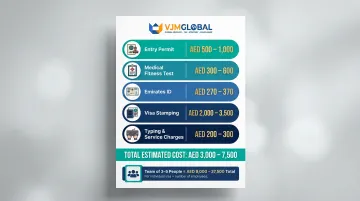
Each investor or employee visa adds AED 3,000-7,500 to your setup cost. Per-visa costs typically break down as follows:
Individual visa cost components include:
- Entry permit: AED 500-1,000
- Medical fitness test: AED 300-600
- Emirates ID: AED 270-370
- Visa stamping: AED 2,000-3,500
- Typing and service charges: AED 200-300
Singapore companies sending a team of 3-5 people should budget AED 9,000-37,500 for visa costs alone—often matching or exceeding the base license fee. These are one-time setup costs; annual visa renewals typically run 70-80% of the initial fee.
Number and Type of Business Activities on the License
Most Free Zones charge per activity listed on your license. A single-activity consultancy license costs less than a multi-activity license covering consultancy + software development + digital marketing. Singapore companies with diversified operations should verify whether a General Trading License covers their scope upfront. In some cases, separate targeted licenses prove more cost-effective — worth modeling before you commit.
Full Cost Breakdown: What Singapore Companies Should Budget For
The total cost of a Dubai business license goes far beyond the headline license fee. Singapore companies should build a full first-year budget across one-time, recurring, and often-overlooked expense categories.
One-Time Setup Costs
Core registration fees:
- Trade name registration: AED 600-1,200
- Initial approval fee: AED 1,000-3,000
- Company registration/incorporation: AED 2,000-5,000
- Articles of Association (if applicable): AED 500-1,500
- Memorandum of Association: AED 1,000-3,000
Singapore-specific costs:
- Document attestation (see Singapore-specific section below): SGD 50-200 per document
- Notarisation in Singapore: SGD 40-150 per document
- UAE Embassy legalisation: Variable, typically higher for commercial documents
Annual Recurring Costs
License and office:
- License renewal fee: Typically 80-90% of first-year license cost (AED 5,000-25,000 depending on jurisdiction)
- Office lease or flexi-desk renewal: AED 3,000-100,000+ annually
- Ejari registration (Mainland tenants): AED 170 plus 5% of annual rent
Visas and compliance:
- Visa renewals per person: AED 2,500-5,500 annually
- Health insurance (mandatory in Dubai): AED 600-5,000 per person annually
- Accounting and bookkeeping: AED 1,500-5,000 monthly (AED 18,000-60,000 annually)
Singapore companies often underestimate how quickly these costs accumulate. A modest 2-person Free Zone operation might face AED 30,000-50,000 in annual recurring costs beyond the initial setup.
Visa and Immigration Costs
A single visa costs AED 3,000-7,500 all-in. For a Singapore team of three, you're looking at AED 9,000-22,500 in visa costs alone during setup. This excludes:
- Status change fees if team members are already in the UAE on visit visas (AED 500-600 per person)
- Refundable security deposit for investor visas (approximately AED 3,000)
- Medical insurance (mandatory, not included in government fees)
Corporate Tax and VAT Compliance Costs
The UAE introduced a 9% federal corporate tax effective for financial years beginning on or after June 1, 2023. Key thresholds:
- 0% rate on taxable income up to AED 375,000
- 9% rate on taxable income above AED 375,000
- Small Business Relief: Companies with revenue at or below AED 3 million can elect for 0% rate through December 31, 2026
Qualifying Free Zone Person (QFZP) status allows Free Zone companies to maintain 0% corporate tax on qualifying income. To qualify, companies must meet all of the following:
- Maintain adequate economic substance in the UAE
- Prepare audited financial statements
- Keep non-qualifying revenue below 5% of total revenue or AED 5 million (whichever is lower)
VAT registration is mandatory above AED 375,000 annual turnover (5% standard rate).
Annual compliance costs:
- Bookkeeping: AED 1,500-3,000/month
- VAT filing: AED 500-1,000/quarter
- Corporate tax filing: AED 2,000-5,000/year
- Annual audit: AED 1,200-10,000 depending on company size
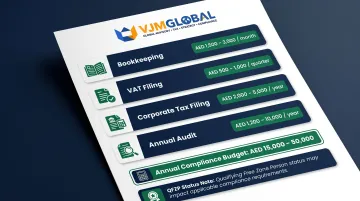
Budget AED 15,000-50,000 annually for full accounting and compliance support. This is the line item that most surprises Singapore companies when they see their actual first-year spend.
Costs Specific to Singapore Companies
Document attestation and notarisation: The UAE is not a member of the Hague Apostille Convention. Singapore-issued documents require a 5-step legalisation chain:
- Notarisation by Singapore Notary Public (SGD 40-150 per document)
- Authentication by Singapore Academy of Law (SGD 10.70 per document)
- UAE Embassy legalisation in Singapore (variable fees, commercial documents cost more)
- Final MOFA attestation in UAE
Budget 7-10 working days for the complete chain and SGD 100-400 per document depending on document type.
Branch vs new entity decision: Singapore parent companies can open a UAE branch (simpler structure, parent liability) or establish a new entity (separate legal personality, limited liability). The right choice depends on your risk tolerance and operational model.
UAE corporate bank account: Opening a UAE corporate bank account typically requires an in-person visit from directors/signatories. Processing takes 7 working days for standard applications, but can extend to 4-6 weeks for foreign directors due to enhanced KYC requirements.
Most banks require 3-6 months of personal bank statements, a business plan, and supporting documentation from your Singapore entity.
Mainland vs Free Zone: Which Setup Is Right for Singapore Companies?
The Mainland vs Free Zone decision drives more of your total Dubai cost than almost any other factor. Your best choice comes down to one question: do you need to sell directly into the UAE market, or are you primarily serving international clients from a Dubai base?
| Factor | Free Zone (IFZA, DMCC, Meydan, RAKEZ) | Mainland (DED) |
|---|---|---|
| First-Year License Cost | AED 5,750-16,500 (SGD 1,984-5,693) | AED 12,500-29,685 (SGD 4,313-10,242) |
| 100% Foreign Ownership | Yes, always | Yes, for most activities since 2021 |
| Physical Office Requirement | Flexi-desk or virtual office acceptable | Physical lease mandatory (AED 15,000-100,000+/year) |
| UAE Mainland Market Access | No (only Free Zone-to-Free Zone or export) | Yes, unrestricted |
| Setup Timeline | 1-2 weeks | 2-4 weeks |
| Annual Renewal Cost | AED 5,000-15,000 | AED 8,000-25,000 |
| Corporate Tax Rate | 0% if QFZP qualifying | 9% on profits above AED 375,000 |
Free Zones suit Singapore companies that:
- Serve international or MENA clients remotely (SaaS, digital agencies, consultancies)
- Run professional services with no need for UAE retail presence
- Want to test the Dubai market with minimal overhead
- Qualify for QFZP status to maintain 0% corporate tax
- Prioritise setup speed and lower entry costs
Mainland suits Singapore companies that:
- Plan to open retail outlets or physical customer locations
- Want to win UAE government contracts (often restricted to Mainland entities)
- Need to trade directly with UAE mainland-based customers
- Operate in sectors where Free Zone restrictions limit business development
How to Estimate and Reduce Your Dubai Business License Budget
The "right" budget isn't the lowest possible cost—it's the one that fits your business model without overpaying for features you don't need. Here's a practical budget-building approach for Singapore companies.
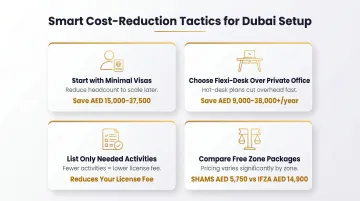
Four smart cost-reduction tactics:
- Start with minimal visas, then scale. Begin with a zero-visa or single-visa Free Zone license. Each visa adds AED 3,000–7,500; five team members means AED 15,000–37,500 before you generate a dirham of revenue.
- Choose flexi-desk over private office in year one. A flexi-desk meets legal office requirements at AED 6,000–12,000 annually, versus AED 15,000–50,000+ for private space. Upgrade once the Dubai operation proves viable.
- List only the activities you actually need. Each additional activity increases your license fee. If you're primarily a consultancy, don't add software development, events management, and training on day one — expand activities as your service mix grows.
- Compare Free Zone packages side by side. Pricing varies significantly for identical activity types: SHAMS starts at AED 5,750, RAKEZ at AED 6,000, Meydan at AED 12,500, and IFZA at AED 14,900. Differences lie in visa allocations, office inclusions, and brand perception.
Beyond the tactics above, the structure you choose on day one is difficult to undo. Working with advisors who understand both Singapore corporate documentation and UAE licensing requirements helps you avoid jurisdiction mismatches, incorrect attestation, and setup structures that don't support your actual business model.
VJM Global provides cross-border accounting, tax compliance, and international business advisory services for companies expanding across multiple jurisdictions. Firms familiar with Singapore corporate structures can help ensure your documents are correctly prepared before UAE submission — reducing delays and unexpected costs.
Frequently Asked Questions
How much does it cost to maintain a company in Dubai?
Annual costs typically cover license renewal (AED 5,000–15,000), office or flexi-desk (AED 3,000–100,000+), visa renewals (AED 2,500–5,500 per employee), and accounting/compliance fees (AED 15,000–50,000+). Total annual maintenance for a typical Free Zone operation runs AED 25,000–80,000 (SGD 8,625–27,600), depending on structure and team size.
Can a foreigner own 100% of a company in Dubai or the UAE?
Yes, 100% foreign ownership is permitted in all UAE Free Zones and in most Mainland sectors following 2021 Commercial Companies Law reforms. A few strategic sectors — banking, insurance, telecommunications, and defense — still require local participation, so confirm your activity's eligibility before applying.
What is the cheapest Dubai business license option for a Singapore company?
The most affordable entry point is a Free Zone license in zones like Ajman Free Zone or SHAMS, with base packages starting from AED 5,750-6,000 (SGD 1,984-2,070). However, this excludes visas, office space, and government approvals—your total first-year cost will run AED 15,000-25,000 once mandatory components are included.
Do Singapore companies need a local sponsor for a Dubai Mainland license?
Since UAE ownership reforms took effect in 2021, most Mainland business activities no longer require a local Emirati sponsor for 100% foreign ownership. Certain regulated or restricted sectors may still require local participation, so confirm your specific activity eligibility with DED.
How long does it take to get a Dubai business license as a Singapore company?
Free Zone licenses typically take 1-2 weeks while Mainland licenses take 2-4 weeks. However, Singapore companies should add 1-2 weeks for document attestation (the UAE doesn't recognize Apostilles, requiring full legalisation through SAL, UAE Embassy, and MOFA UAE). Total realistic timeline including banking setup: 4-8 weeks.
Is there a tax treaty between Singapore and the UAE that affects Dubai business setup costs?
Yes, Singapore and the UAE have a Double Taxation Avoidance Agreement (DTAA) providing 0% withholding tax on dividends and interest, and 5% on royalties — making profit repatriation to Singapore highly tax-efficient. Consult a cross-border tax advisor on how the treaty applies to your structure, particularly the Principal Purpose Test introduced in 2019.