
Introduction
UK-India trade hit £48.0 billion in 2025, up 10.7% from the previous year, with UK exports to India climbing to £19.3 billion (DBT trade and investment factsheet).
As more UK firms pursue that growth, they face a structural choice: enter India directly, or build a holding-subsidiary structure.
Get this wrong and the consequences aren't just administrative. Many UK directors treat "holding company" and "subsidiary company" as interchangeable terms, when they carry distinct legal meanings under both Indian and UK company law.
That confusion leads to structuring mistakes, compliance gaps, and false assumptions about liability protection.
This guide breaks down the legal difference, walks through how UK businesses actually set these structures up in India, and explains exactly when a UK parent can be held responsible for its Indian subsidiary's conduct.
Key Takeaways
- Holding control comes from board composition or majority voting power; the subsidiary stays separate under Section 2(87) of the Companies Act, 2013
- UK companies can legally hold up to 100% of an Indian Private Limited subsidiary under the FDI Automatic Route in most sectors
- Parent liability is generally capped at shareholding value unless a court lifts the corporate veil
- Private Limited is the default structure for UK-owned Indian entities; Public Limited only makes sense for public capital raising
Understanding Holding and Subsidiary Companies Under Indian Law
Indian company law defines these terms with precision, and the definitions matter more than most UK directors expect.
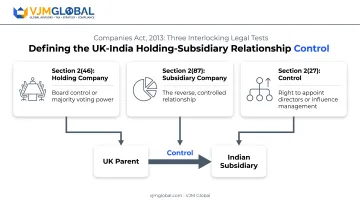
Holding company, under Section 2(46) of the Companies Act, 2013, is a company in relation to which one or more other companies are subsidiaries. In plain terms: it either controls the Board of Directors of another company, or holds more than half its total voting power.
Subsidiary company, under Section 2(87), is the reverse relationship. A company qualifies as a subsidiary where the holding company:
- Controls the composition of its Board of Directors, or
- Exercises or controls more than one-half of its total voting power, alone or with other group subsidiaries
Control, defined separately under Section 2(27), includes the right to appoint a majority of directors or to influence management and policy decisions, directly or indirectly, through shareholding, management rights, or shareholder agreements.
Why the Vodafone Case Still Matters
The Supreme Court of India's ruling in Vodafone International Holdings BV v. Union of India states the principle clearly: a holding company and its wholly owned subsidiary are two distinct legal persons. The parent does not own the subsidiary's assets, even at 100% shareholding.
This cuts both ways for UK businesses. It's good news for liability protection, but it also means:
- A UK holding company does not need to be incorporated in India
- Only the Indian subsidiary must comply with the Companies Act, FEMA, and Indian tax law as a domestic entity
- The UK parent remains governed by UK company law for its own reporting and governance obligations
Holding Company vs Subsidiary Company: Key Differences
Once the legal definitions are clear, the practical differences become straightforward.
| Factor | Holding Company | Subsidiary Company |
|---|---|---|
| Role | Owns or controls the group entity | The entity being controlled |
| Primary purpose | Investment management and strategic direction | Day-to-day operations and revenue generation |
| Decision-making | Sets overall group strategy | Operational and local decisions within board-approved limits |
| Liability exposure | Limited to its investment (absent veil-piercing) | Fully liable for its own debts and obligations |
| Tax treatment | Taxed in its home jurisdiction (UK) | Taxed separately as a domestic Indian company |
A few points are easy to overlook:
- A subsidiary can itself become a holding company. If your Indian subsidiary later acquires shares in another company, it becomes a holding company in that relationship. This matters for UK groups building multi-tier structures across India and other markets.
- Financial reporting does not follow the same split as tax. The Indian subsidiary’s accounts still consolidate into the UK parent’s group accounts under UK GAAP or IFRS (Companies Act 2006, s.399 and s.404), even though the Indian entity files and pays tax separately in India.
Why the Distinction Matters for UK Parent Companies
Misreading this relationship tends to push UK businesses toward one of two mistakes. Some under-protect their assets by trading directly into India without a subsidiary wrapper, exposing the UK entity to Indian operational risk.
Others assume the opposite: that incorporating a subsidiary makes the parent bulletproof, no matter how the parent manages that subsidiary day to day. Liability protection still depends on genuine separation, proper governance, and how control is actually exercised.
How UK Businesses Can Structure Holding and Subsidiary Entities in India
Can a UK Company Have a Subsidiary in India?
Yes. A UK company can legally hold a majority stake (or 100% as a Wholly Owned Subsidiary) in an Indian Private Limited Company, governed by the Companies Act, 2013 and FEMA.
Most sectors where UK firms operate permit 100% FDI under the Automatic Route, meaning no prior government approval is required:
- IT and software services
- Business and management consulting
- Manufacturing (including contract manufacturing)
- Fintech activity regulated by RBI, SEBI, IRDAI, or another notified financial regulator
Fintech activity that's unregulated or only partly regulated falls under the Government Route instead, requiring prior approval. That distinction trips up a fair number of UK fintech entrants.
Common Holding-Subsidiary Structures for UK Groups
Two structures dominate in practice:
- Direct structure: the UK parent holds shares in the Indian subsidiary directly. Simplest to administer, easiest to explain to auditors, and the default for most first-time entrants.
- Intermediate holding structure: an entity in a treaty-favourable jurisdiction sits between the UK parent and the Indian subsidiary, usually for tax or group-restructuring reasons.
An intermediate structure isn't a decision to make without specialist cross-border tax advice. It touches transfer pricing, DTAA treatment, and multi-jurisdiction compliance at once.
Example: Holding Company and Subsidiary in Practice
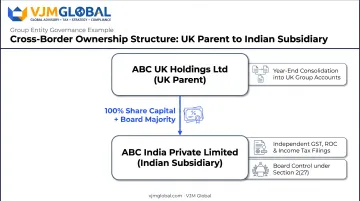
Picture "ABC UK Holdings Ltd" incorporating "ABC India Private Limited" as a wholly owned subsidiary:
- ABC UK Holdings Ltd subscribes to 100% of ABC India's issued share capital
- The UK parent appoints the majority of directors to ABC India's board, satisfying the control test under Section 2(27)
- ABC India operates independently under Indian company law, filing its own GST, ROC, and income tax returns
- At year-end, ABC India's financial results consolidate into ABC UK Holdings Ltd's group accounts
VJM Global has advised 250+ UK businesses through exactly this kind of structuring — from choosing between entity types through to ongoing group compliance, transfer pricing documentation, and management reporting that supports consolidation back in the UK.
Private Limited vs Public Limited Company in India: Which Should Your Indian Subsidiary Be?
For nearly every UK entrant, this decision is straightforward. The comparison turns on shareholders, directors, capital-raising rights, and ongoing compliance.
| Requirement | Private Limited | Public Limited |
|---|---|---|
| Minimum shareholders | 2 | 7 |
| Minimum directors | 2 | 3 |
| Minimum paid-up capital | None | None (post-2015 amendment) |
| Public capital raising | Not permitted | Permitted, subject to SEBI regulations |
| Compliance burden | Lower | Higher, including SEBI disclosure |
Public limited companies suit scale. They can raise capital from the public with no cap on shareholder numbers, but that brings SEBI compliance obligations most UK subsidiaries do not need in their first years of operation.
Unless your Indian subsidiary plans to list on an Indian stock exchange or raise public capital, Private Limited is the standard recommendation. It's simpler to govern, cheaper to maintain, and gives the UK parent the same limited-liability protection without the regulatory overhead.
Liability Protection and Legal Risks: When Can a UK Holding Company Be Held Liable for Its Indian Subsidiary?
The general rule holds: a holding company's liability is limited to its shareholding, and courts treat the subsidiary as a separate legal person. But that protection isn't unconditional.
Indian courts have pierced the corporate veil in specific circumstances, including cases where:
- Parent management exercises direct "steering interference" in the subsidiary's core activities, per the Vodafone principle
- Entities are "inextricably linked" with no genuine separate existence, as in State of U.P. v. Renusagar Power Co. (1988)
- Demonstrable impropriety uses the corporate structure to conceal or avoid liability, as clarified in Balwant Rai Saluja v. Air India Ltd. (2014)
The Vedanta Precedent UK Parents Should Know
The UK Supreme Court's ruling in Vedanta Resources Plc v. Lungowe confirmed something UK groups often overlook. A UK parent can owe a duty of care to third parties affected by its overseas subsidiary's operations, under ordinary tort principles.
Ownership alone does not create that duty. Active intervention, shared risk-management policies, or public claims of group-wide supervision can.
Practical protection for UK groups typically includes:
- Documented board autonomy for the Indian subsidiary, with genuine decision-making at the local level
- Arm's-length inter-company transactions, backed by proper documentation
- India's three-tier transfer pricing framework (Local File, Master File, and Country-by-Country Report) kept current and audit-ready
Getting this governance evidence trail right from day one is far easier than reconstructing it after a dispute arises. For UK groups, that usually means board-minute discipline, resolution documentation, and transfer pricing benchmarking that holds up if challenged—work VJM Global supports through its secretarial and transfer pricing advisory services.

Frequently Asked Questions
Can a UK company have a subsidiary in India?
Yes. A UK company can hold a majority stake or 100% of an Indian Private Limited Company as its subsidiary, subject to FDI rules and Companies Act registration requirements.
What is the difference between a holding company and a subsidiary?
A holding company controls another company through board control or majority shareholding. The subsidiary is the controlled entity, but it remains a separate legal person for liability and tax purposes.
Can you provide an example of a holding company and a subsidiary company in India?
A UK parent, "ABC UK Holdings Ltd," holding 100% of shares in "ABC India Private Limited" is a classic example. ABC India operates independently under Indian law while consolidating into the UK parent's group accounts.
Which is larger: a Private Limited (Pvt Ltd) or a Public Limited (Ltd) company in India?
Public Limited companies are structurally designed for larger scale and public capital-raising. Private Limited remains the standard, lower-compliance choice for most UK-owned subsidiaries.
Is a UK holding company liable for the debts of its Indian subsidiary?
Generally no. Liability is limited to the holding company's shareholding. Exceptions arise only where Indian or UK courts lift the corporate veil due to improper control or misuse of the structure.
Does a UK holding company need to be registered in India?
No. Only the Indian subsidiary needs to be registered and comply with Indian company law. The UK holding company itself doesn't require Indian incorporation.