For a UK business, it's rarely that clean.
UK promoters face extra layers most domestic founders never encounter: apostilled documents, FDI route decisions, entity structuring across two legal systems, and cross-border compliance that doesn't stop at incorporation. Delhi remains one of the most popular entry points for UK companies expanding into India, thanks to its infrastructure, English-speaking talent pool, and a regulatory system that's genuinely become more transparent over the past decade.
This guide walks through the exact steps, structure choices, documentation, and compliance obligations UK business owners need to get right the first time.
Key Takeaways
- Delhi registration follows the standard MCA SPICe+ process, now overseen by ROC NCT of Delhi-I or Delhi-II based on district
- UK businesses must apostille documents and choose a structure: Wholly Owned Subsidiary, LLP, or Branch/Liaison Office
- Government incorporation fees are largely waived, but apostille, DSC, stamp duty, and professional costs still apply
- FC-GPR filing with the RBI is due within 30 days of share allotment — missing this deadline creates non-compliance from day one
- Post-incorporation obligations (GST, audits, annual ROC filings) require ongoing local coordination, not a one-time setup
Why Delhi Is a Strategic Entry Point for UK Businesses
Company registration in Delhi is the legal process of incorporating a business entity with the Registrar of Companies under the Companies Act, 2013. Once registered, the company becomes a separate legal person in India, able to sign contracts, hire staff, and hold assets in its own name.
For UK businesses, this unlocks:
- Access to a large domestic consumer market, without relying solely on export or distributor arrangements
- A skilled, English-speaking workforce, which reduces the friction of managing an overseas team
- A transparent, tech-enabled filing system via the MCA21 portal, where most incorporation steps happen digitally
What Makes Delhi Specifically Attractive
Delhi/NCR pulled in USD 4.453 billion in FDI through December 2024, ranking fourth among Indian states for that period, according to Invest India's FY2024-25 state rankings. That's a nine-month figure, not a full-year total, but it signals real investor traction.
Beyond the numbers, Delhi offers:
- Proximity to central government departments, which can speed up approvals requiring ministry-level sign-off
- A dense ecosystem of chartered accountants, company secretaries, and lawyers experienced with foreign investment structures
- Reliable business infrastructure across Nehru Place, Connaught Place, and the wider NCR corridor
Where UK Founders Commonly Go Wrong
Without proper guidance, first-time filers often hit the same walls:
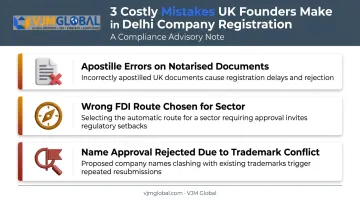
- SPICe+ filings rejected because UK documents were notarised but not apostilled correctly
- Delays from choosing the wrong FDI route for their specific sector
- Name approval rejections due to conflicts with existing trademarks or company names
Firms with specific UK-facing experience tend to avoid these snags because they've handled the documentation chain before. VJM Global has supported over 250 UK businesses entering India, and the recurring theme across those cases is cross-border paperwork, not the Indian filing process itself.
Delhi registration isn't optional for local operations. Any UK company planning to hire employees, invoice Indian customers, or sign local contracts needs a recognised legal entity. Without it, the business is operating in a grey zone that Indian banks, vendors, and tax authorities won't engage with.
Step-by-Step Process for Company Registration in Delhi
The entire process runs through the MCA's SPICe+ portal, from name reservation to the Certificate of Incorporation. MCA describes SPICe+ as an integrated web form bundling 11 services across multiple government departments — a genuine improvement on the fragmented paper-based system of a decade ago.
No official MCA source guarantees a fixed processing time, so treat any "8-15 working days" estimate as a realistic range, not a promise. Delays usually come from resubmissions, apostille turnaround, or name objections.
With that caveat in mind, here's how the six-step process unfolds — many UK founders bring in local accountants or company secretaries at Steps 1, 3, and 6, where paperwork errors most often cause delays.
Step 1: Decide the Business Structure and Obtain DSC
UK directors and subscribers first choose an entity type (covered in detail below), then obtain a Digital Signature Certificate. For foreign nationals, this requires notarised and apostilled ID and address proof from the UK — not something you can skip or fast-track.
Step 2: Reserve the Company Name via Part A of SPICe+
SPICe+ Part A checks your proposed name against existing companies and trademarks. Under Section 4(5) of the Companies Act, an approved name is reserved for 20 days — plan your Part B filing within that window or you'll need to reapply.
Step 3: Draft MOA, AOA and Prepare Incorporation Documents
The Memorandum of Association defines your company's objectives; the Articles of Association sets its internal governance rules. Any UK subscriber documents executed outside India must be apostilled under Hague Convention requirements before they're accepted.
Step 4: File SPICe+ Part B with Linked Forms
This step bundles:
- AGILE-PRO-S — for GST, EPFO, ESIC, bank account, and (in applicable states) professional tax registration
- SPICe+ MOA/AOA — the constitutional documents in electronic format
- INC-9 — a declaration form, typically auto-generated during filing
Step 5: ROC Verification and Certificate of Incorporation
Following the 2026 restructuring, Delhi companies now fall under ROC NCT of Delhi-I or Delhi-II depending on district, rather than the former joint Delhi & Haryana office. Once verified, the Registrar issues the Certificate of Incorporation, along with PAN and TAN generated automatically in the same process.
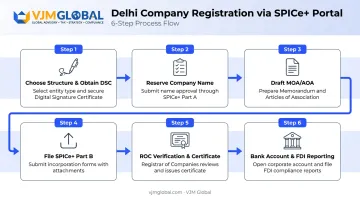
Step 6: Open an Indian Bank Account and Complete FDI Reporting
Once incorporated, open a current account and bring in your foreign investment. Then file Form FC-GPR with the RBI within 30 days of share allotment.
This deadline is strict and frequently missed by first-time foreign investors who assume incorporation is the finish line. Firms handling FEMA compliance for overseas clients, including VJM Global, typically track this filing window closely for exactly that reason.
Documents Required for UK Applicants
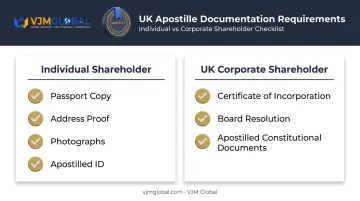
Standard documentation includes:
- Passport copies and proof of address for all directors/subscribers
- Photographs
- Registered office proof for the Delhi address (rent agreement, NOC, or utility bill)
The UK-Specific Requirement: Apostille, Not Embassy Attestation
India has participated in the Hague Apostille Convention since 2005, and the UK is also a Contracting Party. This means:
- Documents executed in the UK need an apostille from the FCDO, not embassy legalisation
- Some documents require prior certification by a UK solicitor or notary before the FCDO Legalisation Office will apostille them
- E-Apostilles are available for certain eligible documents, speeding up the process
If a UK Entity Is Itself a Shareholder
When a UK company (rather than an individual) holds shares in the Indian entity, the document list above isn't enough. Additional documents are needed:
- Certificate of incorporation of the UK parent company
- Board resolution authorising the Indian investment
- Apostilled equivalent of the UK entity's constitutional documents (MOA/AOA equivalent)
Translation and certification may also apply if any document isn't in English. This is uncommon but relevant for group structures with EU-linked entities. VJM Global's team routinely verifies UK-issued documents before filing, helping applicants avoid apostille rejections and delays at the Registrar of Companies.
Choosing the Right Business Structure for Your UK Company
Three structures dominate UK entry strategies into India:
| Structure | Best For | FDI Route | Key Consideration |
|---|---|---|---|
| Wholly Owned Subsidiary | Full-scale operations, hiring, revenue generation | 100% automatic route in most sectors | Broadest operating platform, fullest compliance stack |
| LLP | Professional services, consulting, lower compliance appetite | Automatic route only where 100% FDI is permitted with no performance conditions | Less attractive to Indian banks/investors for fundraising |
| Branch/Liaison Office | Representative presence, no direct commercial activity | Requires RBI approval via an AD Category-I bank | Cannot invoice or trade (Liaison Office especially) |
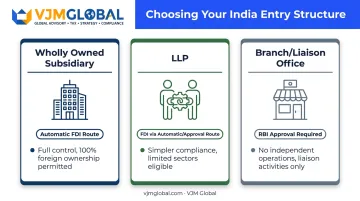
A Wholly Owned Subsidiary suits UK companies planning to hire staff, sign contracts, and generate revenue in India. It offers limited liability protection and, per DPIIT's FDI policy, qualifies for 100% FDI under the automatic route in most — though not all — sectors. Defence beyond automatic limits, multi-brand retail, and public-sector banking are examples where approval routes still apply.
UK professional services or consulting firms wanting simpler compliance often lean toward an LLP instead. The catch: FDI in LLPs only qualifies for the automatic route where 100% FDI is permitted with no performance-linked conditions attached, which is a narrower test than it first appears.
For UK companies wanting a representative presence without commercial activity, a Branch or Liaison Office is the fit. This route goes through RBI approval via an AD Category-I bank rather than standard ROC registration, and Liaison Offices specifically cannot generate local revenue.
Unwinding the wrong structure later is expensive and slow, so review sector-specific FDI caps and tax implications before filing. VJM Global's business setup team runs this assessment for UK clients before any paperwork goes in.
Common Mistakes and Post-Registration Compliance for UK-Owned Entities
Incorporation is the beginning, not the finish line. Here's where UK founders typically stumble:
Assuming registration equals "operational." FC-GPR filing, GST registration, and opening a fully compliant bank account are separate, mandatory steps that follow the Certificate of Incorporation — not automatic outcomes of it.
Underestimating the real cost. Government fees may be waived for smaller authorised capital, but that's not the full picture. Budget separately for:
- FCDO apostille fees (per document)
- Digital Signature Certificate costs
- Stamp duty on incorporation documents
- Professional or consultancy fees for filing and structuring
Believing remote management works long-term. A UK director can sign documents digitally without ever visiting India during incorporation. Annual ROC filings (AOC-4, MGT-7), statutory audits under Section 139, and ongoing FEMA reporting all need someone on the ground tracking deadlines.
Jumping straight to a full subsidiary. A full Private Limited subsidiary might be premature if you're still testing Indian market demand. A Liaison Office or an outsourced service arrangement can validate demand first, with a lighter compliance footprint until you're ready to commit.
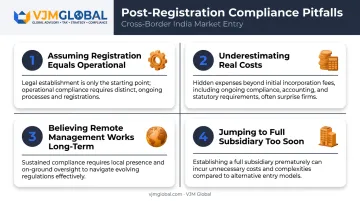
Local coordination is the common thread across all four mistakes. Most UK founders underestimate how much ongoing compliance work sits behind that first Certificate of Incorporation, and partnering with an India-based advisory team early tends to prevent the costliest missteps.
Frequently Asked Questions
How do I register a company in Delhi, India?
Choose your entity structure, obtain a Digital Signature Certificate, reserve a name via SPICe+ Part A, then file incorporation documents through SPICe+ Part B. The ROC issues your Certificate of Incorporation once verification is complete.
How much does it cost to register a company in Delhi?
Government incorporation fees are largely waived for standard authorised capital. Total costs run higher for UK-owned entities once you add apostille fees, DSC costs, stamp duty, and professional fees.
How can I check if a company is registered in India?
Use the free MCA Master Data search tool on mca.gov.in. Enter the CIN or company name to see current registration status.
Can a UK citizen or company own 100% of a company in India?
Yes, in most sectors, under the automatic FDI route for a Wholly Owned Subsidiary. Certain regulated sectors (such as defence beyond specific limits or multi-brand retail) still require government approval.
Do I need to travel to India to register my company?
No. The entire process can be completed remotely using apostilled UK documents and digital signatures, provided you arrange a registered office address in Delhi.
What is the best business structure for a UK company entering the Indian market?
It depends on scale. A Private Limited Subsidiary suits companies planning full operations and hiring, while an LLP or Liaison Office suits smaller, exploratory entries where you're still validating demand. VJM Global's business setup team can help assess which structure fits your specific entry plan.