Introduction
Canada and the US share the world's largest trading relationship, and for Canadian entrepreneurs, expanding south of the border is often the most natural next step. A shared language, similar business culture, and deep supply chain ties make the US an obvious target market.
Here's the good news: registering a US company from Canada is legally straightforward. You don't need US citizenship, residency, or even a Social Security number. The real challenges lie in picking the wrong entity, choosing the wrong state, or ignoring how the CRA will tax the income once it flows back home.
This guide walks through the exact steps, the entity and state decisions that matter most, and the tax and compliance traps Canadian founders need to avoid.
Key Takeaways
- Canadians can own 100% of a US LLC or C-Corp with no US address, visa, or SSN
- LLC vs. C-Corp affects tax treatment, investor appeal, and income flow to Canada
- Delaware and Wyoming remain the top formation states for non-resident founders
- An EIN is mandatory for banking, taxes, and hiring — and it's obtainable without an SSN
- Ongoing compliance support keeps founders in good standing without an in-house finance team
How to Register a US Company from Canada: Step-by-Step
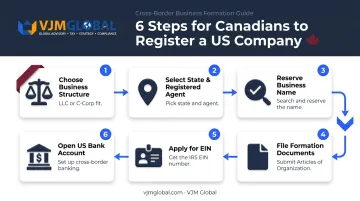
Step 1: Choose Your Business Structure
An LLC is a pass-through entity by default: profits flow to the owner's personal tax return, and paperwork stays light. A C-Corp is taxed separately at the federal corporate rate of 21%, then again when profits are distributed as dividends.
If you're planning to raise venture capital, most US investors will expect a C-Corp. If you're running a smaller operation, an LLC's simplicity is appealing.
One catch: the CRA doesn't always see an LLC the way the IRS does. Talk to a cross-border advisor before you file anything.
Step 2: Select a State and Appoint a Registered Agent
Every state requires a registered agent: someone with a physical street address in that state who can receive legal and government mail on your behalf. You cannot skip this step, and you cannot use a PO box.
Keep in mind: if you later hire employees, open a warehouse, or run a storefront in a different state, you'll likely need to foreign qualify there too, regardless of where you originally formed the company.
Step 3: Reserve and Verify Your Business Name
Before filing, check three things:
- State business name database – confirms the name isn't already taken in your formation state
- USPTO trademark database – checks for conflicting federally registered trademarks
- Domain and social handles – availability across the platforms you'll actually use
Your entity name also needs the right identifier. Delaware LLCs must include "LLC" or "Limited Liability Company," while corporations need "Inc.," "Corporation," or similar. Wyoming follows a nearly identical rule.
Step 4: File Your Formation Documents
LLCs file Articles of Organization; corporations file Articles of Incorporation, both submitted to the Secretary of State in your chosen state.
Delaware charges $110 for an LLC and $109 minimum for a corporation, while Wyoming charges a flat $100 fee for either entity type.
Both states accept fully online or uploaded filings, so you never need to set foot in the US to complete this step. Wyoming's online domestic filings process immediately; mailed submissions can take up to 15 business days.
Step 5: Apply for an EIN from the IRS
Your Employer Identification Number (EIN) is non-negotiable: you need it for banking, tax filings, and hiring. But there's a wrinkle for non-residents.
If you don't have a Social Security number, you can't use the IRS's online EIN application. Instead, you'll file Form SS-4 by fax or mail, entering "foreign" on line 7b where an SSN would normally go.
Processing typically runs about four business days by fax, if you include a return fax number, or up to four weeks by mail.
Step 6: Open a US Business Bank Account
Banks typically ask for:
- Formation certificate (Articles of Organization/Incorporation)
- EIN confirmation letter
- Passport or government-issued ID
- Proof of your Canadian address
Some traditional banks still require an in-person visit, but fintech platforms increasingly allow remote setup for non-resident founders. Whichever route you choose, keep business and personal finances strictly separate. Mixing them undermines your liability protection and makes tax season painful.
Choosing the Right Business Structure and State
Limited Liability Company (LLC)
LLCs work well for freelancers, consultants, and small e-commerce sellers who want flexible ownership without heavy paperwork.
There's a real risk for Canadian owners, though: Canada generally classifies a US LLC as a corporation, while the IRS treats it as a pass-through entity. That mismatch can leave you taxed twice on the same income if the structure isn't set up correctly from day one.
C-Corporation (C-Corp)
C-Corps are the default choice for startups chasing venture capital, since most US investors simply won't invest in an LLC.
There's a tax upside for cross-border founders too. Because a C-Corp is taxed as a separate entity at the corporate level, it can simplify tax alignment between the US and Canada compared to a pass-through structure.
Best States for Canadian Founders
| Factor | Delaware | Wyoming |
|---|---|---|
| Formation fee | $110 (LLC) / $109 min (Corp) | $100 (either entity) |
| Annual LLC fee | $300 flat, due June 1 | $60 minimum license tax |
| Investor familiarity | Very high | Lower |
| Privacy | Moderate | Strong |
Delaware wins on legal precedent and investor comfort: its Court of Chancery has decades of business case law, and VCs expect it. Wyoming appeals to bootstrapped founders who want low ongoing fees and stronger privacy protections.
One important caveat: if your business has a physical footprint (employees, inventory, a storefront) in another state, you'll need to register there directly no matter which state you formed in. A cross-border advisor can help weigh state choice against your actual business activity.
What You'll Need Before You Start
Before you file anything, gather these basics:
- A unique, available business name
- A registered agent with a physical address in your formation state
- A US mailing or registered address
- Government-issued ID, such as a passport or driver's license, for verification
No US Social Security number, physical presence, or visa is required at any point in this process.
If you're converting an existing Canadian company into a US entity (commonly called a "Delaware Flip"), plan for this early, ideally before bringing on outside shareholders. Restructuring after investors are already involved is far more complicated than doing it upfront.
Taxes, Banking, and Ongoing Compliance for Canadian Business Owners
Avoiding Double Taxation
Canadian owners of US LLCs can face double taxation if elections aren't handled correctly. The Canada-US Tax Treaty allows a foreign tax credit for tax paid on the same income in both countries, but the mismatch between how the IRS and CRA classify LLCs can complicate that credit.
Many advisors recommend a C-Corp structure, or routing ownership through a Canadian holding company, to better align tax treatment across both countries. Remember too: state-level taxes like franchise or gross receipts tax sit entirely outside the federal treaty.
US Filing Obligations for Foreign-Owned Businesses
Depending on your structure, expect these filings:
- Form 1120 – annual corporate income tax return for C-Corps, due even with zero income
- Form 5472 with a pro forma Form 1120 – required for foreign-owned single-member LLCs reporting transactions with the foreign owner
Missing Form 5472 is expensive. The IRS penalty starts at $25,000, with an additional $25,000 for every 30 days the failure continues past 90 days of notice. Registering a US entity does not change your personal Canadian tax residency. You'll continue filing your personal return in Canada as usual.
Staying Compliant After Registration
Once your entity exists, the work isn't done. You're now on the hook for:
- Annual reports and franchise or license taxes
- Registered agent renewals
- Federal and state tax filings
Miss these, and you risk penalties or administrative dissolution — Delaware, for example, charges a $200 penalty plus 1.5% monthly interest on late franchise tax payments.
This is where most solo founders get stuck. Managing bookkeeping, EIN-related filings, and multi-jurisdiction compliance alongside actually running the business is a lot to juggle.
VJM Global has supported more than 500 American business owners with accounting outsourcing, bookkeeping, and tax compliance support. This help lets Canadian founders stay on top of US obligations without hiring an in-house finance team, backed by cross-border tax planning services built around exactly this kind of ongoing, multi-jurisdiction complexity.

Common Mistakes to Avoid When Registering a US Company
- Cross-border tax planning gaps: Forming an LLC without a cross-border tax plan leads to unexpected double taxation down the road.
- State selection missteps: Picking a "no income tax" state without considering where the business actually operates.
- Delayed EIN applications: Skipping or delaying the EIN blocks banking and payment processing setup.
- Missed compliance deadlines: Missing annual report or franchise tax deadlines risks penalties or loss of good standing.
Success hinges on choosing the correct structure and state upfront, then staying disciplined about compliance deadlines. Bringing in experienced cross-border advisors early avoids most of these pitfalls entirely.
Frequently Asked Questions
Can I open a US LLC as a Canadian?
Yes. Canadians can fully own and manage a US LLC with no residency or SSN requirement. Just plan for CRA/IRS tax treatment differences before you form one.
Do I need to visit the US to register a company?
No. Filing, EIN applications, and even some bank account setups can all be completed remotely from Canada.
Can a Canadian be the sole owner of a US LLC or C-Corp?
Yes, US law permits sole ownership for both entity types. No US-resident co-owner or partner is required.
Will registering a US company affect my Canadian tax residency?
No. Forming a US entity doesn't change your personal tax residency, so you'll keep filing personal taxes in Canada while the US company files its own separate returns.
What's the cheapest state to register a US company from Canada?
Wyoming is often cited for its low filing and annual fees, but the "best" state really depends on where your business physically operates.
Do I need a US bank account before I can operate my US company?
Not legally, but practically, yes. You'll need one to pay vendors, receive USD payments, and keep clean financial records.