Introduction
Singapore companies entering the Indian market face a critical early question: does their Indian operation need to register for GST, and if so, when? The answer depends not just on revenue but on how the business is structured and how it supplies goods or services into India. A Singapore company that establishes a wholly owned subsidiary in Maharashtra will face different registration rules than one that sells SaaS subscriptions directly to Indian consumers without any local entity.
The stakes are real. In 2024, Singapore contributed ₹14.27 lakh crore (USD 171.92 billion) of cumulative FDI equity inflow to India, representing nearly 24% of India's total FDI. That scale means GST compliance is an operational priority for thousands of Singapore-linked entities already operating here.
This guide helps you understand exactly where your Singapore operation stands: the revenue thresholds that trigger registration, the scenarios that make it mandatory regardless of turnover, available exemptions, and when voluntary registration makes strategic sense.
Key Takeaways
- Mandatory GST registration kicks in once an Indian entity's aggregate annual turnover exceeds ₹40 lakh (goods) or ₹20 lakh (services) in standard states
- Interstate suppliers, e-commerce sellers, and non-resident taxable persons (NRTPs) — including Singapore companies supplying into India directly — must register from day one, regardless of turnover
- Singapore companies providing digital services (SaaS, cloud, online content) directly to unregistered Indian recipients face mandatory OIDAR registration with no turnover threshold
- Voluntary registration unlocks Input Tax Credit, GST-compliant invoicing that B2B clients can claim back, and eligibility for government tenders
GST Registration Thresholds: What Singapore Companies Must Know
Before anything else: India's GST thresholds are based on aggregate annual turnover, not profit — and that turnover includes all taxable, exempt, and export supplies made under the same PAN across India. This distinction matters because many Singapore founders initially assume their group revenue is relevant. It isn't. Only the Indian entity's turnover counts (more on that below).
Standard Thresholds
For most Indian states, the thresholds are:
- ₹40 lakh for businesses primarily supplying goods
- ₹20 lakh for businesses primarily supplying services
Important: These thresholds apply to the turnover of the Indian legal entity (such as a wholly owned subsidiary or branch office), not the global revenue of the Singapore parent company. Consolidated group turnover is not the basis for Indian GST registration.
Special Category State Thresholds
Lower thresholds apply to special category states, which include most of the Northeast states, Himachal Pradesh, Uttarakhand, and Jammu & Kashmir:
| State Category | Goods Threshold | Services Threshold |
|---|---|---|
| Standard states (most of India) | ₹40 lakh | ₹20 lakh |
| Special category states (most) | ₹20 lakh | ₹20 lakh |
| Manipur, Mizoram, Nagaland, Tripura | ₹10 lakh | ₹10 lakh |
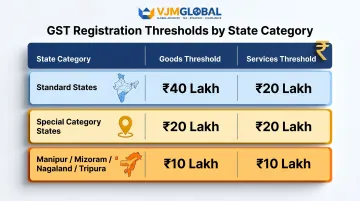
Singapore companies setting up in Tier-2 or northeastern markets — or routing services through entities registered in these states — can hit the registration trigger at half the standard threshold.
Registration Timeline
Once the threshold is crossed — even mid-year — registration is not deferred to year-end. The obligation to register arises within 30 days of the date on which turnover exceeds the limit. Missing this deadline triggers penalties under Section 122 of the CGST Act, with a minimum late fee of ₹10,000 — so tracking turnover monthly matters more than most Singapore operators expect.
When Is GST Registration Mandatory Regardless of Turnover?
Certain business activities trigger mandatory GST registration from the very first rupee, with no turnover threshold applicable. Several of these scenarios directly impact Singapore companies doing business in India.
Interstate Supply of Goods
Any business supplying goods from one Indian state to customers in another state must register for GST regardless of annual turnover. Singapore companies running a distribution or manufacturing setup in one Indian state while selling nationally fall squarely into this category.
E-commerce Sellers
Businesses selling through platforms like Amazon India or Flipkart must register for GST irrespective of their turnover. Singapore companies using Indian e-commerce channels to sell physical goods are not exempt from this rule.
Non-Resident Taxable Persons (NRTPs)
For Singapore companies with no permanent establishment or Indian subsidiary, this is the rule that most directly applies. Any Singapore business supplying taxable goods or services into India under those conditions is classified as a non-resident taxable person (NRTP) under the CGST Act.
NRTP registration requirements:
- Must register before commencing any taxable supply in India, regardless of transaction value
- Registration is temporary — valid for 90 days, extendable by another 90 days
- Requires an advance tax deposit equal to estimated GST liability
- Must appoint a local authorized representative
- Filed using Form GST REG-09, not the standard Form GST REG-01
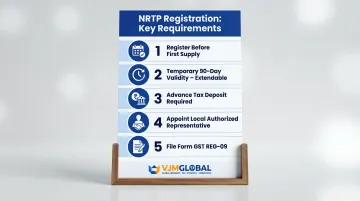
Take a Singapore electronics distributor exhibiting goods at an Indian trade fair — no fixed establishment in India, but still required to register as an NRTP at least 5 days before business commences. That means depositing estimated tax upfront and filing monthly returns in Form GSTR-5.
OIDAR (Online Information and Database Access and Retrieval) Services
Singapore companies providing digital services such as SaaS, cloud computing, online content platforms, or data services to non-registered Indian recipients must register for GST under the OIDAR provisions. Physical presence in India is irrelevant — the obligation follows the supply.
OIDAR registration specifics:
- Use Form GST REG-10 (Simplified Registration Scheme)
- Single registration with Principal Commissioner of Central Tax, Bengaluru West
- File monthly returns in Form GSTR-5A by the 20th of the succeeding month
- Must appoint a person in India for tax payment if no Indian representative exists
One important exception applies to B2B sales: when a Singapore SaaS company sells to registered Indian businesses, the Indian recipient pays IGST under the Reverse Charge Mechanism. The Singapore supplier does not need OIDAR registration for those specific supplies. OIDAR registration is mandatory only for supplies to unregistered individuals or government entities receiving services for non-business purposes.
Other Mandatory Categories
Other mandatory registration categories include:
- Input Service Distributors distributing input tax credit across branches
- Businesses liable under the Reverse Charge Mechanism (RCM) for specified supplies
- Agents making taxable supplies on behalf of a principal supplier
Who Is Exempt from GST Registration in India?
Section 23 of the CGST Act provides exemptions from GST registration. These primarily benefit small Indian businesses rather than foreign entities, but Singapore companies with an Indian subsidiary should understand the rules.
Businesses Below the Threshold
An Indian entity (such as a subsidiary of a Singapore company) with aggregate turnover below the applicable threshold is not required to register, provided it does not fall into any mandatory category.
Example: A small Indian subsidiary providing B2B consulting services with annual turnover of ₹18 lakh is below the ₹20 lakh services threshold and has no mandatory registration trigger — so registration is optional.
Businesses Dealing Exclusively in Exempt Goods and Services
Businesses whose entire supply consists of GST-exempt items are not required to register. Relevant exempt categories include:
- Unprocessed agricultural produce
- Healthcare services by clinical establishments and authorized practitioners
- Educational services by recognized institutions to students, faculty, and staff
- Agricultural services including cultivation and harvesting
Singapore companies whose Indian operations fall entirely within such sectors are similarly exempt.
Reverse Charge Mechanism (RCM) Relief
RCM is another exemption route worth knowing. Under RCM, the liability to pay GST shifts to the recipient (buyer) rather than the supplier. If a Singapore company or its Indian entity's only taxable supplies are fully covered under RCM — meaning the Indian buyer pays the GST — and turnover stays below threshold, registration may not be required.
Note: This is a narrow exemption with strict conditions. Consult a GST advisor before assuming it applies to your situation.
Important Caveat for Singapore Companies
Even if an Indian subsidiary qualifies for threshold-based exemption, a Singapore parent company supplying services directly into India (as an NRTP or OIDAR provider) does not benefit from the same exemption. GST law assesses the two entities separately.
Should Your Singapore Company Voluntarily Register for GST?
Voluntary GST registration is available to any business below the threshold under Section 25(3) of the CGST Act. For Singapore companies building a presence in India, choosing to register early often makes commercial and strategic sense.
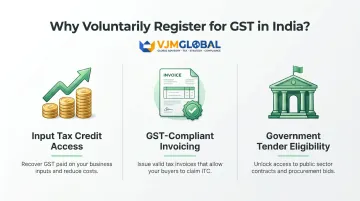
Three Main Advantages
1. Input Tax Credit (ITC) Access
Only registered persons can claim ITC under Section 16(1). ITC allows you to recover GST paid on business inputs (rent, software, professional services, equipment) which reduces effective costs. Unregistered entities absorb this tax as a permanent cost.
2. GST-Compliant Invoicing
Only registered persons may issue tax invoices under Section 31(1) and 31(2). GST-compliant tax invoices are essential for B2B transactions because they are the documentary basis for the buyer's ITC claim. A Singapore subsidiary serving Indian B2B clients without registration cannot issue proper tax invoices — which may disqualify those clients from claiming ITC on their purchases.
3. Government Tender Eligibility
Most government tenders and public sector contracts require a valid GSTIN as a basic eligibility criterion. Without one, your Indian entity is excluded from this procurement channel regardless of its capabilities.
Trade-offs
Once registered voluntarily, the business is subject to the same compliance obligations as a mandatory registrant:
- Periodic return filings (GSTR-1, GSTR-3B)
- Invoice format requirements
- Digital record-keeping
- Monthly or quarterly tax payment
For Singapore companies with limited initial Indian operations, these obligations may add administrative overhead and should be weighed against the benefits.
Whether the benefits outweigh these obligations depends on your transaction volume, client mix, and growth timeline. VJM Global helps Singapore and foreign companies work through this decision, and handles everything from GST registration through return filings and compliance monitoring — reducing the risk of penalties from late or incorrect submissions.
GST Compliance Schemes and the Registration Process for Foreign Entities
Compliance Schemes to Reduce the Burden
Composition Scheme
Available to Indian entities with aggregate turnover up to ₹1.5 crore (₹75 lakh in special category states), the Composition Scheme allows fixed low tax rates:
- 1% for traders and manufacturers
- 5% for restaurants
- 6% for service providers
For eligible businesses, the scheme simplifies operations considerably — quarterly filing replaces monthly returns, detailed ITC recordkeeping is not required, and overall compliance effort drops significantly.
One critical exclusion: The scheme is not available to non-resident taxable persons or interstate suppliers (Section 10(2)(c) and 10(2)(f)). Most Singapore entities operating directly in India cannot access it, but Indian subsidiaries that meet the turnover criteria may qualify.
QRMP (Quarterly Return Monthly Payment) Scheme
Available to registered taxpayers with turnover up to ₹5 crore, QRMP allows:
- Quarterly GSTR-1 filing while paying tax monthly
- Reduces the annual filing burden from 12 GSTR-3Bs to 4
- Optional Invoice Furnishing Facility (IFF) to upload B2B invoices in the first two months of each quarter
For Singapore companies whose Indian entities generate consistent, foreseeable revenue, QRMP reduces administrative overhead without sacrificing compliance accuracy.
Once you've identified the right compliance scheme, the next step is registration. The process differs depending on whether you're registering an Indian subsidiary or operating as a non-resident taxable person (NRTP).
How Singapore Companies Register for GST in India
Standard Registration (Indian Subsidiary)
Steps:
- Obtain a PAN for the Indian company
- Access the GST portal (www.gst.gov.in)
- Submit Form GST REG-01 with business details
Documents required:
- PAN
- Aadhaar of authorized signatory
- Proof of registered business address (rent agreement, electricity bill, municipal khata)
- Bank account details
- Certificate of incorporation
Timeline: CBIC revised instructions (April 2025) mandate 7 working days for standard GST registration applications and 30 days for risk-flagged cases requiring physical verification.
Non-Resident Taxable Person Registration
Steps:
- File Form GST REG-09 at least 5 days before commencing business
- Appoint an authorized representative who is an Indian resident
- Make an advance deposit of estimated GST liability before registration is activated
- Use passport or home-country tax identification number (PAN not required)
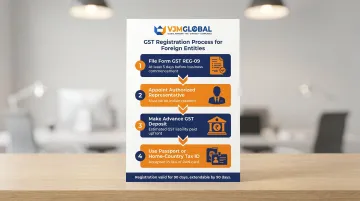
Timeline: Registration is valid for 90 days, extendable by another 90 days if you can demonstrate a continued business need in India.
Returns: File monthly GSTR-5 returns.
NRTP registration is more involved than standard registration — a missed step or incorrect advance deposit calculation can delay your market entry. VJM Global assists Singapore companies through the full NRTP process, handling documentation requirements and deposit calculations to keep things on track.
Frequently Asked Questions
Is GST mandatory for small business in India?
GST is mandatory for small businesses once their annual aggregate turnover exceeds ₹40 lakh (goods) or ₹20 lakh (services) in standard states. Registration is also mandatory earlier if they trigger specific conditions such as interstate supply, e-commerce sales, or non-resident taxable person classification.
Do I need to register for GST if my turnover is below 20 lakhs in India?
Businesses below ₹20 lakh (services) or ₹40 lakh (goods) are generally exempt from mandatory registration. However, registration is still required if you engage in interstate supply, sell via e-commerce platforms, or are classified as a non-resident taxable person.
Who is not required to file GST?
The following are generally not required to register:
- Businesses below the turnover threshold supplying only within their home state
- Suppliers of GST-exempt goods or services (such as unprocessed agricultural produce or healthcare)
- Suppliers whose transactions are fully covered under the Reverse Charge Mechanism
How do you calculate GST for a small business?
GST liability equals tax collected on sales (output tax) minus GST paid on purchases (Input Tax Credit). The applicable rate depends on the HSN/SAC classification of your goods or services.
Does a Singapore company need a PAN to register for GST in India?
An Indian subsidiary of a Singapore company needs a PAN, which is a prerequisite for GST registration. A Singapore company registering as a non-resident taxable person uses Form GST REG-09 and may use a passport in lieu of PAN, though an Indian authorized representative is required.
What is the difference between mandatory and voluntary GST registration for a Singapore company operating in India?
Mandatory registration is legally required once you cross turnover thresholds or fall into categories such as NRTP. Voluntary registration is a strategic choice for businesses below the threshold — typically taken to claim ITC, issue compliant invoices, and access B2B or government clients.
Need help navigating GST registration for your Indian operations? VJM Global specializes in cross-border tax compliance and business setup services for Singapore companies entering India. With over 30 years of experience and a track record serving 500+ American, 250+ UK, and 250+ Australian businesses, our team provides full support from registration through ongoing compliance. Contact us at [email protected] or call +91 9213397070 to discuss your GST registration requirements.