Introduction
India and Singapore share one of Asia's strongest bilateral trade relationships, with bilateral trade reaching USD 34.26 billion in FY 2024-25. Singapore stands as India's largest trading partner within ASEAN and the largest source of FDI into India, with cumulative inflows of USD 186.82 billion from April 2000 to September 2025.
Despite this robust commercial relationship, Singapore companies often hit a critical roadblock when entering India's import-export market. Many assume obtaining an Import Export Code (IEC) works the same way it does for Indian businesses. In reality, there's a mandatory pre-step that reshapes the entire cost picture: establishing a legal entity in India first.
This article breaks down the full licensing cost structure for Singapore companies — entity setup fees, IEC registration costs, the key variables that drive costs up or down, and what to budget for beyond the registration fee itself.
Key Takeaways
Quick summary for Singapore companies entering India's import-export market:
- Total realistic budget ranges from ₹50,000 to ₹2,00,000+ depending on entity type, product category, and professional fees
- IEC government fee is only ₹500 — but that's just 5–10% of your total setup cost
- You must register a legal entity in India before applying for IEC — this is the single largest cost component
- Professional guidance ensures FEMA-compliant structuring and avoids costly restructuring later
How Much Does an Import-Export License Cost in India for Singapore Companies?
Unlike Indian resident businesses, Singapore companies cannot directly apply for an IEC. The total licensing cost has two distinct layers: entity setup in India, then IEC registration on top of it. Missing either layer is the most common reason Singapore companies underestimate their India market-entry budget.
Here's what typically goes wrong when costs are misunderstood:
Common budgeting errors:
- Accounting for only the ₹500 IEC fee and missing entity setup costs entirely
- Choosing the wrong entity type (such as a Liaison Office, which legally cannot engage in commercial trade) and incurring costly restructuring later
- Overlooking sector-specific licenses required in addition to IEC for regulated product categories
Your actual cost depends on which of three situations applies to you.
Tier 1 — IEC-Only Cost (For entities already registered in India)
What's included: ₹500 DGFT government fee + optional professional assistance fee (₹1,000–₹3,500) for application filing and review.
Best for: Singapore companies with an existing Indian subsidiary, branch office, or LLP that now want to activate import-export operations.
Total cost: ₹1,500–₹4,000
If your Singapore company already operates an Indian entity, your licensing cost is minimal. The IEC government fee is ₹500, and professional assistance typically adds ₹1,000–₹3,500 depending on your service provider. Approval takes 1–3 working days for clean applications.
Tier 2 — Entity Registration + IEC (Most Common Scenario)
What's included: MCA company registration fees + professional incorporation fees + PAN/TAN for company + GST registration + IEC registration.
Best for: Companies setting up a new Indian subsidiary (Private Limited Company) as their primary vehicle for India import-export trade.
Total cost: ₹50,000–₹1,00,000+
This is the most common scenario for Singapore companies entering the Indian import-export market. Here's the component breakdown:
Entity registration costs:
- SPICe+ filing fee (MCA): ₹0–₹2,000 (based on authorized capital)
- Name reservation: ₹1,000
- Post-incorporation filings (INC-20A, ADT-1): ₹800
- Professional incorporation fees: ₹15,000–₹50,000+
- State stamp duty: ₹360–₹10,000+ (varies significantly by state)
Source: Ministry of Corporate Affairs fee structure
Additional registrations:
- PAN/TAN: ₹0 (auto-allotted via SPICe+)
- GST registration: ₹0 government fee; professional assistance typically ₹1,500–₹3,000
- IEC registration: ₹500 government fee; professional assistance ₹1,000–₹3,500
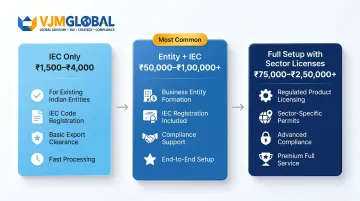
Tier 3 — Full Setup Including Sector-Specific Licenses
What's included: All Tier 2 costs plus product-specific compliance licenses (FSSAI for food products, BIS certification for electronics, APEDA for agri-exports, SCOMET license for restricted/dual-use goods).
Best for: Regulated product categories — food, pharmaceuticals, electronics, or chemicals — where sector licenses are mandatory regardless of entity type.
Total cost: ₹75,000–₹2,50,000+
Sector licenses stack on top of Tier 2 costs and vary widely by product:
Common sector license fees:
- FSSAI (Food products): ₹7,500/year for Central License (required for all importers)
- BIS Certification (Electronics/consumer goods): ₹1,000 application fee + ₹5,000–₹1,00,000/year marking fee + product testing costs
- APEDA Registration (Agricultural exports): ₹5,900 (valid for 5 years)
- SCOMET Export License (Restricted/dual-use goods): ₹1,000+ per application
Sources: FSSAI fee structure, BIS certification fees, APEDA registration
Key Factors That Affect the Total Licensing Cost for Singapore Companies
The gap between a minimal and substantial licensing spend comes down to a handful of technical, legal, and operational variables. Understanding these factors helps you budget accurately and avoid costly surprises.
Choice of Legal Entity Type
The entity structure you choose directly determines both upfront registration costs and ongoing compliance burden.
Private Limited Company (Wholly Owned Subsidiary):
- Higher incorporation costs (₹50,000–₹1,00,000+ including professional fees)
- Full operational flexibility for commercial trade
- Can hold IEC and conduct unlimited import-export activities
- Subject to comprehensive annual compliance requirements
Branch Office:
- Requires RBI approval via Authorized Dealer Category-I Bank
- Can engage directly in import-export operations
- Permitted activities include export/import of goods, professional services, and acting as buying/selling agent
- Parent company must have profitable track record for five years and net worth of at least USD 100,000
Liaison Office:
- Cannot conduct commercial trade or hold an IEC
- Limited to liaison and communication activities only
- Prohibited from maintaining inventory or engaging in import-export
- Choosing this structure by mistake requires costly restructuring to begin trade operations
Limited Liability Partnership (LLP):
- Moderate incorporation costs
- Can hold IEC subject to FDI policy restrictions
- Lower compliance burden than Private Limited Company
- Suitable for professional services firms entering trade
Product Category and Regulatory Classification
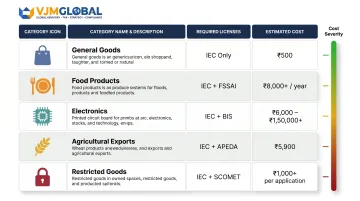
The ₹500 IEC fee covers general trade authorization, but products under restricted, SCOMET, or sector-regulated categories require additional licenses.
General goods: IEC only (₹500)
Food products: IEC + FSSAI Central License (₹7,500/year mandatory for all importers regardless of turnover)
Electronics/consumer goods: IEC + BIS certification (₹6,000–₹1,50,000+ depending on product and testing requirements)
Agricultural exports: IEC + APEDA registration (₹5,900 for 5 years)
Restricted/dual-use goods: IEC + SCOMET export license (evaluated by Inter-Ministerial Working Group; additional fees and longer processing times)
A Singapore company trading in general consumer goods faces licensing costs 5-10x lower than one dealing in pharmaceuticals or defense-adjacent items.
Whether Professional or Consultant Assistance Is Used
Two approaches exist, each with distinct cost and risk profiles.
Self-filing approach:
- Lowest out-of-pocket cost (only government fees totaling ₹1,500–₹5,000)
- Requires accurate knowledge of Indian company law, FEMA regulations on foreign investment, correct entity classification, and document formatting
- Errors cause rejection, delay trade timelines, or require costly restructuring
- Average timeline: 4-8 weeks for complete setup
Professional assistance:
- Adds ₹15,000–₹75,000+ in advisory fees for end-to-end setup
- Significantly reduces error risk and ensures FEMA-compliant structuring from day one
- Compresses setup timeline to 2-4 weeks
- Includes entity registration, PAN, GST, IEC, and initial compliance framework
For Singapore companies unfamiliar with Indian regulatory procedures, professional assistance is usually the more cost-effective path over the long term — the advisory fee is typically recovered through avoided errors, faster setup, and correct FEMA structuring from day one.
State of Incorporation and Office Location
State-specific stamp duties and registration fees vary dramatically across India:
Stamp duty examples (for ₹1 lakh authorized capital):
- Delhi: ₹360
- Maharashtra: ₹1,300
- Karnataka: ₹10,020
Source: State-wise incorporation costs
The choice of city also affects ancillary costs — metro cities typically charge ₹10,000–₹30,000/year for virtual office address services.
Ongoing Annual Compliance Costs
While IEC itself has no annual renewal fee, it requires a free annual update on the DGFT portal between April 1 and June 30. Failure to update by June 30 triggers automatic deactivation of the IEC.
However, the Indian entity must maintain comprehensive annual compliance:
Annual compliance cost breakdown (foreign-owned Private Limited Company):
- ROC annual filings (MGT-7 + AOC-4): ₹5,000–₹15,000
- Statutory audit: ₹10,000–₹30,000 (for turnover up to ₹1 crore)
- Income tax return (ITR-6): ₹5,000–₹15,000
- GST compliance (monthly filings): ₹12,000–₹36,000/year
- Transfer pricing documentation (Form 3CEB + documentation): ₹50,000–₹1,00,000
- DIR-3 KYC (per director): ₹500–₹1,500
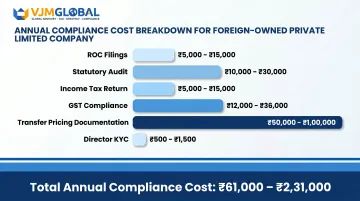
Total estimated annual compliance cost: ₹61,000–₹2,31,000
Source: Annual compliance costs for startups in India
Full Cost Breakdown: What Singapore Companies Actually Pay
The total cost of establishing import-export operations in India goes well beyond the ₹500 IEC application fee. Here's a realistic component-by-component breakdown:
India Entity Registration (One-Time)
Government fees: ₹1,800–₹12,000+ depending on state and authorized capital
Professional/CA fees: ₹15,000–₹50,000+ depending on service provider and complexity
Key components:
- SPICe+ filing and name reservation
- Digital signature certificates (DSC) for directors
- Memorandum and Articles of Association drafting
- State stamp duty (varies significantly by state)
- Certificate of incorporation and commencement of business
PAN, GST, and Bank Account Setup (One-Time)
PAN for company: ₹0 (auto-allotted via SPICe+ integration)
GST registration: ₹0 government fee; professional assistance typically ₹1,500–₹3,000
Bank account: Documentation and initial deposit costs vary by bank; foreign-owned entities may face additional KYC requirements
Total estimated cost: ₹2,000–₹5,000
IEC Registration (One-Time)
Once your entity and tax registrations are in place, the IEC itself is the simplest step in the process.
DGFT government fee: ₹500
Professional assistance: ₹1,000–₹3,500 depending on service provider
Processing time: 1-3 working days for clean applications (may extend to 2 weeks if bank verification takes longer)
Total cost: ₹1,500–₹4,000
Sector-Specific License Fees (One-Time or Periodic)
Cost varies significantly by product category:
FSSAI (Food products):
- Central License (mandatory for importers): ₹7,500/year
- Validity: Up to 5 years
- Late renewal penalty: ₹100/day
BIS Certification (Electronics/consumer goods):
- Application fee: ₹1,000
- License fee: ₹1,000–₹50,000 (scheme-dependent)
- Marking fee: ₹5,000–₹1,00,000+/year (product-specific)
- Testing fee: ₹20,000–₹1,50,000
- 18% GST applicable on all fees
APEDA (Agricultural exports):
- Registration: ₹5,900 (valid for 5 years)
- Renewal: ₹5,900
- Modifications: Free
SCOMET (Restricted/dual-use goods):
- ₹1,000+ per application
- Evaluated by Inter-Ministerial Working Group
- Processing time varies significantly
Annual Compliance and IEC Upkeep (Recurring)
IEC annual update: Free (mandatory between April 1–June 30 on DGFT portal)
Entity annual compliance (foreign-owned Private Limited Company):
- Company filings with MCA: ₹5,000–₹15,000
- GST returns (monthly/quarterly): ₹12,000–₹36,000
- Income tax filings: ₹5,000–₹15,000
- Statutory audit: ₹10,000–₹30,000
- Transfer pricing documentation (if applicable): ₹50,000–₹1,00,000
- Director KYC: ₹500–₹1,500 per director
Total realistic annual cost: ₹61,000–₹2,31,000
Taken together, Singapore companies should budget roughly ₹85,000–₹3,00,000+ in year one (entity setup plus first-year compliance), with annual recurring costs of ₹61,000–₹2,31,000 thereafter. Sector-specific licenses like BIS or FSSAI sit on top of these figures and depend entirely on your product category.
DIY vs. Using a Professional Consultant — What's the Difference for Singapore Companies?
Singapore companies often debate whether to self-file IEC and handle entity registration independently versus engaging an India-specialist advisory firm. The cost difference is real, but so is the risk differential.
Self-filing approach:
Lower out-of-pocket cost (only DGFT's ₹500 fee + MCA government fees totaling approximately ₹2,000–₹5,000), but requires:
- Accurate knowledge of Indian company law and FEMA regulations on foreign investment
- Correct entity classification under FDI policy
- Precise document formatting and attestation requirements
- Understanding of DGFT portal procedures and common rejection reasons
- Ability to navigate state-specific stamp duty and registration procedures
Errors cause rejection, delay trade timelines by 4–8 weeks, or require costly restructuring later. Common mistakes include choosing the wrong entity type (Liaison Office cannot hold IEC), incomplete FEMA compliance documentation, and incorrect valuation certificates for equity inflows.
Professional assistance:
Advisory fees for end-to-end setup (entity registration, PAN, GST, IEC, and initial compliance framework) typically run ₹15,000–₹75,000+, but that covers:
- FEMA-compliant structuring from the outset
- Compressed setup timeline (2-4 weeks vs. 6-10 weeks)
- Elimination of common error patterns that cause rejection
- Proper RBI reporting framework (FC-GPR filing for equity inflows)
- Initial compliance structure including transfer pricing documentation readiness
- Ongoing advisory for annual compliance requirements
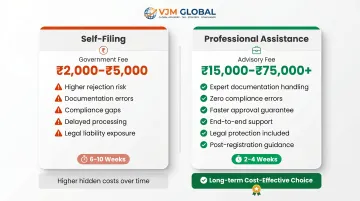
For Singapore companies unfamiliar with Indian regulatory procedures, professional support is the more cost-effective path over the long term — errors caught at the setup stage cost far less than restructuring after the fact. VJM Global works with foreign companies on exactly this process, handling FEMA compliance, RBI reporting, and cross-border registration from a single point of contact.
What Singapore Companies Often Miss When Budgeting for Import-Export Licensing
Assuming IEC is the only license needed
Many Singapore businesses research the ₹500 IEC fee and budget accordingly, without realizing that IEC is a base registration, not a sector clearance. Regulated product categories require additional licenses that can cost far more and take weeks longer to obtain.
Example: A food import business budgets ₹5,000 for "licensing," then discovers they need FSSAI Central License (₹7,500/year mandatory for all importers) plus potentially BIS certification for packaged products. Total actual licensing cost: ₹15,000–₹25,000+.
Forgetting that a legal entity in India must come first
IEC is issued only to entities with a valid Indian PAN. Singapore companies without an Indian subsidiary, branch, or LLP registered with MCA cannot apply for IEC.
A common mistake is registering a Liaison Office — an entity type that legally cannot conduct commercial trade or hold an IEC. Restructuring to the correct entity later adds both cost and delay:
- Conversion to Branch Office or Private Limited Company: ₹30,000–₹75,000+
- Typical market entry delay from restructuring: 2–3 months
- MCA re-registration and fresh IEC application required from scratch
Ignoring FEMA compliance and transfer pricing obligations
Foreign-owned Indian companies face additional regulatory layers that are rarely factored into initial licensing budgets:
FEMA reporting requirements:
- FC-GPR filing within 30 days of share allotment to foreign investors
- FLA annual return filed with RBI by July 15 each year
- Valuation certificate from registered valuer required for equity transactions
Transfer pricing obligations:
When the Singapore parent transacts with the Indian subsidiary (such as for management services, royalties, or inter-company sales), transfer pricing documentation becomes mandatory:
- Local File and Master File preparation
- Form 3CEB from Chartered Accountant
- Arm's length benchmarking studies
- Penalties for non-compliance: 2% of transaction value or ₹1,00,000 flat penalty
Estimated cost: ₹50,000–₹1,00,000 annually for transfer pricing documentation and compliance.
Conclusion
For Singapore companies, the true cost of import-export licensing in India is not a single ₹500 fee but a layered investment that includes entity setup (₹50,000–₹1,00,000+), IEC registration (₹1,500–₹4,000), sector-specific licenses (₹0–₹1,50,000+ depending on product category), and ongoing compliance (₹61,000–₹2,31,000 annually).
Understanding each layer leads to accurate budgeting and smoother market entry—the right cost is one that reflects your product category, trade volume, and long-term India strategy.
Working with an experienced India entry advisor like VJM Global helps Singapore companies structure their licensing and compliance framework correctly from day one, avoiding costly corrections later.
With 30+ years of experience serving foreign companies entering India, VJM Global supports the full setup lifecycle, including:
- Entity structuring and registration
- FEMA compliance and RBI filings
- Annual regulatory submissions
- Transfer pricing documentation
This means your India import-export operations start on the right footing—with no gaps in your compliance structure.
Frequently Asked Questions
What is the cost of an import-export license (IEC) in India?
The DGFT government fee for IEC registration is ₹500, with optional professional service fees adding ₹1,000–₹3,500. For Singapore companies, this is only one component of a broader entity-setup cost that typically ranges from ₹50,000–₹2+ lakhs depending on entity type and product category.
How much does it cost to start an import-export business in India?
The realistic total investment for a Singapore company — covering entity registration, IEC, and ancillary licenses — ranges from approximately ₹50,000 to ₹2+ lakhs. Cost drivers include entity type (Private Limited Company vs. Branch Office), product category, and use of professional services.
How do I get an import-export license in India?
Singapore companies must first register a legal entity in India, then apply for IEC through the DGFT portal (dgft.gov.in) with PAN, business address proof, and bank details. Approval takes 1–3 working days for a clean application; bank verification can extend this to 2 weeks.
Can a Singapore company apply for an IEC directly without registering in India?
No. IEC requires an Indian PAN and a registered Indian business entity. Singapore companies cannot use their Singapore registration to apply directly—they must first incorporate in India through an appropriate entry route under FEMA regulations (typically a Private Limited Company or Branch Office).
What is the difference between an IEC and an export license in India?
IEC is the base registration required for all import-export activity in India; an export license is a separate permit needed only for restricted or SCOMET-category goods. Most standard products require only IEC — dual-use or regulated goods require additional approvals from the relevant government authority.
Does a Singapore company need GST registration to get an IEC in India?
GST registration is not a strict prerequisite for IEC issuance, but it is practically necessary for conducting commercial trade operations in India and for claiming export-related GST refunds. Most Singapore companies register for GST simultaneously with or immediately after IEC to support uninterrupted trade activity.