Introduction
India-Singapore bilateral trade reached USD 34.3 billion in FY2024-25, built on two decades of policy alignment and complementary economic strengths. High-value flows span electronics, pharmaceuticals, textiles, organic chemicals, and engineering goods — sectors where both economies have distinct and compatible advantages.
That scale creates a concrete opportunity for Singapore-based entrepreneurs. Three structural factors make this corridor particularly attractive:
- Market size: India's 1.4 billion consumers and growing middle class offer sustained import demand across multiple categories
- Preferential access: The India-Singapore CECA eliminates or reduces duties on 93% of India's imports from Singapore
- Established FDI pathway: Singapore has been India's largest FDI source for seven consecutive years, contributing roughly USD 174.9 billion cumulatively — meaning regulatory precedent and banking channels already exist
This guide provides a practical, step-by-step roadmap for Singapore residents—whether NRIs, OCIs, or Singapore citizens—to register and operate an import-export business involving India, covering both Indian compliance obligations and cross-border structuring decisions.
Key Takeaways
- An import-export business between Singapore and India means trading goods in both directions — exporting Indian products or importing from Singapore for local distribution
- India-Singapore CECA cuts tariffs on 93% of traded goods — a real cost advantage, provided you hold a valid Certificate of Origin
- Required registrations: Indian legal entity, IEC (Import Export Code), GST, and a current account with an Authorised Dealer bank
- Typical timelines range from 4–10 weeks from registration to first shipment, depending on entity type and product licensing
- Working with an India business setup advisor cuts compliance errors and gets you to first shipment faster
Why the India-Singapore Trade Corridor Is Worth Exploring
India-Singapore trade hit USD 34.3 billion in FY2024-25, and Singapore's cumulative FDI into India stands at USD 174.9 billion — nearly 24% of India's total. The corridor works because the two economies fit together: Singapore is a re-export and financial gateway into Southeast Asia, while India offers low-cost manufacturing and one of the world's largest domestic markets.
The India-Singapore CECA, in force since August 2005, provides direct cost advantages:
- 93% of India's imports from Singapore fall under reduced or zero-tariff lines
- Singapore has bound all tariff lines at zero customs duty for India
- Exporters who obtain a Certificate of Origin benefit from lower landed costs under the Margin of Preference formula
These tariff advantages translate into real savings — and the corridor appeals to a specific set of businesses and individuals:
- NRIs and OCIs in Singapore with existing supplier networks in India
- Singapore entrepreneurs seeking low-cost sourcing in textiles, pharmaceuticals, or engineering goods
- Indian businesses using Singapore as a re-export base to Southeast Asia
What to Know Before You Start
Running an import-export business between India and Singapore means managing two regulatory environments simultaneously—Indian company law, FEMA (Foreign Exchange Management Act), and RBI compliance on one side; Singapore Customs and MAS (Monetary Authority of Singapore) on the other. Most early-stage founders underestimate this complexity—and that's where timelines slip and costs spike.
A few things worth knowing before you commit:
Timelines are longer than most expect:
- India registration and compliance: 4–8 weeks
- Sourcing, logistics setup, first shipment: additional 2–4 weeks
- Budget for 10–12 weeks before your first shipment clears
Your product category determines your compliance load:
- High-compliance categories (pharmaceuticals, food, electronics, chemicals) require approvals from FSSAI, BIS, or the Drug Controller before the first shipment can be filed
- Lower-barrier categories (textiles, handicrafts, spices) carry fewer pre-shipment requirements and reduce early-stage risk
Validate product-specific licensing requirements before committing capital or signing supplier agreements.
Why Start an Import-Export Business in India from Singapore?
The India-Singapore trade corridor offers concrete structural advantages that go well beyond the obvious market size argument:
India's export infrastructure is maturing:
- India's exports grew 7.1% in 2024, outpacing the global rate of 2.5%
- Total exports (merchandise + services) reached USD 346.1 billion in April–August 2025 (+5.19% YoY)
- Export incentive programs—RoDTEP, EPCG, Duty Drawback—remain fully operational under Foreign Trade Policy 2023
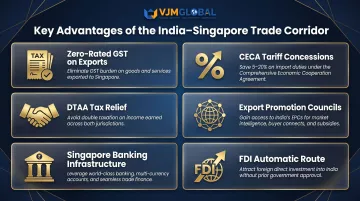
Concrete advantages for Singapore-India traders:
- Zero-rated GST on exports from India, enabling input tax credit refunds
- CECA tariff concessions on eligible goods, reducing landed costs by 5–20% depending on product category
- Double Taxation Avoidance Agreement (DTAA) between India and Singapore reduces cross-border tax burden
- Access to Export Promotion Councils (EPCs) for market intelligence, buyer connections, and trade fairs
- Singapore's robust banking infrastructure simplifies Letters of Credit, wire transfers, and foreign currency transactions
Traders who establish this corridor early also benefit from compounding advantages: supplier relationships, documentation systems, and buyer networks built over time are hard for late entrants to replicate—and they directly strengthen business valuation.
How to Start an Import-Export Business in India from Singapore – Step by Step
The sequence below reflects the actual execution path—skipping or rushing early steps creates compounding problems later.
Step 1 – Choose Your Trade Direction and Product Category
Start by deciding whether you're exporting Indian goods, importing into India, or running both directions simultaneously.
Your trade model options:
- Exporting Indian goods (textiles, spices, pharmaceuticals, engineering products) to Singapore and beyond
- Importing goods into India (electronics, machinery, chemicals) from Singapore or third countries
- Hybrid model involving both directions
Confirm buyer demand (for exports) or supplier capacity (for imports) before committing to a product category. Research product-specific licensing early—categories like food (FSSAI), electronics (BIS), and pharmaceuticals (Drug License) require approvals that take weeks to months.
High-compliance product categories at a glance:
| Product Type | Required Approval | Issuing Body |
|---|---|---|
| Food/Agri Products | FSSAI Central License (₹7,500/year) | Food Safety and Standards Authority of India |
| Electronics | BIS Certification (per model) | Bureau of Indian Standards |
| Pharmaceuticals | Drug License | Drug Controller General of India |
| Certain Natural Materials | WCCB Permit | Wildlife Crime Control Bureau |
FSSAI Central License is mandatory for all food importers/exporters regardless of turnover—often missed during early planning.
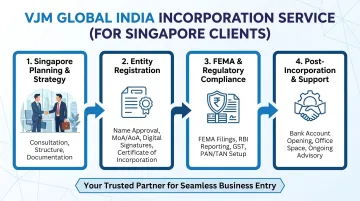
Step 2 – Set Up Your Legal Entity in India
Once your product category is confirmed, the next step is establishing a legal presence in India—without it, you cannot sign contracts, open trade accounts, or access export incentives.
The recommended structure is a Private Limited Company (wholly owned subsidiary). Singapore-based individuals or companies can incorporate one under the FDI automatic route for trading businesses. This route permits 100% FDI without prior government approval.
Why this works for trading businesses:
- Full ownership and legal standing in India
- Access to export incentives (RoDTEP, EPCG, Duty Drawback)
- Permanent establishment for contracts, licenses, and banking
Two structures to avoid:
- Liaison Office: Cannot conduct commercial activity—only liaison functions
- Branch Office: More restrictive and less tax-efficient for trading
Incorporation requirements:
- Director Identification Number (DIN)
- Digital Signature Certificate (DSC)
- Memorandum and Articles of Association (MoA/AoA)
- Registered office address in India
- Filing with Ministry of Corporate Affairs (MCA)
VJM Global handles end-to-end incorporation for Singapore-based clients—DIN/DSC procurement, MoA/AoA drafting, RoC filing, and post-incorporation compliance.
FEMA compliance for FDI from Singapore:
- All FDI must come through the banking channel via an Authorised Dealer (AD) bank
- File Form FC-GPR with RBI within 30 days of share allotment via the FIRMS portal
- Maintain documentation of remittances from Singapore (FIRC, valuation certificate, board resolution)
Step 3 – Register for GST and Obtain Your IEC
With your entity incorporated, three registrations unlock your ability to trade legally and claim available incentives.
Import Export Code (IEC):
- 10-digit code issued by DGFT, mandatory for all cross-border trade
- Application fee: ₹500 (lifetime validity, PAN-based); applied at dgft.gov.in
- No turnover threshold exemption—every importer and exporter must have one
- Requires annual online update by June 30 each year
GST registration:
- Mandatory for tax compliance
- Exports are zero-rated supplies under Section 16 of the IGST Act, allowing input tax credit refunds
- Imports attract IGST (typically 18%) on top of Basic Customs Duty and Social Welfare Surcharge
- Exporters can file a Letter of Undertaking (LUT) to ship without paying IGST upfront, then claim ITC refunds
AD Code registration:
- 14-digit code linking your bank account to the customs system (ICEGATE)
- Required for export proceeds, GST refunds, Duty Drawback, and RoDTEP scrip credits
- Registered at the customs port via ICEGATE
VJM Global manages IEC, GST, and AD Code registration for Singapore-based clients, ensuring all codes are active before your first shipment.
Step 4 – Open Banking Infrastructure in Both Countries
In India:
- Open a current account with an Authorised Dealer (AD) bank (ICICI, HDFC, Axis, SBI)
- Ensure the branch is not flagged as NFEI (No Foreign Exchange Involved)
- This account handles export proceeds, import payments, GST refunds, and RoDTEP credits
In Singapore:
- Maintain a corporate account capable of wire transfers, Letters of Credit (LC), and foreign currency transactions
- LCs and advance payment terms protect both parties in early-stage relationships
Use LCs for first-time supplier transactions to reduce credit risk.
Step 5 – Build Supplier and Buyer Relationships
For exports from India, register with the relevant Export Promotion Council:
- FIEO — general merchandise
- APEDA — agri-products
- EEPC — engineering goods
Also obtain an RCMC (Registration Cum Membership Certificate)—mandatory for claiming RoDTEP and other export incentives. RCMCs also unlock access to buyer databases, trade fairs, and government programs.
For imports into India:
- Source verified suppliers via B2B platforms (Alibaba, TradeIndia, Global Sources)
- Establish clear terms: payment, quality inspection, minimum order quantities, lead times
- Conduct supplier due diligence before signing supply agreements
Step 6 – Set Up Logistics, Documentation, and Compliance Workflows
Shipping modes by use case:
- Sea freight — bulk or cost-sensitive goods
- Air cargo — high-value or time-sensitive shipments
- Courier — samples and small parcels
Two licensed partners you need:
- Customs broker: Handles Shipping Bills (exports) and Bills of Entry (imports)
- Freight forwarder: Manages transportation, documentation, and port clearance
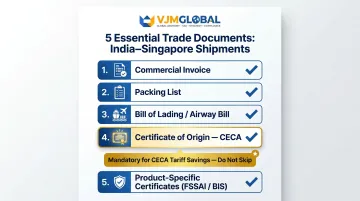
Standard trade documentation (every shipment):
- Commercial Invoice
- Packing List
- Bill of Lading (sea) or Airway Bill (air)
- Certificate of Origin (mandatory for CECA-eligible goods to claim preferential tariffs)
- Product-specific certificates (FSSAI, BIS, health, phytosanitary)
Certificate of Origin under CECA:
- Must be filed via DGFT's eCoO 2.0 platform — mandatory since January 17, 2025
- Requires proof of 40% domestic/regional value content or Change of Tariff Heading (CTH) at 4–6 digit HS level
- Without a valid CoO, standard MFN (Most Favoured Nation) duties apply, negating CECA benefits
Key Licenses and Registrations You Cannot Overlook
Mandatory Licenses and Registrations for India Import-Export
Every Singapore-based business trading with India must clear a specific set of registrations before the first shipment moves. The table below covers the non-negotiables:
| Registration | Issuing Body | Purpose | Consequence if Missing |
|---|---|---|---|
| IEC | DGFT | Authorization to trade | Shipment held at customs |
| GST | GST Council | Tax compliance, refunds | Cannot claim ITC or zero-rated treatment |
| RCMC | Export Promotion Council | Access to export incentives | Ineligible for RoDTEP, EPCG |
| AD Code | ICEGATE/Bank | Link bank account to customs | Refunds and proceeds cannot be credited |
| PAN | Income Tax Department | Underpins IEC and tax filings | Cannot obtain IEC or GST |
FEMA compliance for Singapore investors:
- All FDI must come through the banking channel
- File FC-GPR within 30 days of share allotment via RBI's FIRMS portal
- Trading companies fall under 100% FDI automatic route—no prior RBI approval needed
- Maintain FIRC (Foreign Inward Remittance Certificate), valuation certificate, and CS certificate
Beyond FEMA, Singapore traders can capture meaningful duty savings — but only with the right paperwork in place.
CECA Certificate of Origin:
- Exporters must obtain a preferential CoO from DGFT's eCoO 2.0 platform
- Without it at the destination port, standard duties apply instead of concessional (reduced) CECA rates
- 93% of India's imports from Singapore are eligible for reduced tariffs under CECA
Depending on what you're trading, additional product-specific licenses layer on top of the baseline registrations above.
Product-specific licenses:
- FSSAI Central License (₹7,500/year): Mandatory for food imports/exports regardless of turnover
- BIS Certification: Required per model for electronics (mobiles, laptops, LEDs, CCTV, power banks)
- Drug License: Required for pharmaceuticals
- WCCB Permit: Required for certain natural materials
DGFT's Foreign Trade Policy (FTP 2023) governs export incentive schemes, prohibited/restricted item lists, and compliance thresholds — review it before finalizing your product category and trade structure.
Common Mistakes and Early Decisions That Matter
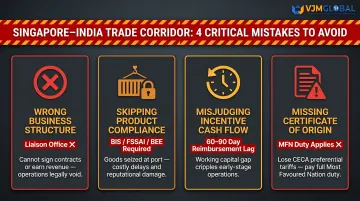
Most Singapore entities that stumble in the India trade corridor don't fail on strategy — they fail on execution details that seem minor until they aren't. These four mistakes account for the majority of early setbacks.
1. Choosing the wrong business structure
- Incorporating a Liaison Office (which cannot conduct commercial activity) forces a costly re-incorporation months later
- A Private Limited Company is almost always the right structure for Singapore entities wanting to trade actively in India
2. Underestimating product compliance
- Shipping without required BIS certification, FSSAI registration, or drug approval leads to customs detention, fines, or destruction of goods
- Obtain all product-specific approvals before the first shipment — not after the goods are already in transit
3. Misjudging cash flow on export incentives
- Duty Drawback and RoDTEP incentives are genuine but disbursements typically lag 60–90 days — building financial projections around immediate receipt is a common error
- Model working capital for a full 6–12 month lag cycle, particularly in your first year of operations
4. Skipping CECA Certificate of Origin requirements
- Exporting without a valid Certificate of Origin means paying full MFN duties, wiping out the cost advantage CECA provides
- Engage a customs consultant to handle CoO filing via eCoO 2.0 before every shipment — it's a small step that protects a significant margin advantage
Frequently Asked Questions
How much money is needed to start an import-export business in India?
Startup costs include company incorporation fees (₹15,000–₹30,000), IEC and GST registration (₹500 + minimal), initial working capital for inventory or samples, logistics, and product-specific licensing. The scale of investment depends heavily on product type—bulk trading requires higher capital than sample-first models.
How to register an export business in India?
The core steps are: incorporate your entity and obtain PAN and GST, apply for IEC on the DGFT portal, register with the relevant Export Promotion Council (RCMC), then complete AD Code and ICEGATE registration before your first shipment.
Which license is required for export from India?
The IEC (Import Export Code) from DGFT is the primary mandatory license for all exports and imports. Application costs ₹500 and the code has lifetime validity. Additional product-specific licenses (FSSAI, BIS, Drug License) may apply depending on the category.
Can I start an export business in India?
Yes. Singapore-based individuals and companies can set up a wholly owned subsidiary under the FDI automatic route (100% FDI permitted). Once incorporated, you obtain IEC, GST, and RCMC registrations and comply with FEMA guidelines for inward investment.
What is the most profitable import-export business in India?
High-demand categories include engineering goods (USD 49.24B in Apr–Aug 2025), electronic goods (+40.63% YoY growth), pharmaceuticals (USD 12.76B), textiles and garments, and agri-products. Most of these categories qualify for export incentives under schemes such as RoDTEP and EPCG, reducing overall costs.
Does the India-Singapore CECA offer any specific advantages for import-export businesses?
Yes. The India-Singapore CECA reduces or eliminates duties on 93% of traded goods. Businesses that obtain a valid Certificate of Origin and meet rules of origin criteria (40% domestic value content or CTH) can significantly reduce landed costs on eligible shipments.
Ready to start your India import-export business from Singapore? VJM Global provides full-service support from company incorporation and IEC/GST registration to FEMA compliance, FC-GPR filing, and ongoing accounting services. With 30+ years of experience serving foreign businesses entering India, our team ensures your setup is structured for compliance and built to scale in the Indian market. Contact us at [email protected] or +91 98915 76441 to begin your India market entry.