Introduction
India-Singapore bilateral trade reached USD 35.5 billion in FY 2024-25, making Singapore India's 6th largest export destination and accounting for nearly 28% of India's total ASEAN trade. This corridor—growing at a 12.7% CAGR since 2020—presents genuine opportunity for Singapore businesses eyeing the Indian import-export market. Yet most first-time entrants stumble not on market fit, but on budget planning.
The challenge splits into two layers. Setup costs (IEC registration, GST compliance, entity incorporation) are visible and predictable. The real expense shock comes from recurring costs: customs duties per shipment, monthly GST filings, freight charges, and documentation fees that multiply with every container.
Singapore companies that budget only for registration often find themselves cash-strapped at the first customs hold or GST penalty notice.
This article breaks down realistic start-up budgets across three entry models, covering both one-time and recurring costs, the factors that push expenses higher, and the planning mistakes that routinely derail Singapore businesses entering India.
Key Takeaways
- Start-up cost range: Rs. 1,500–5,500 (SGD 25–90) for agent-based trade to Rs. 50,000–1,50,000+ (SGD 800–2,500+) for full India entity setup
- Biggest cost drivers: entity structure choice, product HS code classification, customs duty rates, and professional compliance fees
- CECA benefit: 81% of Singapore exports to India qualify for reduced or nil duties under CECA—requires a valid Certificate of Origin and 35% local value-add
- Recurring cost trap: GST filing, per-shipment customs clearance, and port detention charges compound quickly—budget Rs. 15,000–25,000+ per active trade quarter
- Budget determinant: Trade model and shipment frequency matter more than product type—monthly shipments carry 3–4× the recurring compliance overhead of quarterly ones
What Does It Cost to Start an Import-Export Business in India?
There is no fixed cost. Total investment depends on trade model (agent-based vs. direct vs. India entity), product category (regulated goods require BIS/FSSAI licensing), shipment frequency, and whether the Singapore business needs physical India presence.
Most businesses underestimate costs — and that leads to mid-setup stalls, cash-flow gaps on first shipments, or compliance penalties. A business that budgets Rs. 10,000 for "setup" but faces Rs. 8,000 in customs clearance fees per shipment plus Rs. 71,000 in detention charges for a single documentation error will quickly burn through reserves.
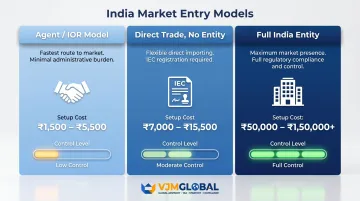
Three distinct models apply to Singapore businesses entering India, each with a very different cost floor:
Lean / Agent-Based Model
No India-registered entity required. The Singapore business appoints an Indian freight forwarder or Importer of Record (IOR) who holds the IEC and files customs declarations — the Singapore company pays the agent per shipment.
Realistic cost range:
- INR: Rs. 1,500–5,500 (IEC government fee Rs. 500 + professional assistance Rs. 1,000–5,000)
- SGD: SGD 25–90
Included in this model:
- IEC application via agent
- Basic logistics coordination
- Customs filing under the agent's name
Not included: GST registration, India entity setup, direct customs oversight, or ability to claim GST Input Tax Credit.
Key limitation: Under India's Foreign Trade Policy and FEMA, foreign companies cannot hold an IEC directly. A Singapore business must either use an Indian IOR or incorporate an India entity.
Standard Setup (Direct Trade, No India Entity)
This model establishes a direct import-export relationship with Indian buyers or suppliers — with your own IEC and GST registration via minimal India presence, plus a Customs House Agent (CHA) — but stops short of incorporating an India entity.
Realistic cost range:
- INR: Rs. 7,000–15,500 (IEC Rs. 500 + GST registration Rs. 2,500–5,000 + initial CHA retainer Rs. 4,000–10,000)
- SGD: SGD 115–250
Included in this model:
- IEC and GST registration
- RCMC if applicable (Rs. 12,000 + 18% GST for exporters under Rs. 5 crore turnover)
- CHA retainer and basic trade advisory
Not included: India company incorporation, warehouse lease, dedicated India staff, or a direct India bank account.
Full-Scale Setup (India Entity + Operational Infrastructure)
The Singapore business incorporates a Private Limited Company, Branch Office, or Liaison Office in India. This triggers full MCA registration, statutory audit requirements, tax compliance obligations, and dedicated accounting — along with the highest upfront investment.
Realistic cost range:
- INR: Rs. 50,000–1,50,000+ (first year) — government fees Rs. 2,000–7,000 + professional incorporation Rs. 6,000–80,000 + compliance Rs. 15,000–60,000
- SGD: SGD 800–2,500+
Included in this model:
- Company incorporation via SPICe+ filing
- IEC and GST registration
- Registered office address, DSC and DIN for directors
- Annual ROC filing and statutory audit setup
Not included: Warehouse lease, inventory holding costs, or employee payroll beyond compliance staff.
Choose this model when annual trade volume exceeds Rs. 1 crore, when physical distribution in India is required, or when direct GST Input Tax Credit recovery is a priority.
Key Cost Components Singapore Businesses Must Budget For
Total start-up costs comprise several distinct layers—each with its own fee structure. Miscalculating even one layer can materially undermine a Singapore business's India entry budget.
IEC and Business Registration Costs
Import Export Code (IEC):
- Government fee: Rs. 500 (one-time, paid on dgft.gov.in)
- Validity: Lifetime, but mandatory annual update required between April 1-June 30 each year (failure = automatic deactivation)
- Professional/consultant fees: Rs. 1,000-5,000
- Processing time: 1-5 working days
Private Limited Company Incorporation (if establishing India entity):
| Component | Cost (INR) |
|---|---|
| Name reservation (RUN) | Rs. 1,000 |
| SPICe+ filing (capital up to Rs. 15L) | Nil |
| SPICe+ filing (Rs. 15L-25L capital) | Rs. 500 |
| SPICe+ filing (Rs. 25L-1Cr capital) | Rs. 2,000 |
| Stamp duty (state-dependent) | Rs. 500-3,000 |
| DSC per director | Rs. 800-2,000 |
| DIN per director | Rs. 500 |
| Government total | Rs. 2,000-7,000 |
| Professional fees | Rs. 6,000-28,000 |
Branch Office (for foreign companies):
- Professional advisory: Rs. 30,000-80,000
- Apostille and courier per foreign director: Rs. 5,000-20,000
- FC-GPR filing (FDI reporting): Rs. 5,000-15,000
- Timeline: 4-8 weeks
GST Registration and Compliance
Registration:
- Government fee: Rs. 0 (free) on gst.gov.in
- Professional assistance: Rs. 500-5,000
- Processing: 3-7 working days
Ongoing filing obligations:
| Return | Frequency | Due Date | Late Fee |
|---|---|---|---|
| GSTR-1 | Monthly or quarterly | 11th/13th of following month | Rs. 50/day (cap Rs. 5,000) |
| GSTR-3B | Monthly or quarterly | 20th of following month | Rs. 50/day (cap Rs. 5,000) |
| GSTR-9 (annual) | Annual | 31st December of following FY | Rs. 200/day (cap 0.25% of turnover) |
Professional filing fees: Rs. 5,000-10,000 annually
Letter of Undertaking (LUT): Required for zero-rated exports to avoid paying IGST upfront and claiming refunds later. Filed annually in Form GST RFD-11, free on GST portal.
Customs Duties and Tariffs
India's import duty structure cascades:
- Basic Customs Duty (BCD): Product-specific, typically 5-30% (e.g., 15% on mobile phones, 30% on roasted nuts, 6% on gold)
- Social Welfare Surcharge (SWS): 10% of BCD
- Integrated GST (IGST): 5-28% on (CIF value + BCD + SWS)
- Customs Handling Fee: ~1% of assessable value
India-Singapore CECA Impact:
- 81% of Singapore exports to India enjoy reduced/nil BCD under CECA
- Requirements: Minimum 35% local value-added in Singapore (FOB basis) + change in 6-digit HS code from raw materials to final product
- Documentation: Valid Preferential Certificate of Origin (PCO) from Singapore Customs must accompany shipment
Failure to qualify: Full MFN BCD applies—potentially 10-30% of shipment value.
Critical: Customs duties are per-shipment recurring costs, not one-time setup costs. A business importing 12 containers annually must budget BCD + IGST for every shipment.
Logistics, Freight, and Customs Clearance Fees
Sea Freight (Singapore to India):
- Transit time: 15-50 days
- Indicative FCL rate to JNPT: USD 1,661-1,786 per container (volatile, verify current rates)
- Major ports: JNPT/Mumbai, Chennai, Mundra
Air Freight:
- Transit time: 2-8 days
- Rates: SGD 4-13 per kg (standard cargo; express and DG higher)
- Chargeable weight = actual or volumetric (1 CBM = 166.67 kg), whichever is greater
Customs House Agent (CHA) Fees:
- Standard clearance: Rs. 4,000-5,000 per shipment
- Complex clearance (BIS, FSSAI, WPC): Rs. 6,000-8,000+
Terminal Handling Charges (THC) at Indian ports (20ft dry container, 2023 rates + 18% GST):
| Port/Terminal | 20ft Dry (INR) | 40ft Dry/HC (INR) |
|---|---|---|
| JNPT - JNPT Trust | 9,150 | 14,625 |
| JNPT - GTI/APM | 7,750 | 12,200 |
| Chennai - CITPL | 5,575 | 8,325 |
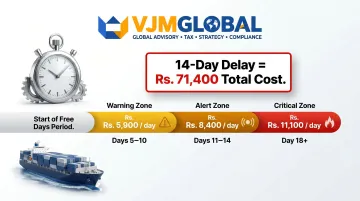
Detention charges (Maersk, after 4 free days):
- Day 5-10: Rs. 5,900/day (20ft)
- Day 11-14: Rs. 8,400/day
- Day 18+: Rs. 11,100/day
A 14-day delay = Rs. 71,400 in detention alone for one 20ft container.
Professional Advisory and Compliance Fees
Singapore businesses without local India expertise routinely incur penalties, shipment holds, and compliance errors that cost multiples of what professional advisory would have charged upfront.
A local compliance partner covers IEC applications, GST filings, entity registration, ongoing tax advisory, and customs documentation management. Firms like VJM Global specialise in helping Singapore and other foreign businesses navigate end-to-end India setup: entity incorporation, IEC registration, monthly GST filing, statutory audits, and FEMA compliance.
Typical professional engagement costs:
- IEC + GST registration: Rs. 5,000-10,000
- Entity incorporation: Rs. 30,000-1,00,000 (depending on entity type)
- Annual compliance retainer: Rs. 50,000-2,00,000 (for India entity with full bookkeeping and audit)
What Factors Affect Your Total Start-Up Budget?
Your total India import/export budget isn't fixed — it shifts based on how you structure your operations, what you're trading, and how often you ship.
Trade Model and Entity Structure
- Agent/IOR model: Lowest setup cost (Rs. 1,500-5,500) but zero control over customs, GST filings, or ITC recovery; dependency on third party
- Direct trade, no entity: Mid-range cost (Rs. 7,000-15,500); own IEC and GST but limited India operational control
- Full India entity: Highest setup and recurring cost (Rs. 50,000-1,50,000+ first year, Rs. 50,000-2,00,000+ annually) but full regulatory control, direct CECA claims, GST ITC recovery
Product Category and HS Code
Product classification drives:
- Duty rates: Electronics (15% BCD), roasted nuts (30%), gold (6%)
- Licensing: Food (FSSAI), electronics (BIS), pharmaceuticals (drug licensing)
- Freight handling: Perishables require reefer containers; hazardous goods attract premium air freight surcharges
The table below shows how duty rates, licensing requirements, and CHA fees vary across three common product categories — differences that can shift your first-year budget by Rs. 30,000-40,000 or more.
| Product | BCD | Licensing Required | Typical CHA Fee |
|---|---|---|---|
| Laptop computers | 15% | BIS (Rs. 10,000-50,000) | Rs. 6,000-8,000 |
| Roasted cashews | 30% | FSSAI (Rs. 5,000-20,000) | Rs. 5,000-7,000 |
| Gold jewellery | 6% | Hallmarking | Rs. 4,000-5,000 |
Scale of Operations and Shipment Frequency
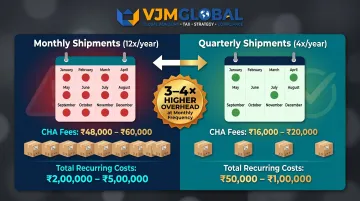
A business planning monthly shipments faces:
- 12x customs clearance fees annually (Rs. 48,000-60,000)
- 12x freight charges
- 12x BCD + IGST outlays (recovered via ITC if GST-registered)
Drop to quarterly shipments (4x per year) and the picture changes considerably:
- Rs. 16,000-20,000 in annual CHA fees
- Lower total freight spend
- Longer cash-to-cash cycle but less administrative burden
That frequency gap translates directly into annual budget ranges. High-volume traders (10+ shipments/year) should plan for Rs. 2,00,000-5,00,000 in recurring logistics and compliance costs, versus Rs. 50,000-1,00,000 for low-volume operations.
One-Time vs. Ongoing Costs: Full Breakdown
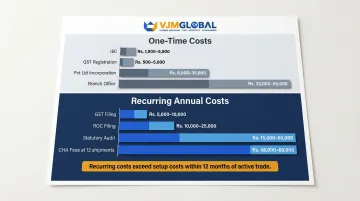
Most planning errors stem from treating import-export setup as a one-time investment when the reality is that recurring costs often exceed setup costs within the first 12 months of active trade.
The tables below separate what you pay once from what you pay repeatedly. Review the SGD column alongside INR figures — exchange rates fluctuate, but the proportions stay consistent.
One-Time Setup Costs
| Item | Government Fee (INR) | Professional Fee (INR) | Total (INR) | Approx. SGD |
|---|---|---|---|---|
| IEC registration | 500 | 1,000–5,000 | 1,500–5,500 | 25–90 |
| GST registration | 0 | 500–5,000 | 500–5,000 | 8–80 |
| Pvt Ltd incorporation | 2,000–7,000 | 6,000–28,000 | 8,000–35,000 | 130–565 |
| Branch office setup | Varies | 30,000–80,000 | 30,000–80,000 | 485–1,290 |
| RCMC (FIEO, <Rs. 5Cr) | 12,000 + 18% GST | Included | 14,160 | 230 |
| AD Code (bank + customs) | 0 | Minimal | Free–nominal | — |
AD Code: A 14-digit Authorised Dealer Code from an RBI-authorised bank, required at each customs port. Processing: 5–10 days per port. Free to register.
Recurring Per-Shipment Costs
| Item | Cost per Shipment (INR) | Annual (12 shipments) | Approx. SGD |
|---|---|---|---|
| CHA fees | 4,000–5,000 | 48,000–60,000 | 775–970 |
| BCD + IGST (product-specific) | Varies by HS code | Varies | Varies |
| Sea freight (FCL to JNPT) | ~₹1,25,000 | 15,00,000 | 24,200 |
| THC (JNPT, 20ft) | 9,150 + 18% GST | ~1,29,500 | 2,090 |
| Certificate of Origin (CECA) | 500–1,500 | 6,000–18,000 | 97–290 |
Per-shipment costs dominate the budget at scale. At 12 shipments annually, sea freight and THC alone account for roughly SGD 26,000 — before duties. Annual compliance costs below run independently of shipment volume.
Recurring Annual Compliance Costs
| Item | Annual Cost (INR) | Approx. SGD |
|---|---|---|
| GST return filing (professional) | 5,000–10,000 | 80–160 |
| IEC annual update | 0 (but mandatory) | — |
| Annual ROC filing (Pvt Ltd) | 10,000–25,000 | 160–405 |
| Statutory audit | 15,000–60,000 | 240–970 |
| Accounting/bookkeeping retainer | ₹1,000–10,000/month | 195–1,935 |
| FC-GPR filing (FDI reporting) | 5,000–15,000 | 80–240 |
VJM Global structures compliance retainer packages that bundle GST filing, IEC maintenance, ROC filings, and bookkeeping into a single monthly fee — so Singapore businesses know exactly what Indian compliance costs each month, with no unexpected penalty exposure.
Common Budgeting Mistakes Singapore Businesses Make
1. Focusing Only on Registration Fees, Ignoring Per-Shipment Costs
Many Singapore businesses budget Rs. 10,000–20,000 for "setup" but fail to model the recurring per-shipment cost stack:
- CHA fee: Rs. 4,000–5,000
- Freight: Rs. 1,25,000+ per container
- THC: Rs. 9,150+
- BCD + IGST: 15–50% of CIF value
Recurring costs often exceed total setup costs within 6–12 months of active trading.
2. Assuming CECA Duty Benefits Apply Automatically
CECA preferential rates require:
- 35% local value-added in Singapore (FOB basis)
- Change in tariff sub-heading at 6-digit HS code level
- Preferential Certificate of Origin from Singapore Customs
For example, a Singapore company re-exporting Chinese electronics without substantial transformation does not qualify. They pay full 15% BCD instead of 0% — adding Rs. 1,50,000 to a Rs. 10,00,000 shipment.
3. Skipping Professional Advisory to Save Upfront Costs
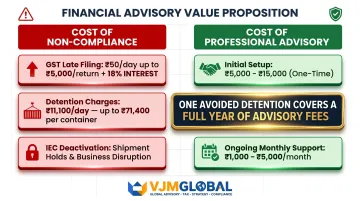
The cost of non-compliance adds up fast:
- GST late filing: Rs. 50/day (capped at Rs. 5,000 per return) + 18% annual interest on unpaid tax
- Incorrect customs documentation: 14-day detention at Rs. 11,100/day = Rs. 71,400 per container
- IEC deactivation (missed annual update): shipments cannot clear until reactivation
Professional advisory typically costs Rs. 5,000–15,000 for initial setup and Rs. 1,000–5,000/month for ongoing compliance. A single avoided detention (Rs. 71,400) covers an entire year of that support.
4. Underestimating Working Capital Requirements
The gap between paying your supplier and receiving payment from your buyer can stretch 30–90 days. This entire period must be funded from working capital — often for months at a stretch.
A typical cash flow looks like this:
- Day 0: Pay supplier SGD 50,000
- Day 21: Shipment arrives in India; pay Rs. 1,50,000 in duties, freight, and CHA fees
- Day 30: Clear customs
- Day 60–90: Buyer pays
That's SGD 50,000 + Rs. 1,50,000 (~SGD 2,400) tied up for up to 90 days before a single rupee returns.
Conclusion
Start-up costs for Singapore businesses entering India's import-export market range from Rs. 1,500–5,500 (SGD 25–90) for a lean agent-based model to Rs. 50,000–1,50,000+ (SGD 800–2,500+) for full India entity setup. The structure, product category, and compliance approach chosen at the outset determines not just the initial outlay — it sets the trajectory for every ongoing cost that follows.
The three most impactful steps Singapore businesses can take:
- Separate one-time from recurring costs and model both across the first 12 months
- Map product-specific customs duties and licensing requirements before finalising budgets
- Engage qualified India compliance support early—far less than what penalties, detention charges, and shipment delays will cost you
Frequently Asked Questions
Can I start an import/export business in India as a Singapore company?
Yes, but not directly. Singapore companies can't hold an IEC without an India-registered entity, so you must either appoint an Indian Importer of Record (IOR) agent or incorporate a branch/subsidiary in India. The IOR route works for low-volume trade; a registered India entity is required for sustained operations or GST Input Tax Credit recovery.
What is the Import Export Code (IEC) and is it mandatory for Singapore businesses?
The IEC is a 10-digit code issued by India's DGFT, and no commercial shipment clears Indian customs without one. Singapore businesses obtain it through an India-registered entity or via an Indian agent/IOR. Government fee: Rs. 500; processing time: 1-5 days.
How does the India-Singapore CECA affect import duties?
CECA eliminates tariffs on 81% of qualifying goods, but Rules of Origin apply: goods need 35% local value-added (FOB basis) and a 6-digit HS code change from inputs to finished product. A Preferential Certificate of Origin from Singapore Customs is mandatory at import — without it, full MFN BCD rates apply.
Do Singapore businesses need to register a company in India to start trading?
Not always. Low-volume trade can run through an Indian freight forwarder or IOR without incorporating locally. A registered India entity (Private Limited or Branch Office) becomes necessary for local distribution, direct GST Input Tax Credit claims, or operations exceeding Rs. 1 Crore annually.
What ongoing compliance costs should Singapore businesses expect?
Recurring costs vary by structure, but typically include:
- GST return filing: Rs. 5,000–10,000/year (professional fees)
- IEC annual update: Free, but mandatory each April–June
- Customs documentation & CHA fees: Rs. 4,000–5,000/shipment
- ROC filings (India entity only): Rs. 10,000–25,000/year
- Statutory audit (India entity only): Rs. 15,000–60,000/year
- Accounting retainer (India entity only): Rs. 12,000–1,20,000/year
How long does it take to set up import-export operations in India from Singapore?
IEC and GST registration: 1-3 weeks combined. Private Limited Company incorporation: 10-15 days (MCA SPICe+). Branch Office (RBI approval required): 4-8 weeks. A business setup specialist familiar with India's regulatory process can compress these timelines significantly and prevent documentation errors that commonly cause delays — VJM Global's team handles this end-to-end for Singapore clients.