A JV's success rarely comes down to the paperwork. It hinges on partner selection, agreement structure, and how well you handle regulatory compliance from day one.
This guide walks through the step-by-step process, structure options, regulatory essentials, and the mistakes that trip up UAE investors most often.
Key Takeaways
- A JV pairs a UAE firm with an Indian partner as a Pvt Ltd, LLP, or contract
- Most sectors allow 100% FDI on the automatic route; structure still hinges on sector and control
- Path: due diligence → MOU → JV Agreement → MCA/RBI filings → post-incorporation compliance
- CEPA and the India-UAE BIT make capital flows and investor protection more predictable
- JV failures usually stem from weak partner vetting or vague clauses—not incorporation itself
Why Set Up a Joint Venture in India as a UAE Business?
India is a priority destination for UAE capital, and the numbers back that up.
Bilateral merchandise trade between India and the UAE hit US$101.25 billion in FY2025-26, with both governments now targeting US$200 billion by 2032. That kind of trajectory doesn't happen by accident.
What a Local Partner Actually Gets You
A standalone entity can take years to build the same footing a JV offers on day one:
- Distribution networks already tested across Indian states with wildly different consumer behaviour
- Regulatory familiarity, particularly for state-level licensing that varies from Gujarat to Tamil Nadu
- Existing supplier and customer relationships that would otherwise take years of relationship-building
- On-ground credibility with Indian banks, vendors, and government offices
When a JV Isn't the Right Call
Not every UAE entrant needs a local partner. If your sector allows 100% automatic-route FDI and doesn't involve complex local licensing, a Wholly Owned Subsidiary is often faster to set up and cheaper to run long-term.
IT services and many manufacturing categories fall into this bucket. Save the JV structure for sectors where local knowledge genuinely changes your odds of success.
Step-by-Step Process to Set Up a Joint Venture in India from the UAE
Step 1: Confirm FDI Eligibility and Choose the JV Structure
Before you approach a single partner, check the sector-specific FDI cap and route. Most activities allow 100% FDI automatically, but exceptions exist:
- Defence manufacturing: automatic route up to 74%, government approval beyond that
- Insurance: automatic route up to 100%
- Multi-brand retail: capped at 51% and requires government approval
Once eligibility is clear, decide your structure. An equity-based JV (Private Limited Company or LLP) suits long-term operations with shared ownership.
A contractual JV works better for single projects with a defined end date, since it avoids setting up a new legal entity altogether.
Step 2: Identify and Vet the Right Indian Partner
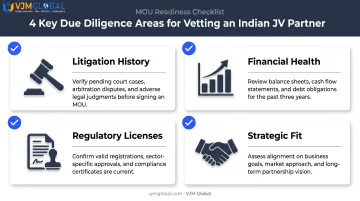
This step decides whether your JV survives past year three. Due diligence should cover:
- Litigation history and any pending disputes
- Financial health, including debt obligations and cash flow patterns
- Existing licenses and regulatory standing in their sector
Beyond the paperwork, assess strategic fit. Does the partner have the capital contribution capacity they claim? Do their long-term goals actually align with yours, or are you both just excited about the same market?
Step 3: Sign an MOU or Letter of Intent
Document the non-binding terms before either side commits legal fees to a full agreement. This should cover equity split, board composition, and each party's roles.
Include confidentiality and exclusivity clauses here. Commercially sensitive information gets shared during negotiations, and you want it protected before, not after, deal terms firm up.
Step 4: Draft and Execute the Joint Venture Agreement
The JVA is where vague intentions become enforceable terms. It should detail:
- Capital contribution schedules and timing
- Management and voting rights
- IP ownership and licensing terms
- Profit-sharing formulas
- Exit mechanisms and buyout triggers
Align the Articles of Association with the JVA at this stage. Mismatched governing documents create conflicts later that are expensive and slow to resolve. VJM Global's advisory team typically reviews these terms with legal counsel before the agreement is finalised and signed.
Step 5: Complete Regulatory Filings and Incorporate the Entity
Incorporation runs through the Ministry of Corporate Affairs:
- Obtain Digital Signature Certificates (DSCs) for all proposed directors
- Secure Director Identification Numbers (DINs)
- File the SPICe+ form for name reservation and incorporation
- Receive the Certificate of Incorporation with your CIN
Once shares are issued to the UAE partner, that investment must be reported through FC-GPR on RBI's FIRMS portal within 30 days of the issue date. Miss this window and penalties compound.
Step 6: Complete Post-Incorporation Compliance and Begin Operations
Before operations start, you'll need:
- GST registration and PAN/TAN
- A corporate bank account
- Accounting systems aligned with Indian Accounting Standards (Ind AS) where applicable
Most UAE investors prefer not to manage ROC filings, FEMA reporting, and tax compliance manually across the JV's lifecycle.
A cross-border advisory partner like VJM Global typically handles entity formation and ongoing compliance, so you can focus on running the business instead of tracking statutory deadlines.
Key Regulatory & Agreement Considerations for UAE Investors
FDI Route and RBI Reporting
Most sectors permit 100% automatic-route FDI, but always verify your specific activity against DPIIT's current policy before committing capital. Sectors like defence, insurance, and multi-brand retail carry caps or approval requirements that can change your timeline significantly.
On the reporting side, share transfers between residents and non-residents require FC-TRS filing within 60 days of the transfer or fund receipt, whichever comes first. Valuation matters too. Unlisted equity cannot be issued below fair value, set through an internationally accepted arm's-length method.
CEPA and the Bilateral Investment Treaty
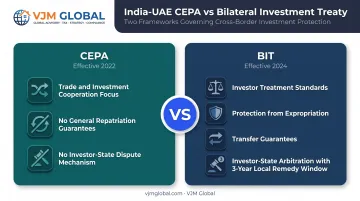
CEPA, effective 1 May 2022, promotes investment cooperation but doesn't provide general repatriation guarantees or investor-state dispute mechanisms on its own.
That gap gets addressed by the India-UAE Bilateral Investment Treaty, in force since 31 August 2024. It covers treatment standards, protection from expropriation, transfers, and investor-state arbitration. Local remedies generally must be exhausted first, with a three-year window before arbitration is available.
Must-Have JVA Clauses
For a cross-border deal specifically, your JVA needs:
- Dispute resolution and arbitration seat: India, SIAC, or DIFC, decided upfront
- IP ownership: who owns what, especially for jointly developed technology
- Non-compete terms: scope, duration, and geography
- Exit and buyout formulas: agreed before anyone needs to use them
Tax Structuring for UAE Parent Companies
The India-UAE DTAA caps source-state withholding tax on dividends and royalties at 10% for beneficial owners, provided that income is not connected to a permanent establishment in India.
Transfer pricing needs equal attention. Intra-group transactions must use arm's-length pricing, backed by local-file documentation on the Indian side. DTAA benefit claims typically need a Tax Residency Certificate and Form 10F; VJM Global handles this benchmarking and claim support for UAE parents.
Common Mistakes & Challenges to Avoid
Most UAE–India JV delays come from a few avoidable gaps. Catch them early and you protect both timeline and capital.
Skipping due diligence on the Indian partner. Litigation history and financial red flags often surface only after incorporation. By then, unwinding the deal costs far more than vetting would have.
Fix: Commission a legal and financial audit of the prospective partner before signing the MOU, not after.
Underestimating FEMA and RBI reporting timelines. Delayed FC-GPR or FIRMS filings trigger compounding penalties that add up fast.
Fix: Keep a compliance calendar, or work with an advisor who tracks statutory deadlines for you.
Leaving deadlock and exit clauses vague. When priorities diverge—and they often do—an unclear JVA can prolong disputes for months or years.
Fix: Define buyout valuation formulas and arbitration mechanisms at the drafting stage. Don't wait until a dispute forces the conversation.
Alternatives to a Joint Venture for UAE Companies Entering India
A JV isn't the only path into India. Three alternatives are worth weighing first:
| Structure | Best For | Trade-off |
|---|---|---|
| Wholly Owned Subsidiary | Sectors with 100% automatic-route FDI, full control | Bears full capital and market-entry risk alone |
| Branch or Liaison Office | Market research, project execution, representation | Commercial activity is restricted; can't earn Indian income (liaison offices) |
| Franchise/Distribution Agreement | Brand presence without equity investment | Limited control over execution and quality standards |
When each option fits:
- Wholly owned subsidiary — You want 100% ownership and do not need a local partner’s market knowledge
- Branch office — You need project execution or limited commercial presence without a full Indian company
- Liaison office — You want to assess demand and build relationships before committing capital
- Franchise or distribution — You want brand or shelf presence without running an Indian entity
Frequently Asked Questions
What are the new agreements between India and the UAE?
Recent agreements include CEPA (effective 2022), the 2024 Bilateral Investment Treaty, and MoUs covering digital infrastructure, energy cooperation, and a 10-year LNG supply agreement signed in early 2026.
What does the UAE buy from India?
Petroleum products, gold and jewellery, telecom instruments, and cotton ready-made garments top the list. In FY2024-25, petroleum products alone accounted for roughly US$6.4 billion of Indian exports to the UAE.
Is India the UAE’s largest trading partner?
According to the UAE Ministry of Foreign Affairs, India ranks as the UAE’s second-largest trading partner by trade volume.
How long does it take to set up a joint venture in India from the UAE?
There’s no fixed timeline—due diligence, JVA drafting, and incorporation each depend on deal complexity. Once incorporation completes, FC-GPR reporting must still be filed within 30 days of any equity issuance.
Can a UAE company hold 100% ownership instead of forming a joint venture?
Yes, through a Wholly Owned Subsidiary, provided your sector permits 100% FDI under the automatic route. This skips the need for a local equity partner entirely.
Do I need to travel to India to complete joint venture registration?
No. Digital Signature Certificates and MCA e-filing allow most incorporation steps to happen remotely, with a local advisor managing on-ground filings and RoC correspondence on your behalf.