For a UK founder starting from London, Manchester, or anywhere else in the UK, none of that is usually in place. The Accounting and Corporate Regulatory Authority (ACRA) itself moves fast once a compliant application lands on its desk. The bottleneck isn't ACRA — it's everything a UK business needs to arrange before that application can even be filed.
This guide breaks the real timeline into stages, from document prep through to a fully operational company with a working bank account, so you can plan realistically rather than against a headline figure.
Key Takeaways
- ACRA approval is fast once filed, but it is rarely the slowest step for UK founders
- UK founders need a Corporate Service Provider; BizFile+/SingPass self-filing is limited to Singapore residents
- Sourcing a local nominee director is the biggest variable in how fast registration can begin
- A fully banked, operational company takes 2–4 weeks with fintech providers or 8–12 weeks with traditional banks
How Long Does It Actually Take to Register a Company in Singapore From the UK?
Once a complete, correctly filed application reaches ACRA, approval moves quickly. According to ACRA's own registration guidance, most local company registrations are approved "soon after payment."
Complex applications can stretch to 15 working days. Applications that need referral-authority approval take 14–60 days.
The commonly cited "1-3 business days" figure floating around online tends to describe the best-case scenario: a director, registered address, and company secretary already arranged. For most UK entrepreneurs starting from scratch, that's not where the clock actually begins.
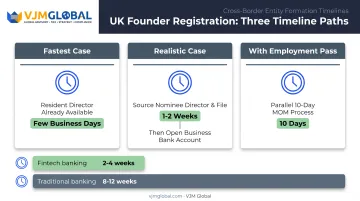
Fastest-Case Scenario: You Already Have a Singapore-Resident Director
If your business already has an employee, partner, or connection who qualifies as a Singapore-resident director, you're in the best possible position. Once your Corporate Service Provider files a compliant application, approval can land within a few business days.
This scenario is uncommon among UK founders, but it does happen, particularly for businesses that already have a regional presence in Southeast Asia.
Realistic Timeline for Most UK Founders Starting From Scratch
For everyone else, sourcing a nominee director and completing their KYC documentation typically adds 3-10 business days before you can even file. That pushes total incorporation to roughly 1-2 weeks. Add banking, and you're looking at:
- 2-4 weeks total if using a fintech banking provider
- 8-12 weeks total if opening with a traditional bank
Timeline If You Plan to Relocate on an Employment Pass
Planning to move to Singapore yourself to run the business? Factor in the Employment Pass separately. The Ministry of Manpower's stated benchmark is that applications are processed or given an update within 10 business days.
This runs parallel to incorporation, not after it. It is still a distinct process with its own paperwork and timeline.
Breaking Down Every Stage of the Registration Timeline
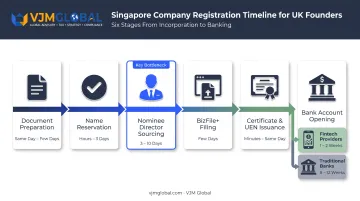
Company registration isn't one event. It's six distinct stages, each with its own turnaround.
| Stage | Typical timeline |
|---|---|
| Document preparation and structure | Same day to a few days |
| Name reservation (ACRA) | Hours to 3 working days |
| Local nominee director | 3–10 business days |
| BizFile+ incorporation filing | A few business days |
| Certificate and UEN issuance | Minutes to same day |
| Corporate bank account | 1–2 weeks (fintech) or 8–12 weeks (traditional) |
Stage 1: Document Preparation and Entity Structure Decision
Deciding between a Private Limited company (Pte Ltd) and a branch office, then gathering passports and proof of address, can take anywhere from same-day to a few days. It depends entirely on how organised the founder is before starting.
Stage 2: Company Name Reservation With ACRA
Straightforward name applications are typically approved within a few hours to three working days. Names containing regulated terms such as "bank," "finance," "law," "academy," or "institute" get referred to authorities like MAS, MinLaw, or MOE. Those referrals can add several extra weeks.
Stage 3: Securing a Local Nominee Director (the Real UK Bottleneck)
This is where UK timelines stall. Sourcing a compliant nominee director and completing their vetting typically takes 3-10 business days, depending on the provider's process. Firms with established cross-border teams (VJM Global among them) can run this step in parallel with document preparation rather than making it a sequential delay.
Stage 4: Filing Incorporation Documents via BizFile+
Once your Corporate Service Provider submits the completed application, ACRA processing is quick for straightforward filings: typically within a few business days once everything is in order.
Stage 5: Certificate of Incorporation and Post-Registration Documents
Approval outputs (the notice of incorporation, your Unique Entity Number (UEN), and access to your Business Profile) are issued almost immediately, often within minutes to same-day of approval.
Stage 6: Corporate Bank Account Opening
This is the biggest and most variable time sink in the entire process. Expect 1-2 weeks with fintech providers, versus 8-12 weeks with traditional banks that require deeper in-person or video verification.
What Affects Your Timeline as a UK Business
Four variables drive most of the timeline difference UK founders experience compared to Singapore residents.
- SingPass restriction: Foreigners can't self-file via BizFile+ (SingPass is limited to citizens, PRs, and FIN holders). Every UK founder needs a Corporate Service Provider, a step residents skip.
- Nominee director availability: The biggest lever. A provider with vetted directors ready can cut a week or more versus sourcing on demand.
- Entity structure: A Branch Office needs extra checks on the UK parent's documents (certified constitution, financials, translations if required), so filing often runs longer than a standard Pte Ltd.
- Provider quality: Template-only, unmonitored filings are more likely to draw ACRA queries or miss windows, adding unplanned days or weeks.
Bank Account and Compliance Setup Timeline After Incorporation
Bank account opening is usually the longest phase for UK founders after incorporation.
Traditional banks (DBS, OCBC, UOB) typically take 8–12 weeks. Banks usually put foreign-owned companies without local residency through relationship-manager onboarding. Expect checks on:
- Director identity documents
- Beneficial ownership details
- Residential address verification for every party involved
Fintech providers move faster. Airwallex, Aspire, and Statrys offer largely remote onboarding and often finish verification within days of a complete submission. Statrys reports that 96% of its approved accounts were opened within three days of a completed application. For UK founders running the company remotely, fintech is the practical default.
Banking is only one post-incorporation task. You must also appoint a corporate secretary within six months of incorporation. It will not block day-to-day operations, but arrange it early so it does not slip once trading starts.
Common Timeline Mistakes UK Businesses Make
UK founders often lose weeks to a few avoidable assumptions. The most common:
- Believing the "1-day incorporation" headline without a Singapore-resident director already lined up. That figure assumes prerequisites most UK founders have not arranged yet
- Treating bank account opening as a post-incorporation step instead of running nominee director sourcing, filing, and bank introductions in parallel. Handling them in sequence needlessly adds weeks
- Choosing a provider purely on lowest price. Budget CSPs more often cause delays through incomplete KYC or missed ACRA filing windows
Working with an experienced cross-border partner changes the maths considerably. VJM Global delivers entity formation and compliance across 100+ countries and runs nominee director sourcing, document filing, and bank introductions concurrently rather than sequentially. That parallel approach is the single biggest factor separating a two-week setup from a two-month one.

Frequently Asked Questions
How much money is needed to register a company in Singapore?
The ACRA government fee is SGD 315 (SGD 15 for name reservation plus SGD 300 for registration). UK founders should budget SGD 3,500-4,000+ for year one once nominee director, corporate secretary, and professional fees are included.
Can you register a business in Singapore without staying there?
Yes. Registration is fully remote via a Corporate Service Provider. Some traditional banks may still require an in-person visit or video call for account opening, though fintech providers avoid this entirely.
How long does ACRA take to approve a company registration?
ACRA typically approves straightforward applications within a few business days once a complete filing is submitted. Complex cases or regulated business activities requiring referral approval can take considerably longer.
Can I speed up company registration in Singapore?
Having a nominee director and KYC documents ready before you start, and using a provider with an established compliance process, removes the most common sources of delay. Running name reservation, director appointment, and KYC in parallel shortens the overall timeline.
How long does it take to open a business bank account in Singapore after incorporation?
Fintech providers like Airwallex, Aspire, and Statrys typically open accounts within 1-2 weeks through remote onboarding. Traditional banks such as DBS, OCBC, and UOB usually take 8-12 weeks, often requiring in-person or video verification.
Do UK businesses need a local director immediately, or can this be arranged later?
A local resident director must be in place before incorporation can be filed. Arrange the nominee or resident director as one of your first steps.