But many US firms misjudge what entry actually requires. They assume a quick registration process, underestimate regulatory screening, and pick a legal structure before validating demand. The result? Delays, wasted capital, and sometimes a costly do-over.
This article breaks down the real opportunity, the entry structures available, the legal and tax framework, regional differences, and the mistakes that trip up American investors most often.
Key Takeaways
- Vietnam's GDP growth and young workforce make it a top diversification target for US companies
- No blanket foreign ownership cap exists, but sectors like telecom and logistics need early screening
- Full setup realistically takes 3-6 months, not the "15 days" statutory figure often quoted
- Structure choice (distributor, RO, WFOE, JV, M&A) should follow business goals, not speed
- Regional choice matters as much as legal structure — North, Central, and South Vietnam serve different purposes
Why Vietnam Is a High-Potential Market for US Businesses
Vietnam's economy grew 8.0% in real GDP terms in 2025, well above earlier forecasts, according to World Bank data. The country now has roughly 102.3 million people, with almost 63% between ages 15 and 59, a workforce that is both large and young.
US-Vietnam commercial ties have accelerated fast. Total goods-and-services trade hit an estimated $215.4 billion in 2025, up 39.1% from the prior year, per the Office of the US Trade Representative.
Apple has put roughly $15.84 billion into its Vietnam supply chain since 2019, supporting around 200,000 jobs. Intel runs a $1.5 billion assembly and testing operation there. Both are production-scale commitments.
The "Vietnam + Global" Advantage
Vietnam belongs to CPTPP, EVFTA, and RCEP, trade agreements the United States is not part of. Manufacturing in Vietnam can give a US company's finished goods preferential access to markets that direct US exports can't reach. The EVFTA eliminates roughly 99% of tariff lines with the EU over time; RCEP does about 90% with member states, per the US Commercial Service.
That said, US-origin content doesn't automatically qualify. Rules of origin still apply, and this benefit flows to the manufacturing operation, not to the passport of the parent company.
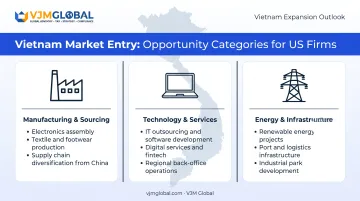
Three opportunity categories stand out for US firms:
- Manufacturing and sourcing: component production, assembly, and China+1 diversification
- Technology and services: IT outsourcing, fintech, and digital services
- Energy and infrastructure: renewables, logistics infrastructure, and industrial parks
Key Factors US Businesses Must Evaluate Before Entering Vietnam
Regional Differences
Vietnam isn't one market. Match your model to the right region:
- North — electronics and industrial manufacturing
- Central — emerging logistics hub
- South — commercial and consumer engine
Picking the wrong region for your business model is a common and expensive mistake.
Business Culture and Relationship-Building
Vietnamese business culture runs on trust and consensus, built over repeated meetings and personal rapport. US deal cycles, which often move in weeks, don't map well onto this reality. Rushing a joint venture partner or distributor relationship tends to backfire later, when governance disputes surface.
Sector Screening
Some sectors carry conditional restrictions that must be identified before you structure anything:
- Telecom — ownership limits vary by service type; new cloud/data-center categories allow 100% foreign ownership
- Education — 100% foreign ownership possible, but with steep minimum capital thresholds
- Distribution — foreign companies need licensed authority to trade directly, or must use a local distributor
- Logistics — foreign ownership capped at 49% for Vietnamese-flag marine transport, 50% for container handling
Skipping this screening step is how companies end up incorporated with the wrong license scope.
Choosing the Right Market Entry Structure and Process in Vietnam
There's no single "best" structure. It depends on what you're trying to accomplish.
| Structure | Best-Fit Use Case | Trade-Off |
|---|---|---|
| Local Distributor | Testing demand without capital commitment | No direct control over pricing, branding, or customer data |
| Representative Office | Market research, liaison work | Cannot invoice, trade, or generate local revenue |
| 100% Foreign-Owned LLC | Long-term manufacturing or services with full control | Higher setup cost, longer licensing in conditional sectors |
| Joint Venture | Regulated sectors needing local licenses or relationships | Requires clear governance terms up front |
| M&A/Acquisition | Fast market access via an existing operation | Due diligence complexity, integration risk |
The Real Incorporation Timeline
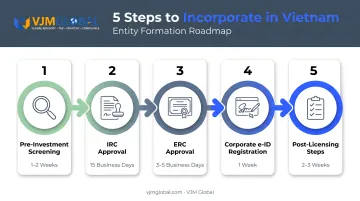
The statutory benchmark quotes 15 days for the Investment Registration Certificate (IRC) and about 3 working days for the Enterprise Registration Certificate (ERC) once a valid dossier is filed. In practice, advisory firms cite 15-45 working days just for company setup, and that doesn't include:
- Pre-investment screening — confirming sector access and conditions
- IRC approval — registering the investment project
- ERC approval — establishing the legal entity
- Corporate e-ID registration — for digital filings and signatures
- Post-licensing steps — tax registration, bank account, and labor registration
Once you add legalization of documents, lease negotiations, and banking setup, most US investors are realistically looking at 3-6 months end-to-end. Anyone promising a two-week turnkey setup is quoting the statutory minimum, not the operational reality.
Matching Structure to Objective
- Testing demand with minimal capital — Use a local distributor; you learn price and channel fit before incorporating
- Research and liaison only — A representative office supports groundwork but cannot invoice or book local revenue
- Long-term manufacturing or services — A 100% foreign-owned LLC gives full operational and branding control
- Regulated sector access — A joint venture can shorten licensing when a local partner already holds key approvals
A local partner is not legally required in most sectors. In tightly regulated industries, the right partner can still cut months off licensing—if governance and exit terms are locked in before you file.
Legal, Tax, and Compliance Framework US Investors Must Navigate
Two statutes anchor everything: the Law on Enterprises and the Law on Investment (143/2025/QH15), effective March 2026. The newer law trimmed the conditional-business list by 38 lines, which is a meaningful simplification, but it also changed some licensing sequences, so don't rely on outdated guides.
Tax Rates You'll Actually Pay
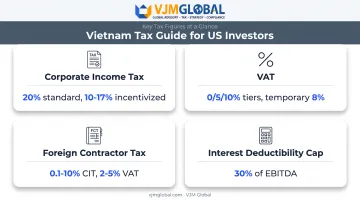
- Corporate Income Tax (CIT): Standard rate is 20%, with qualifying incentivized projects eligible for 10%, 15%, or 17%
- VAT: Standard tiers of 0%, 5%, 10%, and exempt; a temporary 8% rate applies to normally-10% goods through December 2026
- Foreign Contractor Tax: Applies to cross-border payments — deemed CIT runs 0.1%-10% and deemed VAT 2%-5%, depending on the activity (services typically hit 5%/5%)
Compliance Obligations You Can't Skip
- Annual statutory audit with financial statements due within 90 days of year-end
- Transfer pricing documentation for related-party transactions
- Interest deductibility capped at 30% of EBITDA for related-party debt, with a 5-year carryforward
- Social insurance contributions — 17.5% employer and 8% employee
Incentives worth checking: high-tech, renewable energy, and education projects can qualify for CIT holidays (often full exemption after first profit, then 50% of the applicable rate for a set period) plus land rent reductions.
The Piece Most US Firms Forget: Coordinating Both Sides
Setting up in Vietnam doesn't pause your US filing obligations. A Vietnamese subsidiary can trigger FBAR reporting, Form 8938 disclosures, and CFC/GILTI considerations back home, on top of foreign tax credit calculations using Form 1116.
This is where things get messy for companies managing it themselves: two compliance calendars, two regulatory languages, and easy-to-miss overlap.
VJM Global works with US businesses on that home-country half—FBAR, FATCA, CFC/GILTI, and Form 1116 foreign tax credit planning—so US filings stay aligned as the Vietnam entity comes online. The firm does not claim Vietnam-specific licensing expertise; US tax and cross-border reporting coordination is the core of what it does for clients expanding into new markets.
Best Regions in Vietnam for US Investment
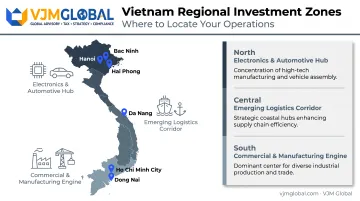
US investment in Vietnam clusters in three corridors. Match the region to your industry mix, cost targets, and logistics needs.
Northern Vietnam (Hanoi, Hai Phong, Bac Ninh)
The electronics and automotive corridor. Hanoi alone reported roughly VND 1.426 quadrillion in 2024 GRDP. Samsung's additional $1.8 billion OLED investment in Bac Ninh signals where component manufacturers are clustering.
Central Vietnam (Da Nang)
A lower-cost option with real logistics momentum. Construction on a $2 billion container port at Lien Chieu is scheduled to start in 2026. It's an early-mover opportunity, not yet a mature hub.
Southern Vietnam (Ho Chi Minh City, Dong Nai)
The commercial engine. HCMC is where consumer-facing and service businesses want to be for speed-to-market.
Dong Nai, next door, has 40 planned industrial parks and drew $571 million in FDI in a single quarter of 2024. That makes it a strong option for manufacturers that want proximity to HCMC and the Cai Mep-Thi Vai ports.
Common Pitfalls and Risk Mitigation for US Companies Entering Vietnam
Treating Vietnam as a pure cost play. Labor costs matter, but under-investing in relationship-building with partners, distributors, and local officials slows everything else down. Build partner and official relationships into the plan with the same rigor as your cost model.
Picking a structure before validating demand. A full wholly foreign-owned company is a big commitment. So is a joint venture without clear governance:
- Define decision rights and voting percentages upfront
- Specify approval thresholds for major transactions
- Address staffing and technology-sharing terms in writing
- Build an exit policy before you need one
Assuming ASEAN rules are uniform. Vietnam's 2025 Investment Law changed licensing sequences and trimmed conditional sectors. Guides written even a year ago may already be outdated. Confirm current licensing steps and conditional-sector rules before you file.
Skipping local expertise. Engaging legal, tax, and compliance advisors before finalizing structure or location costs less than unwinding a mistake later.
Frequently Asked Questions
What does market entry strategy mean?
A market entry strategy is a planned approach for how a company enters and operates in a new country, covering legal structure, timing, and regulatory compliance. For Vietnam, that means matching structure to the business objective—not just speed.
What are the four market entry strategies?
The four broad approaches are exporting, licensing/franchising, joint ventures, and wholly-owned entities (WFOEs). Each carries different levels of control, cost, and commitment.
What is the minimum capital requirement for a foreign-owned company in Vietnam?
There's no universal statutory minimum outside conditional sectors like education or banking. Capital must realistically match the scale of your proposed business plan.
How long does it take to set up a business in Vietnam?
Official timelines are about 15 days for the Investment Registration Certificate (IRC) and a few days for the Enterprise Registration Certificate (ERC). With banking, leases, and post-licensing steps, expect 3–6 months end-to-end.
Can US firms fully own their companies in Vietnam?
Yes, in most sectors. Exceptions apply in telecom, defense, and select logistics activities, where foreign ownership caps or additional conditions apply.
Do US companies need a local partner to enter Vietnam?
Not in most sectors. A local partner isn't legally mandatory, but in regulated industries it can speed up licensing and help navigate approvals.